
Disclosure: this guide contains Amazon affiliate links. As an Amazon Associate, Anantam IAS earns from qualifying purchases — at no extra cost to you.
The best books for UPSC CSAT depend on your weak area. Start with a recent timed paper, then choose a manual or a focused numeracy or reasoning book only if the result shows you need it. Official previous papers are a useful starting resource before any purchase.
CSAT is the qualifying General Studies Paper II in Prelims, with a minimum of 33%. Qualifying still requires preparation: review comprehension, numeracy, reasoning and time use separately. Aim for reliable performance across papers rather than treating one favorable mock score as proof that the subject is finished.
Use the CSAT paper guide for the syllabus and the previous-paper guide for practice. A book should address a diagnosed gap, and its exercises should be compared with the actual exam.
How many CSAT books do you actually need?
For most aspirants, two books plus previous-year papers is enough: one consolidated CSAT manual to cover the syllabus and set the difficulty bar, and one focused aptitude or reasoning book for whichever section is your weak spot. That’s it. If you’re an engineer or a commerce graduate comfortable with numbers, you may need zero aptitude books and just heavy comprehension practice. If you froze on the 2023 paper’s reasoning sets, you need a dedicated reasoning book more than another manual.
Use CSAT previous papers to diagnose the gap before buying. The paper guide explains the syllabus and preparation needs. Question types and their distribution can change; no manual fixes a permanent topic quota.
The all-in-one CSAT manuals: start here
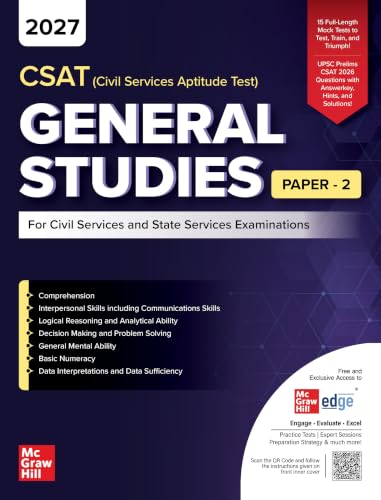
UPSC Prelims 2026-27: CSAT (GS Paper 2) Manual: McGraw Hill
- Practice relevant topics before checking the solutions
- Compare question types with official CSAT papers
- Check the format, edition and years covered before buying
If you buy one book, buy a single comprehensive manual that covers comprehension, aptitude, and reasoning in UPSC’s own pattern, then drill it against past papers. Two manuals dominate this slot.
General Studies Paper 2 (CSAT) Manual from McGraw Hill is a broad manual for structured practice. Inspect its contents and sample explanations before buying. Select the topics you need and attempt the exercises before reading the solutions; another manual is unnecessary if your existing source does this well.
Arihant’s CSAT Paper II is another consolidated option. Compare its contents, worked explanations and question coverage with your present needs. Page count changes across editions and is not a dependable way to decide whether a book suits a beginner.
For the named Arihant products, Cracking the CSAT Paper II 2027, English ISBN 9788169711067, is the complete manual with listed solved papers for 2025 and 2026 and 10 publisher-created Crack Sets. The separate UPSC IAS Prelims CSAT 2027 (General Studies Paper II) Solved Papers, English ISBN 9788169711913, organizes questions from 2011 through 2026 by topic. Choose the manual for explanations and the solved-paper collection for question practice; attempt each question before reviewing its solution. The Hindi-medium 2027 manual is a separate product with ISBN 9789378166730.
Disha’s CSAT topic-wise solved papers organizes previous questions for practice. Check the years covered by the listed edition and supplement it with newer official papers. The current listing covers questions through 2025, so it should not be mistaken for a complete collection of later papers.
Quantitative aptitude and data interpretation
Quantitative Aptitude by R.S. Aggarwal
- Select topics according to the CSAT syllabus
- Compare question types with official CSAT papers
- Check the format, edition and years covered before buying
For the numeracy and data-interpretation section, you need a fundamentals book only if your basics are shaky. Otherwise, past papers and a manual cover it. When you do need to rebuild, two books sit at opposite ends.
Quantitative Aptitude by R.S. Aggarwal can help rebuild arithmetic. Select topics such as numbers, ratios, percentages, averages, time and work, speed and distance, and data interpretation against the syllabus. It serves several competitive exams, so solving every chapter is unnecessary for CSAT.
Logical Reasoning and Data Interpretation for CAT by Nishit K. Sinha (Kindle ebook) is optional additional practice for a reader with a specific need for those question types. This link opens a digital edition. It is written for CAT, so it should not displace CSAT papers or be treated as a necessary purchase for an anxious beginner.
Logical and analytical reasoning
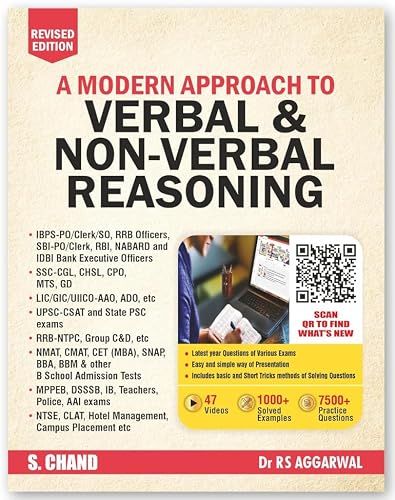
A Modern Approach to Verbal & Non-Verbal Reasoning: R.S. Aggarwal
- Practice relevant topics before checking the solutions
- Compare question types with official CSAT papers
- Check the format, edition and years covered before buying
Choose reasoning exercises that address a difficulty you observed in a paper. Work through the logic of the solution, then attempt a fresh question of a similar type.
A Modern Approach to Verbal & Non-Verbal Reasoning by R.S. Aggarwal offers a large reasoning question bank. Choose exercises matching the current syllabus and relevant past-paper demands. Do not assume every question type in a general competitive-exam book is equally useful for CSAT.
Analytical Reasoning by M.K. Pandey is an option when you need to work through the reasoning behind an inference or assumption. Attempt the exercise, explain your reasoning and then compare it with the solution. Buy it for that gap, not simply because it appears on a booklist.
CSAT books at a glance
| Resource | Main Use | Limit |
|---|---|---|
| McGraw Hill CSAT Manual | Broad organized practice | Choose relevant topics rather than reading every page mechanically. |
| Arihant CSAT Paper II | Alternative consolidated practice source | Compare explanations and coverage before buying a second manual. Match the exact title and ISBN: the complete English 2027 manual has ISBN 9788169711067; the topicwise solved-paper collection is separate. |
| Arihant UPSC IAS Prelims CSAT 2027 Solved Papers | Topicwise PYQ practice, 2011-2026 | Separate English collection, ISBN 9788169711913. Use for question practice; it does not replace concept explanations. |
| Disha topic-wise solved papers | Organized PYQ practice | The linked edition covers through 2025; add newer official papers. |
| R.S. Aggarwal Quantitative Aptitude | Arithmetic foundation | General competitive-exam coverage; select CSAT-relevant chapters. |
| M.K. Pandey Analytical Reasoning | Focused reasoning practice | Use for a diagnosed gap. |
| R.S. Aggarwal Verbal & Non-Verbal Reasoning | Additional reasoning exercises | Select question types against actual needs. |
| Nishit K. Sinha CAT reasoning and DI (Kindle) | Optional digital practice source | CAT-oriented, not a default CSAT recommendation. |
How to use this list: reading order and a 60-day plan
Don’t read these books in parallel. Diagnose, then sequence. Here’s the order that works for most aspirants:
- Attempt a recent official CSAT paper under the time limit.
- Sort errors into comprehension, arithmetic, reasoning, reading mistakes and time decisions.
- Choose one source for the most important gap and practice its relevant topics.
- Attempt another official paper and review why the result changed.
- Keep useful drills, revise persistent errors and avoid expanding the booklist without a reason.
Select the relevant exercises in each resource and leave time to review them. For comprehension, practice passages and explain why the rejected options fail; general reading can support this but does not replace question practice. Use the CSAT strategy guide to fit it into your routine.
What to Use First
Begin with official papers and your error analysis. Choose one manual if you need broad structure, then add a focused source only for a weakness it does not resolve. Keep reading, solving and review in the same routine.
For a worked reading routine, use the guide for the source you have chosen:
Frequently Asked Questions
Is one CSAT book enough?
One suitable manual may be enough alongside official papers if it addresses your gaps. A focused book is useful only when you need more explanation or practice in a particular area.
Is R.S. Aggarwal necessary for every aspirant?
No. It can help with an arithmetic foundation, but readers who already solve relevant questions accurately may need timed practice more than another textbook.
Do I need a CAT book for CSAT?
No. A CAT resource is optional and should be used only for relevant additional practice. It does not replace the CSAT syllabus or official papers.
Is the Nishit Sinha link for a printed book?
The link in this article is explicitly labeled as a Kindle ebook. Choose a different verified format if you prefer paper, and check the edition before purchase.
Should I judge a manual by its page count?
No. Compare the explanation, question coverage, format and your present needs. Page counts and contents differ across editions.
How can I prepare without buying a PYQ book?
Download official previous papers and review them systematically. A paid topic-wise compilation can save organization time but is not required to access the questions.
Tell Google you want more of this.
Add Anantam IAS as a preferred sourceOne tap, and this site shows up more often in your own Top Stories, AI Overviews and AI Mode. Remove it any time.