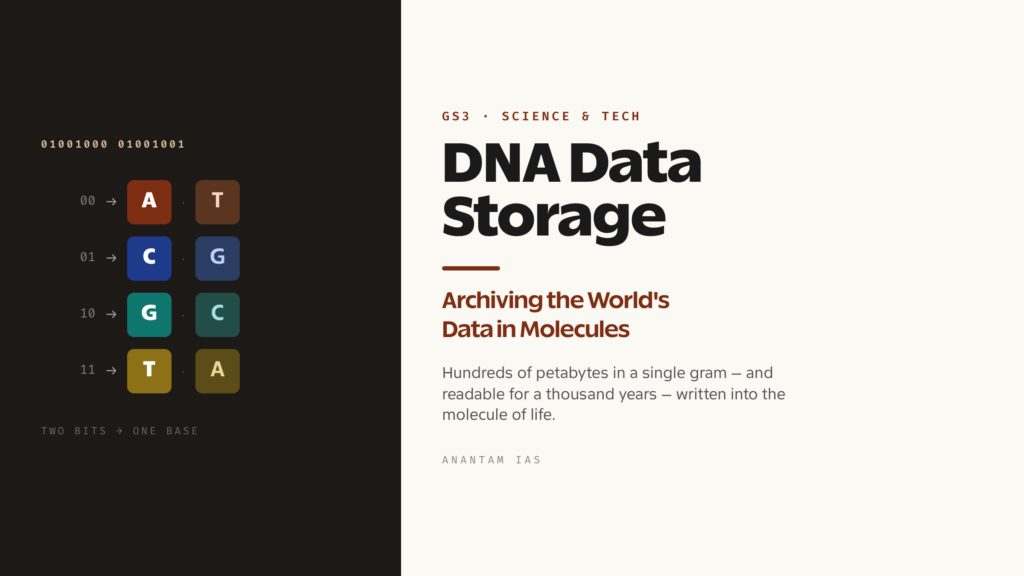
Every photo you take, every message you send, every sensor reading from a factory floor adds to a pile of digital information that is now growing faster than the world can build places to keep it. Humanity creates more data in a single day than it produced in entire centuries, and the spinning hard drives and magnetic tapes we store it on are running out of road — they wear out in years, they hog space and electricity, and they go obsolete the moment a new format arrives. So a quietly radical idea has moved from the lab bench toward the data centre: write our data not onto silicon and metal, but into the same molecule that has stored the instructions for life itself for billions of years. That molecule is DNA.
DNA data storage means encoding digital files — ordinary 0s and 1s — into the chemical alphabet of synthetic DNA, then keeping that DNA in a tube to be read back later. The appeal is almost absurd: a single gram of DNA can in principle hold hundreds of petabytes, enough to swallow a large data centre into something the size of a grain of rice, and it can survive for thousands of years without electricity. For a UPSC aspirant, this sits at the intersection of biotechnology, information technology and the new politics of data — and it is exactly the kind of futuristic, cross-cutting topic that a strong Science and Technology answer can own with a few sharp facts and a clear chain of logic.
Why the World Is Running Out of Room to Store Data
Start with the problem, because the technology only makes sense once you feel the squeeze. The world’s stock of digital data is exploding — driven by streaming video, smartphones, scientific instruments, surveillance cameras and now the enormous appetite of artificial intelligence, which both consumes and produces data on a scale earlier decades never imagined. Analysts measure the global “datasphere” in zettabytes — each zettabyte is a trillion gigabytes — and it keeps climbing year after year. A large and growing share of this is “cold” data: information we are legally or sentimentally bound to keep but rarely touch — old medical records, bank archives, government documents, scientific datasets, film libraries. We don’t read it often, but we cannot throw it away.
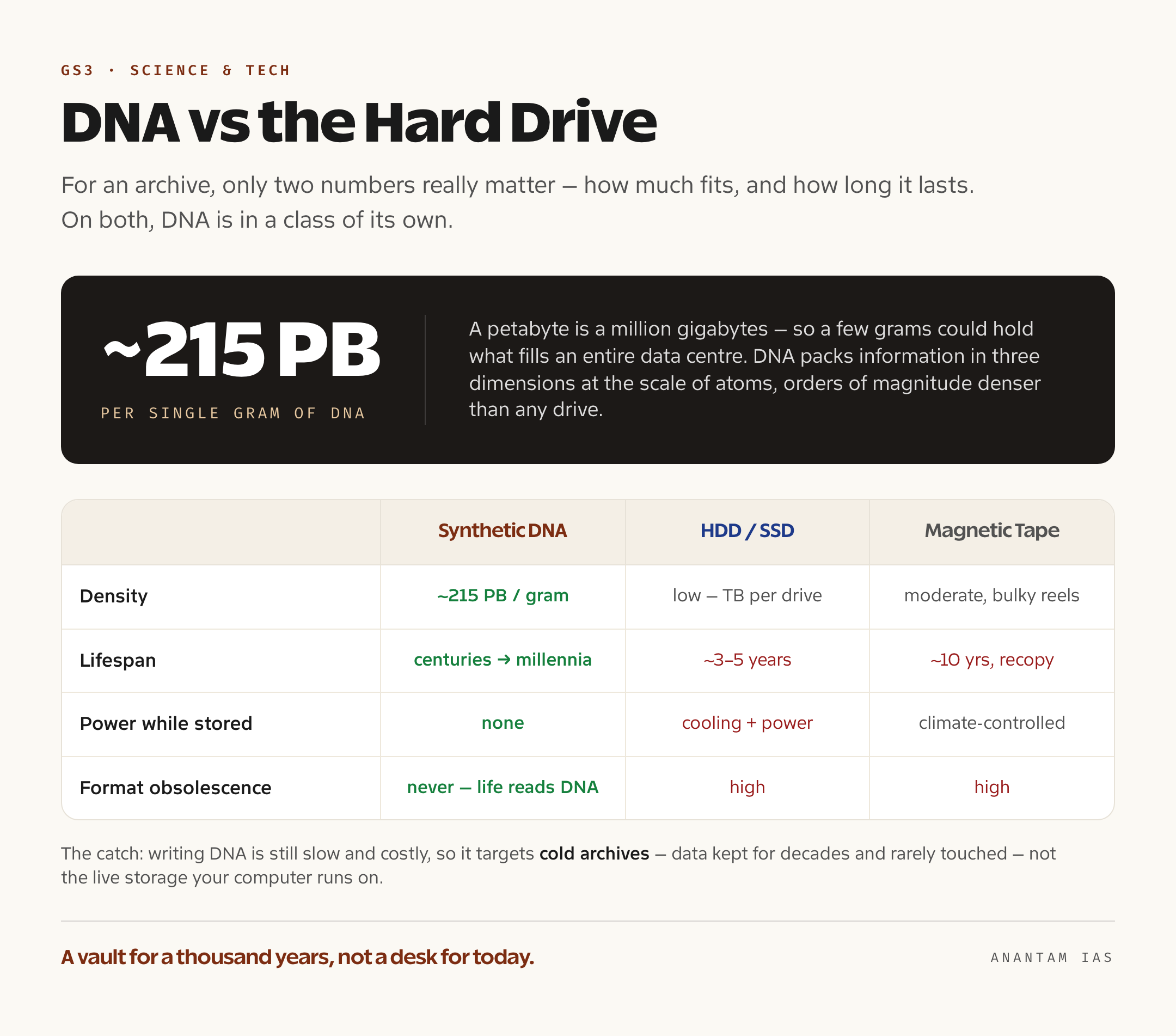
Here is where the storage we have starts to creak. Hard disk drives and solid-state drives are fast but power-hungry and short-lived; leave one in a drawer for a decade and the data may already be gone. Magnetic tape, the workhorse of cheap archives, is denser and cheaper but still needs climate-controlled rooms, and a tape must be copied onto fresh tape every decade or so before it degrades. And every one of these media suffers from format obsolescence — the slow death by which the hardware and software needed to read an old format simply stop being made. Ask anyone who still has data trapped on a floppy disk or a Zip drive. On top of all this, the data centres that house these drives are becoming serious consumers of electricity and water for cooling, drawing real scrutiny over their energy and climate footprint as their numbers swell.
So the long-term challenge is blunt: data is growing exponentially, while the media we keep it on are bulky, thirsty, fragile and forever going out of date. The search is on for an archival medium that is staggeringly dense, lasts for centuries, sips no power while idle, and never goes obsolete. That search keeps arriving at the same answer — the molecule of life.
How Digital Data Is Written Into and Read Back From DNA
DNA is, at its core, an information-storage molecule. Its long strands are built from four chemical building blocks called bases — adenine, cytosine, guanine and thymine, abbreviated A, C, G and T — and the order in which those bases are strung together is what carries meaning, just as the order of letters carries meaning in a sentence. (For a refresher on the molecule and how it differs from its cousin, see DNA vs RNA.) A computer already stores everything — text, images, video — as binary, a string of 0s and 1s. DNA storage simply translates between the two alphabets: a four-letter chemical code can hold digital information just as a two-symbol electronic code can.
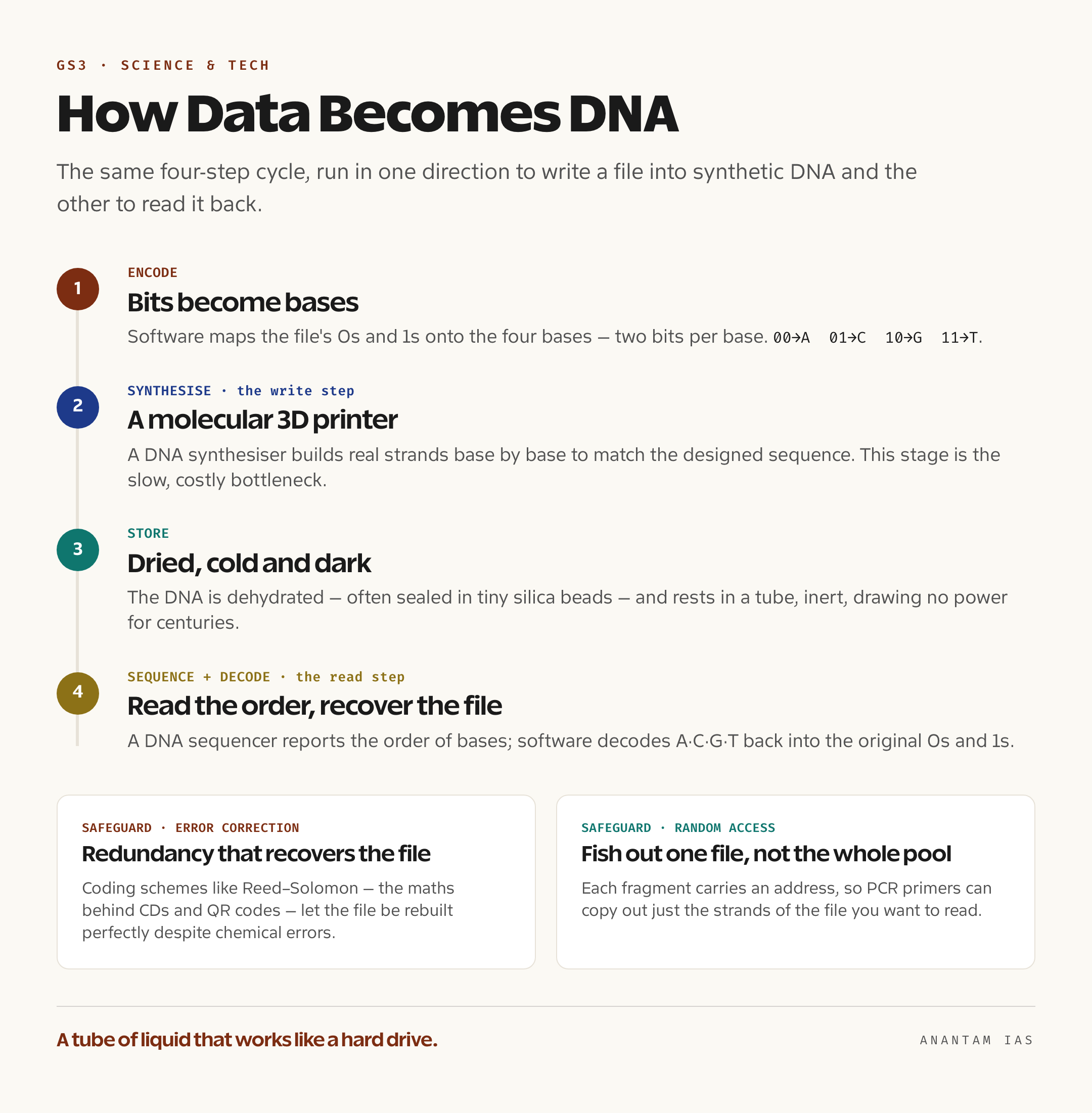
The process runs as a cycle with four clear steps, and naming them in order is the heart of any good answer. First, encode: software converts the file’s binary stream into a sequence of the four bases, with two bits mapping neatly onto each base — so a pair like 00 might become A, 01 become C, 10 become G, and 11 become T. The long virtual sequence is chopped into thousands of short, manageable fragments, each tagged with an address so the file can be reassembled in the right order. Second, synthesise: a DNA synthesiser, in effect a molecular 3D printer, manufactures real, physical strands of synthetic DNA matching that designed sequence, base by base. Third, store: the DNA is dried out and kept cool, dark and dry — often encapsulated in tiny silica glass beads or held in a sealed tube — where it sits inert, needing no power at all. Fourth, read: when the data is wanted, the DNA is rehydrated and run through a DNA sequencer — the same kind of machine used to read genomes — which reports back the order of bases, and software decodes that sequence back into the original 0s and 1s.
Two practical wrinkles make this real rather than magical, and examiners reward candidates who mention them. One is error correction: chemistry is messy, so synthesising and sequencing introduce errors, and copies of strands are made in different numbers. To survive this, the data is stored with deliberate redundancy and clever mathematical coding — the same family of techniques, such as Reed-Solomon codes, that protect CDs and QR codes from scratches. A celebrated 2017 method called DNA Fountain pushed this to roughly 85 per cent of the theoretical maximum a strand can hold while still recovering the file perfectly. The other wrinkle is random access: you don’t want to read a whole archive to retrieve one file, so each fragment’s address lets specific files be fished out using the same molecular tools — PCR primers — that biologists use to copy a chosen stretch of DNA. Get those two things right and a tube of cloudy liquid becomes a working, searchable hard drive.
Why DNA Is So Tempting: Density, Durability and No Obsolescence
Now the three reasons this idea refuses to go away, because together they make DNA almost uniquely suited to long-term archiving. The first is density, and the numbers are staggering. A gram of DNA can theoretically hold on the order of 200 to 215 petabytes of data — a petabyte being a million gigabytes — which works out to something like ten quintillion bits packed into a single cubic centimetre. Researchers like to put it vividly: in principle, all the world’s data could fit into a space about the size of a room, and the entire contents of a sprawling data centre could be compressed into a few sugar cubes. No silicon technology comes within several orders of magnitude of this. DNA stores information in three dimensions at the scale of individual atoms, which is why nature has used it to pack the full blueprint of a human being into a cell you cannot see.
The second reason is durability. DNA is astonishingly tough when kept dry, cold and away from oxygen and ultraviolet light. We routinely recover and read DNA from bones and frozen remains that are tens of thousands of years old — a feat no hard drive or tape will ever match. Encode your data into DNA and store it well, and it could remain readable for hundreds or even thousands of years, with no need for the constant recopying that magnetic tape demands. For archives meant to outlast institutions — national records, scientific data, cultural heritage — this is precisely the property that matters most.
The third reason is the subtlest but may be the most important over the long run: no format obsolescence. The reason a floppy disk is now useless is that the machines and software to read it have vanished. DNA will never face that problem, because as long as life and biology exist, humans will have machines that read DNA — it is the universal code of biology, and reading it is a fast-improving, foundational technology rather than a passing commercial format. A medium that is dense, durable, power-free while idle and immune to obsolescence is close to the archivist’s dream. And DNA, remarkably, is all four at once. This is also why DNA storage is increasingly discussed alongside efforts to compute with biological molecules — the broader push toward bio-computers and biological computing substrates that treat life’s machinery as information technology.
The Catch: Why DNA Storage Is Slow, Costly and Only for Cold Archives
If DNA is so wonderful, why isn’t your phone backed up to a test tube already? Because the honest answer is that DNA storage today is slow and expensive, and a balanced answer must say so plainly. The bottleneck sits at the writing stage. Synthesising DNA, base by base, is a chemical process that is both costly and slow — for years the price of writing data into DNA ran into thousands of dollars per megabyte, far beyond anything commercial, and even with rapid progress it remains orders of magnitude dearer than conventional storage. Reading is cheaper and faster than writing but still takes time and lab work, because the DNA must be prepared and sequenced rather than simply spun up like a disk. You cannot click a file and have it open in milliseconds.
This is why the entire field aims at one specific use, not a general one. DNA storage is being built for cold archival storage — the deep, write-once, read-rarely vault where data goes to rest for decades, not the live, random-access memory your computer needs to run. Think of the contrast as a working desk versus a vault buried under a mountain: you would never fetch your daily files from the mountain, but you would happily entrust your most precious, rarely touched records to it. DNA is the vault. Its slowness at reading and writing barely matters for data you intend to touch once a decade, while its density and durability matter enormously. Anyone who frames DNA as a replacement for everyday drives has misunderstood it; it is a replacement for tape archives, and only those.
There are other hurdles stacked behind cost and speed. Errors in synthesis and sequencing must be corrected, which eats into usable capacity. Scaling up the chemistry to industrial volumes, reliably and repeatably, is hard. And the whole pipeline still depends on specialised laboratory equipment rather than a sealed appliance you could slot into a server rack — though that, too, is the engineering challenge companies are racing to solve. The trajectory is encouraging: costs are falling and speeds are rising fast, and many in the industry expect DNA archives to become cost-competitive with magnetic tape toward the end of this decade. But as of now, the technology is real, demonstrated and improving — not yet cheap.
From Lab Demos to Real Systems: The Milestones That Matter
The history of DNA storage is a tidy ladder of demonstrations, and a few rungs are worth carrying into an answer because they show the technology maturing from a stunt into a system. The modern era began around 2012 and 2013, when separate teams — one led by the geneticist George Church at Harvard, another by Nick Goldman and Ewan Birney at the European Bioinformatics Institute — independently encoded books, images and audio into DNA, with the Goldman team adding the error-correction tricks that made reliable recovery possible. The proof of principle was in: digital files could be written into and read back out of DNA.
The race then turned to density and capacity. In 2017, Yaniv Erlich and Dina Zielinski demonstrated their DNA Fountain method, storing data at that famous density of about 215 petabytes per gram and recovering it without error. Microsoft, working with the University of Washington, became the field’s most visible champion: the partnership encoded a high-definition music video by the band OK Go, the Universal Declaration of Human Rights in more than a hundred languages, and a hundred classic books, and in 2019 it unveiled the first fully automated, end-to-end system that took digital data in and gave it back without a human touching the DNA in between — a crucial step from manual lab work toward an actual machine. Around the same time, Twist Bioscience and researchers at ETH Zurich stored an episode of a Netflix series in synthetic DNA, a vivid demonstration that even video archives could be entrusted to molecules.
Since then the work has focused squarely on the weak points — speed, cost and random access. Companies have built dedicated DNA writers that encode far faster than before and demonstrated ways to search DNA-stored data without reading the whole pool. Researchers have used artificial intelligence to accelerate the decoding step dramatically, cutting retrieval times from days to minutes, and have shown “movable-type” and reusable approaches that drive the cost of writing down. Investment has followed the science: in 2025 a new venture, Atlas Data Storage, raised substantial seed funding and absorbed DNA-storage assets from earlier players, a signal that serious money now believes the archival market is real. The picture, taken together, is of a technology climbing steadily out of the laboratory toward the data centre — slowly, but with unmistakable momentum.
For Your Mains Answer
This is a high-value topic for GS Paper 3, which covers developments in science and technology and their applications, indigenisation of technology, and IT and biotechnology. It fits questions on emerging technologies, the convergence of biology and computing, data infrastructure, and even the environmental cost of digital growth. The skill that earns marks is the one this article uses: explain a futuristic idea in a clear chain — the problem, the mechanism, the advantages, the honest limits, and the India angle — anchored by two or three exact figures rather than vague awe.
How to Build the Answer
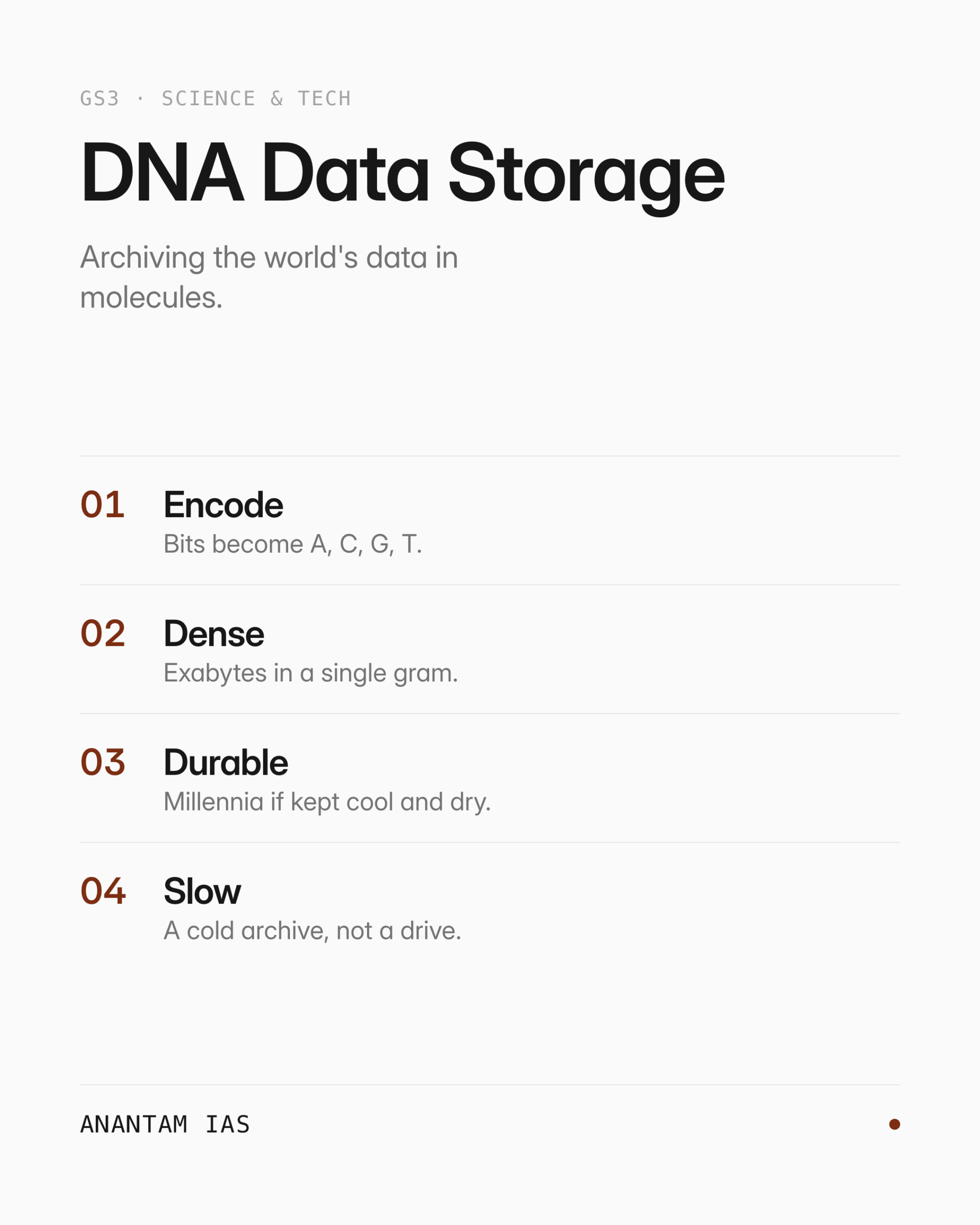
Open with the driver, not the gadget — the data explosion against fragile, power-hungry, obsolescence-prone storage. Then explain the mechanism in its four steps: encode bits into A, C, G and T → synthesise DNA → store it dry and cold → sequence to read it back, with a line on error correction and random access. Lay out the three advantages — density, durability, no obsolescence — and then, crucially, the honest limits: slow and costly writing, suited only to cold archives. Close with significance for India and a measured verdict. That arc — problem, mechanism, promise, limits, relevance — fits almost any emerging-technology question.
Common Mistakes to Avoid
Don’t present DNA storage as a replacement for everyday hard drives or RAM; it is for cold, write-once, read-rarely archives only, and saying so signals understanding. Don’t confuse it with editing or hacking living organisms — the DNA used is synthetic and inert, carrying data, not running a cell. Don’t quote density figures without a unit; “215 petabytes per gram” lands, “a lot” does not. And don’t gush about the promise while ignoring cost and speed — the balanced answer names the bottleneck at the synthesis stage.
A Compact Answer Spine
Data exploding into zettabytes, much of it “cold” → existing media (HDD, SSD, tape) are bulky, power-hungry, short-lived and obsolescence-prone → DNA storage encodes binary into four bases A/C/G/T → cycle: encode → synthesise → store dry/cold → sequence to read, with error-correction codes and PCR-based random access → advantages: density (~215 PB/gram), durability (millennia), zero idle power, no format obsolescence → limits: writing slow and costly, so it is for cold archives, not live use → milestones: Church and Goldman (2012-13), DNA Fountain (2017), Microsoft-UW automated system, Netflix episode in DNA → India: data-sovereignty and archival needs, BioE3 and biotech capability, data-as-a-resource → verdict: a promising long-term archival medium, not yet cheap.
Diagram or Flowchart Idea
Draw the storage cycle as a simple loop: a box of 1s and 0s → an arrow labelled “encode” to a strand of A-C-G-T → “synthesise” to a sealed tube → “sequence + decode” back to the box. Beside it, a tiny two-row comparison — DNA versus hard drive — on density and lifespan. This single visual captures both how it works and why it tempts archivists, and it is quick to sketch.
A Balanced-Conclusion Line
A line that lands the marks: “DNA data storage will not replace the hard drive on your desk, but it offers something no drive can — a way to keep humanity’s growing record dense, durable and readable for a thousand years, in the very molecule that has safeguarded life’s own information since the beginning.”
How to Use Data Without Cramming
You need only three or four anchors, not a textbook: about 215 petabytes per gram (density), A, C, G and T (the four bases), the four-step encode-synthesise-store-sequence cycle, and the fact that DNA recovered from remains tens of thousands of years old is still readable (durability). Attribute claims plainly — “as Microsoft and University of Washington researchers demonstrated” — rather than scattering numbers loose.
Frequently Asked Questions
What is DNA data storage in simple terms?
It is a way of saving ordinary digital files — the 0s and 1s of any document, photo or video — by writing them into the chemical sequence of synthetic DNA. The four DNA bases (A, C, G and T) act like an alphabet, so pairs of bits are mapped onto bases, real DNA matching that sequence is manufactured, kept in a tube, and later read with a DNA sequencer and decoded back into the original file. The DNA used is synthetic and inert; it is a storage medium, not a living thing.
How much data can DNA hold, and how long does it last?
The density is enormous — a single gram of DNA can in principle store on the order of 200 to 215 petabytes (a petabyte is a million gigabytes), so a few grams could hold what fills a data centre. And it is extraordinarily durable: kept cold, dry and dark, DNA can remain readable for hundreds to thousands of years, which is why scientists can still read DNA from remains tens of thousands of years old. No hard drive or magnetic tape comes close on either count.
Why isn’t DNA storage used widely if it’s so good?
Because writing data into DNA is still slow and expensive — synthesising DNA base by base has historically cost thousands of dollars per megabyte and remains far dearer than conventional storage. Reading is faster but still needs lab equipment, so you cannot retrieve a file instantly. That is why DNA storage targets “cold” archival data — records kept for decades and rarely touched — rather than the live, fast-access storage your computer needs. Costs are falling quickly, and many expect it to rival magnetic tape for archives toward the end of this decade.
Why does DNA data storage matter for India?
India generates and stores vast and fast-growing volumes of data, and its push for data localisation and digital sovereignty means more of that data must be kept securely within the country for the long term — exactly the archival need DNA storage addresses, without the energy and obsolescence problems of conventional data centres. India also has a deepening biotechnology base and a national bioeconomy strategy under the BioE3 policy, which builds the synthetic-biology and bio-manufacturing capability that this technology rests on. It is a clean example of biotechnology, IT and data policy converging.
Practice Questions
Prelims MCQs
- With reference to DNA data storage, which of the following statements is correct?
(a) Digital data is encoded into the four bases of DNA — adenine, cytosine, guanine and thymine
(b) Data is stored by altering the genes of living human cells
(c) DNA can only store text, not images or video
(d) The DNA used is naturally occurring and extracted from plants
Answer: (a) Digital 0s and 1s are mapped onto the four bases A, C, G and T of synthetic, inert DNA, which can hold any kind of file. - DNA data storage is best suited for which type of storage need?
(a) High-speed random-access memory for running programs
(b) Cold archival storage of data kept for long periods and rarely accessed
(c) Everyday read-write storage on personal devices
(d) Real-time streaming of live video
Answer: (b) Because writing and reading DNA are slow and costly, it targets long-term “cold” archives, not live or random-access use. - Which of the following are cited as advantages of DNA over conventional storage media? 1. Extremely high data density 2. Durability of hundreds to thousands of years 3. No power required while stored 4. Immunity to format obsolescence. Select the correct answer:
(a) 1 and 2 only
(b) 1, 2 and 3 only
(c) 2, 3 and 4 only
(d) 1, 2, 3 and 4
Answer: (d) DNA storage is dense, long-lasting, power-free while idle, and not prone to the obsolescence that kills old formats — all four hold. - In the DNA data storage process, which step manufactures the physical DNA strands matching the designed sequence?
(a) Encoding
(b) Synthesis
(c) Sequencing
(d) Decoding
Answer: (b) Synthesis is the writing step, where a synthesiser builds real DNA base by base; sequencing is the later reading step. - The chief limitation that prevents DNA data storage from replacing everyday drives today is:
(a) DNA cannot store more than a few kilobytes
(b) DNA degrades within months even when stored well
(c) Writing data into DNA is slow and expensive
(d) DNA storage requires constant electricity to retain data
Answer: (c) The synthesis (writing) stage is the main bottleneck in both cost and speed; stored DNA actually needs no power and lasts for ages.
Mains Practice Questions
- Explain the principle of DNA data storage and the steps by which digital information is written into and read back from synthetic DNA. Why is it considered a promising solution to the world’s growing archival data needs? (15 marks, 250 words)
- “DNA data storage is not a replacement for the hard drive but for the tape archive.” Critically examine this statement with reference to the advantages and limitations of molecular data storage. (15 marks, 250 words)
- Discuss how the convergence of biotechnology and information technology, illustrated by DNA data storage, could reshape long-term data infrastructure. What capabilities must India build to participate in this field? (15 marks, 250 words)
- The exponential growth of digital data raises concerns about the energy and environmental footprint of data centres. Evaluate the potential of emerging storage technologies such as DNA storage to address these concerns. (10 marks, 150 words)
- Examine the relevance of DNA data storage to India’s goals of data sovereignty and a knowledge-and-bio economy. How do policies such as BioE3 support the underlying scientific capability? (15 marks, 250 words)
Tell Google you want more of this.
Add Anantam IAS as a preferred sourceOne tap, and this site shows up more often in your own Top Stories, AI Overviews and AI Mode. Remove it any time.