The history of computing has been a story of substrate change. Mechanical gears gave way to vacuum tubes. Vacuum tubes gave way to transistors. Discrete transistors gave way to integrated circuits. Each transition compressed the previous generation’s machine into a smaller, faster, cheaper form. The next transition is now being explored, and it points away from silicon altogether. The candidate substrates are the very molecules that life itself uses to compute: DNA, proteins, and living cells.
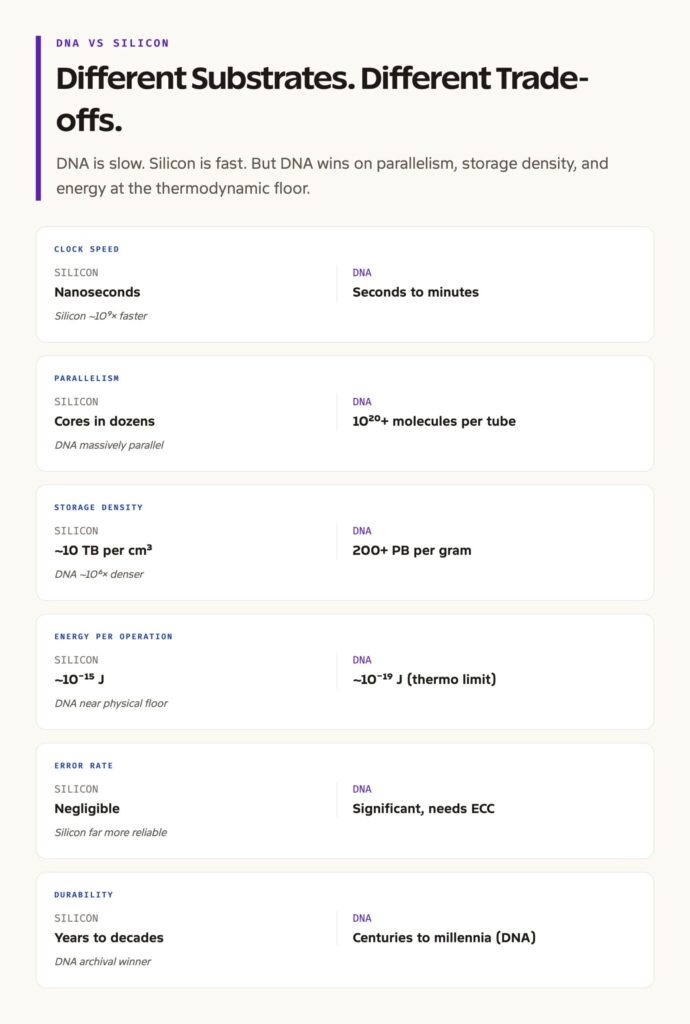
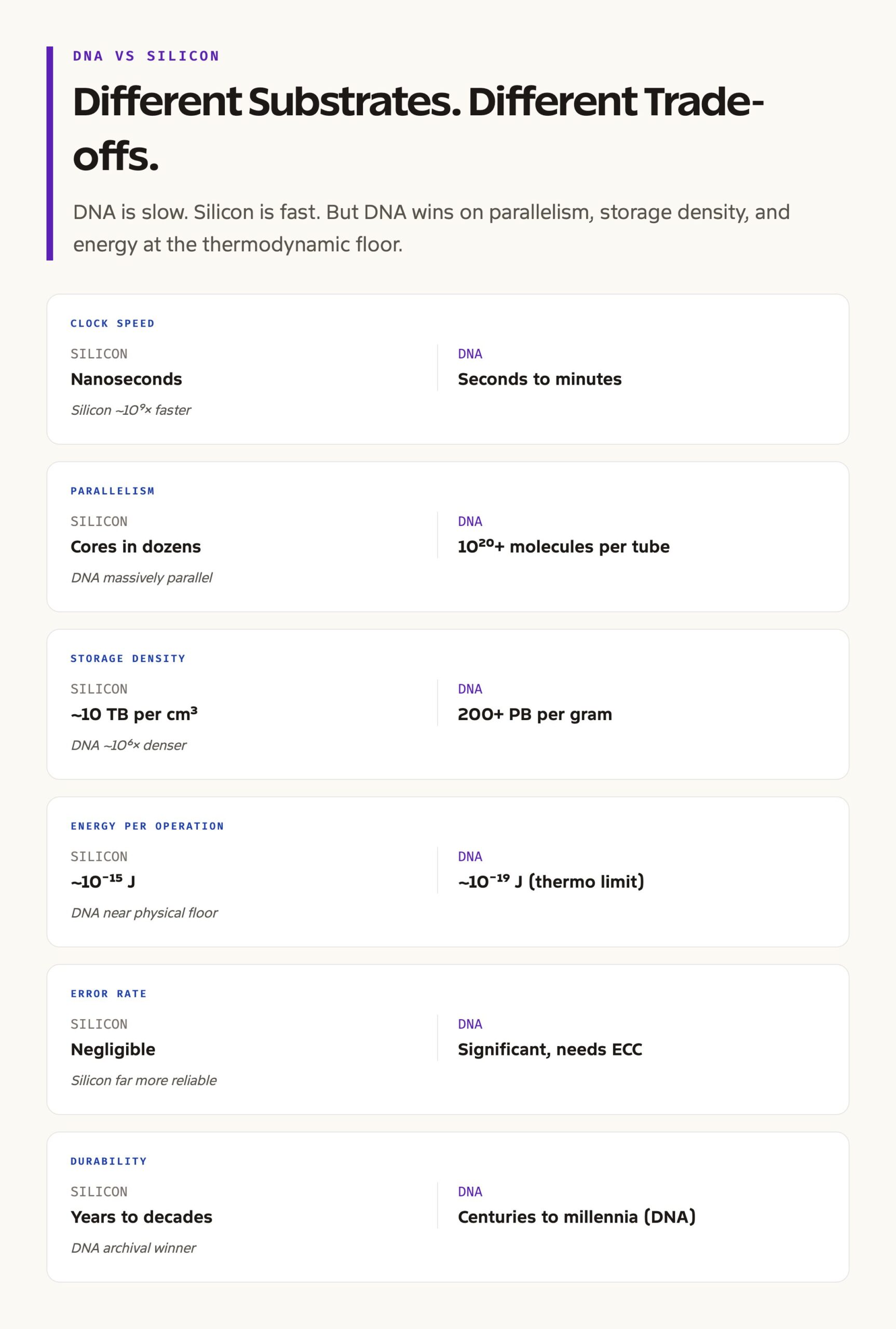
A bio-computer is a computing system that uses biological molecules or living cells to perform computation, data storage, or information processing. Instead of moving electrons through silicon transistors, a bio-computer moves chemical signals through molecular networks. The clock speed is slower than a silicon processor by orders of magnitude, but the parallelism, energy efficiency, and storage density can be many orders of magnitude higher. For specific classes of problem, that trade-off is overwhelmingly favourable.
For UPSC purposes, the topic sits at the intersection of biotechnology, computing, ethics, and India’s emerging biotech research base. It overlaps with genome research, with synthetic biology, and with the broader question of where data, computation, and biology meet. This article walks through what bio-computers actually are, how the major variants work, where the field is going, and what India is doing in this space.
Quick Facts on Bio-Computers
A bio-computer uses biological molecules or living cells to carry out computation. The four most active variants are DNA computers, protein and enzyme computers, cellular living-cell computers, and organoid-based computers using laboratory-grown brain tissue.
The basic working principle in each case is to translate a computational problem into a biological process. Inputs are presented as specific molecules or signals. The biological system responds through chemical reactions, molecular recognition, biological self-assembly, or neural signalling. The output is read out as the presence or concentration of specific products.
The field traces its origin to a 1994 demonstration by Leonard Adleman at the University of Southern California, who used DNA strands to solve a small instance of the Hamiltonian path problem. Adleman’s experiment showed that biology could compute something a computer could compute. Three decades later, the field has expanded to include data storage, sensing, drug delivery decisions, and emerging organoid-based learning systems.
What Bio-Computers Actually Do
The simplest bio-computer is conceptual. Take a chemical reaction whose products depend on which inputs are present. Encode a logical operation, like AND or OR, into the chemistry. Provide inputs as specific molecules. Read the output as the presence or absence of a specific product. You have just done a single logic operation in a test tube.
DNA computers, the best-known variant, use DNA strands as the carriers of information. A DNA molecule is a sequence of four bases, which is enough to encode arbitrary information in a way analogous to binary. DNA strands of complementary sequences hybridise to each other, which is a recognition operation. Enzymes can cut, paste, and copy DNA, which are the equivalent of editing operations. Combined, these operations allow encoding of search problems, of arithmetic, and of large-scale data storage.
Protein and enzyme computers use enzymatic reactions instead of DNA hybridisation. The advantage is speed. Enzymes operate on millisecond timescales, faster than DNA hybridisation. The disadvantage is fragility. Protein networks are sensitive to temperature, pH, and the cellular environment.
Cellular computers genetically engineer living cells to act as logic gates. Each cell senses input signals such as small molecules or light, processes them through engineered gene circuits, and produces an output such as fluorescence or a secreted product. This is the core of synthetic biology as a computing technology.
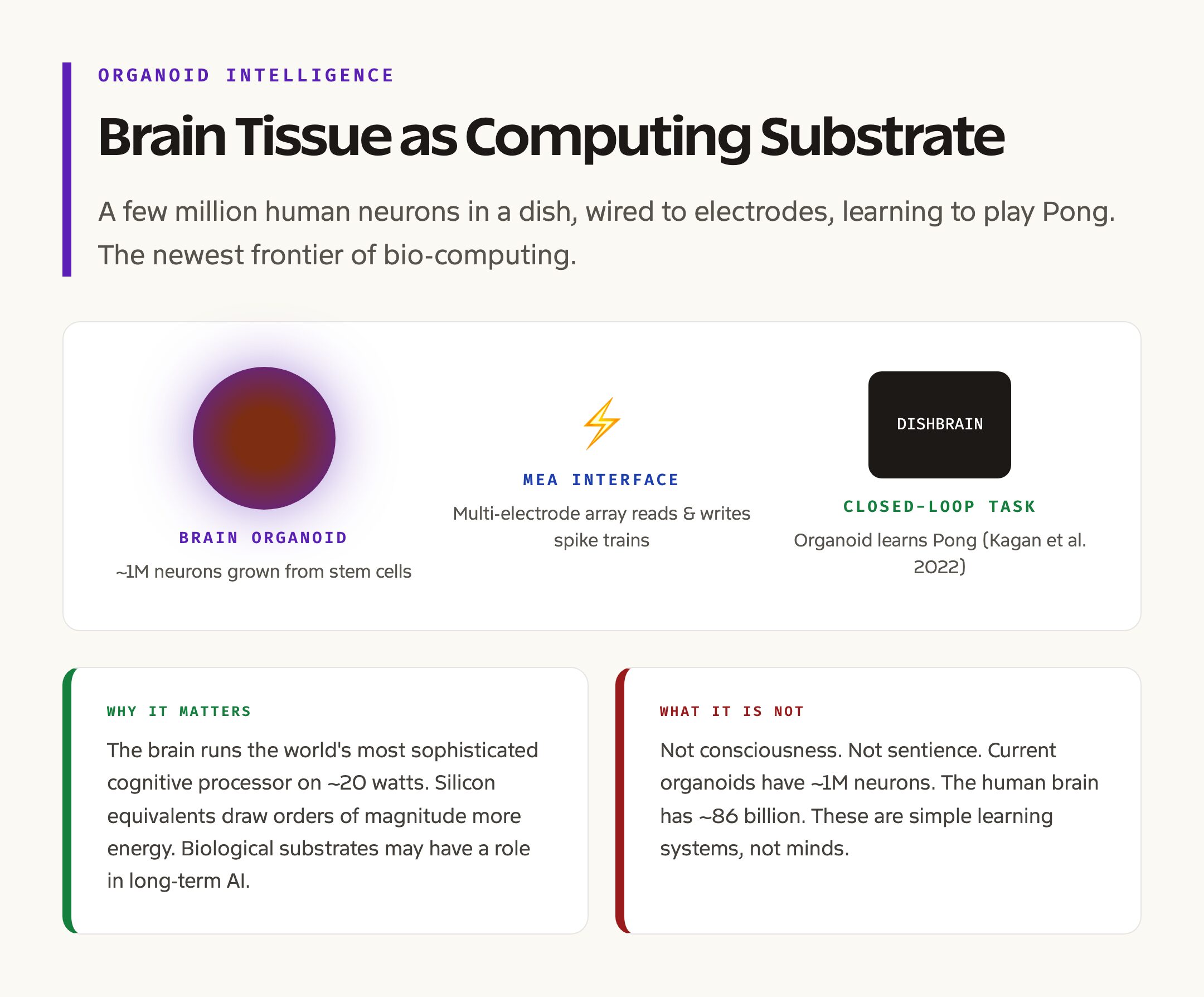
Organoid intelligence is the newest variant. Researchers grow small clusters of brain tissue in a laboratory dish, wire them to electrodes, and train them to perform tasks. The 2023 demonstration that a brain organoid could learn to play a simplified version of Pong opened a new chapter in the field.
Background and Historical Context
The field’s first publication is Leonard Adleman’s 1994 paper showing that DNA can solve a directed Hamiltonian path problem. The instance Adleman solved was small, only seven nodes, and the experiment took about a week. It was conceptual rather than practical. But it demonstrated that biology could carry out computation.
The 2000s saw a wave of theoretical work on DNA computing and the development of more sophisticated DNA logic circuits. Erik Winfree at Caltech and others built DNA-based finite state machines and reaction networks that could compute arbitrary functions in principle.
The field shifted focus in the 2010s. DNA data storage emerged as the most promising near-term application. Researchers at Microsoft, Twist Bioscience, and several academic groups demonstrated that arbitrary digital data could be encoded into DNA, stored for long periods, and retrieved by sequencing. The density advantage is overwhelming. A few grams of DNA can theoretically store as much data as a major data centre.
Cellular computing came forward in parallel. The Synthetic Biology Centre at MIT and several Boston-area groups demonstrated cells engineered with multi-input gene circuits that act as biological logic. Applications in environmental sensing, smart probiotics, and tumour-targeting cell therapy became real demonstrations rather than theoretical possibilities.
Organoid intelligence emerged in the early 2020s as the most provocative thread. Brett Kagan and colleagues in Australia showed in 2022 that a culture of human neurons could learn to play Pong. Subsequent work has expanded to more complex tasks.
Key Features of Bio-Computers
Five features matter.
The first is parallelism. A test tube of DNA contains billions of molecules. Each molecule can carry out a computational step in parallel with all the others. This makes DNA computers extraordinarily well-suited to problems that decompose into many parallel comparisons, such as combinatorial search.
The second is storage density. DNA encodes information at a density orders of magnitude higher than silicon storage. A single gram of DNA can theoretically hold over two hundred petabytes. For archival applications, particularly long-term cold storage of scientific or cultural data, this is transformative.
The third is energy efficiency. Biological systems carry out computation at thermodynamic limits well below those of silicon. The brain runs the world’s most sophisticated cognitive processor on roughly twenty watts. A silicon processor running comparable workloads draws orders of magnitude more.
The fourth is biological compatibility. A bio-computer can be deployed inside a living organism in ways silicon cannot. Cellular computers can be designed to detect a biomarker, decide whether a drug should be released, and execute the release, all from within a cell or a tissue. This is the basis of an emerging class of smart therapeutics.
The fifth is the reverse: bio-computers operate at slower clock speeds than silicon. A DNA hybridisation takes seconds or minutes. A gene circuit takes minutes to hours. Bio-computers will not replace silicon for general computing. They will complement it for specific problems.
Why Bio-Computers Matter
Bio-computers matter for four reasons.
First, DNA data storage offers a credible solution to a real problem. Global data generation is growing faster than silicon-based storage capacity is expanding. The world will not be able to store all the data it produces in the form it currently uses. DNA storage offers a path. Several companies, including Twist Bioscience, Catalog DNA, and DNA Script, are commercialising the technology.
Second, cellular computing enables new classes of medical intervention. A cell engineered to sense cancer-specific signals and respond by secreting a tumour-killing protein is a more sophisticated therapeutic than a static drug. CAR-T cell therapy is an early example. More elaborate engineered-cell therapeutics are in development.
Third, organoid intelligence opens a new path for studying and ultimately leveraging biological computation. The energy efficiency and learning capability of biological neural networks far exceeds that of silicon, by enough that direct biological substrates may have a role in the long-term future of artificial intelligence.
Fourth, the field connects directly to the broader biotechnology and synthetic biology agendas. Tools for engineering DNA and cellular circuits feed into agricultural biotech, drug development, vaccines, and gene therapy. A national capability in bio-computing is a capability in synthetic biology.
Detailed Comparison: DNA, Silicon, Quantum, and Neuromorphic Computing
Each substrate has distinct strengths.
| Substrate | Strength | Weakness | Best Suited For |
|---|---|---|---|
| Silicon | Speed, mature ecosystem | Energy use, density limits | General computing |
| DNA | Density, parallelism | Slow operation, error rate | Archival storage, search problems |
| Quantum | Specific algorithm acceleration | Decoherence, scale | Cryptography, optimisation |
| Neuromorphic biological | Energy, learning | Variability, control | Adaptive sensing, biological interfaces |
Silicon will remain the dominant substrate for general computing. DNA storage will become the standard for archival applications. Quantum computing will accelerate specific classes of problem. Neuromorphic biological systems may emerge for adaptive control and biological interfaces. None of the alternatives replaces silicon. They sit alongside it.
Common Misconceptions
A frequent misunderstanding is that bio-computers will replace silicon. They will not, at least not for general purpose computing. The clock speeds are too slow. Bio-computers will instead complement silicon for specific problems.
A second misconception is that DNA storage is theoretical. It is not. Twist Bioscience and several other companies sell DNA synthesis services that customers use for data storage today. The bottleneck is cost rather than capability.
A third misconception is that cellular computers are programmable in the way silicon computers are. They are not yet. Each engineered gene circuit currently requires bespoke design and validation. The development of standardised biological parts, through projects like the BioBricks Foundation and the iGEM competition, is gradually moving the field towards more reusable design.
A fourth misconception is that organoid intelligence is conscious or sentient. The current generation of brain organoids contains a few million neurons. The human brain has roughly eighty-six billion. The systems being built are simple learning systems, not minds.
India’s Stake in Bio-Computing
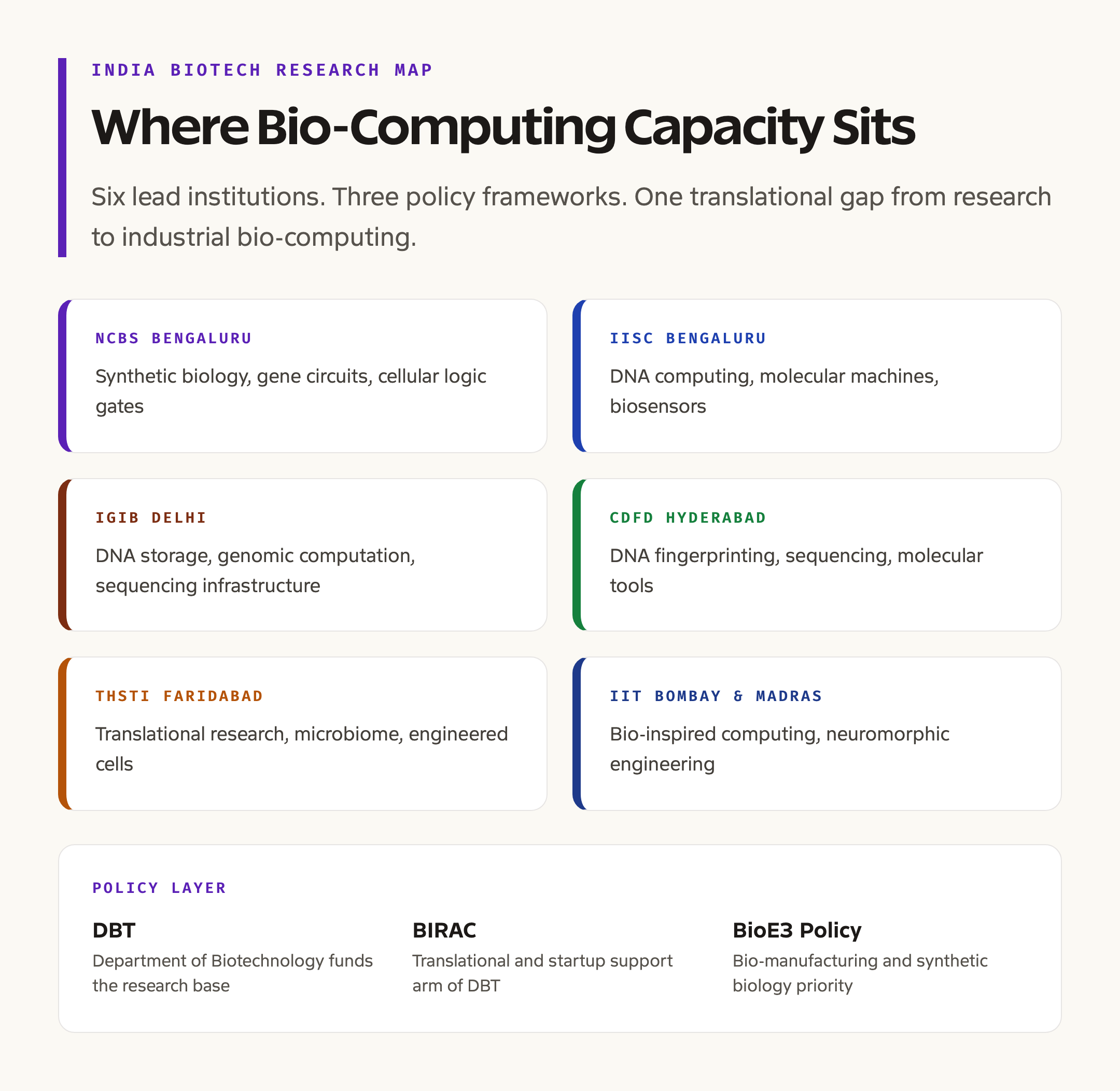
India’s biotechnology research base has the components that bio-computing needs. The National Centre for Biological Sciences in Bengaluru, the Indian Institute of Science, the National Institute of Immunology, the Institute of Genomics and Integrative Biology, the Centre for DNA Fingerprinting and Diagnostics, and several IITs have published work on synthetic biology, DNA-based circuits, and engineered cellular systems.
The Department of Biotechnology under the Ministry of Science and Technology funds the research base. The Biotechnology Industry Research Assistance Council (BIRAC) supports translational and startup work. The National Biotechnology Development Strategy, most recently revised in 2021 and the BioE3 policy approved in 2024, identify synthetic biology and bio-manufacturing as priority areas.
Indian startups in DNA storage and cellular computing are still emerging. The base of relevant biotechnology firms, including those working on biosimilars, gene therapy, and CRISPR applications, provides the technical capacity that bio-computing requires. Translation from research base to industrial bio-computing remains the gap.
Challenges in the Bio-Computing Ecosystem
Speed is the first persistent challenge. Biological operations are slow compared to silicon. For most general computing tasks, this rules bio-computers out. Their economic case rests on specific problem classes where parallelism, density, or biological compatibility outweigh the speed disadvantage.
Error rate is the second. DNA synthesis, hybridisation, and sequencing all introduce errors. Error correction is an active research area. Practical bio-computing systems use redundancy and error-correcting codes that consume some of the storage and computation advantage.
Standardisation is the third. Biological parts that work reliably in one cell type often fail in another. The lack of standard biological components has slowed the field’s industrial maturation. Initiatives like the Registry of Standard Biological Parts and iGEM are addressing this but progress is gradual.
Ethics and biosafety is the fourth. Engineered cells released into the environment, or organoid systems with increasing sophistication, raise questions that biological research has been wrestling with since recombinant DNA. The Indian regulatory framework, through DBT, the Review Committee on Genetic Manipulation, and the GEAC, handles parts of this. As organoid intelligence and engineered-cell therapeutics advance, the framework will need to evolve.
Way Forward
Three directions look most promising for India.
First, DNA data storage as a national capability. India produces large volumes of scientific, cultural, and demographic data that need long-term archival storage. Building DNA storage capacity, even at pilot scale, would establish a strategic capability and feed forward into the broader biotechnology ecosystem.
Second, cellular computing for medical applications. India’s strength in vaccines, biosimilars, and emerging cell therapy gives the country a base on which engineered-cell therapeutics could be built. Programmes that link the synthetic biology research base to clinical deployment would accelerate this.
Third, an organoid intelligence research programme as part of the broader brain research and AI agenda. Organoid intelligence is at an early stage globally. Indian participation at this stage is feasible and would help build long-term capability in a frontier area.
For UPSC, the takeaway is that bio-computing is not science fiction. It is an active research area with real industrial demonstrations, real medical applications under development, and real strategic implications for data storage and biotechnology.
Frequently Asked Questions
What is a bio-computer?
A bio-computer is a computing system that uses biological molecules or living cells, including DNA, proteins, enzymes, or neurons, to perform computation, data storage, or information processing instead of using only silicon-based electronics.
Who invented DNA computing?
Leonard Adleman at the University of Southern California demonstrated DNA computing in 1994 by using DNA strands to solve a small instance of the Hamiltonian path problem. His paper is generally treated as the founding demonstration of the field.
How does DNA data storage work?
Digital data is encoded into a sequence of DNA bases, the corresponding DNA molecules are synthesised chemically, and the data is later retrieved by sequencing the DNA. Storage density is several orders of magnitude higher than any silicon-based medium, making DNA particularly suited to archival applications.
What is organoid intelligence?
Organoid intelligence refers to using laboratory-grown clusters of human brain tissue, called brain organoids, as computing substrates. The organoids are wired to electrodes and trained to perform tasks. A 2022 demonstration showed that organoids can learn to play a simplified version of Pong.
Where does India stand on bio-computing?
India has a strong research base in synthetic biology and biotechnology at NCBS, IISc, NII, IGIB, CDFD, and several IITs, supported by DBT and BIRAC. Industrial bio-computing capacity is emerging. National policies including the BioE3 policy and the National Biotechnology Development Strategy identify synthetic biology and bio-manufacturing as priority areas.
Tell Google you want more of this.
Add Anantam IAS as a preferred sourceOne tap, and this site shows up more often in your own Top Stories, AI Overviews and AI Mode. Remove it any time.