
Education System in India: Structure & Reforms
India’s education system is the world’s largest after China, serving over 25 crore students across 15 lakh schools and 56,000+ higher education institutions. The National Education Policy (NEP) 2020 — India’s first comprehensive education reform in 34 years — restructured the system from a 10+2 to a 5+3+3+4 framework, emphasizing multidisciplinary learning, vocational integration, and mother-tongue instruction. Education is a concurrent subject under the Constitution (added to the Concurrent List by the 42nd Amendment, 1976). The system encompasses school education under the Ministry of Education, higher education regulated by UGC and AICTE, and vocational training under the Skill India framework.
Structure of India’s Education System
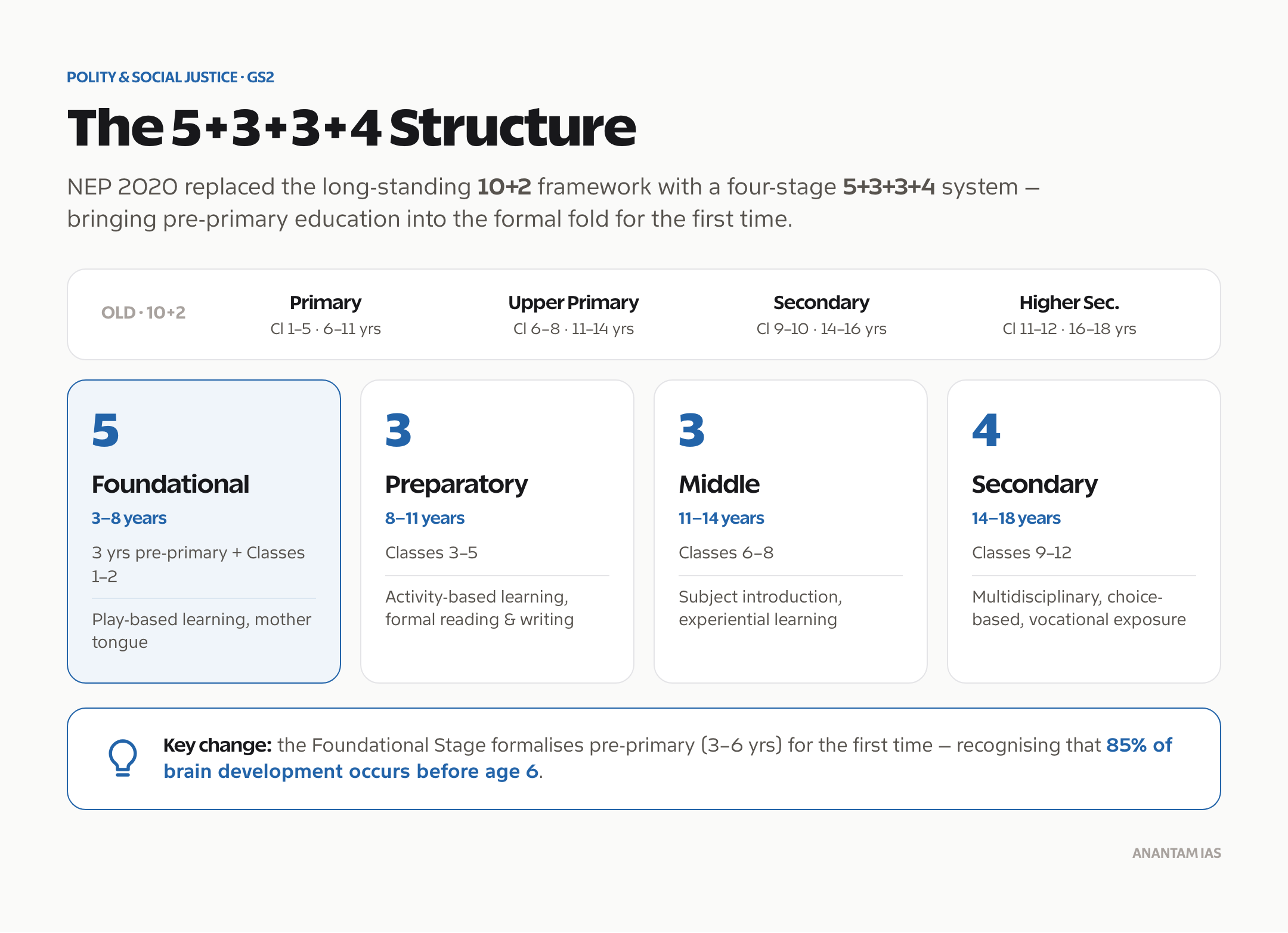
The Old Framework (10+2)
For decades, India followed a 10+2 structure:
- Primary: Classes 1–5 (ages 6–11)
- Upper Primary: Classes 6–8 (ages 11–14)
- Secondary: Classes 9–10 (ages 14–16)
- Higher Secondary: Classes 11–12 (ages 16–18)
The New Framework Under NEP 2020 (5+3+3+4)
| Stage | Age Group | Classes | Focus |
|---|---|---|---|
| Foundational | 3–8 years | 3 years pre-primary + Classes 1–2 | Play-based learning, mother tongue |
| Preparatory | 8–11 years | Classes 3–5 | Activity-based learning, formal reading/writing |
| Middle | 11–14 years | Classes 6–8 | Subject introduction, experiential learning |
| Secondary | 14–18 years | Classes 9–12 | Multidisciplinary, choice-based, vocational exposure |
Key change: The Foundational Stage brings pre-primary education (3–6 years) into the formal education framework for the first time, recognizing that 85% of brain development occurs before age 6.
National Education Policy 2020: Key Reforms
NEP 2020, approved on 29 July 2020, replaced the National Policy on Education, 1986. It is the most comprehensive education reform document since independence.
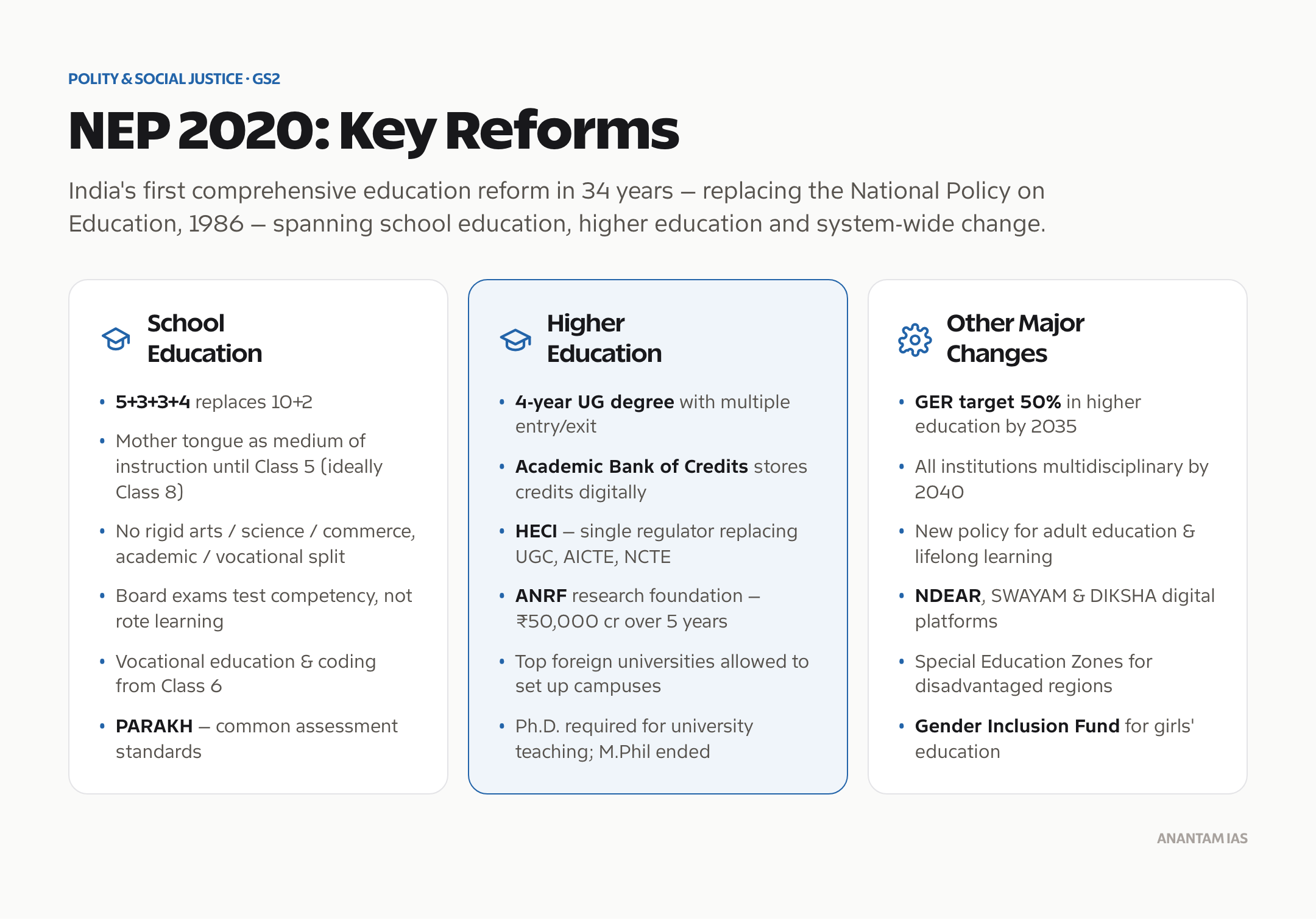
School Education Reforms
- 5+3+3+4 structure replacing 10+2
- Mother tongue/regional language as the medium of instruction until Class 5 (preferably until Class 8)
- No rigid separation between arts, sciences, commerce, curricular and co-curricular, vocational and academic
- Board exams reformed: Reduced stakes — testing competency rather than rote learning; option for semester-based boards
- Vocational education starting from Class 6 with internships
- Coding and computational thinking from Class 6
- 360-degree holistic report card replacing single-exam assessment
- National Assessment Centre (PARAKH): Common standards for all education boards
Higher Education Reforms
| Reform | Details |
|---|---|
| Multidisciplinary education | All institutions to become multidisciplinary by 2040 |
| 4-year undergraduate degree | Multiple entry/exit with certificate (1 year), diploma (2 years), degree (3 years), honors/research (4 years) |
| Academic Bank of Credits (ABC) | Digital storage of credits earned across institutions |
| HECI (Higher Education Commission of India) | Proposed single regulator replacing UGC, AICTE, NCTE, etc. |
| Research foundation (NRF/ANRF) | Anusandhan National Research Foundation with Rs 50,000 crore over 5 years |
| Internationalization | Top foreign universities allowed to set up campuses in India |
| Ph.D. as eligibility for teaching | M.Phil discontinued; Ph.D. or equivalent required for university teaching |
Other Major Changes
- Gross Enrollment Ratio (GER) target: 50% in higher education by 2035 (from ~28% in 2024)
- Adult education: New policy for adult education and lifelong learning
- Technology in education: NDEAR (National Digital Education Architecture), SWAYAM, DIKSHA platforms
- Special Education Zones: For regions with historically disadvantaged groups
- Gender Inclusion Fund: Dedicated fund for girls’ education
Key Educational Bodies and Regulators
| Body | Full Name | Role |
|---|---|---|
| UGC | University Grants Commission | Regulation and funding of higher education |
| AICTE | All India Council for Technical Education | Technical education regulation |
| NCERT | National Council of Educational Research and Training | Curriculum framework, textbooks |
| CBSE | Central Board of Secondary Education | School board (pan-India) |
| CISCE | Council for Indian School Certificate Examinations | ISC/ICSE board |
| NAAC | National Assessment and Accreditation Council | Quality assessment of institutions |
| NBA | National Board of Accreditation | Accreditation of technical programmes |
| NCTE | National Council for Teacher Education | Teacher education regulation |
| NTA | National Testing Agency | Conducts JEE, NEET, CUET, UGC NET |
| ANRF | Anusandhan National Research Foundation | Research funding and coordination |
Literacy and Enrollment Data
Literacy Trends
| Census Year | Overall Literacy | Male Literacy | Female Literacy | Gender Gap |
|---|---|---|---|---|
| 1951 | 18.3% | 27.2% | 8.9% | 18.3% |
| 1971 | 34.5% | 46.0% | 22.0% | 24.0% |
| 1991 | 52.2% | 64.1% | 39.3% | 24.8% |
| 2001 | 64.8% | 75.3% | 53.7% | 21.6% |
| 2011 | 73.0% | 80.9% | 64.6% | 16.3% |
| 2021 (est.) | ~78% | ~84% | ~72% | ~12% |
The gender gap in literacy has narrowed from 18.3% in 1951 to approximately 12% — significant progress but still substantial.
Enrollment Data (UDISE+ 2023-24)
- Total schools: ~14.9 lakh (1.49 million)
- Total enrollment (elementary + secondary): ~25 crore students
- Gender Parity Index (elementary): ~1.0 (near parity)
- Gross Enrollment Ratio (primary): ~100%
- Gross Enrollment Ratio (secondary): ~78%
- Higher education GER: ~28%
- Dropout rate (secondary): ~12.6%
Higher Education in India
Scale and Structure
India has one of the world’s largest higher education systems:
| Metric | Data (2023-24) |
|---|---|
| Total universities | 1,168 |
| Total colleges | 45,000+ |
| Total enrollment | ~4.3 crore |
| Gross Enrollment Ratio | ~28% |
| Female GER | Higher than male GER (first time in 2020-21) |
| Institutions of National Importance | IITs, IIMs, NITs, AIIMS, etc. |
| Private sector share | ~70% of institutions |
Key Challenges in Higher Education
- Quality: Only 30% of universities and 15% of colleges are NAAC accredited
- Research output: India’s research spending is ~0.65% of GDP (target 2% under NEP)
- Faculty shortage: ~35% faculty positions vacant in central universities
- Employability: Only ~45% of graduates are considered employable by industry surveys
- Regional disparity: Southern and western states have higher GER than northern and eastern states
- Autonomy: Excessive regulation stifles institutional innovation
Institutions of Excellence
India’s globally ranked institutions include IITs, IISc Bengaluru, IIMs, AIIMS, JNU, Delhi University, and BHU. IISc Bengaluru and several IITs consistently appear in global rankings (QS, THE, ARWU).
Right to Education Act, 2009
The RTE Act operationalized Article 21A of the Constitution.
Key Provisions
- Free and compulsory education for all children aged 6–14 years
- 25% reservation for EWS/disadvantaged children in private schools
- Pupil-teacher ratio: 30:1 (primary), 35:1 (upper primary)
- No detention policy until Class 8 (later amended in 2019 to allow states to hold back-exams)
- All schools must meet infrastructure norms within 3 years
- No screening or capitation fee for admission
Impact and Criticism
Positive:
- Near-universal enrollment at the primary level
- Increased school infrastructure
- Greater access for disadvantaged communities
Criticism:
- Focus on enrollment over learning outcomes
- No detention policy reduced accountability (later amended)
- 25% EWS quota implementation remains patchy
- Quality of education not adequately addressed
- Age 6–14 coverage excludes 3–6 (pre-primary) and 14–18 (secondary)
Digital Education
Key Platforms
| Platform | Purpose |
|---|---|
| SWAYAM | Massive Open Online Courses (MOOCs) from top institutions |
| DIKSHA | School education digital platform (textbooks, courses, assessments) |
| NDEAR | National Digital Education Architecture framework |
| e-Vidya/PM eVIDYA | Multi-modal education (TV, radio, online) — accelerated during COVID-19 |
| National Digital Library | Digital repository of learning resources |
| Virtual Labs | Online laboratory experiments for science and engineering |
Digital Divide
COVID-19 exposed the massive digital divide in Indian education:
- Only 24% of households have internet access (rural: 15%)
- ~40% of students couldn’t access online education during lockdowns
- Gender gap in device access: girls significantly disadvantaged
- Government response: PM eVIDYA using DTH TV channels (one channel per class)
Comparison: Education Systems
| Parameter | India | Finland | USA | China |
|---|---|---|---|---|
| Spending (% of GDP) | ~3% | ~6.3% | ~5% | ~4% |
| Structure | 5+3+3+4 (NEP 2020) | 6+3+3 | K-12 + 4-year degree | 6+3+3 |
| Medium of instruction | Mother tongue (NEP goal) | Finnish/Swedish | English | Mandarin |
| Board exams | Multiple boards (CBSE, State) | No national exams until 18 | Standardized tests (SAT, ACT) | Gaokao (single high-stakes exam) |
| Teacher training | B.Ed (4-year integrated under NEP) | Master’s degree mandatory | Bachelor’s + certification | Bachelor’s + exam |
| Research spending | ~0.65% of GDP | ~2.8% | ~3.5% | ~2.4% |
India’s education spending at ~3% of GDP falls short of the NEP’s own recommendation of 6%.
Key Challenges
- Learning crisis: Students enrolled but not learning — ASER data shows poor foundational literacy and numeracy
- Teacher quality: Inadequate training, absenteeism, reliance on contract teachers
- Infrastructure gaps: Many schools lack basic facilities (toilets, drinking water, electricity)
- School closures: 1.5 lakh schools have fewer than 20 students — questions about viability and quality
- Vocational stigma: Vocational education seen as inferior to academic education
- Coaching culture: Dependence on private coaching for competitive exams reflects systemic failure
- Financing: Gap between allocated and needed resources; NEP’s 6% GDP target unmet
UPSC Exam Strategy
Prelims Focus
- NEP 2020 key provisions (5+3+3+4, medium of instruction, ABC)
- Constitutional provisions (21A, 42nd Amendment, Concurrent List)
- RTE Act provisions
- Regulatory bodies (UGC, AICTE, NCERT, NTA, NAAC)
- Education statistics (literacy rates, GER)
Mains (GS Papers I, II)
- NEP 2020: transformative potential and implementation challenges
- Digital divide in education
- Quality vs access debate
- Comparison with global education models
- Role of education in social mobility and empowerment
- Privatization of education: benefits and concerns
Women Empowerment in India: Schemes & UPSC Notes
Child Labour in India: Laws, Data & Measures
Frequently Asked Questions
What is the 5+3+3+4 structure under NEP 2020?
NEP 2020 replaced the 10+2 school structure with 5+3+3+4: Foundational (ages 3–8, including 3 years of pre-primary), Preparatory (ages 8–11), Middle (ages 11–14), and Secondary (ages 14–18). The key change is including pre-primary education and removing rigid academic/vocational and arts/science divisions.
Is education a state or central subject in India?
Education was originally a State subject under the Constitution. The 42nd Constitutional Amendment (1976) transferred it to the Concurrent List, giving both Centre and States legislative power over education. This means both Parliament and State Legislatures can make laws on education, with central laws prevailing in case of conflict.
What is NAAC accreditation and why does it matter?
NAAC (National Assessment and Accreditation Council) assesses and grades higher education institutions on a scale of A++, A+, A, B++, B+, B, C. Accreditation indicates quality standards in teaching, research, infrastructure, and governance. Only about 30% of universities are NAAC accredited, meaning most institutions haven’t undergone quality assessment.
What is the Academic Bank of Credits (ABC)?
The Academic Bank of Credits is a digital repository that stores academic credits earned by students across different institutions. Students can accumulate credits from multiple universities, enabling multiple entry and exit options in higher education. This supports the NEP 2020 goal of flexible, student-centric learning pathways.
How much does India spend on education?
India spends approximately 3% of GDP on education (combined Centre and State expenditure). NEP 2020 recommends increasing this to 6% of GDP. By comparison, the global average for developed countries is about 4.5–6%. The gap between spending and the NEP target remains one of the biggest challenges.
Tell Google you want more of this.
Add Anantam IAS as a preferred sourceOne tap, and this site shows up more often in your own Top Stories, AI Overviews and AI Mode. Remove it any time.





