An election is only as honest as the people believe it to be. And belief rests on one quiet assumption: that the body running the contest isn’t quietly rooting for one side. So the moment you ask “who picks the people who run our elections?” you’re not asking a procedural question. You’re asking whether the umpire owes anything to one of the teams. That’s the whole fight here, and as of now the Supreme Court has heard it out and reserved its verdict, which means the answer is awaited, not settled.
The Constitution left a door open on purpose. Article 324 said the Chief Election Commissioner and the Election Commissioners would be appointed “subject to the provisions of any law made in that behalf by Parliament,” and then Parliament didn’t walk through that door for seventy-three years. When it finally did, in 2023, it wrote a law that hands the government two of three seats on the panel that chooses the umpire. Whether that keeps the umpire neutral, or quietly tilts the field, is the question a future administrator has to be able to argue from both ends.
The Issue, Framed
Let’s fix the vocabulary first, because most of the confusion around this topic comes from people using big words loosely.
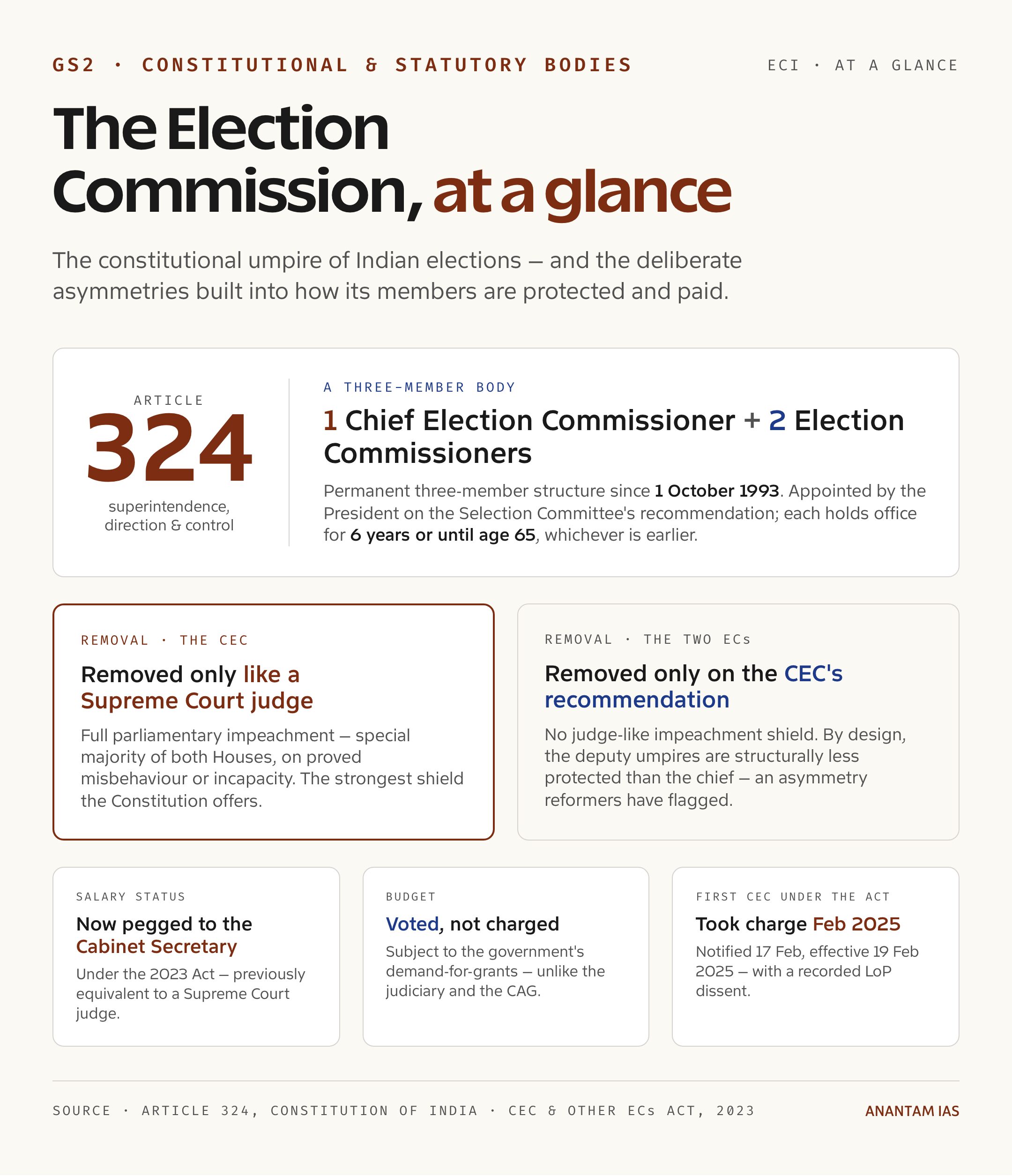
The Election Commission of India, the ECI, is the constitutional body that runs every major election in the country, from Parliament and the state legislatures to the offices of President and Vice-President. It’s a three-member body: one Chief Election Commissioner, the CEC, and two Election Commissioners, the ECs. That three-member structure became permanent on 1 October 1993, after a brief single-member spell.
Article 324 is the constitutional anchor. Its first clause vests the “superintendence, direction and control” of elections in the Commission, which is constitutional shorthand for total operational command of the electoral process. Its second clause is the one that lights this whole controversy. It says the President appoints the CEC and the ECs, but those appointments are “subject to the provisions of any law made in that behalf by Parliament”. Read that carefully. The framers didn’t fix the appointment method in the Constitution. They left it to a future statute, and trusted Parliament to write one. Parliament took until 2023.
Two more terms you have to be precise about. Security of tenure means how hard it is to remove someone once appointed, and Article 324(5) builds in a deliberate asymmetry here. The CEC “shall not be removed from his office except in like manner and on the like grounds as a Judge of the Supreme Court,” which means full parliamentary impeachment on proved misbehaviour or incapacity, the highest protection the Constitution offers. But the two ECs get no such shield. They can be removed only on the recommendation of the CEC. So the deputy umpires are, structurally, less protected than the chief.
And independence, in the “umpire” sense, isn’t about personal honesty. A decent person can sit in a compromised chair. Independence is structural: it asks whether the office is insulated from the team it has to referee, in how the holder is chosen, paid, and protected. That’s the lens for everything below.
The dispute, then, isn’t whether the ECI matters. Everyone agrees it does. The dispute is whether the way we now pick its members leaves it free to call a foul against the government of the day.
What the Data Says
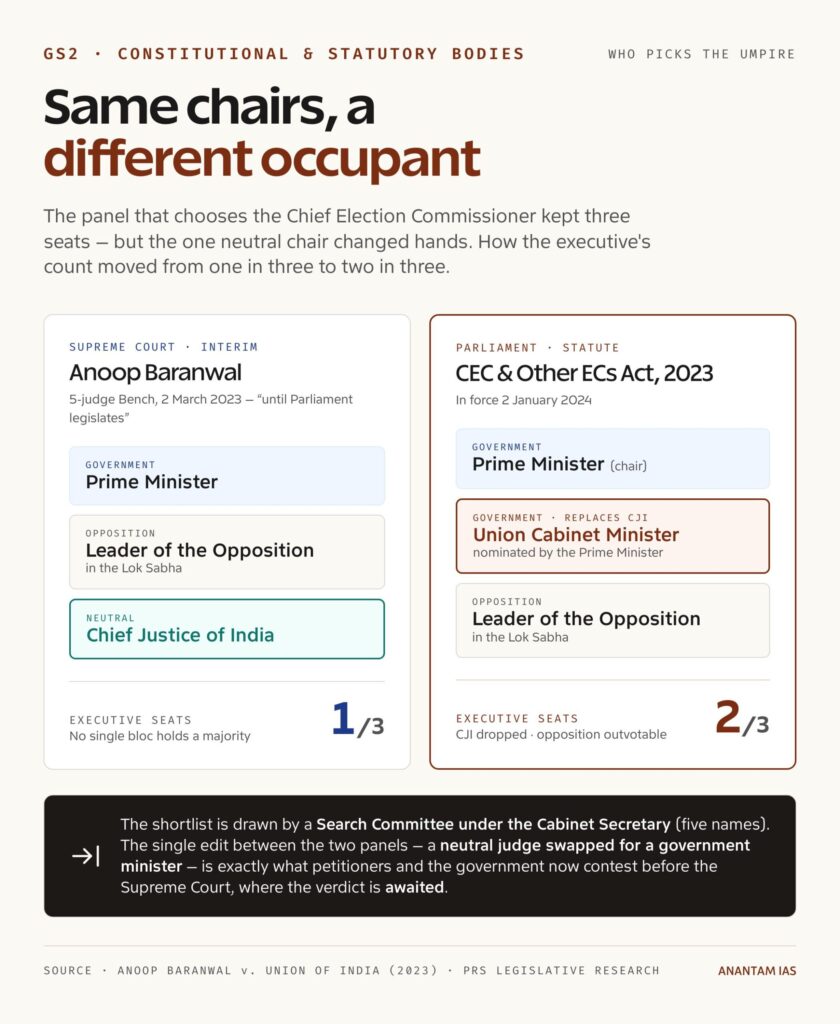
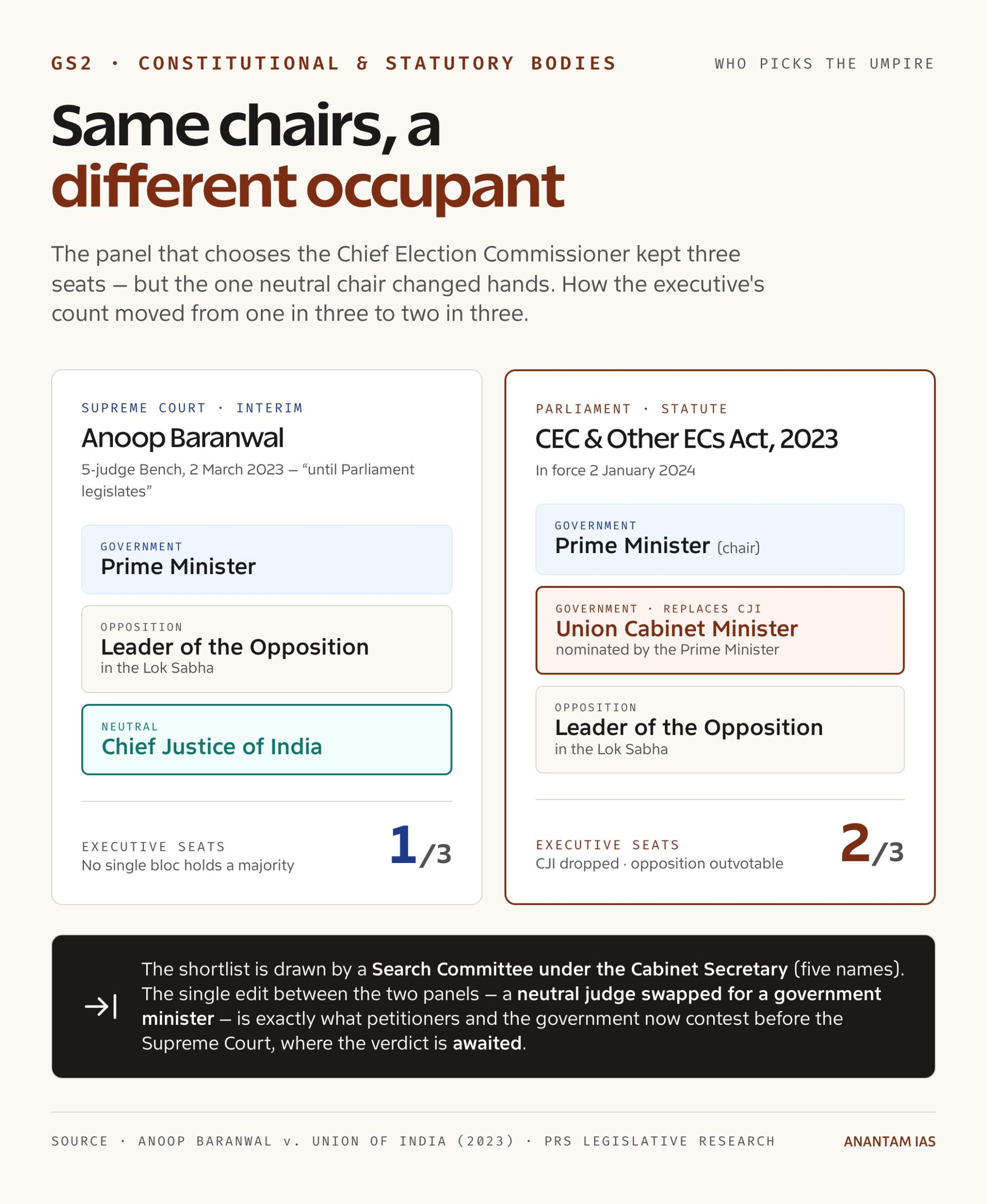
The cleanest way to see the shift is to put the two appointment panels side by side, because the change is small on paper and large in effect.
When the Supreme Court decided Anoop Baranwal v. Union of India on 2 March 2023, a five-judge Constitution Bench led by Justice K.M. Joseph held unanimously that appointing the CEC and ECs solely on the executive’s advice “gives power to the executive thereby taking away the independence of the ECI and is therefore unconstitutional”. The Court pointed at the seventy-three-year gap: Parliament had simply never enacted the Article 324(2) law. So, to fill the vacuum “until Parliament legislates,” the Court built an interim panel of three: the Prime Minister, the Leader of the Opposition in the Lok Sabha, and the Chief Justice of India. The arithmetic there is one government voice, one opposition voice, one neutral judge. No single bloc holds an automatic majority.
Then Parliament legislated. The CEC and Other ECs (Appointment, Conditions of Service and Term of Office) Act, 2023 received Presidential assent on 28 December 2023 and came into force on 2 January 2024. Its selection committee is also three members, but the names changed. It’s the Prime Minister as chair, a Union Cabinet Minister nominated by the Prime Minister, and the Leader of the Opposition. The Chief Justice was dropped. So the arithmetic flipped to two government voices against one opposition voice. The executive can now carry its choice 2-1, every time, by design.
A second number sharpens the point. Under the old 1991 Act, the CEC and ECs drew salary and service conditions equivalent to a Supreme Court judge, whose pay is fixed by an Act of Parliament and so insulated from the executive. The 2023 Act pegs them to the Cabinet Secretary instead, whose pay the government fixes on Pay Commission advice. It reads like a protocol footnote. It isn’t. It moves the office one notch closer to the executive’s hand, on the one variable an institution can’t easily defend itself on: its own pay.
And here’s a structural fact that sits underneath all of it. The ECI’s budget is voted by Parliament, not charged on the Consolidated Fund of India. The salaries of Supreme Court judges and the CAG are charged, meaning they’re paid out automatically and aren’t put to a vote the government can squeeze. The umpire’s running costs are not. So even before you reach the appointment panel, the body depends annually on the government’s demand-for-grants.
The system already produced its first test case. Gyanesh Kumar became the first CEC appointed under the 2023 Act, with the Law Ministry notification dated 17 February 2025 and the appointment effective 19 February 2025. The selection committee of the Prime Minister, the Union Home Minister and the Leader of the Opposition cleared his name, and the Leader of the Opposition filed a written dissent, objecting that the committee shouldn’t pick a CEC while the Supreme Court was about to hear the challenge to the panel’s own validity “in less than forty-eight hours”. So the law is no longer theoretical. It has already chosen the country’s chief umpire once.
The Case For
The defence of the 2023 law is stronger than its critics like to admit, and a good answer states it at full strength before knocking it.
Start with the text, because it’s the government’s best card. Article 324(2) doesn’t just permit a Parliamentary law, it subordinates the appointment to one: “subject to the provisions of any law made in that behalf by Parliament”. On this reading, the elected legislature is the constitutionally designated rule-maker, not the Court. And Anoop Baranwal said its own panel was a stopgap “until Parliament legislates.” So the supporters’ line is simple: Parliament has now done exactly what the Constitution asked, and a court-built panel can’t outrank a duly enacted law.
There’s a separation-of-powers argument that cuts the other way too. Putting the Chief Justice on an executive appointments committee drags the judiciary into an administrative, non-judicial job, and risks a judge later having to rule on disputes about an official he himself helped pick. Keep the judge off the panel, the argument runs, and you keep him free to adjudicate election disputes cleanly afterwards. Independence of the judiciary is a value here, not just independence of the Commission.
Then there’s democratic accountability. The Prime Minister and a Cabinet Minister answer to Parliament and, ultimately, to voters. An unelected judge answers to neither. So a panel weighted toward accountable, elected office-holders is, on this view, more democratically legitimate than one steered by a judge nobody elected.
And the honest comparison isn’t with the Anoop Baranwal panel. It’s with what existed before any of this. Until 2023, the President appointed the CEC and ECs purely on the Council of Ministers’ advice, with no statutory committee, no search process, and no written criteria at all. The 2023 Act, for the first time, created a statutory selection committee, a search committee under the Cabinet Secretary that shortlists five names, and codified eligibility rules. So measured against the genuine status quo ante, the Act adds process and a formal opposition seat where there had been none. During the 2026 hearings the Bench itself asked whether a court can direct Parliament to enact a particular law, which captures the deeper limit on judicial law-making in this space.
The Case Against
Here’s what that defence walks past. A panel can be statutory, codified, and transparent, and still be rigged in its arithmetic. The petitioners, led by Dr Jaya Thakur and the Association for Democratic Reforms, argue that the 2023 Act is independence in form and executive control in substance.
The core objection is the 2-1 math. With the Prime Minister and a Prime-Minister-nominated minister both sitting for the government, the executive holds two of three votes and the Leader of the Opposition is a single, outvotable member. A committee where one side can never lose isn’t a check. It’s a formality wearing a committee’s clothes.
The petitioners’ sharper point is that this dilutes Anoop Baranwal’s whole reason for existing. The Court inserted the Chief Justice precisely to break the executive’s monopoly over the choice. Replacing that neutral member with a Cabinet Minister, critics argue, walks the panel straight back into the imbalance the Court had just called unconstitutional. You can read the 2023 Act as Parliament exercising its mandate, or as the executive restoring the very tilt a Constitution Bench had removed. That’s exactly the question now reserved before the Court.
There’s a conflict-of-interest argument underneath. The ECI routinely adjudicates against the government of the day, on the Model Code of Conduct, on poll dates, on complaints about ministers. So letting that same government effectively pick the adjudicator is, the petitioners say, like letting one team appoint the referee for its own matches. And because perception is part of the ECI’s mandate, even a personally upright appointee can carry a credibility deficit if the process looks government-controlled.
Two finer points complete the case. The salary downgrade from Supreme Court judge to Cabinet Secretary lowers the office’s structural insulation, since the government now sets the pay. And the Act’s “valid despite vacancy” clause lets an appointment proceed even when the Leader of the Opposition is absent or dissenting, which blunts the opposition’s one formal check. The February 2025 appointment, pressed ahead while the Court was about to hear the challenge, drew exactly that charge of pre-empting judicial review.
The Deeper Structural Read
Step back from the headline fight and a longer pattern shows up, the kind that earns marks because it reframes the whole debate.
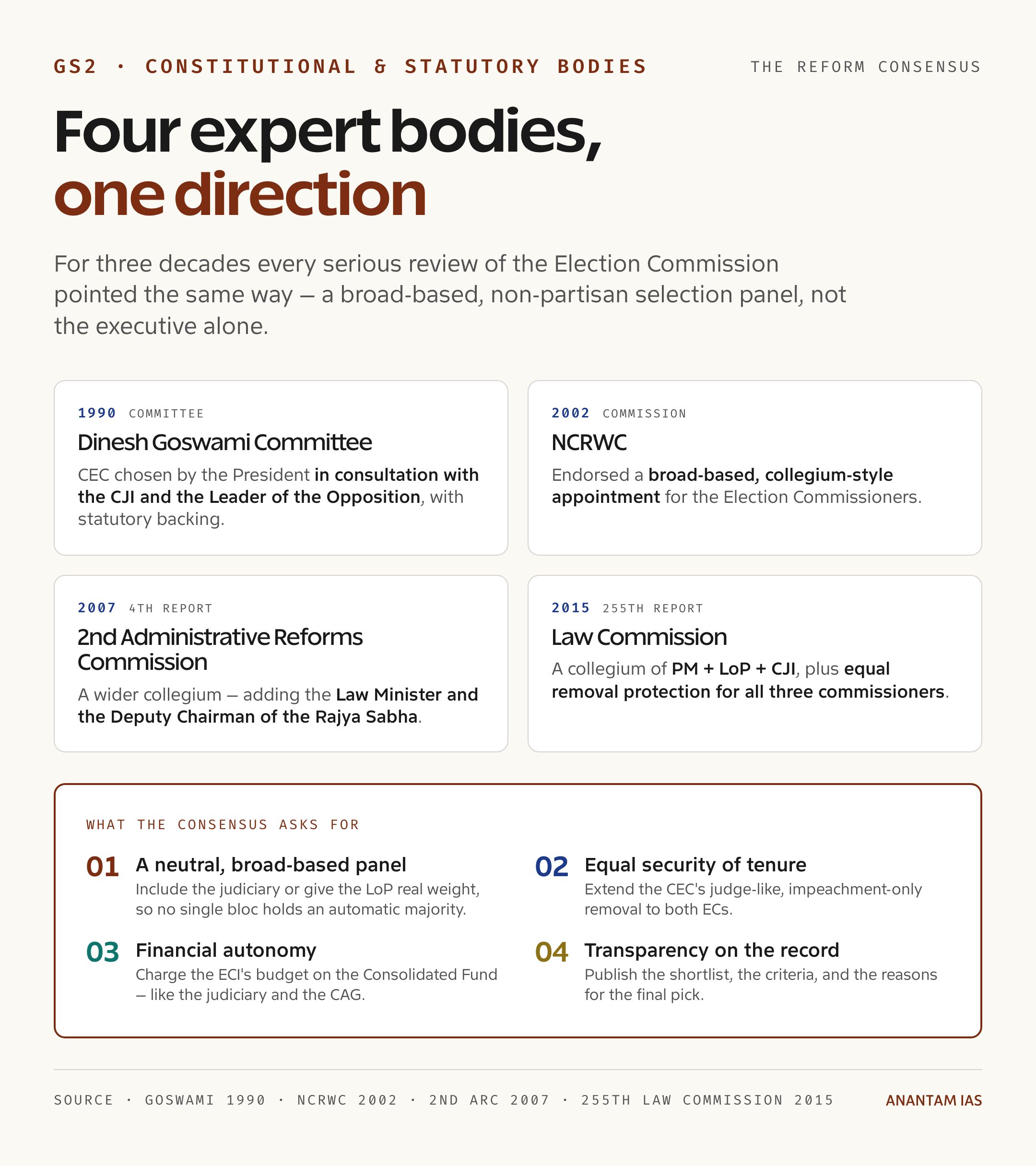
This isn’t a sudden 2023 problem. Across three decades, every serious reform body that looked at the ECI reached the same conclusion: appointments should run through a broad-based, non-partisan panel, not the executive alone. The Dinesh Goswami Committee in 1990 recommended the CEC be chosen by the President in consultation with the Chief Justice and the Leader of the Opposition. The NCRWC in 2002 endorsed a collegium-style appointment. The 2nd Administrative Reforms Commission in 2007 went wider, proposing a collegium that even added the Law Minister and the Deputy Chairman of the Rajya Sabha. And the Law Commission’s 255th Report in 2015 recommended a collegium of Prime Minister, Leader of the Opposition and Chief Justice, plus equal removal protection for all three commissioners. Four expert bodies, three decades, one direction of travel: away from executive monopoly. The 2023 Act is the one document in that lineage that narrows the panel rather than broadening it.
There’s an asymmetry the reformers kept flagging that the 2023 Act still doesn’t fix: security of tenure. The CEC enjoys judge-like protection; the two ECs can be removed on the CEC’s recommendation. In Anoop Baranwal itself, Justice Ajay Rastogi’s concurrence argued that the impeachment-style shield of Article 324(5) should extend to all ECs, not just the chief, for genuine independence. An EC who can be eased out more easily than the CEC is, structurally, more exposed to pressure. Independence built only at the top isn’t quite independence.
And there’s a reason this office, of all offices, draws such heat: the T.N. Seshan legacy. As CEC from 1990 to 1996, Seshan turned a sleepy body into an assertive one, enforcing the Model Code of Conduct strictly, pushing voter ID cards, and cracking down on booth-capturing. He proved that the ECI’s teeth come from who sits in the chair. Which is precisely why how that person is chosen became, and stays, contested. When the government of the day moved to expand the Commission to three members in 1993, Seshan resisted, and in T.N. Seshan v. Union of India the Court upheld the multi-member design with decisions by majority. Even the three-member structure was born from an executive-versus-assertive-CEC standoff.
So the structural read is this. Free and fair elections sit inside the basic structure of the Constitution, recognised since Indira Nehru Gandhi v. Raj Narain. An umpire that depends on one team for its appointment, its pay, and its annual budget is structurally compromised, however upright the individual. The question reserved before the Bench, whether “independence” is a procedural guarantee that mandates a neutral member, or merely whatever law Parliament passes, will set the template for far more than the ECI. It touches every constitutional appointment where the line between the executive and an independent body has to be drawn.
What Should Be Done
So what does an appointment process that actually protects the umpire look like? Not a vague plea for “more independence,” but specific, buildable changes, most of which already carry expert backing.
- Put a genuine neutral back on the panel. Restore a member no single bloc controls, the Chief Justice or a CJI-nominated judge, or give the Leader of the Opposition real weight, so the executive can’t carry every choice 2-1. This is the common thread across the Dinesh Goswami Committee, the NCRWC, the 2nd ARC and the 255th Law Commission Report. The fix isn’t novel. It’s the consensus everyone reached and the 2023 Act stepped away from.
- Give all three commissioners equal security of tenure. Extend Article 324(5)’s judge-like, impeachment-only removal to the two ECs, not just the CEC, exactly what Justice Rastogi urged and the 255th Report recommended. An EC who is easier to remove is easier to lean on, so equal protection is the cheapest structural insulation available.
- Charge the ECI’s budget on the Consolidated Fund of India. Make the Commission’s expenditure charged rather than voted, the way the judiciary’s and the CAG’s already are. An umpire shouldn’t have to pass the hat to the team it referees every single year.
- Make the selection transparent on the record. Publish the search committee’s shortlist, the criteria applied, and the reasons for the final pick, and record committee minutes. Transparency is the single best answer to the “midnight appointment” charge, because a process done in the open is far harder to call captured.
- Build an independent permanent secretariat. Staff and service the ECI through its own cadre rather than entirely through the executive, so the body that referees the government isn’t run day-to-day by the government’s officials.
- Add a cooling-off bar after office. A post-retirement restriction on accepting executive appointments reduces the perception that a commissioner might angle for favours after demitting office, which is half the independence battle, since perception is part of the mandate.
None of these weakens the Commission. Every one of them strengthens the only thing that makes an umpire’s whistle worth obeying: the losing side’s willingness to accept that it lost.
For Your Mains Answer
This is a high-yield GS2 topic. It sits at the crossroads of constitutional bodies, separation of powers, judicial review, and the basic-structure doctrine, and it carries a live, citable peg.
GS paper mapping: GS2: the Constitution; statutory, regulatory and constitutional bodies; separation of powers between organs; appointment to constitutional posts; functioning of the executive and the judiciary.
PSIR optional relevance: Paper I (Indian Government and Politics) on election machinery, constitutional bodies, and institutional autonomy; Paper I (Political Theory) on democracy and free elections as a precondition of legitimacy; Indian Constitution on judicial law-making to fill legislative vacuums and on free elections as a basic feature (Indira Nehru Gandhi v. Raj Narain). A comparative line on independent versus executive-appointed election bodies across democracies adds value if you can ground it.
Likely question frames:
- The independence of the Election Commission depends as much on how its members are appointed as on who they are. Critically examine in light of Anoop Baranwal and the CEC and Other ECs Appointment Act, 2023.
- Article 324 leaves the appointment of Election Commissioners to a law of Parliament. Discuss the tension between Parliamentary supremacy in this domain and the constitutional demand for an independent electoral umpire.
- A selection committee on which the executive holds a built-in majority cannot guarantee a neutral Election Commission. Evaluate.
Quotable data and cases:
- Anoop Baranwal v. Union of India (2 March 2023): a 5-judge Bench held appointment solely on executive advice unconstitutional; interim panel of PM, LoP and CJI “until Parliament legislates.”
- The 2023 Act (assent 28 December 2023, in force 2 January 2024) sets the panel as PM, a Union Cabinet Minister, and the LoP, dropping the CJI, giving the executive 2 of 3 seats.
- Salary status moved from Supreme Court judge (Parliament-fixed) to Cabinet Secretary (government-fixed).
- The ECI’s budget is voted, not charged on the Consolidated Fund of India.
- Gyanesh Kumar, first CEC appointed under the Act (notified 17 February 2025, effective 19 February 2025), with a recorded LoP dissent.
- Reform convergence: Goswami (1990), NCRWC (2002), 2nd ARC (2007), 255th Law Commission Report (2015) all backed a broad-based collegium.
Keywords to use: Article 324, Article 324(2), Article 324(5), superintendence direction and control, selection committee, security of tenure, separation of powers, basic structure, free and fair elections, institutional independence.
Syllabus linkages: salient features of the Constitution, constitutional and statutory bodies, separation of powers, judicial review, appointment to constitutional posts, governance and transparency.
Balanced conclusion line: The Constitution left the appointment method to Parliament, but the same Constitution treats free and fair elections as part of its basic structure; the real test of the 2023 law is not whether Parliament was entitled to legislate, but whether the umpire it produces can still call a foul against the team that chose it.
How to Build the Answer
Open with the conflict, not a definition. The tension is that Parliament has a genuine textual mandate to legislate the appointment, while the Constitution also demands an umpire the losing side can trust. Naming both in the first two sentences tells the examiner you’ve grasped the clash, not just the topic. The Article 324 definition can come in sentence two or three.
Bring the institutional history in early, because it’s your edge. Most candidates write only the 2023-versus-2026 fight. The candidate who shows that Goswami, NCRWC, the 2nd ARC, and the 255th Report all pointed the same way, toward a broad-based panel, reframes the Act as a departure from a thirty-year consensus. That single move lifts an average answer.
The body should steelman both sides. Give the government’s textual and separation-of-powers argument real weight before you test it against the 2-1 arithmetic and the conflict-of-interest point. An answer that only prosecutes, or only defends, reads as opinion, not analysis.
The way forward must be grouped, not scattered. Cluster the reforms: a neutral panel member, equal tenure for all ECs, charged finance, transparent selection, an independent secretariat, a cooling-off bar. Use the topic’s own vocabulary, security of tenure, basic structure, separation of powers, so the answer sounds like constitutional analysis.
Close on judgment, not a slogan. Because the verdict is awaited, the strongest ending states the principle the Court must weigh, the difference between procedural independence and whatever-Parliament-passes independence, rather than predicting the outcome.
Common Mistakes to Avoid
- Don’t take a partisan side. This is politically charged. Frame every “for” and “against” as a party’s argument, and present the litigation as a fact, never as a verdict you’re delivering.
- Don’t say the verdict came down. As of writing, the judgment is reserved. Treat it as awaited; predicting the holding is a needless risk.
- Don’t confuse the two panels. Anoop Baranwal gave PM, LoP and CJI; the 2023 Act gives PM, Cabinet Minister and LoP. Mixing them up sinks the whole answer.
- Don’t reduce independence to honesty. The point is structural insulation, appointment, pay, tenure, not whether a given commissioner is personally upright.
- Don’t forget the finance angle. A budget that’s voted, not charged, is an under-used point that signals depth.
A Compact Answer Spine
- Introduction: Open with the appointment-versus-independence conflict; define Article 324 and the ECI in the next sentence.
- The shift: Anoop Baranwal‘s neutral panel to the 2023 Act’s executive-majority panel, with the salary and finance points as support.
- Arguments: The case for Parliamentary mandate and judicial-independence, then the case against executive dominance and conflict of interest. Keep both fair.
- Structural diagnosis: Three decades of reform consensus pointing the other way; tenure asymmetry; free elections as basic structure.
- Way forward: Grouped guardrails, each with a clear actor, Parliament, the Court, the ECI.
- Conclusion: Adapt the balanced conclusion line to the exact question wording.
Diagram or Flowchart Idea
For a 15-marker, a two-column comparison does the most work: “Anoop Baranwal panel (PM + LoP + CJI, 1 executive seat)” against “2023 Act panel (PM + Cabinet Minister + LoP, 2 executive seats).” The examiner reads the tilt in three seconds.
For a 10-marker, sketch a short causal chain instead: executive-majority panel picks umpire to government-set pay with voted budget, equals a perceived independence deficit, met by reforms (neutral member, charged finance, equal tenure). One clean line of logic beats a decorative web.
Ethics and Governance Angle
Add one line of governance ethics even in a GS2 answer. The deepest point here is perception as a public value. An institution that adjudicates against the powerful must not only be impartial, it must be seen to be impartial, because its authority rests on consent, not force. That’s the principle behind “justice must be seen to be done,” applied to the electoral umpire.
Then convert the principle into design. Don’t just say “the ECI should be independent.” Say how: a neutral appointer, charged finance, equal tenure, published selection reasons. That’s the move from a value to administrative maturity, which is what the examiner rewards.
A portable sentence pattern travels well here: “The aim is legitimate, but its legitimacy depends on a process that even the losing side can accept.” It credits Parliament’s mandate without handing it a blank cheque, which is exactly the balance a politically sensitive question demands.
How to Use Data Without Sounding Mechanical
Use fewer numbers than you know. Three anchors carry this topic: the panel arithmetic (1 executive seat versus 2 of 3), the salary status change (SC judge to Cabinet Secretary), and the reform tally (four expert bodies, one direction). Lead with the arithmetic, support with the status downgrade, and clinch with the reform consensus.
Never leave a fact standing alone. After “the executive holds two of three seats,” add what it means: the government’s choice can’t lose. The figure is the anchor; the “this means” is the mark. In Mains, facts are raw material and judgment is the finished answer.
Finish with one test: can a tired examiner follow this in a single pass? Short introduction, the panel shift early, two sides marked cleanly, grouped way forward, a conclusion that shows judgment. For UPSC, clarity is how depth becomes visible.
FAQ
What did the Supreme Court hold in Anoop Baranwal v. Union of India (2023)?
On 2 March 2023, a five-judge Constitution Bench held that appointing the Chief Election Commissioner and Election Commissioners solely on the executive’s advice was unconstitutional because it stripped the Commission of independence. As a stopgap “until Parliament legislates,” the Court set up an interim appointment panel of the Prime Minister, the Leader of the Opposition in the Lok Sabha, and the Chief Justice of India.
How did the CEC and Other ECs Appointment Act, 2023 change the panel?
The Act, which got Presidential assent on 28 December 2023 and came into force on 2 January 2024, kept a three-member selection committee but replaced the Chief Justice with a Union Cabinet Minister nominated by the Prime Minister. The panel is now the Prime Minister, a Cabinet Minister, and the Leader of the Opposition, which gives the executive two of three seats. It also pegged the commissioners’ salary status to the Cabinet Secretary rather than a Supreme Court judge.
Why does it matter who appoints the Election Commission?
Because the Election Commission referees disputes against the government of the day, on the Model Code of Conduct, poll dates, and complaints, its credibility depends on being insulated from any one political side. The concern is structural, not personal: even an upright commissioner can carry a credibility deficit if the process that selected the body looks controlled by the executive it has to oversee.
Has the Supreme Court decided the challenge to the 2023 Act?
Not yet. The petitions by Dr Jaya Thakur, the Association for Democratic Reforms, and others were heard and the judgment was reserved, so the verdict is awaited. The central question before the Court is whether “independence” is a procedural guarantee that requires a neutral member on the panel, or whether any validly enacted law of Parliament satisfies Article 324. (Re-check the case status before relying on this, as a verdict may since have been delivered.)
Tell Google you want more of this.
Add Anantam IAS as a preferred sourceOne tap, and this site shows up more often in your own Top Stories, AI Overviews and AI Mode. Remove it any time.