Disclosure: this guide contains Amazon affiliate links. As an Amazon Associate, Anantam IAS earns from qualifying purchases — at no extra cost to you.
“Technology as the silent factor in international relations” appeared as Topic 8 of Section B in the UPSC Civil Services Mains Essay paper held on 8 January 2021 (CSE 2020 Mains). Six words on a question paper. One hundred and twenty-five marks if you handle it well. A wasted hour if you do not. This guide breaks the topic down the way it should be tackled in the hall — first the meaning, then the angles, then the time map, then the paragraph-by-paragraph plan, and finally a complete 1,200-word model essay you can study, dissect and adapt.
When this was asked and what UPSC is really testing
The topic was set in UPSC CSE Mains 2020, Essay paper, Section B, Topic 8. Three hours, two essays, one from each section, roughly 1,000 to 1,200 words each, 125 marks per essay. “Technology as the silent factor in international relations” is a semi-abstract prompt with a clear policy spine — it sits between the philosophical Section A topics and a pure GS II/III question. Aspirants who treat it as a Science & Tech notes-dump miss the prompt; aspirants who treat it as pure philosophy waste the spine.
UPSC is checking four things at once. One, can you read the word “silent” — the operative word — and build the essay around it rather than around “technology”. Two, can you move comfortably across history, diplomacy, defence, cyberspace, climate and trade without sounding like a textbook. Three, can you weigh tech against politics rather than declaring it the sole driver of world affairs. Four, can you anchor a global topic in Indian institutions — ISRO, DRDO, the International Solar Alliance, the IndiaAI Mission — without turning the essay into a brochure. The aspirant who handles all four scores in the 130s. The one who handles only the fourth scores in the 90s.
Five angles that unlock “Technology as the silent factor in international relations”
The trap with semi-abstract prompts is to ride one obvious meaning for 1,100 words. The mark-pulling answer instead identifies several lenses, names them clearly, and weaves them. Here are the five most defensible readings of the topic. You do not need all five in your essay — three, treated well, is the sweet spot. But you should know all five so your choice is conscious.
- Technology as the historical undercurrent — the literal reading. Gunpowder shifted the Asia-Europe balance; the steamship and railway enabled colonial logistics; the nuclear bomb defined the Cold War; semiconductors define the current US-China rivalry. The headlines name leaders and treaties; the undertow is almost always technological.
- Technology as quiet leverage — the soft-power reading. ISRO’s Mars Orbiter and Chandrayaan, India’s pharmaceutical and vaccine diplomacy during the pandemic, the BrahMos export, the International Solar Alliance — none of these are headline diplomacy, but each rearranges how other states view India. Quiet capability is its own foreign policy.
- Technology as invisible battlespace — the cyber reading. Estonia 2007, Stuxnet, SolarWinds, election-interference operations, undersea cable cuts. The next war between states may be fought without a uniform crossing a border. Wars that are not declared still shape alliances.
- Technology as the new contested commons — the governance reading. Who writes the rules for AI, data flows, semiconductors, critical minerals, space debris and synthetic biology? The EU AI Act, the US chip export controls, the Quad’s critical-and-emerging-technology pillar, India’s DPDP Act of 2023 — each is a different attempt to write the rulebook.
- Technology as connector and divider at once — the dual reading. The same satellite that delivers internet to a remote village in conflict can also guide a missile. The same model that translates languages can also generate election deepfakes. Technology is morally indifferent; international relations rarely is.
A strong essay picks angles 1, 2 and 4 as its backbone (history, Indian capability, governance), uses 3 as a contemporary edge (cyber) and 5 as the counter-current. That gives the essay rhythm — origin, complication, governance, dilemma — instead of a single straight line.
A time map for the 1,500-second window
One essay deserves about 75 to 90 minutes inside the three-hour paper. Spending more on Essay 1 starves Essay 2. The single biggest source of below-100 essay scores is poor time discipline — beautiful introductions, panicked conclusions. Use a rough breakdown like this:
| Minutes | Activity | What it earns you |
|---|---|---|
| 0 — 10 | Decode the topic. Underline “silent”. Write a one-line thesis. List 4 to 5 angles. Pick 3. | Direction. The single most important investment of the 90 minutes. |
| 10 — 18 | Brainstorm: history episodes, Indian tech anchors, cyber incidents, governance frameworks, one counter. | The substance the body paragraphs will run on. |
| 18 — 22 | Draft a paragraph-level outline — 12 to 15 bullets, in sequence. | Prevents the mid-essay drift that kills 60% of attempts. |
| 22 — 80 | Write the essay — opening, body, conclusion — without re-planning. | The actual marks come from this window. Protect it. |
| 80 — 85 | Read the conclusion. Tighten the last two sentences. Fix factual errors and dates. | Conclusions are over-weighted by examiners. A clean ending saves 5 marks. |
Notice what is not on the list: rewriting the introduction halfway, hunting for the perfect quote, fancy diagrams, decorative underlining. None of that earns marks. Discipline does.
What to add — and what to avoid at all costs
The essay paper rewards what most aspirants under-do and punishes what most aspirants over-do. Memorise this list before you walk into the hall.
Add liberally
- One precise thesis, stated by the end of paragraph two and not abandoned. “Technology rarely speaks in the language of diplomacy, but it sets the terms in which diplomacy is conducted; the silence is not absence but mastery.”
- Concrete examples across three or four domains — one historical (gunpowder, the railway, the printing press, the atom bomb), one Indian (ISRO’s Chandrayaan-3 and Aditya-L1, the indigenous 4G/5G stack, the Semiconductor Mission, the International Solar Alliance), one strategic-cyber (Stuxnet, Estonia 2007, SolarWinds, undersea cables), one humanitarian (Vaccine Maitri, pharma supply chains during the pandemic).
- Two or three short, named references — Kautilya on the four upayas, Vivekananda on India’s gift of method, the Atharva Veda’s instruction to make the earth our common ground. One per major section is enough.
- One Indian philosophical anchor. Vasudhaiva Kutumbakam from the Maha Upanishad, framed not as slogan but as the principle India offers to a fragmenting tech order.
- Counter-arguments handled briefly. “Technology does not determine outcomes — the Soviet Union had nuclear and space tech and lost on politics.” Two lines, then resolved.
- A clean conclusion that returns to the opening image — not a fresh argument, not a new example.
Avoid — even when tempted
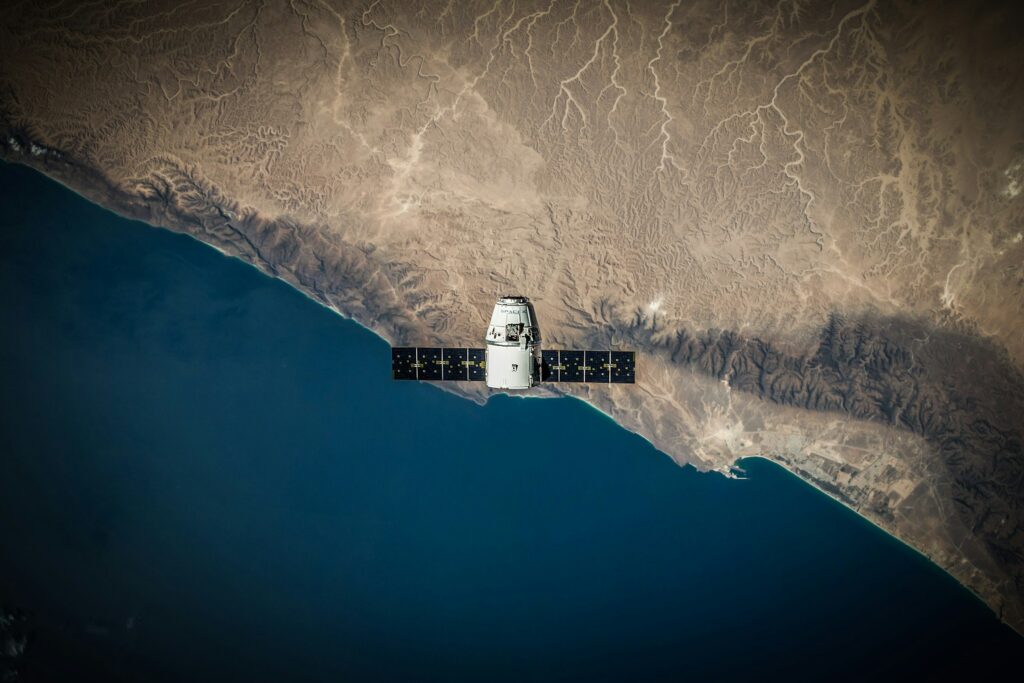
- Restating the topic in the first sentence. “Technology is the silent factor in international relations…” — this signals that you have nothing to add. Open with an image: a satellite passing over a contested coastline, an undersea cable being cut, a vaccine shipment landing in a foreign capital.
- Drifting into a single domain. A 1,100-word essay only on cyber, or only on space, or only on AI looks like a GS III answer. Range matters.
- Unsourced statistics. “60% of global semiconductors are made in Taiwan” — if you cannot vouch for the figure, write “the majority”. Examiners cross-mark precise numbers.
- Hot-button political examples. Naming current parties or leaders by name introduces avoidable risk. Use the institution — ISRO, DRDO, MEA, Quad, IAEA, ITU — not the personality.
- Decorative scholar-dropping. Citing Joseph Nye, Henry Kissinger and Yuval Harari in one paragraph to look serious. One scholar, used well, beats four named in passing.
- Techno-determinism. “AI will reshape the entire world order” — this kind of sentence reads like a TED talk and earns the marks of one. Examine, do not prophesy.
A paragraph-by-paragraph blueprint
Twelve paragraphs at roughly 95 words each gets you to 1,140. Thirteen at 90 each gets you to 1,170. Either works. What follows is a 13-paragraph plan that maps cleanly onto the model essay below. Each line is what that paragraph is doing, not what it is saying.
- Opening image — a satellite passing silently over an ocean of contested claims, or an undersea cable being severed in the small hours. No mention of the topic yet.
- The pivot to thesis — name the topic, then state the thesis in one sentence built around the word “silent”.
- Define the terms — what “technology” means here (capability, infrastructure, standards), what “silent” means (rarely the headline, almost always the undertow).
- Historical arc — gunpowder, the printing press, the railway, the steamship, the atom bomb, the silicon chip. The pattern of one technology rearranging the table.
- Indian anchor — ISRO, Pokhran-II 1998 and the Indo-US civil nuclear understanding of 2008, BrahMos and Akash exports, the Semiconductor Mission, the 4G/5G stack.
- Soft-power use — Vaccine Maitri, the International Solar Alliance, the Coalition for Disaster Resilient Infrastructure, the digital public infrastructure stack offered to partner countries.
- The invisible battlespace — Estonia 2007, Stuxnet, SolarWinds, undersea cable cuts, GPS denial. War without a declaration.
- The new contested commons — EU AI Act, US chip export controls, India’s DPDP Act 2023, IndiaAI Mission, critical-mineral supply chains, space-debris norms.
- Connector and divider — drones in Ukraine and satellite internet in conflict zones; deepfakes and election interference; mRNA vaccines shared and withheld.
- Counter-argument handled — politics still leads; technology is necessary, not sufficient. The Soviet example.
- Way forward — capability — raise R&D to 2% of GDP, indigenous chips, critical-mineral strategy, brain-gain policies, public science cooperation through CERN, ITER and SKA.
- Way forward — governance — multilateral tech rules, AI ethics frameworks, data-flow agreements, demilitarisation norms for space and seabed.
- Closing image — return to the satellite, the cable, the vaccine shipment. Close with one resonant line.
How to make an examiner stop and read
An essay examiner reads several hundred scripts in a sitting. The first paragraph decides whether they read the second with attention or with autopilot. Four small habits separate the essays that get attention from the ones that get skimmed.
- Open with a scene, not a statement. A satellite passing silently overhead. An undersea cable in the Red Sea. A vaccine box stamped Made in India being unloaded in Accra. Concrete images cost no marks and earn attention.
- Use the topic phrase itself two or three times across the essay. Once in the thesis, once at the turn, once at the close. It signals discipline and prevents drift.
- Vary sentence length. A short sentence after three long ones lands. Examiners feel rhythm before they parse meaning.
- End paragraphs with the takeaway, not with examples. Place the example mid-paragraph. Let the last sentence be the thought, so the reader carries it into the next paragraph.
The complete essay — “Technology as the silent factor in international relations”
What follows is a 1,200-word model essay built on the blueprint above. Read it twice — once for the argument, once for the moves. The moves are what you can carry into your own essay; the argument is one of many you could make.
At a few minutes past midnight in the Red Sea, the lights on a container ship blink, falter and then come back. Three thousand kilometres away, a stock exchange in Mumbai notices a microsecond of latency. A bank in Frankfurt cannot reach its server in Singapore. By morning, an undersea cable has been severed, repair ships dispatched, and a fragment of the world’s information has briefly travelled a longer route. There has been no statement, no summit, no declaration of intent. And yet the diplomatic conversation of the day has already shifted. This is how technology speaks in international relations — rarely on the front page, almost always under it.
“Technology as the silent factor in international relations” names that quiet shift. The operative word in the prompt is not “technology” but “silent”. Diplomacy speaks in communiqués, summits and speeches; technology speaks in capabilities, infrastructures and standards. The first is audible and slow; the second is inaudible and quick. The thesis of this essay is straightforward: technology rarely speaks in the language of diplomacy, but it sets the terms in which diplomacy is conducted, and that silence is not absence but mastery.
Some careful definitions help. “Technology” here is wider than gadgets. It includes the capabilities a state can deploy, the infrastructure on which its citizens and firms depend, and the standards through which other states are made to play by its rules. “Silent” does not mean unseen; it means uncommented. A frigate is loud; a semiconductor is silent. Yet the semiconductor often shapes where the frigate sails and what it can do when it arrives.
History supplies the clearest evidence. Gunpowder, perfected in China and harnessed in Europe, rearranged the Asia-Europe balance for four centuries. The printing press dissolved the Catholic monopoly on scripture and rewrote the European map of faith. The steamship and the railway turned a few European capitals into the administrators of half the planet; without them, no empire of that size was logistically possible. The atom bomb defined the rules of the Cold War without ever being used in a second war. And today, a small island in the Western Pacific that fabricates the world’s most advanced chips quietly sits at the centre of the most consequential rivalry of our age. The headlines name leaders and treaties. The undertow has almost always been technological.
India’s own arrival on the high table is best read through this undertow. Pokhran-II in May 1998 was an explosion the world could measure; the Indo-US civil nuclear understanding that followed a decade later was a diplomatic settlement that the explosion had quietly made necessary. ISRO’s Mars Orbiter on a shoestring budget, Chandrayaan-3’s south-pole landing and the Aditya-L1 solar mission have each done more for the country’s standing than dozens of summits. BrahMos exports to South-East Asia, an indigenous 4G and 5G telecommunications stack, and the Semiconductor Mission’s slow climb up the value chain are silent letters of credit. None of them shouts. All of them speak.
The same silent register works in soft power. During the COVID-19 pandemic, India’s Vaccine Maitri sent vaccines and pharmaceuticals to nearly a hundred countries before its own coverage was complete. The International Solar Alliance, headquartered in Gurugram, now links more than a hundred sun-rich nations in a common procurement and standards regime. The Coalition for Disaster Resilient Infrastructure offers an Indian framework to a problem every island and coastal state recognises. The Unified Payments Interface and Aadhaar-style digital public infrastructure are being adopted, in modified form, from Africa to Latin America. Each of these is a foreign policy without a foreign minister having to speak.
Silence has a darker side. The Estonian cyberattacks of 2007 paralysed a NATO member’s banking and government for days without a soldier crossing a border. Stuxnet, discovered in 2010, set back a national nuclear programme by years through code rather than ordnance. The SolarWinds compromise, surfaced in 2020, reached deep into a superpower’s federal agencies for months before anyone noticed. Undersea cable cuts in the Baltic and the Red Sea, GPS denial over conflict zones, the weaponisation of satellite imagery — these are wars that are not declared and yet decisively shape what alliances are willing to do.
This is why technology has become the new contested commons. The European Union’s Artificial Intelligence Act of 2024 is one attempt to write rules for a frontier that has none. The United States’ chip export controls are another. India’s Digital Personal Data Protection Act of 2023, the IndiaAI Mission of 2024, the Quad’s critical-and-emerging-technology pillar, and the renewed attention to critical minerals and space-debris norms are each Indian and partner contributions to the same rulebook. The state that writes the standard wields a quieter power than the state that wins the war.
Technology is morally indifferent; international relations rarely is. The same satellite that delivers internet to a village under siege can guide a missile to its target. The same machine-translation model that lets a refugee family speak to a relief worker can manufacture a deepfake of an election candidate. The mRNA platform that produced a pandemic vaccine in months can produce, in the wrong hands, the next pathogen. The connector and the divider are the same instrument; only the holder differs.
It might be objected that this overstates the case — that politics, not technology, finally decides outcomes. The objection is partly right. The Soviet Union had nuclear weapons, satellites and the first man in space, and lost the Cold War on economics and legitimacy, not on hardware. Technology is necessary; it is not sufficient. The maxim is best read with that caution: technology does not write the script of international relations, but it sets the stage on which the script is performed, and a state that does not understand the stage will not understand the play.
For India, this points to a familiar list. Raise gross expenditure on research and development from below 1% of GDP toward the 2% target. Build an end-to-end semiconductor ecosystem and a critical-minerals strategy that does not depend on a single supplier. Reverse the brain drain with serious career paths in public science. Stay inside the great multilateral instruments — CERN, ITER, the Square Kilometre Array — where global capability is built. And resist the temptation to treat every new technology as an immediate weapon; some are best treated as a slow accumulation of standing.
It also points to governance. The Maha Upanishad’s Vasudhaiva Kutumbakam — the world is one family — is not a sentimental slogan. It is a posture from which to write rules for AI, for data flows, for space, for the seabed, and for the next pathogen. India’s argument in the technology forums of the next decade will be most persuasive if it is built on that posture: capability that is hers, but standards that are shared.
Return for a moment to the dark Red Sea with which we began. The cable is being repaired; the latency has been absorbed; the diplomats will issue a statement in a day or two. The silent factor will, as always, have moved first. The question for India, and for any state that wishes to shape the century rather than be shaped by it, is whether it will learn to hear that silence — and to speak in it.
Word count: approximately 1,200.
How to use this model essay
Do not memorise it. Memorised essays read like memorised essays, and examiners spot them in two paragraphs. Use the model the way a chess student uses a master game: study the opening move, the pivot, the way each paragraph hands the reader to the next, the placement of the Indian anchor, the way the counter-argument is brought up and then closed. Then take a related topic — try “Cyberspace and internet have transformed the way humans communicate” or “Science and technology are the panacea for the growth and security of the nation” — and write your own essay using the same blueprint. Repeat that exercise eight to ten times and the structure becomes muscle memory. On the day of the exam, the only thing you should have to think about is the topic itself.
Books quoted in this essay
Sapiens, Yuval Noah Harari.
Tell Google you want more of this.
Add Anantam IAS as a preferred sourceOne tap, and this site shows up more often in your own Top Stories, AI Overviews and AI Mode. Remove it any time.