Economic coercion occupies a comfortable position in public argument. It is the thing states do instead of fighting, which makes it look automatically preferable to fighting, which in turn means it is rarely subjected to the tests that any use of force must pass. A country that would demand a legal basis, a proportionality assessment and an exit plan before authorising a military operation will impose a trade restriction on the strength of a press statement.
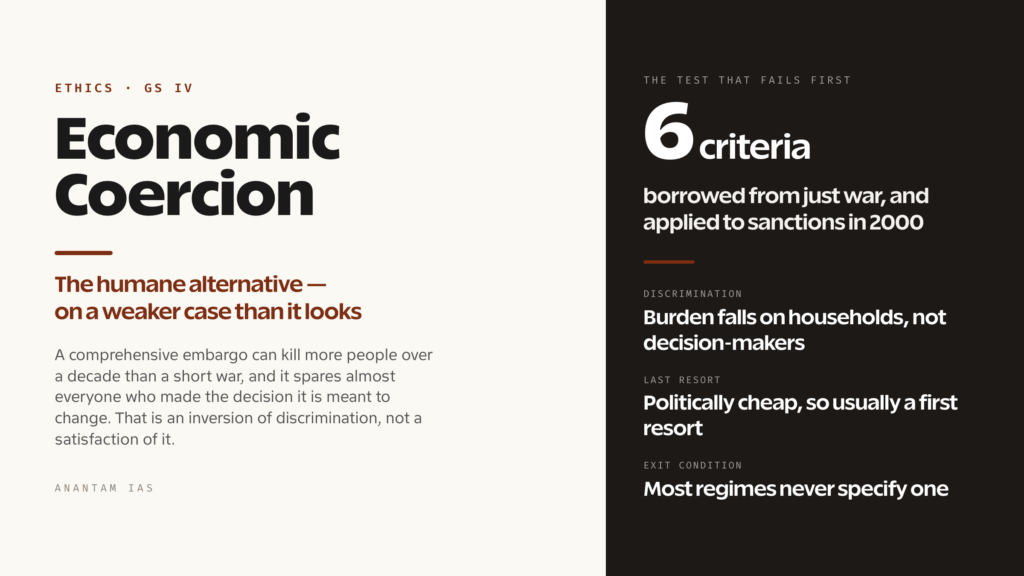
The comfortable position is not earned. A comprehensive embargo can kill more people over a decade than a short war, and it kills them in a way that spares almost everyone who made the decision it is meant to change. That is not a reason to abandon economic instruments; the alternatives include doing nothing while aggression proceeds, which has victims of its own. It is a reason to hold coercive economic measures to the same standard of justification as any other coercion, and to notice how often they fail it.
Coercion Is Coercion
The starting point is definitional and it settles more than it appears to. A sanction is designed to impose costs on a population or an economy so that behaviour changes. That is coercion by deliberate infliction of harm, differing from military force in the means and the tempo rather than in the moral structure. Deprivation spread over years is less visible than an explosion and not obviously less serious.
International law recognises the category. Article 41 of the UN Charter authorises the Security Council to decide on measures not involving the use of armed force, including complete or partial interruption of economic relations — placed deliberately before Article 42, which authorises force. The drafting order encodes the last-resort logic. It also means that Council-mandated sanctions have an authority that unilateral measures do not, and that most sanctions in force today are unilateral.
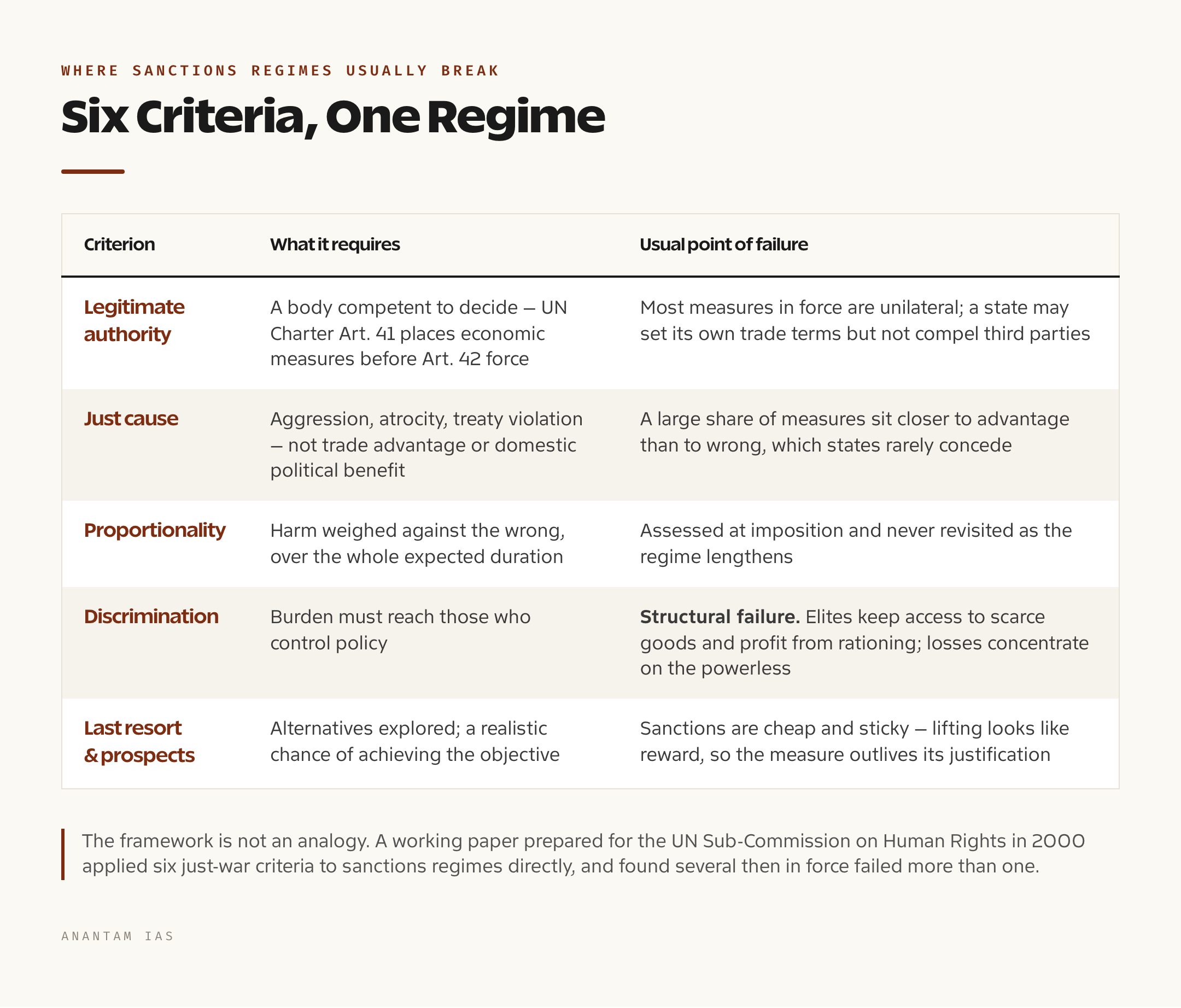
The most careful application of ethical tests to sanctions came in a 2000 working paper prepared for the UN Sub-Commission on Human Rights by Marc Bossuyt, which took six criteria drawn from the just-war tradition and applied them to sanctions regimes directly. It concluded that several regimes then in force failed more than one. That framework — rather than the language of “pressure” and “signals” — is the one to use.
Applying the Tests
Legitimate authority. Council-authorised measures satisfy this. Unilateral measures rest on the argument that a state may set the terms on which it trades, which is true and does not extend to compelling third parties.
Just cause. Aggression, atrocity and treaty violation are the strong cases. Trade advantage, domestic political benefit and punishment for policy disagreement are not, and a large share of measures fall closer to the second group than states admit.
Proportionality. The harm inflicted must be weighed against the wrong addressed. Sanctions harm accumulates over time, so the calculation has to be made against the whole expected duration and not against the first year, and it has to be revisited as the regime lengthens.
Discrimination. This is where comprehensive sanctions fail, and fail structurally rather than accidentally. The intended target is a leadership that controls policy; the burden falls on households that do not. Elites in a sanctioned economy typically retain access to scarce goods and often profit from the smuggling and rationing that scarcity creates, while the losses concentrate on people with the least influence over policy. The principle of non-combatant immunity is not merely unmet; it is inverted.
Last resort. Sanctions are frequently a first resort, chosen because they are politically cheap and visible. They are also sticky: once imposed, lifting them looks like reward, so the measure outlives the assessment that justified it.
Reasonable prospect of success. The scholarly literature on sanctions effectiveness is contested, but no serious study reports a high success rate for comprehensive measures against a determined authoritarian government. A regime with no realistic prospect of achieving its objective is inflicting harm for expressive purposes.
The Shift to Targeted Measures
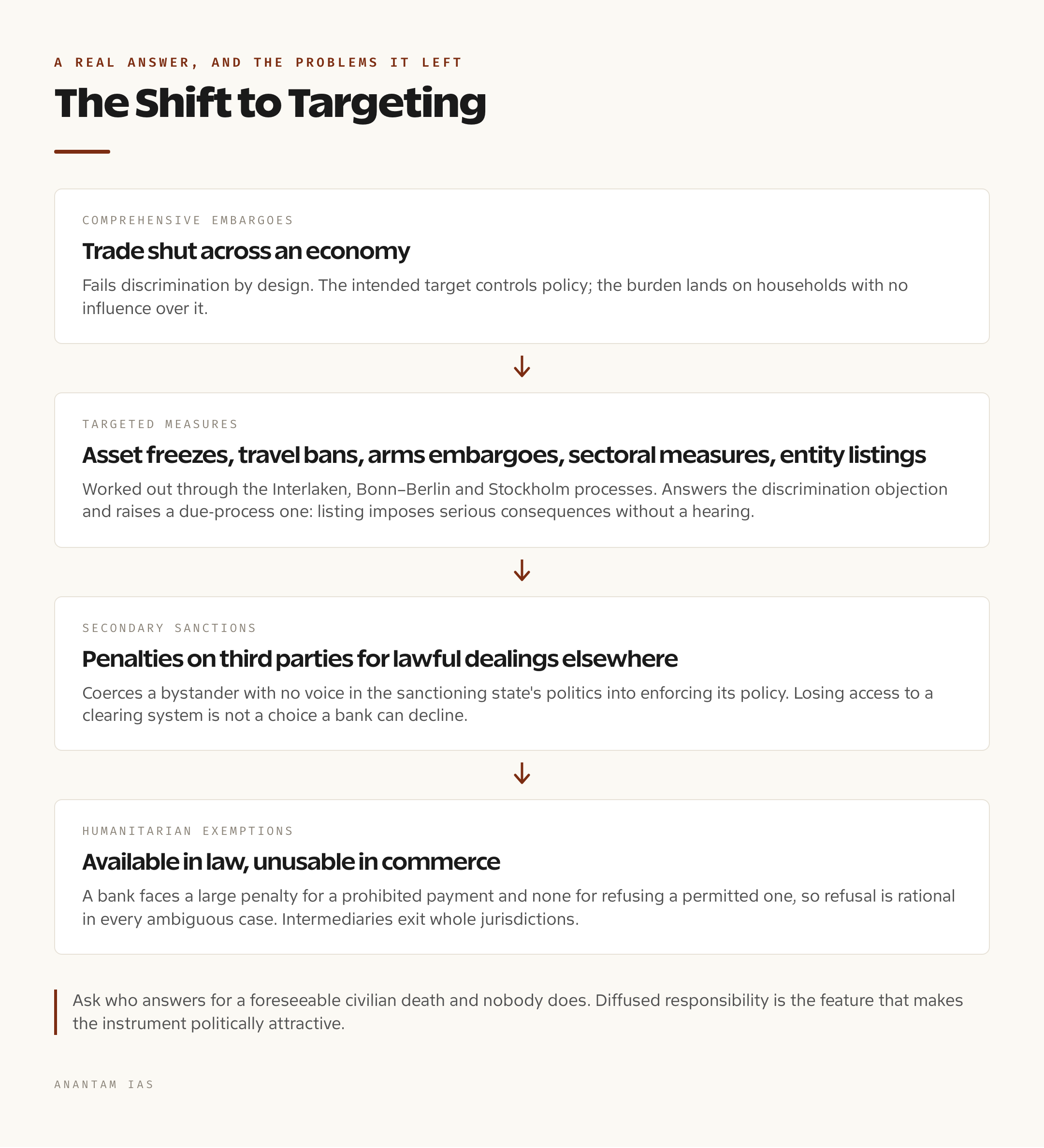
The 1990s produced the strongest case against comprehensive sanctions, and the shift that followed was a genuine ethical response rather than a cosmetic one. Three intergovernmental processes worked out the instruments: the Interlaken process from 1998 on targeted financial sanctions, the Bonn-Berlin process from 1999 on arms embargoes and travel bans, and the Stockholm process from 2002 on implementation and monitoring.
The resulting toolkit tries to move the burden onto decision-makers. Asset freezes on named individuals and entities. Travel bans on officials and their families. Arms embargoes, which restrict the means of repression rather than the means of living. Sectoral measures aimed at revenue streams controlled by the state — energy, minerals, defence procurement. Financial measures restricting sovereign borrowing or access to correspondent banking. Entity listings naming specific firms.
This is a real improvement on the discrimination test and it introduces a new problem in its place: due process. A listing imposes serious consequences on a named person without a hearing, on the basis of intelligence they cannot see. The European Court of Justice confronted this in the Kadi judgment of 2008, holding that fundamental rights protections applied to the implementation of a UN listing. The UN’s answer was an Ombudsperson for the counter-terrorism list, created in 2009, with power to receive delisting petitions. The remedy is thin — no adversarial hearing, no disclosure of the underlying material — and the gap between the consequences and the procedure is unresolved.
Targeted measures also under-deliver. Assets are held through intermediaries; family members and proxies are hard to enumerate; sectoral measures on a state’s main export sector are targeted in name and comprehensive in effect, because that sector employs people.
Secondary Sanctions and Third Parties
A secondary sanction penalises a person or firm in a third country for dealing with a sanctioned entity, even where the transaction has no connection to the sanctioning state beyond the currency used or a piece of software in the payment chain. A bank in Mumbai financing a lawful trade between two other countries can face exclusion from the financial system of a state that is not party to the transaction.
The ethical objection is direct: the third party was not part of the dispute, has no voice in the sanctioning state’s politics, and is being coerced to enforce another state’s foreign policy. Whatever justification exists for coercing a wrongdoer does not transfer to coercing a bystander into becoming an instrument. The claim that the third party is free to choose is formal — for a bank, losing access to a reserve currency’s clearing system is not a choice.
This is the specific mechanism examined at length in weaponised interdependence: a state that sits at a chokepoint in a global network can convert that position into extraterritorial jurisdiction without asserting jurisdiction at all. India’s long-standing position — that it observes Security Council sanctions and does not regard unilateral third-country measures as binding — is a coherent response, and it has a cost, since the compliance decisions are ultimately made by private banks that fear exclusion more than they fear a government’s displeasure.
Why Humanitarian Exemptions Under-Perform
Almost every sanctions regime exempts food, medicine and medical equipment on paper. The exemptions systematically fail in practice, and the reason is worth understanding because it recurs wherever compliance is delegated to private intermediaries.
Over-compliance is rational for the intermediary. A bank faces a large penalty for processing a prohibited payment and no penalty at all for refusing a permitted one. The expected-cost calculation points to refusal in every ambiguous case, so the bank withdraws from the whole jurisdiction rather than assessing individual transactions — the pattern the Financial Stability Board and the World Bank have documented as de-risking. Shipping lines and insurers reason the same way. The exemption is legally available and commercially unusable.
Licensing regimes add friction that consumes the exemption. A medicine consignment needs a payment channel, a shipper, an insurer and a port that will all handle it. Any one of them declining is sufficient to stop the shipment, and each declines for its own reasons.
Spare parts and inputs fall outside the carve-out. A hospital with an exempted scanner and a sanctioned spare part has an ornament. Chlorine for water treatment, refrigeration for vaccines and dual-use laboratory equipment sit in the same category.
The Security Council adopted a cross-cutting humanitarian carve-out for UN sanctions regimes in 2022, an acknowledgement that item-by-item exemptions had not worked. Whether a carve-out changes bank behaviour is a different question from whether it changes the law, and the honest answer is that the evidence is not yet in. Sanctions on food, medicine and vaccines are the boundary case — a measure that operates by denying the means of survival to people who cannot change the policy has stopped being coercion of a government.
The Separate Ethics of Tariffs
Tariffs get merged into the sanctions discussion and should not be. Two different things go by the name.
A tariff as industrial policy is a domestic instrument: protection for an infant industry, a response to dumping, a revenue measure, or a deliberate cost imposed on consumers to build capacity. It is defensible or not on ordinary grounds of distributive justice and efficiency, and it is aimed at the tariff-imposing state’s own economy.
A tariff as coercion is aimed at another state’s conduct and belongs in the sanctions analysis, subject to the same criteria. The distinction matters because the justifications do not transfer. “We must protect our workers” does not justify a measure whose purpose is to force a policy change abroad, and “they must change their behaviour” does not justify a measure whose real purpose is to shelter a domestic producer.
The incidence question is where public argument is weakest. A tariff is a tax, and the question of who bears a tax is empirical rather than rhetorical. The exporting firm bears it only if it cuts prices to preserve market share. Otherwise it is paid by the importing firm and passed to domestic buyers, which means a tariff described as punishing a foreign country is frequently a tax on the imposing country’s own consumers and on manufacturers who use the input. Studies of the major tariff episodes since 2018 have generally found pass-through into domestic prices close to complete. Anyone defending a tariff on ethical grounds has to say who they think pays it.
Producers with no voice bear a share. A tariff or a standards barrier that shuts a category of exports affects smallholders and small manufacturers in poorer economies who had no part in the dispute and no representation in either government. That is a discrimination problem of the same shape as the sanctions one.
The workers-versus-consumers argument is genuinely hard. Protection concentrates its benefit on identifiable workers in an identifiable place and spreads its cost thinly across all consumers, which makes the political economy one-sided and the ethics unclear. The strongest case for protection is not economic efficiency but the claim that a community facing rapid destruction of its livelihood is owed transitional protection while adjustment happens. The weakest use of that case is a permanent tariff with no adjustment. The related distributive questions where technology rather than trade displaces work are taken up in the ethics of automation.
Chokepoints and Dual-Use Controls
Weaponised interdependence names the underlying asymmetry: networks built for efficiency — payment messaging, correspondent banking, reserve currencies, cloud infrastructure, chip design tools, standard-essential technology — developed central nodes, and whoever has jurisdiction over a node acquires leverage over everyone who uses it. The ethical asymmetry is that this leverage is unearned in any moral sense. It follows from historical accident and market structure rather than from a state’s better claim to decide, yet it produces something close to legislative power over other jurisdictions.
Two consequences follow for a state that lacks such positions. Its firms carry compliance risk it cannot control, and its foreign policy autonomy is partly held by other states’ regulators. The rational response — building alternative channels, diversifying reserves, developing domestic capability in chokepoint technologies — is expensive and fragments the network for everyone, which is a genuine cost rather than a rhetorical one. The competition for control over mineral and technological chokepoints is set out in geoeconomics and critical minerals.
Export controls on dual-use technology are the sharpest case, because the same equipment serves a hospital and a weapons programme. The multilateral regimes — the Wassenaar Arrangement of 1996, the Nuclear Suppliers Group, the Missile Technology Control Regime and the Australia Group — exist to coordinate this, and India joined the MTCR in 2016, the Wassenaar Arrangement in 2017 and the Australia Group in 2018. The ethical difficulty is that non-proliferation and technology denial are hard to separate in practice: a control justified by security also preserves an incumbent’s advantage, and the state applying it is not a neutral judge of which motive is operating.
Who Answers for the Harm
Ask who is responsible for a foreseeable civilian death caused by a sanctions regime and the answer is that nobody is. The sanctioning state points to the exemption on paper. The bank points to its regulator. The regulator points to the legislature. The target government points to the sanctions, and is often glad to. The affected population has no forum. Compare a military operation, which produces a chain of command, a documented authorisation, an after-action requirement and at least the possibility of a tribunal. Economic coercion produces none of these, and the diffusion is not an accident — it is the feature that makes the instrument politically attractive. The general structure of answerability, and how diffusion defeats it, is set out in accountability and responsibility.
For a state caught between regimes the problem is practical. It may face a legal duty to trade under one framework and a penalty for trading under another, with a domestic economy that needs the goods either way. The defensible position is procedural: observe Security Council measures as binding, treat unilateral extraterritorial measures as claims to be assessed rather than law, decide openly rather than through quiet bank-level compliance, and say what the criteria are. The indefensible position is to claim neutrality while allowing private intermediaries to enforce another state’s policy without a decision anyone has to defend.
The Honest Objections
The alternatives are worse, and that is a real argument. Doing nothing in the face of aggression or atrocity is a choice with victims, and the victims are usually the same people the sanctions would harm. Military action is worse on almost every measure. A critique of sanctions that does not say what should be done instead is not an ethical position, it is a preference for clean hands.
The counterfactual is unknowable. The claim that sanctions caused a given amount of suffering has to be separated from the suffering caused by the target government’s own decisions about how to allocate scarcity, and the target has every incentive to attribute all of it to the sanctions. Both attributions are self-serving and the evidence rarely settles it.
Effectiveness research is contested. Estimates of how often sanctions achieve their stated objective vary widely with how “success” and “objective” are coded, and the honest summary is that targeted measures with limited, specific demands do better than comprehensive measures with regime-level demands, and that nobody has a high success rate.
The defensible position, stated plainly. Sanctions are a coercive instrument and require the same justification as any other coercion: a legitimate authority, a serious cause, a proportionality assessment revisited as the measure lengthens, targeting that reaches decision-makers rather than households, exemptions engineered to actually function against the incentives of intermediaries, and a stated exit condition. Most regimes in force lack the last of these, which is the clearest signal that they have stopped being instruments of a policy and become an expression of one.
FAQ
Why do comprehensive sanctions fail the discrimination test? Because the burden falls on households with no influence over policy while the leadership retains access to scarce goods and often profits from the rationing and smuggling that scarcity creates. The principle of non-combatant immunity is not simply unmet; the incidence of harm is inverted.
What are targeted or “smart” sanctions? Measures aimed at decision-makers rather than economies — asset freezes, travel bans, arms embargoes, sectoral and financial measures, and entity listings. They were developed through the Interlaken, Bonn-Berlin and Stockholm processes and answer part of the discrimination objection while raising a due-process one.
What is the ethical problem with secondary sanctions? They coerce a third party who was not part of the dispute and has no voice in the sanctioning state’s politics, using control over a network chokepoint to compel it to enforce another state’s foreign policy. The justification for coercing a wrongdoer does not transfer to conscripting a bystander.
Why do humanitarian exemptions fail in practice? Because compliance is delegated to banks, shippers and insurers who face a large penalty for a prohibited transaction and none for refusing a permitted one. Refusal is rational in every ambiguous case, so intermediaries withdraw from whole jurisdictions rather than assess individual payments.
Who actually bears the cost of a tariff? Empirically, mostly buyers in the importing country — importing firms and their customers — unless the exporter cuts prices to hold market share. Studies of major tariff episodes since 2018 have generally found pass-through into domestic prices close to complete, which makes “punishing a foreign country” a poor description of the mechanism.
What is weaponised interdependence? The conversion of a central position in a global network — payments, currency, cloud, chip design, standards — into coercive leverage over everyone who uses it. The leverage follows from network structure rather than from any better claim to decide, which is the source of the ethical asymmetry between states that hold such positions and those that do not.
Practice Questions
Prelims MCQs
- Article 41 of the UN Charter deals with: (a) The inherent right of self-defence (b) Measures not involving the use of armed force, including interruption of economic relations (c) Regional arrangements for peace and security (d) Non-intervention in matters of domestic jurisdiction — Answer: (b) it precedes Article 42 on the use of force, encoding a last-resort sequence.
- The Interlaken, Bonn-Berlin and Stockholm processes were concerned with: (a) Climate finance for developing economies (b) Designing and implementing targeted sanctions (c) Reform of the WTO dispute settlement system (d) Regulation of dual-use technology exports — Answer: (b) they worked out financial measures, arms embargoes and travel bans, and implementation respectively.
- “Over-compliance” in the sanctions context refers to: (a) A state applying measures stricter than the Security Council mandated (b) Private intermediaries refusing permitted transactions because refusal carries no penalty (c) Duplication of listings across multiple sanctions regimes (d) Extension of measures to family members of listed individuals — Answer: (b) the asymmetry of penalties makes refusal rational in every ambiguous case, which is why humanitarian exemptions under-perform.
- India became a member of the Missile Technology Control Regime in: (a) 2008 (b) 2016 (c) 2017 (d) 2018 — Answer: (b) India joined the MTCR in 2016, the Wassenaar Arrangement in 2017 and the Australia Group in 2018.
- The Kadi judgment of 2008 is significant because it: (a) Upheld the primacy of Security Council listings over regional law (b) Held that fundamental rights protections apply to the implementation of a UN sanctions listing (c) Established the legality of secondary sanctions (d) Created the office of the UN sanctions Ombudsperson — Answer: (b) it brought the due-process problem of listing without a hearing into a judicial forum.
Mains Practice Questions
- “Sanctions differ from military force in means and tempo rather than in moral structure.” Examine this claim using the just-war criteria. (250 words)
- Explain why humanitarian exemptions in sanctions regimes systematically under-perform, and what would have to change for them to work. (150 words)
- Distinguish between a tariff as industrial policy and a tariff as coercion, and explain why the justifications for one do not transfer to the other. (150 words)
- “The leverage that comes from sitting at a network chokepoint is unearned in any moral sense.” Discuss the ethical asymmetry this creates between states, and the costs of the available responses. (250 words)
- A country must trade with parties to a conflict while facing conflicting sanctions regimes. Set out a defensible framework for deciding, and identify what makes a claim of neutrality dishonest. (250 words)
Tell Google you want more of this.
Add Anantam IAS as a preferred sourceOne tap, and this site shows up more often in your own Top Stories, AI Overviews and AI Mode. Remove it any time.