Cloud computing solved a problem of scale. It let any business push storage and compute to remote data centres and pay only for what it used. But the cloud sits hundreds or thousands of kilometres away from where data is generated, and the round-trip latency that this creates has become a hard ceiling on a growing class of applications. A self-driving car cannot wait 200 milliseconds for a remote data centre to decide whether to brake. A factory floor cannot stream every vibration reading to the cloud. A hospital monitor cannot ship a patient’s ECG to a public cloud and wait for an alert.
Fog computing is the architectural answer to that ceiling. It places a layer of compute, storage, and networking close to the source of data, between the end-device and the cloud. The fog layer handles latency-sensitive work locally and forwards only filtered or aggregated data upstream. For UPSC GS-III, fog computing connects to questions on emerging technology, cyber security, smart-city design, and the data infrastructure that supports 5G networks and the India Stack DPI architecture.
This explainer walks through the definition, the three-tier architecture, the differences between fog and the closely related edge model, fog node design, applications, security implications, and the standards landscape that has shaped the technology.
What Fog Computing Is
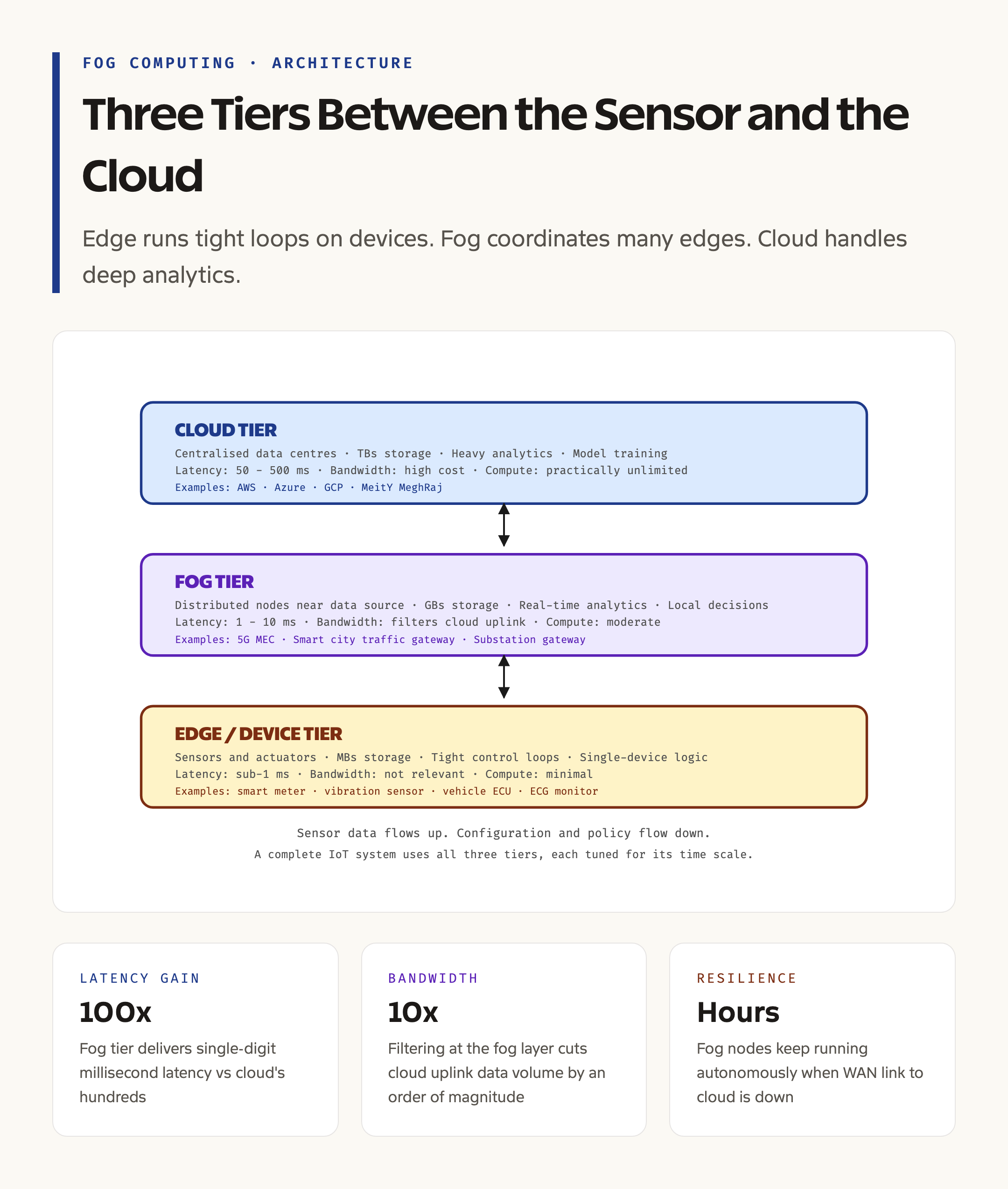
Fog computing is a decentralised computing architecture in which storage, compute, and networking resources are placed close to the data source rather than in distant cloud data centres. The term was coined by Cisco around 2012 to describe the layer of intelligence that sits between cloud and edge devices.
The metaphor is geographical. Cloud sits high and far. Fog sits low and close, distributed near the ground where data is generated. A fog node may be a router, a gateway, a small server in a base station cabinet, a controller in a factory, or a roadside unit on a highway. What unites them is that they offer compute and storage resources at the network edge.
The OpenFog Consortium, formed in 2015 by Cisco, Microsoft, Intel, Dell, ARM, and Princeton University, set out a reference architecture for fog computing. The consortium merged with the Industrial Internet Consortium in 2019, and IEEE published the OpenFog Reference Architecture as IEEE 1934 in 2018. The standardisation gave fog a clear technical definition and a common vocabulary.
The Three-Tier Architecture
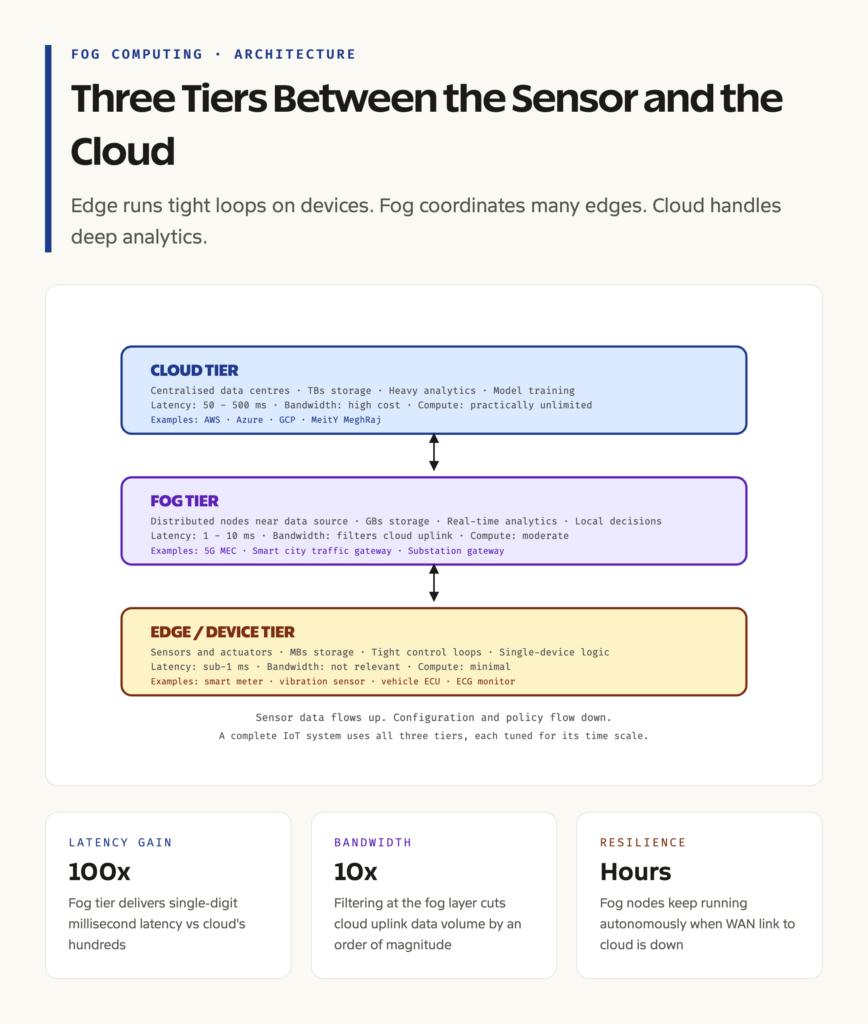
A fog system has three distinct tiers, each with a defined role.
The device tier is the source of data. Sensors, actuators, machines, vehicles, smartphones, and any IoT endpoint sit here. The tier produces data at a high rate but holds little local intelligence. In an industrial setting, this tier may include vibration sensors, temperature probes, RFID tags, and machine controllers.
The fog tier is the middle layer. Fog nodes process data from many devices in their vicinity. A fog node typically runs general-purpose compute, has tens of gigabytes of local storage, and is networked both to the devices below and to the cloud above. A fog node performs filtering, aggregation, real-time analytics, and decision-making. Latencies between device and fog node are in the single-digit milliseconds.
The cloud tier is the top layer. The cloud receives only filtered, aggregated, or alarm data from the fog tier. It runs heavy analytics, long-term storage, model training, and cross-site coordination. Latencies between fog and cloud are in the tens to hundreds of milliseconds, depending on geography.
The three tiers move data and decisions in two directions. Sensor data flows up through fog towards cloud. Configuration, model updates, and policy decisions flow down through fog to devices. The tiered architecture also lets the system survive a disconnected cloud, because the fog tier can continue operating autonomously for hours or days if the wide-area link fails.
Fog vs Cloud vs Edge
Fog and edge are often used interchangeably in the popular press. The technical literature distinguishes them.
Cloud computing centralises everything. All data and all logic sit in remote data centres. The strengths are cost efficiency, near-infinite storage, deep analytics, and centralised model training. The weaknesses are round-trip latency that can run into hundreds of milliseconds, dependence on a working wide-area network, bandwidth costs that grow with data volume, and privacy issues when raw sensor data leaves the local site.
Edge computing pushes processing to the device itself or to a single device just behind it. Edge nodes are tightly coupled to the sensor or actuator and do not coordinate across many devices. An edge controller in a wind turbine, a smart meter with built-in anomaly detection, or a smartphone that does on-device inference are all edge nodes. The strengths are sub-millisecond latency and full data sovereignty. The weakness is limited compute, limited storage, and no cross-device intelligence.
Fog computing is the layer between cloud and edge. A fog node coordinates many edges, holds more compute than any single edge node, and offers a vantage point from which cross-device decisions can be taken. A traffic controller that aggregates signals from a hundred intersections, a factory gateway that coordinates a fleet of robotic arms, or a 5G base station that runs application logic for thousands of devices in its cell are fog nodes.
The three tiers are complementary, not competing. A complete IoT system uses edge for tight loops, fog for wide-area coordination, and cloud for heavy analytics and long-term storage. We cover the device tier in our edge computing explainer and the cloud tier in standard cloud architecture references.
Inside a Fog Node
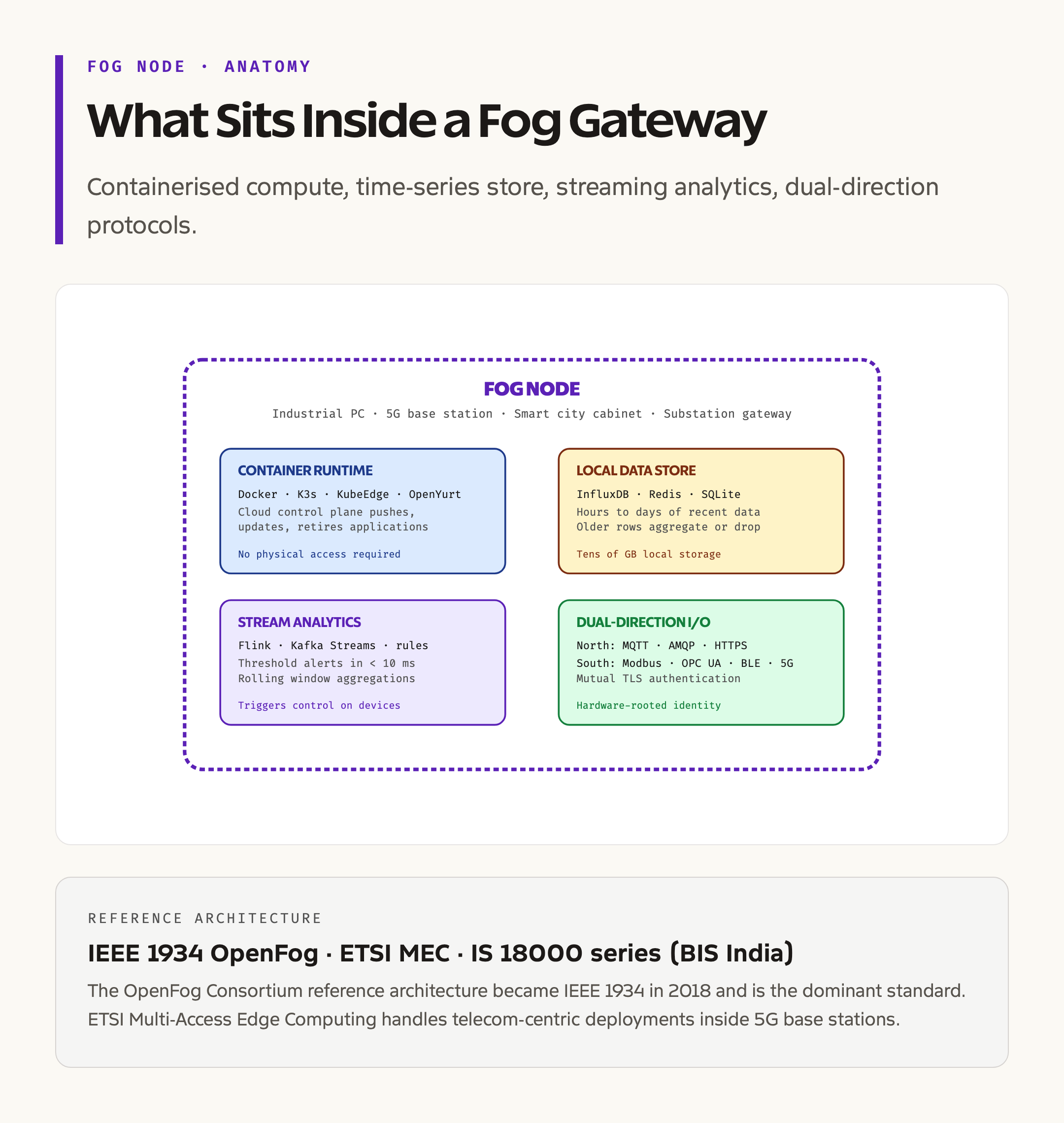
A fog node is a software-defined compute resource sitting in the middle tier. The hardware varies. A roadside cabinet on a highway holds an industrial PC. A 5G base station holds a multi-access edge compute server. A smart-city control box holds a small cluster. What is common is the software stack.
The fog operating system handles local resource management. Containerisation through Docker and Kubernetes-edge variants like K3s, KubeEdge, and OpenYurt is now the standard for deploying applications to fog nodes. Container orchestration lets the cloud control plane push, update, and retire applications without physical access.
Local data store handles short-term storage of incoming sensor data. The store may be a time-series database like InfluxDB, a key-value store like Redis, or a small SQL database. The fog node only needs enough storage to hold a few hours to a few days of recent data. Anything older is either discarded or aggregated and pushed to the cloud.
Real-time analytics engines run streaming queries on incoming data. Apache Flink, Apache Kafka Streams, and lightweight rule engines are common. The engine fires alerts when readings cross thresholds, computes aggregations like average, max, and standard deviation in rolling windows, and triggers control actions on devices below.
Communication interfaces handle two directions of traffic. Northbound to the cloud over MQTT, AMQP, HTTPS, or proprietary protocols. Southbound to devices over Modbus, OPC UA, BLE, Zigbee, LoRa, or 5G. A typical fog node holds a dozen or more protocol drivers because the IoT estate is heterogeneous.
Security and identity are core. Mutual TLS authentication between fog and cloud, secure boot of the fog node, hardware-rooted device identities for the connected devices, and signed firmware updates are baseline requirements.
Applications That Need Fog
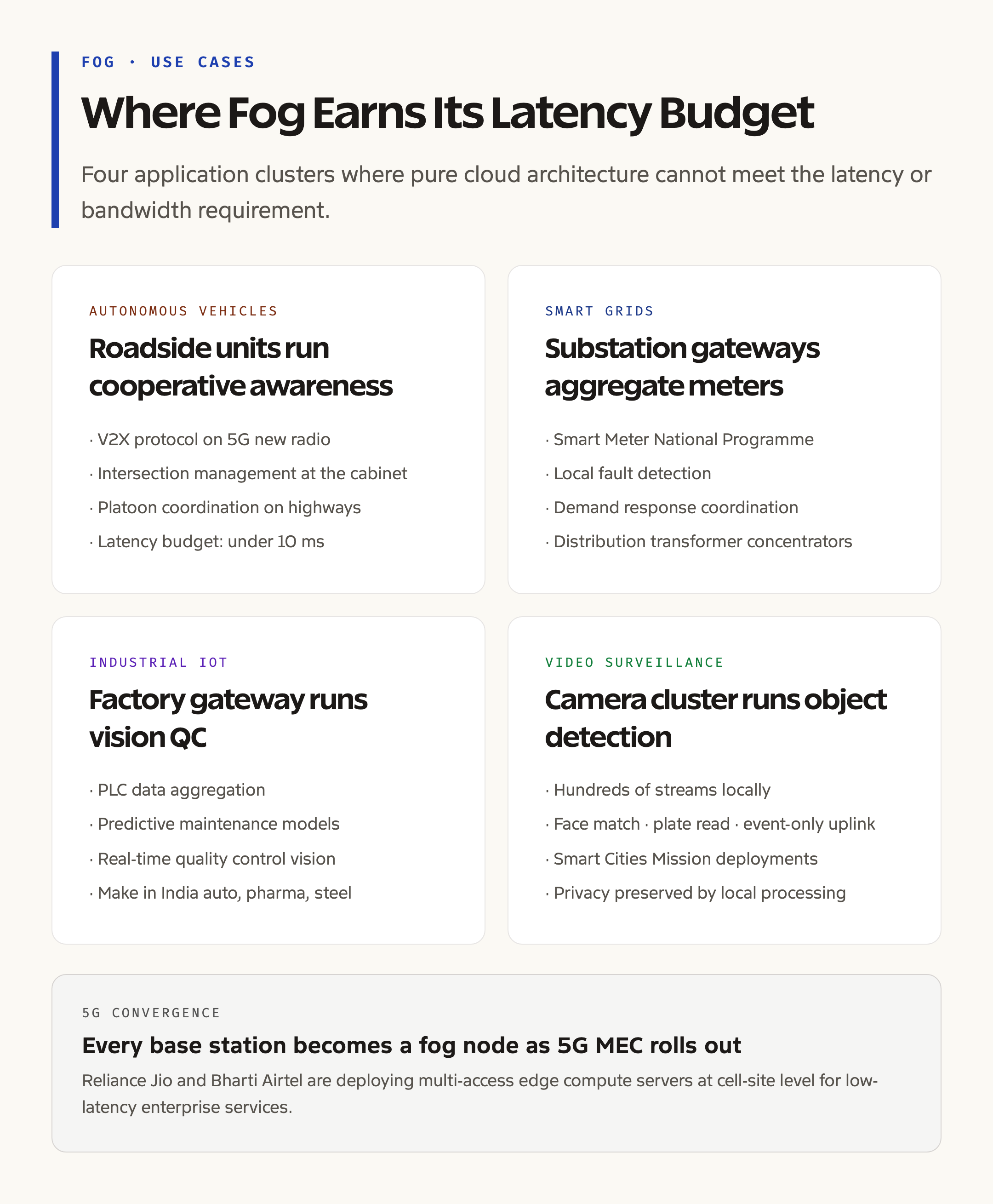
Several application classes need the latency, bandwidth, or autonomy that fog provides.
Smart traffic management is one of the most cited use cases. A traffic controller in a city corridor reads from a hundred intersections and a thousand vehicles. Fog nodes at the intersection level run signal optimisation that responds to actual traffic, while the city-wide cloud handles long-term planning. Bengaluru, Pune, and Hyderabad have piloted fog-based adaptive traffic systems under the Smart Cities Mission.
Autonomous vehicles depend on fog at multiple scales. The vehicle itself runs edge compute for second-by-second control. Roadside units, base station servers, and corridor controllers run fog compute for cooperative awareness, intersection management, and platoon coordination. The 5G new radio standard explicitly defines vehicle-to-everything communication that anchors on fog-class compute at the network edge.
Smart grids use fog at the substation level. A substation gateway aggregates readings from hundreds of smart meters and feeders, performs local fault detection, and coordinates demand response with the utility cloud. India’s Smart Meter National Programme rollout uses fog-style data concentrators at the distribution transformer level.
Healthcare monitoring uses fog in hospitals and at home. A bedside gateway processes patient telemetry, triggers ICU alerts within milliseconds, and forwards summaries to the hospital cloud. Home health gateways do similar work for chronic disease monitoring.
Industrial IoT is perhaps the largest commercial use case. Factory floors deploy fog nodes that read from PLCs, run quality-control vision models, perform predictive-maintenance analytics, and coordinate with manufacturing execution systems in the cloud. The Make in India push and the National Manufacturing Policy have made industrial fog deployments common in automotive, pharma, and steel sectors.
Video surveillance analytics is the bandwidth-driven case. Streaming hundreds of high-resolution video feeds to a remote cloud is impractical and expensive. Fog nodes at the camera cluster level run object detection, face matching, and licence-plate recognition locally, and forward only events to the cloud.
Security and Privacy in Fog
Fog computing changes the security model. Pushing compute and data to many distributed nodes increases the attack surface and creates new threat vectors that pure cloud architectures do not face.
Physical security of fog nodes is a hard problem. A traffic-cabinet fog node sits in a public location and can be physically accessed. Tamper-resistant hardware, secure boot, and hardware-rooted identity are baseline countermeasures. The recent shift towards trusted platform modules and ARM TrustZone in industrial fog hardware reflects this concern.
Network security between tiers needs end-to-end encryption, mutual authentication, and certificate management at scale. A typical fog deployment may have thousands of fog nodes, each holding short-lived certificates. The certificate authority infrastructure that supports this is non-trivial.
Data privacy benefits from fog. Sensitive data can be processed locally and never leave the site. Health monitoring, video surveillance, and industrial process data can be filtered or anonymised at the fog tier before any transmission to the cloud. This aligns with India’s Digital Personal Data Protection Act 2023 framework, which favours local processing and minimised central data flow. We cover this and related concerns in our cyber security explainer.
Distributed denial of service is a different shape in fog. The many distributed nodes can be enrolled into botnets if not properly secured. The 2016 Mirai attack on IoT devices demonstrated the scale that compromised distributed nodes can produce.
Standards and the Indian Landscape
The IEEE 1934 OpenFog Reference Architecture is the dominant standard. ETSI Multi-Access Edge Computing standards are the major counterpart for telecom-centric fog deployments, particularly inside 5G base stations.
In India, the Telecommunication Engineering Centre under DoT has published standards for IoT and fog deployments. The Bureau of Indian Standards has issued the IS 18000 series on IoT reference architecture. The C-DAC fog-computing testbed and the Indian Institute of Science fog-research effort are the major academic and applied-research nodes.
Commercial fog platforms in India include offerings from TCS, Infosys, Wipro, and L&T Smart World. These integrate with international fog stacks like Cisco IOx, Microsoft Azure IoT Edge, and AWS Greengrass.
The 5G rollout in India is a significant catalyst. 5G new radio explicitly supports multi-access edge compute at the base station, which is fog computing in everything but name. Reliance Jio and Bharti Airtel are deploying MEC servers at the cell-site level for low-latency enterprise services.
What to Watch
Three trends will shape fog computing through 2030.
The first is the convergence of fog and 5G MEC. As 5G coverage expands, every base station becomes a potential fog node. The fog tier will increasingly live inside the telecom network rather than on customer premises.
The second is the AI shift. Large language models and computer-vision models are now run on fog hardware for low-latency inference. Inference at the fog tier rather than the cloud is reducing costs and round-trip times for AI applications. The Bharat AI Mission and the IndiaAI Mission make explicit reference to distributed compute infrastructure that overlaps with fog.
The third is the policy push for data localisation. The Digital Personal Data Protection Act 2023 and sector-specific localisation rules in finance, telecom, and healthcare create regulatory demand for fog-style local processing. Compliance designs will increasingly look like fog architectures by default.
For UPSC, the right way to remember fog is as the layer that solved cloud computing’s latency problem without giving up its scale. The architecture connects to almost every emerging technology question on the syllabus, from autonomous vehicles to smart grids to digital health.
Frequently Asked Questions
What is fog computing in simple terms?
Fog computing is a decentralised computing architecture that places storage, compute, and networking resources close to the data source, between the end-device and the cloud. A fog node aggregates data from many nearby devices, runs real-time analytics locally, and forwards only filtered or aggregated information to the cloud. The goal is to reduce latency, save bandwidth, and improve resilience compared to a pure cloud setup.
What is the difference between fog and edge computing?
Edge computing pushes processing to the device itself or to a single controller right behind it. Fog computing sits between edge and cloud and coordinates many edges. An edge controller acts on data from one device; a fog node aggregates data from many devices and runs cross-device logic. The two complement each other and are typically deployed together in a complete IoT system.
Why is fog computing important for 5G and IoT?
5G networks promise sub-10 millisecond latencies that pure cloud architectures cannot deliver because of the wide-area round trip. Fog computing places compute at the base station and the network edge, where 5G’s low latency can be exercised by application logic. For IoT, fog is the only architecture that scales when device counts run into the millions, because raw sensor data cannot be streamed to a remote cloud at that scale.
Who coined the term fog computing?
Cisco coined the term around 2012 and developed the early reference architecture. The OpenFog Consortium, formed in 2015 by Cisco, Microsoft, Intel, Dell, ARM, and Princeton University, set out a formal reference architecture that became IEEE 1934 in 2018. The OpenFog Consortium merged with the Industrial Internet Consortium in 2019.
What are the security risks of fog computing?
Fog increases the physical attack surface because nodes sit in distributed locations rather than in secure data centres. The certificate management, secure boot, and tamper-resistant hardware needs are larger than in cloud-only architectures. Distributed denial of service through compromised fog nodes is a real threat, as the 2016 Mirai botnet demonstrated. Strong identity management, encrypted communication, and signed firmware are baseline countermeasures.
Where is fog computing used in India?
India deploys fog computing in smart-city traffic systems under the Smart Cities Mission, in smart-grid data concentrators under the Smart Meter National Programme, in industrial IoT deployments across automotive, pharma, and steel sectors, in 5G multi-access edge compute servers being rolled out by Reliance Jio and Bharti Airtel, and in healthcare monitoring at major hospitals. The C-DAC fog testbed and the Indian Institute of Science fog research are the major applied-research nodes.
Tell Google you want more of this.
Add Anantam IAS as a preferred sourceOne tap, and this site shows up more often in your own Top Stories, AI Overviews and AI Mode. Remove it any time.