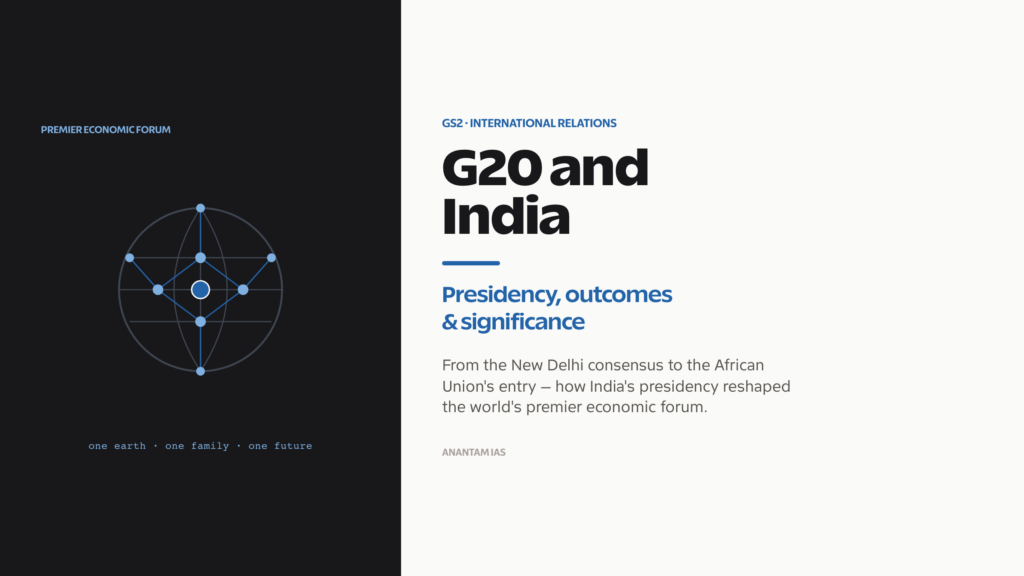
G20 and India: Presidency, Outcomes and Significance
The G20 (Group of Twenty) is the premier forum for international economic cooperation — bringing together the world’s largest economies to coordinate policy on trade, finance, climate, and global governance. India held the G20 Presidency in 2022-23, hosting the New Delhi Summit in September 2023.
India’s G20 presidency was more than a hosting exercise. It delivered substantive outcomes, reshaped perceptions of India’s global leadership, and permanently changed the G20’s composition by bringing in the African Union.
What is the G20?
The G20 was formed in 1999 as a forum for Finance Ministers and Central Bank Governors of major economies following the Asian financial crisis. It was elevated to Leaders’ Summit level in 2008 — at the initiative of US President George W. Bush — in response to the global financial crisis.
| Particulars | Details |
|---|---|
| Full name | Group of Twenty |
| Formed | September 1999 (Finance Ministers); Summit level since 2008 |
| Members | 21 (20 countries + EU); now 22 with African Union |
| Population represented | ~80% of world population |
| GDP represented | ~85% of world GDP |
| Trade represented | ~75% of global trade |
| Presidency | Rotates annually |
| Secretariat | No permanent secretariat (rotating host country manages) |
Unlike the UN, the G20 has no permanent secretariat and no treaty-based legal status. It works through consensus — decisions are made by agreement, not voting. This makes it agile but also limits its binding power.
G20 vs G7: The Key Distinction
The G7 (Group of Seven) is the older club of wealthy democratic economies — USA, UK, France, Germany, Italy, Japan, Canada, plus the EU. It has a combined GDP of about $44 trillion (nominal) but represents only about 10% of the world’s population.
| Metric | G20 | G7 |
|---|---|---|
| Members | 21+1 (with AU) | 7+EU |
| Share of world GDP (nominal) | ~85% | ~44% |
| Share of world population | ~80% | ~10% |
| Includes developing nations | Yes | No |
| Includes China, India, Brazil | Yes | No |
| Binding decisions | No | No |
| Focus | Global economic governance | Democratic values + economy |
The G7 was the dominant forum before 2008. But a world where China, India, and Brazil aren’t at the table is not representative. The G20 filled that gap — though the G7 still meets separately and retains influence.
G20 Members
| Country/Entity | Classification |
|---|---|
| United States | Advanced economy |
| European Union | Regional bloc |
| China | Emerging economy |
| Japan | Advanced economy |
| Germany | Advanced economy |
| India | Emerging economy |
| United Kingdom | Advanced economy |
| France | Advanced economy |
| Italy | Advanced economy |
| Canada | Advanced economy |
| South Korea | Advanced economy |
| Australia | Advanced economy |
| Brazil | Emerging economy |
| Russia | Emerging economy |
| South Africa | Emerging economy |
| Mexico | Emerging economy |
| Argentina | Emerging economy |
| Saudi Arabia | Oil-producing economy |
| Indonesia | Emerging economy |
| Turkey | Emerging economy |
| African Union | Regional bloc (joined 2023) |
India’s G20 Presidency 2022-23
India assumed the G20 Presidency on 1 December 2022 — taking over from Indonesia (which had hosted the Bali Summit in November 2022). India’s presidency ran through the New Delhi Summit on 9-10 September 2023, when the presidency passed to Brazil.
India’s G20 Theme
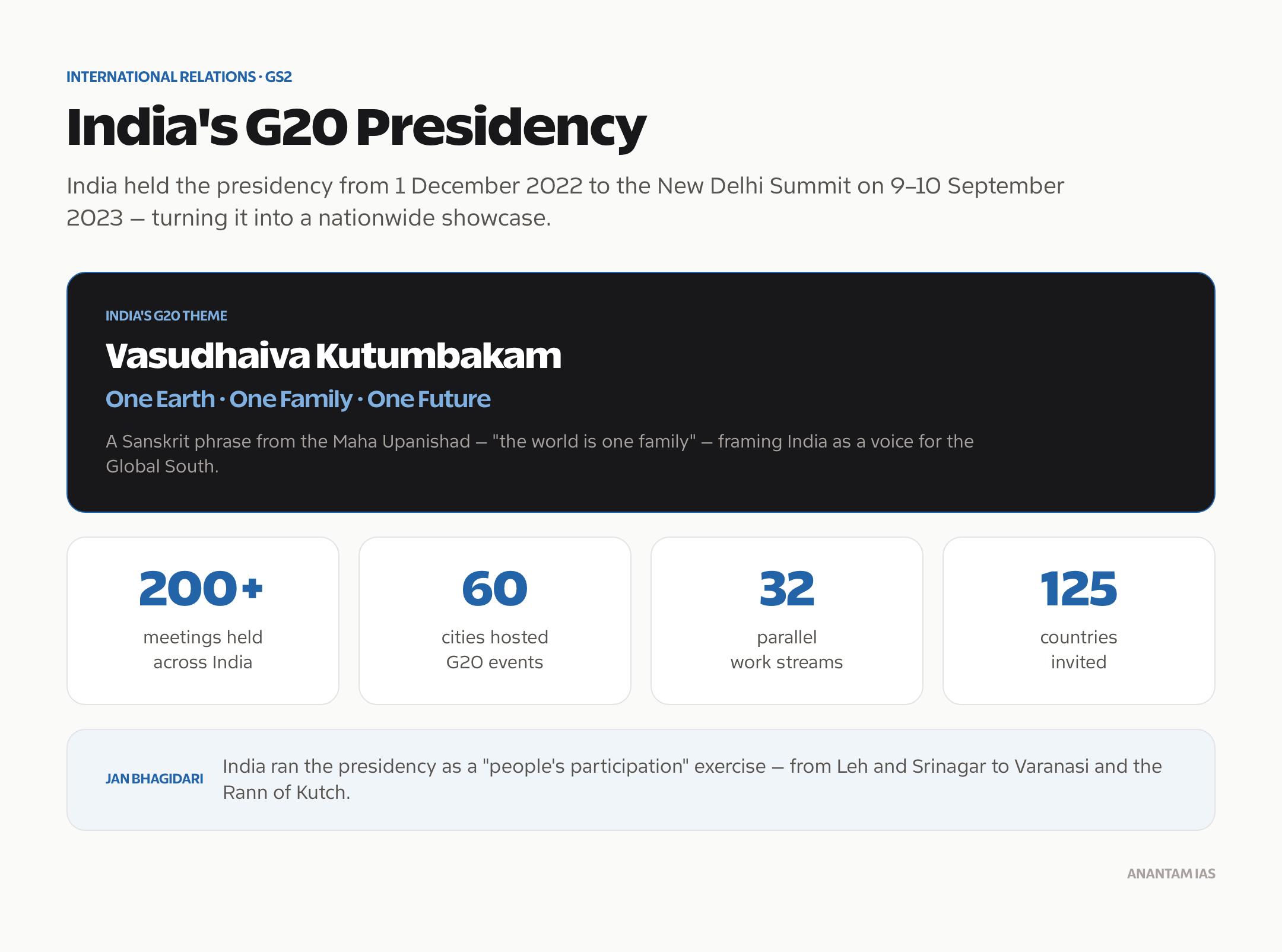
India’s theme was: “Vasudhaiva Kutumbakam — One Earth, One Family, One Future”
This Sanskrit phrase from the Maha Upanishad — “the world is one family” — was India’s thematic framing: the idea that global challenges require global solidarity, and that India speaks for the Global South (developing nations), not just its own interests.
The lotus — India’s national flower — was the official G20 logo under India’s presidency.
Scale of India’s Presidency
India turned its G20 presidency into a national exercise in soft power and decentralised showcase:
- 200+ meetings held across India (not just Delhi)
- 60 cities hosted G20 events — from Leh and Srinagar to Varanasi and Rann of Kutch
- 32 different work streams ran in parallel
- 125 countries invited (including non-G20 countries as guests)
- India promoted the presidency as a “Jan Bhagidari” (people’s participation) exercise
This was deliberate: show the world India’s diversity, modernisation, and governance capacity across geographies.
Key Outcomes of the New Delhi G20 Summit
1. Consensus New Delhi Declaration
The summit produced a consensus New Delhi Declaration — all 21 members agreed on a joint statement. This was far from guaranteed given US-Russia-China tensions over Ukraine.
Previous G20 summits (Bali 2022, Rome 2021) had struggled to produce consensus language on Ukraine. India’s diplomatic achievement was crafting language on the Ukraine conflict that both the West and Russia/China could accept — acknowledging “different views” on the conflict rather than explicitly condemning Russia.
This required delicate behind-the-scenes negotiations — reportedly involving National Security Advisor Ajit Doval’s backchannel work.
2. African Union as Full Member
The African Union (AU) joined the G20 as a permanent member — announced dramatically by PM Modi as the summit opened, with AU Commission Chairperson Moussa Faki Mahamat seated at the table.
The African Union represents 55 African nations and 1.4 billion people. Its inclusion was India’s most lasting structural achievement at the G20.
This was significant for several reasons:
- Africa had been the only inhabited continent without G20 representation (EU represents Europe, but Africa had no bloc representation)
- It aligned with India’s “Voice of the Global South” positioning
- It was a diplomatic win for India’s relationship with the African continent
3. India-Middle East-Europe Corridor (IMEC)
One of the summit’s biggest surprise announcements was the India-Middle East-Europe Economic Corridor (IMEC) — a planned infrastructure corridor connecting India, UAE, Saudi Arabia, Jordan, Israel, and Europe via rail and shipping links.
IMEC was framed as an alternative connectivity vision to China’s Belt and Road Initiative — with the US, India, and Gulf states as backers. It would potentially reduce transit time for goods from India to Europe from 30+ days (via Suez) to around 18 days.
But IMEC’s viability was immediately complicated by the Israel-Gaza war (October 2023), which disrupted the Saudi Arabia-Israel normalisation that underpinned the corridor.
4. Global Biofuels Alliance
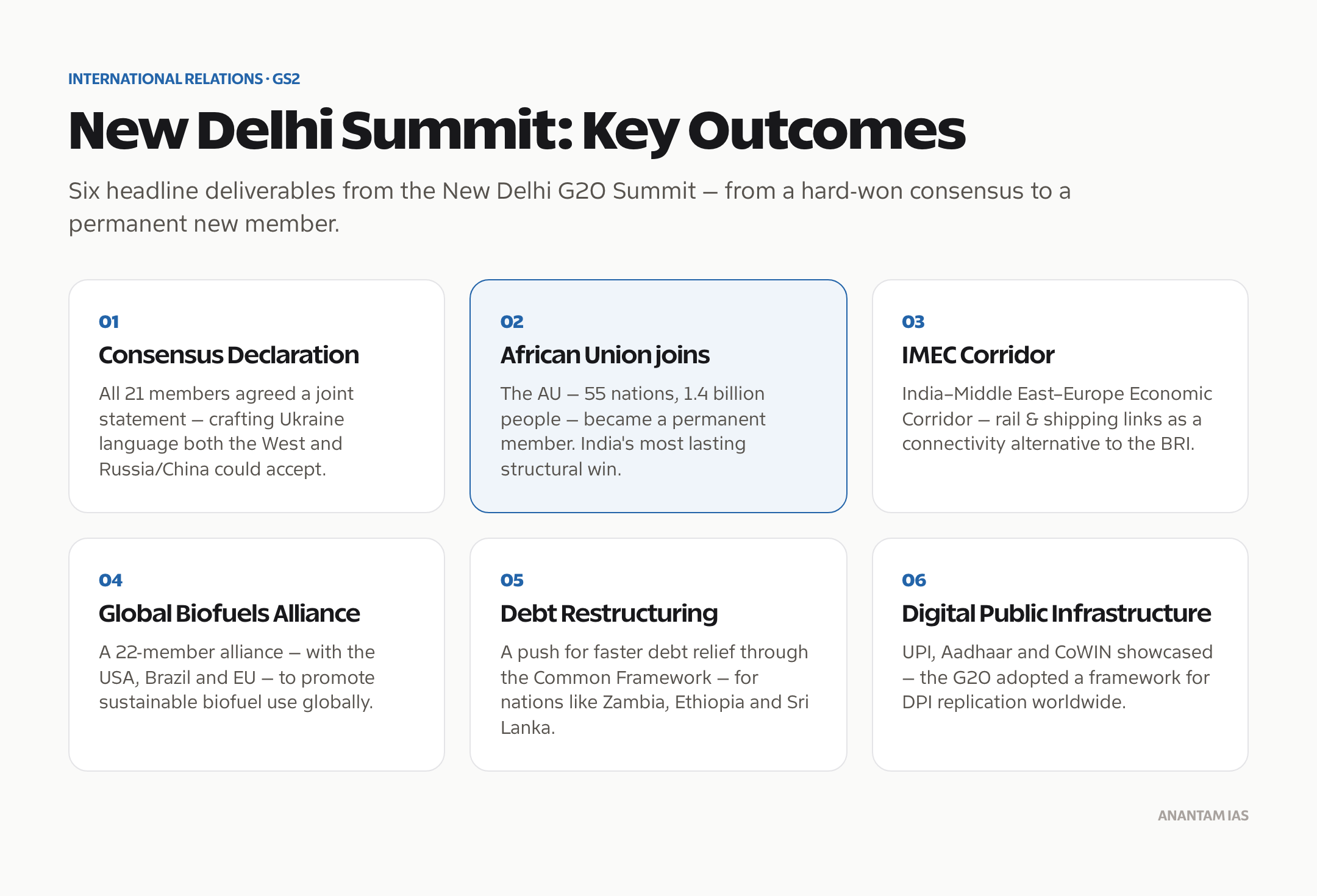
India launched the Global Biofuels Alliance at the G20 — a 22-member alliance (including USA, Brazil, and the EU) to promote sustainable biofuel use globally. India’s ethanol blending programme (20% blending target by 2025) is a domestic success story India wanted to globalise.
5. Debt Restructuring for Developing Nations
The G20 under India’s presidency pushed for faster debt restructuring for developing countries through the Common Framework for Debt Treatment — addressing countries like Zambia, Ethiopia, and Sri Lanka stuck in debt distress. Progress was partial but meaningful.
6. Digital Public Infrastructure (DPI)
India showcased its Digital Public Infrastructure — UPI, Aadhaar, CoWIN — as a model for developing nations. The G20 adopted a framework for DPI replication globally, essentially internationalising India’s digital governance innovations.
G20 Work Streams: Sherpa and Finance Tracks
The G20 operates through two parallel tracks:
Finance Track: Finance ministers and central bank governors work on economic, monetary, and financial issues — trade, debt, inflation, financial regulation. India’s Finance Minister Nirmala Sitharaman led this track.
Sherpa Track: Personal representatives of heads of state (Sherpas) negotiate political and broader economic issues — development, climate, health, anti-corruption. India’s Sherpa was Amitabh Kant.
Under each track are Working Groups on specific issues — Climate Finance, Infrastructure, Agriculture, Energy Transition, Digital Economy, etc.
India’s G20 Legacy
India used the G20 presidency to position itself as:
- Voice of the Global South: India convened the “Voice of the Global South” summits (January and November 2023) — virtual summits of developing countries — to bring their agenda into the G20.
- Mediator between blocs: India’s ability to get US-Russia-China consensus on the declaration demonstrated diplomatic maturity.
- Showcase of capabilities: Hosting 200 meetings across 60 cities demonstrated India’s administrative and logistical scale.
- Technology leadership: DPI, biofuels, and clean energy transitions placed India as a tech-governance leader.
After India, Brazil (2024) and South Africa (2025) hold the G20 presidency — a remarkable run of BRICS members chairing the world’s premier economic forum.
United Nations: Structure, Agencies and India’s Role
BRICS Full Form: Brazil Russia India China South Africa
Frequently Asked Questions
What is the G20?
The G20 (Group of Twenty) is the premier international forum for economic cooperation among the world’s largest economies. It represents about 85% of global GDP and 80% of world population. It was formed in 1999 and elevated to Leaders’ Summit level in 2008.
What was India’s G20 theme in 2023?
India’s G20 theme was u0022Vasudhaiva Kutumbakam — One Earth, One Family, One Future.u0022 This Sanskrit phrase from the Maha Upanishad reflects the idea of global solidarity and positions India as a voice for the global community, including the developing world.
What was the most significant outcome of India’s G20 presidency?
India’s most lasting structural achievement was the inclusion of the
African Union as a full G20 member — announced at the New Delhi Summit in September 2023. The African Union represents 55 African nations and 1.4 billion people.nnWhat is the difference between G20 and G7?
The G7 is the older club of seven wealthy democratic economies (USA, UK, France, Germany, Italy, Japan, Canada). The G20 includes all G7 members plus major emerging economies like China, India, Brazil, and others — making it more representative of today’s global economy.
What is IMEC?
IMEC (India-Middle East-Europe Economic Corridor) was announced at the New Delhi G20 Summit as a planned infrastructure corridor connecting India to Europe via the UAE, Saudi Arabia, Jordan, and Israel. It was framed as an alternative to China’s BRI, but its progress was disrupted by the Israel-Gaza conflict.
Tell Google you want more of this.
Add Anantam IAS as a preferred sourceOne tap, and this site shows up more often in your own Top Stories, AI Overviews and AI Mode. Remove it any time.