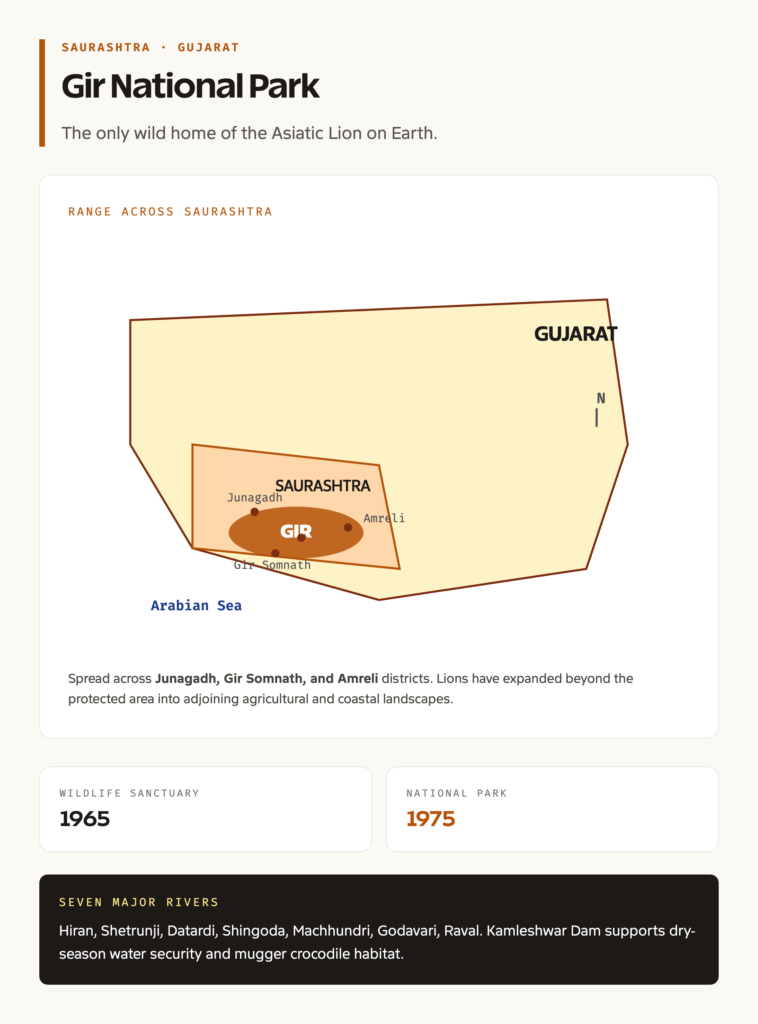
The Asiatic Lion was once distributed across a vast belt from Greece and Turkey through Mesopotamia, Persia, and northwestern India. By the start of the twentieth century, hunting and habitat loss had wiped the lion out of every part of this historical range except a small dry forest pocket in Saurashtra. Today, Gir National Park and its surrounding sanctuary network in Gujarat are the only place on Earth where the Asiatic Lion lives in the wild. The conservation of this single isolated population is one of the most consequential single-species recovery stories in the modern history of biodiversity in India.
What makes Gir distinctive is the tight integration of forest, lion, and the Maldhari pastoralist community. Unlike many flagship parks where human use is excluded from the core, Gir has long contained pastoral nesses where Maldhari families graze livestock. Lions, leopards, and Maldharis share the same landscape in a low-conflict equilibrium that is rare globally. The model has its critics and its defenders, and the debate over whether to translocate a portion of the lion population to a second site has been one of the most prominent wildlife-policy debates of the past three decades.
For UPSC, Gir is a high-frequency topic that touches on environment, wildlife protection law, federalism, indigenous community rights, and species translocation policy. This guide walks through the park’s geography, species, history, and the policy debates that surround its single greatest asset.
Quick Facts
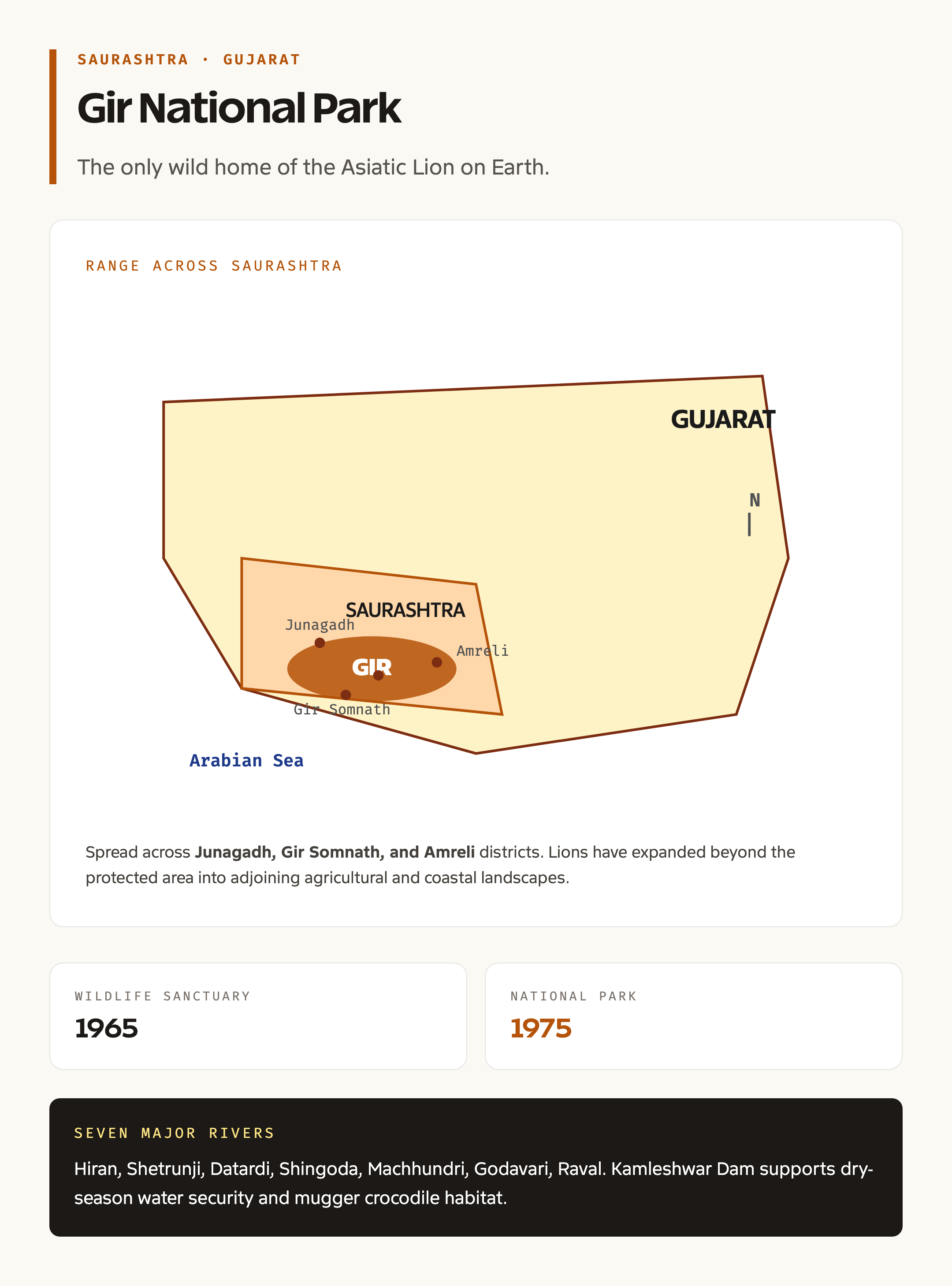
- Location: Junagadh, Gir Somnath, and Amreli districts, Gujarat (Saurashtra peninsula)
- Established as Wildlife Sanctuary: 1965
- Declared National Park: 1975
- Origin of name: Gir Hills of the Girnar range
- Area: Approximately 1,400 square kilometres in the broader Gir Protected Area, with a smaller core National Park
- Key species: Asiatic Lion, Indian Leopard, Chowsingha (Four-Horned Antelope), Mugger Crocodile, Sambar, Spotted Deer
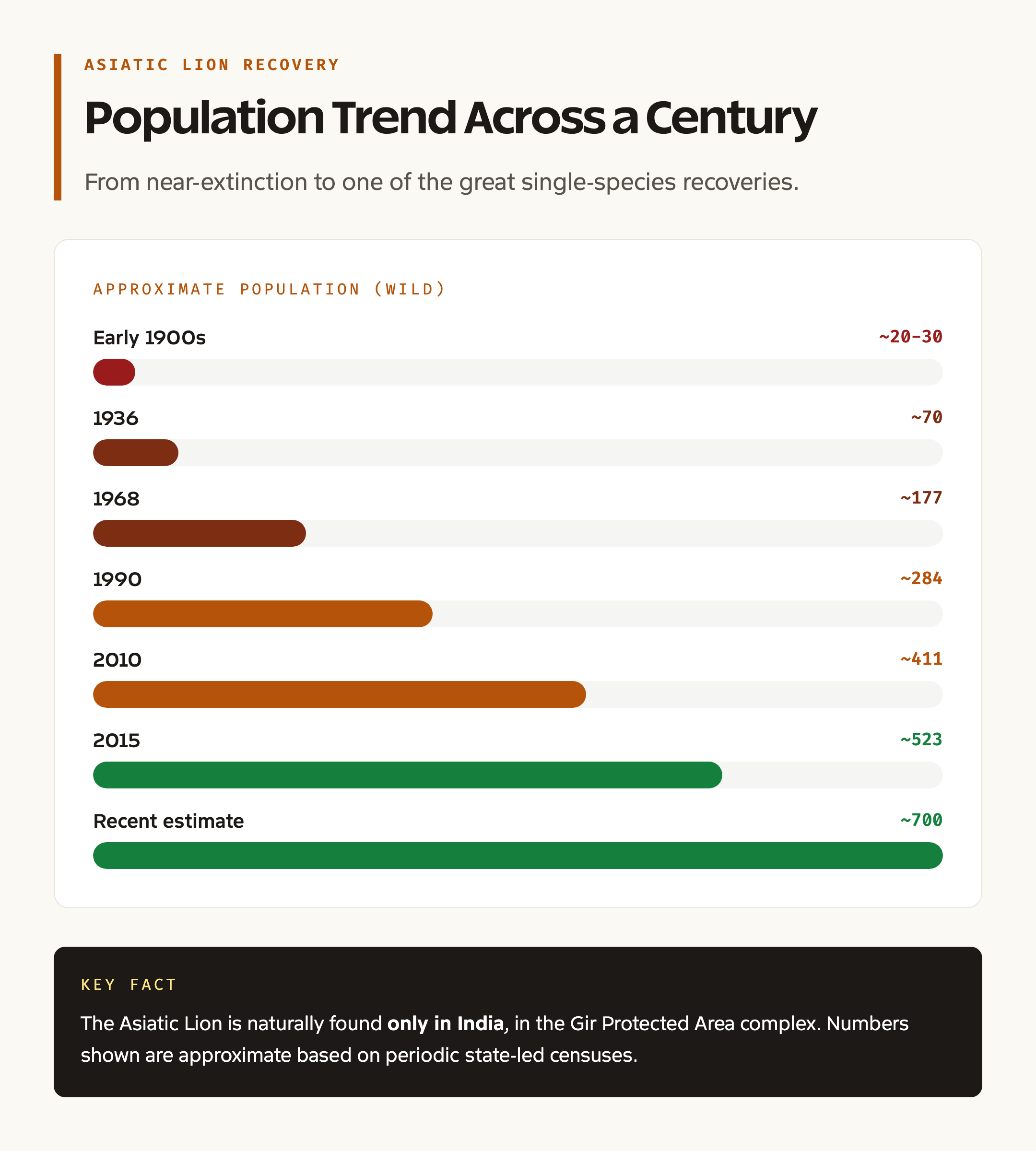
- Asiatic Lion population: Around 700 across the broader Gir landscape (per recent census)
- Asiatic Lion only in: India (Gir is the sole wild population)
- Landscape: Dry deciduous forest, thorny scrub, riverine corridors
- Major rivers: Hiran, Shetrunji, Datardi, Shingoda, Machhundri, Godavari, Raval
- Geographical features: Kamleshwar Dam, Kankai Mata Temple
- Communities: Maldhari pastoralists, Siddhi (an ethnic group of African descent)
- Cultural heritage: Dhamal Dance of the Siddhi community
- Translocation site: Kuno National Park in Madhya Pradesh, identified for a second lion population
What Is Gir National Park
Gir National Park is the core protected area of a larger Gir Protected Area complex that includes the Gir Wildlife Sanctuary, Gir National Park, Pania Wildlife Sanctuary, and the Mityala Wildlife Sanctuary. The complex covers a continuous tract of dry deciduous forest, thorny scrub, and riverine vegetation in the Saurashtra peninsula of Gujarat. The terrain is undulating, dotted with low hills of the Girnar range, and laced with seven major rivers and a number of seasonal streams.
The park’s defining species is the Asiatic Lion. Smaller and more compact than its African cousin, the Asiatic Lion has a thinner mane that exposes the ears, a distinctive belly fold, and a slightly different social structure. Lions in Gir live in smaller prides than African lions, and males are more solitary in habit. Genetic analyses indicate that the Gir population descends from a small founder group, which has consequences for genetic diversity that we will return to in the discussion of challenges.
Other important species include the Indian Leopard, which has high density in Gir and has shown remarkable behavioural adaptation to coexistence with lions and humans. The Chowsingha or Four-Horned Antelope is a signature species of Indian dry forests and is well represented in Gir. Mugger Crocodiles inhabit the rivers and reservoirs, with the Kamleshwar Dam reservoir being a notable mugger habitat. Spotted Deer, Sambar, Nilgai, Wild Boar, and Indian Hare provide the prey base for the carnivores.
Background and Historical Context
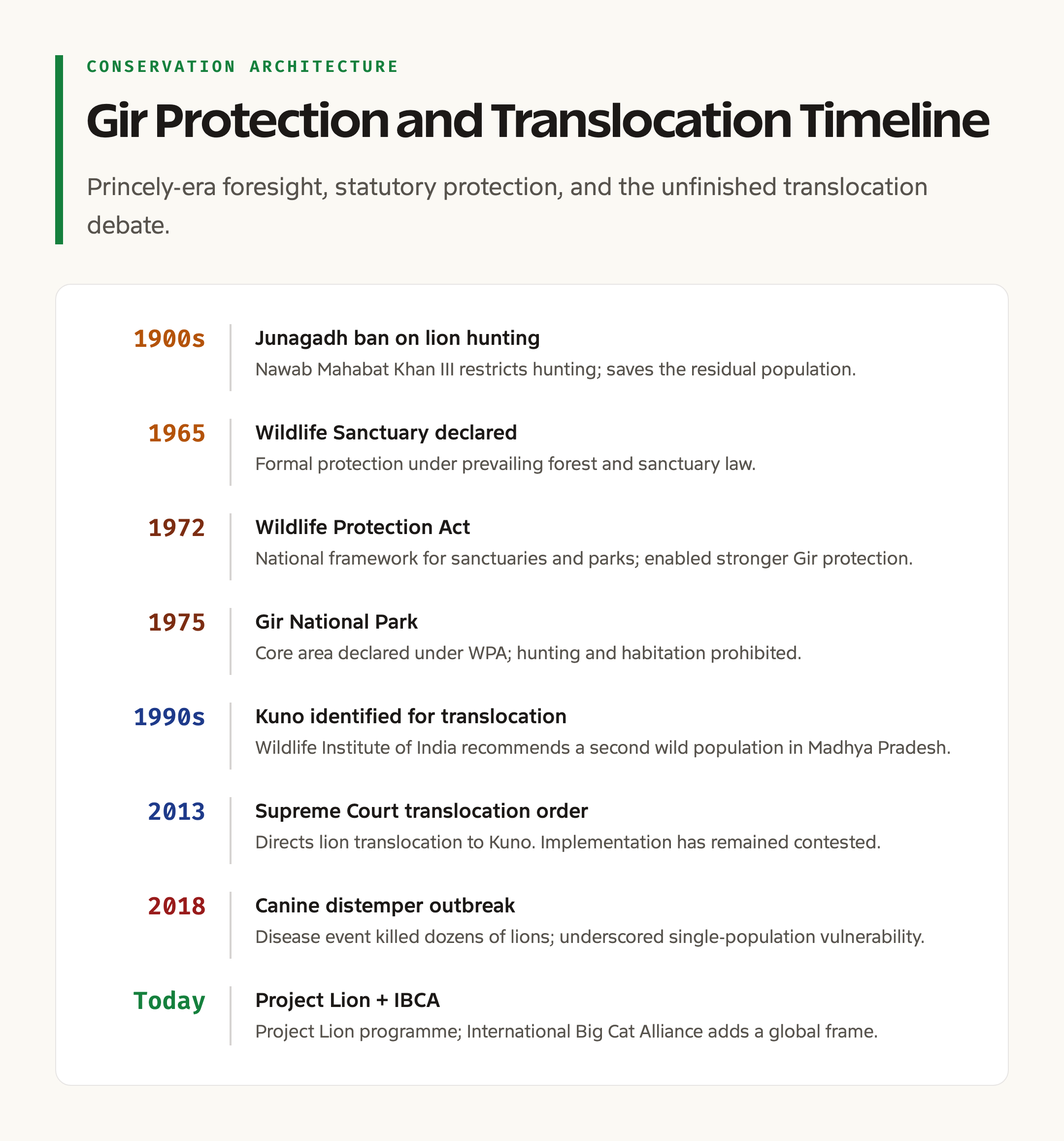
The Asiatic Lion’s near-extinction in the late nineteenth century is a well-documented case of unregulated hunting and habitat fragmentation. Trophy hunting by colonial officers and Indian princes, combined with agricultural expansion across the lion’s historic range, reduced the population from thousands at the start of the British period to a few dozen by the early twentieth century. The Nawab of Junagadh, Mahabat Khan III, played a critical role by banning lion hunting on his territory in the 1900s and establishing a personal protection regime that allowed the small surviving population to recover.
The post-Independence period saw the formal protection framework take shape. The area was declared a Wildlife Sanctuary in 1965, providing legal protection under the existing forest laws. The Wildlife (Protection) Act, 1972 brought the strongest framework, and in 1975 the core was upgraded to National Park status, prohibiting human activity within the most sensitive zones.
Population trajectory has been steadily upward. From an estimated 20 to 30 lions in the early twentieth century, the population grew to around 200 by the 1970s, around 300 by 2000, and roughly 700 by recent estimates. The lion has now expanded beyond the Gir Protected Area into surrounding agro-pastoral landscapes, including the coastal stretch and the agricultural fields of Amreli. This range expansion is both a sign of success and a source of new management challenges.
The translocation debate has been a recurring theme. The Wildlife Institute of India and conservation biologists have argued for decades that a single isolated population is vulnerable to disease outbreaks, natural disasters, and inbreeding depression. Kuno National Park in Madhya Pradesh was identified in the 1990s as a suitable second site, and the Supreme Court ruled in 2013 that lions must be translocated to Kuno. Implementation has been slow and contested, with Gujarat seeking to retain the lion as a state symbol. Kuno has since been reused for the African Cheetah introduction, complicating the original translocation plan.
Key Provisions and Conservation Architecture
National Park status under the Wildlife Protection Act, 1972
The 1975 declaration provides the highest tier of legal protection for the core area. Hunting, grazing, and resource extraction are prohibited. Settlements within the core have been progressively relocated, though Maldhari nesses remain in some peripheral areas under specific arrangements.
Wildlife Sanctuary classification for the broader Gir Protected Area
The surrounding sanctuary status allows controlled human use, including Maldhari grazing in designated zones, while still providing strong legal protection against hunting and major land-use change.
Eco-sensitive zone
The notified eco-sensitive zone around Gir restricts incompatible activities. Mining, polluting industry, and major construction face restrictions. The zone has been the subject of repeated litigation, with the Supreme Court and the National Green Tribunal upholding strict protection.
Wildlife Action Plan and Lion Conservation Plan
The state and central governments operate a dedicated Lion Conservation Plan that includes population monitoring, disease surveillance, habitat management, and human-lion conflict mitigation through compensation schemes.
Project Lion
The Government of India launched Project Lion in recent years to expand the lion conservation framework, modelled in part on Project Tiger. The plan covers Gir and surrounding satellite habitats, infrastructure for veterinary care, and long-term genetic management.
Why It Matters
Gir matters at three levels. Globally, it is the only wild home of the Asiatic Lion, the species’ last natural population. Loss of Gir would mean loss of the lion in the wild worldwide. The conservation responsibility carried by India through Gir is unique among national parks anywhere in the world.
Nationally, Gir is the centerpiece of the Big Cat conservation framework that also includes Project Tiger and the new Cheetah project. The recently launched International Big Cat Alliance, headquartered in India, treats Gir as a symbol of the country’s conservation leadership for big cats. The lion’s continued recovery validates a model of state-led, community-integrated species conservation.
Locally, Gir sustains a layered economy. Eco-tourism through jeep safaris, Devalia Safari Park experience zones, and pilgrim circuits to Kankai Mata and Somnath generates revenue for Junagadh, Gir Somnath, and Amreli districts. Maldhari pastoralism continues in modified form. Nature-based jobs in forest management, anti-poaching, and tourism support a layer of local employment.
Detailed Analysis
A closer view reveals Gir’s distinctive ecology. The dry deciduous forest is dominated by teak, with a mix of acacia, ber, dhak, and other thorny species. The vegetation is shorter and sparser than in moist deciduous forests of central India, but the ground-layer grass cover supports a substantial ungulate prey base. Seasonal water availability is the limiting factor. The Kamleshwar Dam reservoir and a network of artificial watering points have become important during the dry season.
The Asiatic Lion’s behaviour in Gir reflects this dry forest landscape. Pride sizes are small, typically two to three females with cubs, and males are often solitary or in small coalitions. Hunting is opportunistic, with prey ranging from spotted deer and sambar to nilgai and the occasional buffalo. Lions also predate on Maldhari livestock, though compensation schemes and electric fencing have reduced direct conflict to manageable levels.
The Maldhari community is integral to Gir’s social ecology. Maldharis are traditional pastoralists who keep cattle and buffalo in forest-fringe nesses. Their relationship with the forest is centuries old. The state has progressively moved many Maldhari families out of the core National Park while allowing limited continuation in the sanctuary zones. The trade-off between strict protection and traditional rights is one of the most studied cases in Indian conservation policy.
The Siddhi community adds a remarkable cultural layer. Descendants of African origin, brought to the subcontinent through medieval trade and military service, the Siddhis form a distinctive ethnic group in Junagadh. Their Dhamal Dance, performed during festivals, blends African rhythmic traditions with local musical influences and has been documented as a unique living heritage form.
The lion population’s expansion outside the protected area is a recent and significant development. Lions are now seen in agricultural fields, along the coastal Saurashtra belt, and even in the outskirts of Amreli town. This expansion creates new conflict scenarios and demands new policy frameworks. Compensation for cattle losses, electric fencing of farmlands, awareness programmes, and rapid response teams are all part of the toolkit.
The genetic question remains live. The small founder population means that genetic diversity is limited compared with other large carnivore populations. Disease outbreaks, such as the canine distemper virus event of 2018 that killed dozens of lions, are a particular concern. A second wild population in a different geography is the textbook insurance policy.
Comparative Perspective
Gir’s conservation model is best compared with two other systems. Kruger National Park in South Africa hosts large African lion populations across a vast landscape with very different ecology, social structure, and management challenges. Kruger’s experience with disease management, prey-base monitoring, and tourism revenue provides useful templates.
Within India, Gir is contrasted with the tiger reserves of India network. The single-population, single-state model of Gir differs sharply from the distributed multi-state network of tiger reserves. The trade-offs are clear. A distributed network is more resilient to local disasters but harder to manage uniformly. A single concentrated population is easier to manage closely but more vulnerable to a single shock.
The Cheetah introduction at Kuno is a parallel project that has both complicated and reframed the Gir translocation debate. African Cheetahs at Kuno occupy ecological space that was originally identified for Asiatic Lion translocation. Whether the two species can coexist at Kuno or whether alternative second sites need to be developed for lions is an ongoing policy question.
Challenges
Four challenges define contemporary Gir management. First, the single-population vulnerability. Even with strong protection, an isolated population is exposed to disease, climate shocks, and stochastic events. The 2018 canine distemper outbreak underscored this risk in real terms.
Second, the translocation impasse. The Supreme Court’s 2013 directive remains substantively unimplemented for lions. The combination of state political resistance, the parallel Cheetah project at Kuno, and unclear alternative-site planning has stalled progress.
Third, range expansion outside the protected area. Lions now use agricultural and coastal landscapes where neither legal protection nor habitat suitability is guaranteed. Conflict mitigation, livestock compensation, and human safety frameworks must scale up to match the expanding lion footprint.
Fourth, the Maldhari relocation balance. Continued presence inside the sanctuary creates regulatory complexity. Full relocation may improve ecological metrics but disrupts traditional livelihoods. The state has pursued a middle path with mixed results.
Prelims Pointers
- Located in Gujarat, spread across Junagadh, Gir Somnath, and Amreli districts
- Declared a Wildlife Sanctuary in 1965 and a National Park in 1975
- The only wild habitat of the Asiatic Lion in the world
- Asiatic Lion is naturally found in India only (correct UPSC fact)
- Other key species: Indian Leopard, Chowsingha (Four-Horned Antelope), Mugger Crocodile
- Landscape: Dry deciduous forest and thorny scrub
- Seven major rivers: Hiran, Shetrunji, Datardi, Shingoda, Machhundri, Godavari, Raval
- Notable features: Kamleshwar Dam, Kankai Mata Temple
- Communities: Maldharis (traditional pastoralists), Siddhis (ethnic group of African descent)
- Cultural heritage: Dhamal Dance of the Siddhi community
- Identified translocation site: Kuno National Park in Madhya Pradesh
- One-Horned Rhino is found in India, Nepal, and Bhutan; not exclusive to India
- Double-humped camel is found in India (Ladakh) and also in Mongolia and parts of Central Asia; not exclusive to India
Mains Practice Questions
- The Asiatic Lion is the most concentrated case of single-site dependence in global big-cat conservation. Discuss the implications of this concentration and evaluate the case for translocation to Kuno.
- Examine the Maldhari pastoralist model at Gir as an example of human-wildlife coexistence. What lessons does it offer for community-integrated conservation in Indian protected areas?
- With reference to Project Lion and the International Big Cat Alliance, analyse India’s evolving framework for big-cat conservation across tiger reserves and lion habitat.
- Lions in Gir have expanded beyond the protected area into agricultural and coastal landscapes. Suggest a policy framework for managing this range expansion while maintaining strong core-area protection.
Way Forward
Five priorities define the next decade for Gir. First, implement the second-population insurance. Whether at Kuno (alongside or instead of cheetah), Madhya Pradesh’s Nauradehi, or Rajasthan’s Mukundra Hills, a second wild population must be established to insure against catastrophic events at Gir. The Supreme Court’s 2013 directive provides the legal mandate.
Second, scale disease surveillance and response. The 2018 distemper outbreak showed how quickly a single pathogen can threaten an entire population. Veterinary capacity, vaccination programmes for surrounding domestic animals, and rapid response protocols must be permanent features.
Third, formalise the human-lion conflict toolkit. Compensation, electric fencing, rapid response teams, and awareness campaigns need standardisation across districts where lions now live. Insurance schemes for cattle losses and quick disbursement protocols build community support.
Fourth, manage tourism within carrying capacity. Visitor numbers, jeep safari frequency, and the Devalia experience zone need ongoing optimisation to balance revenue with ecological pressure.
Fifth, invest in genetic management. Studbook-style monitoring, structured breeding decisions for any captive populations, and consideration of carefully managed genetic exchange between Gir and any future second site are part of long-term species recovery planning.
For UPSC aspirants, Gir is the textbook case of how a single visionary intervention by a princely ruler combined with sustained state and community effort produced one of the world’s most distinctive conservation outcomes. It is also a reminder that conservation success is never permanent. The next phase of Gir’s story will be shaped by how India navigates the tension between national species responsibility and state-level political ownership.
Frequently Asked Questions
Where is Gir National Park located?
Gir National Park is in Gujarat, spread across Junagadh, Gir Somnath, and Amreli districts on the Saurashtra peninsula. The park sits within a larger Gir Protected Area complex that includes the Gir Wildlife Sanctuary and adjoining sanctuaries.
When was Gir established as a National Park?
Gir was declared a Wildlife Sanctuary in 1965 and upgraded to a National Park in 1975 under the Wildlife (Protection) Act, 1972.
Why is Gir famous globally?
Gir is the only place in the world where the Asiatic Lion lives in the wild. The species was once distributed across Greece, Turkey, Mesopotamia, and Persia, but is now restricted to this single Indian protected area.
Is the Asiatic Lion found only in India?
Yes, in the wild. The Asiatic Lion is naturally found only in India, in the Gir Protected Area complex of Gujarat. Some captive populations exist in zoos in other countries, but the wild population is exclusively Indian.
What other species are found at Gir?
Important species include the Indian Leopard, the Chowsingha or Four-Horned Antelope, the Mugger Crocodile, Sambar, Spotted Deer, Nilgai, Wild Boar, and a rich bird community. Leopard density at Gir is among the highest in India.
Who are the Maldharis?
Maldharis are traditional pastoralists of Saurashtra who graze cattle and buffalo in forest-fringe nesses. They have lived alongside lions for centuries in a relatively low-conflict equilibrium that has been studied widely as a model of human-wildlife coexistence.
Who are the Siddhis and what is the Dhamal Dance?
The Siddhis are an ethnic group of African descent who settled in parts of Gujarat over centuries through trade and military service. The Dhamal Dance is their distinctive performance form, blending African rhythmic traditions with local musical influences, and is performed during festivals.
What is the Kuno translocation issue?
Conservation biologists have argued for decades that a second wild population of the Asiatic Lion is needed to reduce single-site vulnerability. Kuno National Park in Madhya Pradesh was identified as the destination, and the Supreme Court ruled in 2013 that lions must be translocated. Implementation has been delayed, and Kuno has subsequently been used for the African Cheetah introduction.
What is Project Lion?
Project Lion is a central government initiative modelled on Project Tiger that focuses on the long-term conservation of the Asiatic Lion. It includes population monitoring, disease management, habitat expansion, and human-lion conflict mitigation.
What is the current Asiatic Lion population at Gir?
The most recent census-style estimates put the total Asiatic Lion population in the broader Gir landscape at around 700 animals, including those that have expanded into adjoining agricultural and coastal areas. The figure has grown steadily from a few dozen at the start of the twentieth century.
Tell Google you want more of this.
Add Anantam IAS as a preferred sourceOne tap, and this site shows up more often in your own Top Stories, AI Overviews and AI Mode. Remove it any time.