Globalisation is the central social process of the post-1991 era — the mechanism by which Indian society became plugged into a planetary network of trade, capital, ideas, technology, culture, labour, and risk. Driven primarily by the end of the Cold War (1991), the disintegration of the Soviet Union, and India's own LPG reforms of 1991, globalisation reshaped the family, caste, gender, language, food, religion, and the very idea of what it means to be Indian. UPSC GS-I (Indian Society, salient features, urbanisation) and GS-II/III (international relations, economy, social justice) demand a clear, theory-and-data-rich understanding of the topic.
This guide unpacks definitions, theory, the LPG inflection point, the eight social impacts, glocalisation, the 2024-26 deglobalisation churn, the legal-policy framework, and the way forward.
What Is Globalisation?
Globalisation is the process of interaction and integration among people, companies, and governments of different nations, driven by international trade and investment, and aided by information technology. It compresses time and space (Anthony Giddens), creates "world consciousness" (Roland Robertson), and creates a "network society" (Manuel Castells).
Dimensions
| Dimension | Markers |
|---|---|
| Economic | Trade, FDI, capital flows, GVCs |
| Political | International institutions, sovereignty pooling |
| Cultural | Media, food, dress, language, religion |
| Technological | Internet, mobile, AI, satellites |
| Social/Demographic | Migration, diaspora, remittances |
| Ecological | Climate, pandemics, biodiversity |
Sociological Theory
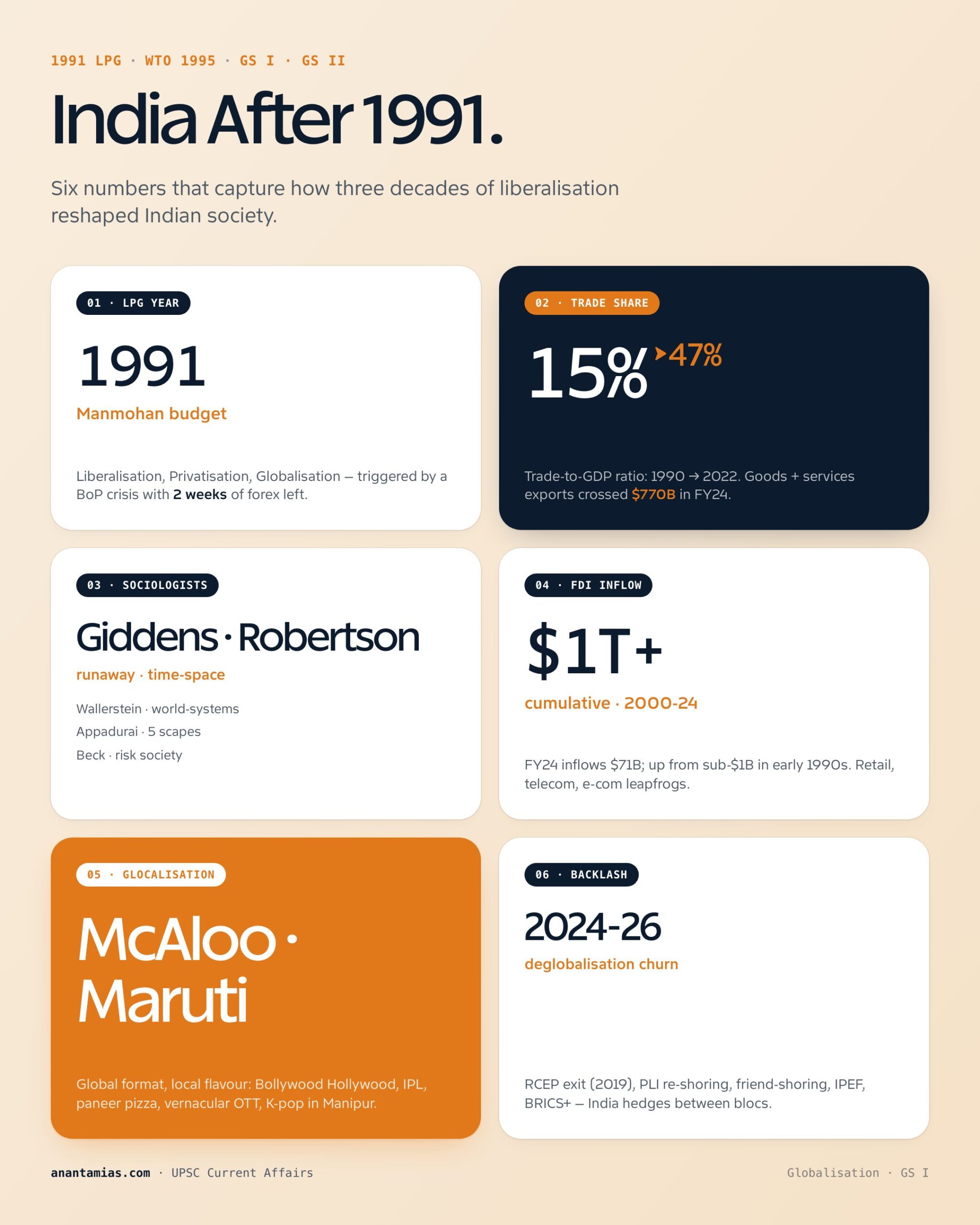
- Anthony Giddens (1990): "Intensification of worldwide social relations which link distant localities" — time-space distanciation.
- Roland Robertson: Globalisation = "the compression of the world and the intensification of consciousness of the world as a whole." Coined glocalisation.
- Manuel Castells: Network society — "space of flows" replacing "space of places".
- Saskia Sassen: Global cities concentrate command-control functions.
- Ulrich Beck: World Risk Society — global risks (pandemics, climate, financial crises).
- Arjun Appadurai: Five "scapes" — ethnoscape, mediascape, technoscape, financescape, ideoscape.
- Immanuel Wallerstein: World-system theory — core, semi-periphery, periphery.
- Joseph Stiglitz: Globalisation's discontents — inequality and asymmetric integration.
Origin and Phases
| Era | Marker |
|---|---|
| Mercantile (16-18th c.) | Spices, textiles trade, colonialism |
| Industrial (19th c.) | Steamships, telegraph, gold standard |
| Bretton Woods (1945-71) | IMF, WB, GATT |
| Neoliberal (1989-2008) | WTO, Washington Consensus, Internet |
| Post-2008 | Slowbalisation; rise of China |
| Post-2020 (COVID era) | Fragmentation, friend-shoring, deglobalisation? |
The Indian Inflection: 1991 LPG
The balance-of-payments crisis of 1991 triggered the Liberalisation, Privatisation, Globalisation (LPG) reforms under PM P.V. Narasimha Rao and FM Manmohan Singh (Industrial Policy 1991). Key elements:
- Rupee devaluation, IMF stand-by arrangement.
- Removal of industrial licensing for most sectors.
- FDI policy liberalisation.
- Trade barrier reduction; CRR/SLR cuts.
- Joining WTO (1995).
Driving factors globally: democracy + capitalism (the "Washington Consensus" or neoliberalism).
Eight Social Impacts of Globalisation on Indian Society
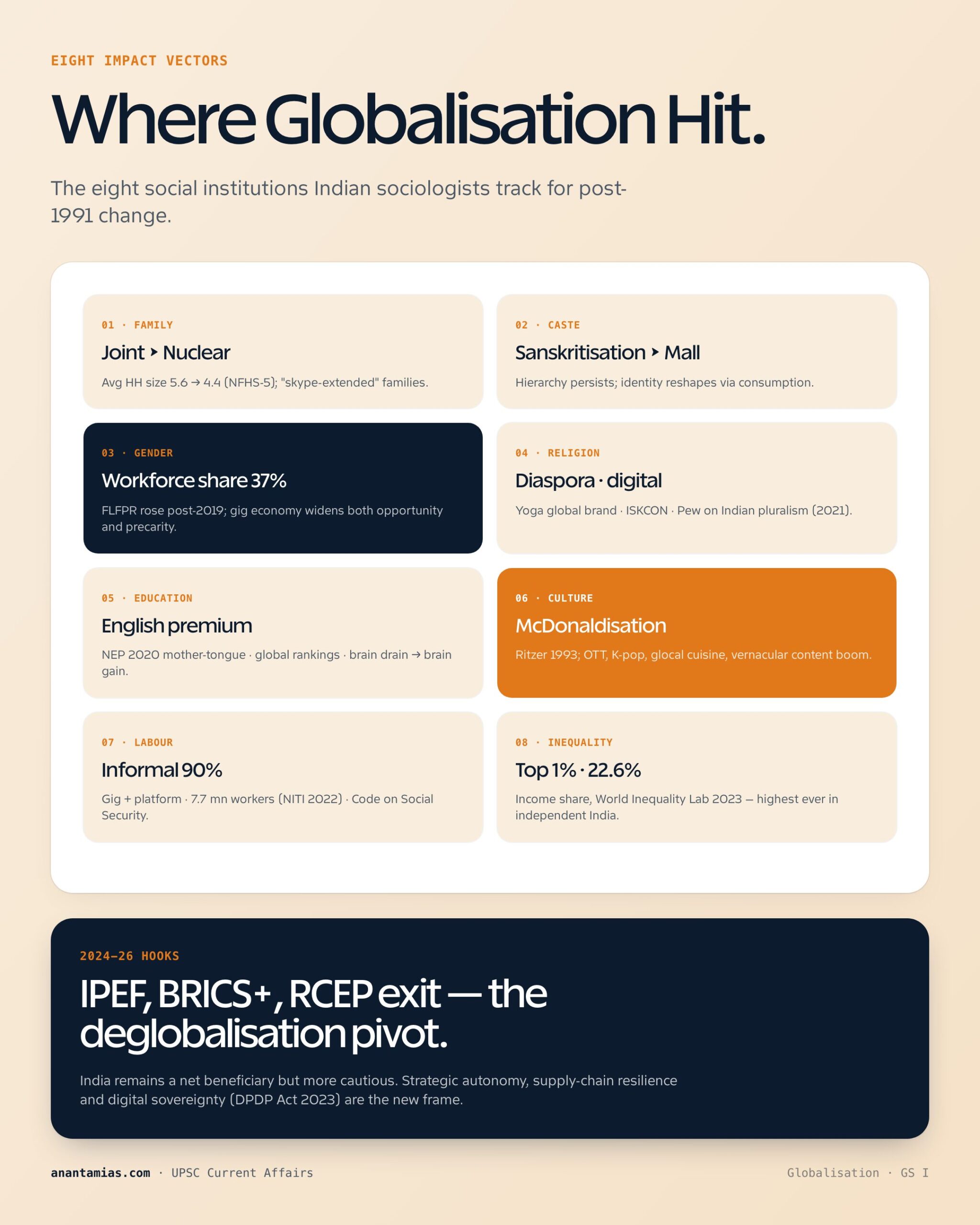
1. Family
- Rise of nuclear, dual-income, urban, mobile families.
- Mean household size: 5.5 (NFHS-1) → 4.4 (NFHS-5).
- Diaspora families: 35.4 million Indian-origin people abroad (MEA 2024); ~$129 billion remittances (World Bank 2024) — India is the world's largest recipient.
- "Skype/WhatsApp families" — physical separation, virtual togetherness.
- Working couples with shared parenting; ageing parents in India.
2. Caste
- Caste as economic occupation dilutes; identity persists.
- Caste in global IT diaspora: California SB 403 (2023), Cisco discrimination case (2020) brought caste to American legal landscape.
- Dalit middle class emergence; Sukhadeo Thorat, Surinder Jodhka studies.
- Inter-caste marriage still ~10% — but rising in metros.
- Globalised caste advocacy: Equality Labs, Ambedkar International Mission.
3. Gender
- Female LFPR rose from 23.3% (PLFS 2017-18) to 41.7% (PLFS 2023-24).
- Women in IT, BPO, gig work — 30% of IT workforce is female (NASSCOM 2023).
- Transnational marriages and feminism: NGO-led activism, MeToo movement (2018-).
- Yet Global Gender Gap Index 2024: India 129/146.
- Care globalisation: nurses, caregivers from Kerala, Andhra to Gulf.
4. Religion
- Religious revivalism + globalisation simultaneously.
- Yoga, Ayurveda, meditation as global Indian soft power (UN International Day of Yoga since 2015).
- Global Hindu/Muslim/Sikh diaspora — temples in 70+ countries.
- Religious fundamentalism as backlash to globalisation (Castells, Bauman).
- Cosmopolitan localism — local identity reaffirmed within global frame.
5. Language and Education
- English as gateway: ~10% Indians speak English; 90% of formal urban jobs require English.
- NEP 2020 mandates multilingualism — Indian languages in higher education.
- Hindi-Urdu-Punjabi diaspora media: Bollywood, regional cinema's global circulation.
- Endangered languages: ~196 (UNESCO 2024).
- EdTech globalisation: Coursera, Khan Academy + Indian startups.
6. Food, Dress, Lifestyle
- Glocalised food: McDonald's Aloo Tikki burger; KFC Veg Strips; Domino's Paneer pizza; Desi Chinese.
- Coffee culture: Starbucks (385+ outlets in India by 2024).
- Dress: Western office wear + Indian ethnic for festivals.
- Wellness boom: Yoga at $15 billion industry (FICCI 2024).
- Streaming: Netflix, Amazon Prime regional Indian content reaches 200+ countries.
7. Health
- Medical tourism: India among top 5 destinations; ~$13 billion industry projected by 2026.
- Telemedicine globalisation: Indian doctors consult international patients.
- Pandemic risks: COVID-19 demonstrated "world risk society" — Beck.
- Rise of NCDs: globalised lifestyle → diabetes, obesity (NFHS-5: 24% women obese).
- Pharma exports: India is the "pharmacy of the world" — 20% of global generic drug supply.
8. Politics, Polity, Sovereignty
- Pooled sovereignty in WTO, UN, climate negotiations (UNFCCC, Paris 2015).
- Diaspora as foreign policy asset: PM's Howdy Modi, Wembley addresses.
- Civil society globalisation: Greenpeace, Amnesty, OXFAM operate in India.
- Digital sovereignty: Data Protection Act 2023; PSU vs. Big Tech.
Glocalisation: Indian Examples
Glocalisation = simultaneous globalisation + localisation (Roland Robertson).
| Sector | Example |
|---|---|
| Food | Desi Chinese (Hakka noodles, Manchurian); McAloo Tikki burger; KFC Veg Zinger |
| Cinema | Bollywood crossover (RRR Oscar 2023); Netflix regional originals |
| Fashion | Indo-Western fusion (Sabyasachi-Christian Louboutin) |
| Music | Bhangra-EDM, Carnatic-Jazz, Diljit-global tours |
| Language | Hinglish, Tanglish, Manglish |
| Religion | UN International Yoga Day (2015); ISKCON globally |
| Tech | Bengaluru as "Silicon Plateau" — global delivery model |
Backlash and Discontents
- Religious fundamentalism: Hindutva, Islamism, Christian fundamentalism.
- Cultural anxiety: "Westernisation eroding tradition".
- Inequality: Top 1% holds 40.1% of national wealth (Oxfam 2023).
- Anti-globalisation politics: Make in India, atmanirbhar Bharat, vocal for local.
- Linguistic chauvinism: Hindi-imposition debates; English-only resistance in TN, KA.
Deglobalisation? The 2024-26 Churn
The post-2020 world has seen partial deglobalisation signals:
- COVID-19 supply-chain shocks (semiconductors, APIs).
- US-China decoupling: technology, trade, finance.
- Russia-Ukraine war (2022): energy, food, payments fragmentation.
- Friend-shoring, near-shoring replacing offshoring.
- Trade as % of world GDP: stagnant ~58-60% since 2008 (World Bank).
- Industrial policy revival: US CHIPS Act 2022, EU IRA, India PLI Schemes (₹1.97 lakh crore across 14 sectors).
- Atmanirbhar Bharat (2020) — strategic autonomy.
- G20 Delhi Summit 2023: Multipolarity, India presidency consensus.
Constitutional and Legal Anchors
- Article 51: Promotion of international peace and security.
- Article 246, 7th Schedule: Trade, treaties under Union List.
- Article 14, 15, 21: Equality, dignity — limit on globalisation's social costs.
- Foreign Trade (Development and Regulation) Act 1992 (post LPG).
- FEMA 1999 (replacing FERA 1973).
- DPDP Act 2023 — Digital Personal Data Protection.
- Telecommunications Act 2023.
- PLI Schemes for Make in India.
Government Initiatives
- Make in India (2014).
- Atmanirbhar Bharat (2020).
- PLI Schemes — 14 sectors, ₹1.97 lakh crore.
- Skill India + PMKVY 4.0 for global workforce.
- Digital India + India Stack (Aadhaar, UPI, ONDC, ULIP, DigiLocker).
- G20 presidency 2023 outcomes — Global South leadership.
- Vibrant Villages Programme (border globalisation).
- PM Vishwakarma — artisanal craft for global market.
- National Logistics Policy 2022.
- Pravasi Bharatiya Divas + OCI scheme.
Sociological Perspectives Applied to India
| Theorist | Concept | Application |
|---|---|---|
| Anthony Giddens | Time-space distanciation | Diaspora video calls |
| Roland Robertson | Glocalisation | Aloo Tikki burger |
| Manuel Castells | Network society | India Stack |
| Saskia Sassen | Global city | Mumbai, Bengaluru |
| Ulrich Beck | Risk society | COVID-19 |
| Arjun Appadurai | Five scapes | Mediascape (Bollywood global) |
| Wallerstein | World-system | India in semi-periphery rising |
| Stiglitz | Discontents | Inequality, agrarian distress |
Data Snapshot (2024-26)
| Indicator | Value | Source |
|---|---|---|
| Indian diaspora | 35.4 million | MEA 2024 |
| Remittances received | ~$129 billion | World Bank 2024 |
| FDI inflows (FY 2023-24) | $70.9 billion | DPIIT |
| Global Gender Gap | 129/146 | WEF 2024 |
| Top 1% wealth share | 40.1% | Oxfam 2023 |
| GHI 2024 rank | 105/127 | Global Hunger Index |
| Female LFPR | 41.7% | PLFS 2023-24 |
| English speakers | ~10% | Census 2011 |
| PLI sectors | 14 | DPIIT |
| Yoga industry | $15 billion (FICCI 2024) | |
| Generic drug share | 20% global | IBEF |
| Press Freedom rank | 159/180 | RSF 2024 |
Challenges
- Inequality and exclusion: Top 1% holds 40.1% wealth.
- Cultural homogenisation vs. local identity.
- Linguistic erosion: 196 endangered languages.
- Climate burden disproportionately on poor.
- Digital divide: rural, women, elderly under-access.
- Job polarisation: high-skill IT booms; mid-skill manufacturing stagnant.
- Geopolitical fragmentation (US-China, Russia-NATO).
- Migrant precarity (Gulf workers, intra-state migrants).
- Pandemic, climate, financial shock vulnerability.
- Tech-mediated communalism and disinformation.
Way Forward
- Inclusive globalisation: Strengthen MGNREGA, e-Shram (30 crore registered) for safety nets.
- Atmanirbhar without autarky: PLI + open trade with strategic sectors protected.
- Glocalised cultural policy: NEP 2020 multilingualism + Sahitya/Sangeet Akademis.
- Diaspora engagement: PIO, OCI, Pravasi Bharatiya Divas; Vande Bharat consular reform.
- Climate-just globalisation: CBDR-RC; LIFE (Lifestyle for Environment) at G20.
- Digital sovereignty: Operationalise DPDP Act 2023; ONDC, India Stack export.
- Multipolar leadership: Voice of the Global South; UNSC reform; G20 outcomes.
- Skilling for global jobs: Skill India + Mobility partnerships (Australia, Germany, UK).
Mains Hook
"Globalisation is not a uniform tide — it lifts and drowns differently across caste, gender, region, and class in India." Critically discuss the social consequences of globalisation on Indian society in the context of the post-2020 deglobalisation churn. (GS-I/GS-II, 250 words, 15 marks)
Prelims Pointers
- LPG reforms: 1991, P.V. Narasimha Rao, Manmohan Singh.
- WTO: India joined 1995.
- Glocalisation: Roland Robertson.
- Five scapes: Appadurai (ethno, media, techno, finance, ideo).
- World Risk Society: Ulrich Beck.
- Network Society: Manuel Castells.
- Atmanirbhar Bharat: 2020.
- PLI sectors: 14, ₹1.97 lakh crore.
- G20 New Delhi Summit: 2023.
- DPDP Act: 2023.
- Foreign Trade (Development and Regulation) Act: 1992.
- FEMA: 1999, replaced FERA 1973.
- International Day of Yoga: 21 June, since 2015.
- Indian diaspora: 35.4 million; remittances: $129 billion (World Bank 2024).
- Top 1% wealth share: 40.1% (Oxfam 2023).
Globalisation is the single most important macro-driver of social change in post-1991 India. UPSC answers should weave together theory + LPG history + NFHS/PLFS data + 2024-26 deglobalisation context + glocalisation examples for top marks.
Tell Google you want more of this.
Add Anantam IAS as a preferred sourceOne tap, and this site shows up more often in your own Top Stories, AI Overviews and AI Mode. Remove it any time.