Health System in India: Structure & Challenges
India’s health system serves 1.4 billion people through a complex mix of public facilities, private providers, and traditional medicine systems. Despite significant progress — eradicating polio, reducing maternal mortality, and expanding health insurance through Ayushman Bharat — the system faces persistent challenges: low public spending, inadequate infrastructure in rural areas, shortage of trained healthcare workers, and deep inequalities in access. This article covers the structure, key programmes, challenges, and reform initiatives that UPSC frequently tests.
Structure of India’s Health System
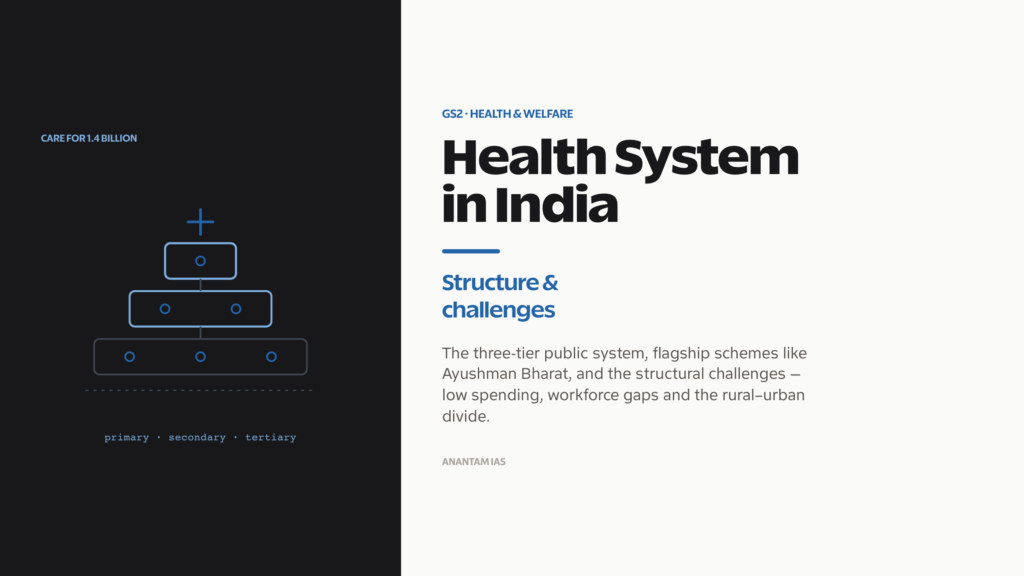
India’s healthcare delivery operates through a three-tier public system alongside a dominant private sector.
Public Healthcare: Three-Tier Structure
| Level | Facility | Population Coverage | Services |
|---|---|---|---|
| Primary | Sub-Centre (SC) | 3,000–5,000 | Basic outreach, maternal health, immunization |
| Primary | Primary Health Centre (PHC) | 20,000–30,000 | OPD, basic diagnostics, preventive care |
| Secondary | Community Health Centre (CHC) | 80,000–1,20,000 | Specialist services, referral, surgery |
| Secondary | Sub-District/District Hospital | District level | Advanced diagnostics, specialist care, emergencies |
| Tertiary | Medical Colleges, AIIMS | State/Region | Super-specialty care, research, teaching |
Infrastructure Numbers (Approximate)
| Facility Type | Number |
|---|---|
| Sub-Centres | 1,60,000+ |
| Primary Health Centres | 31,000+ |
| Community Health Centres | 6,000+ |
| District Hospitals | 800+ |
| Medical Colleges | 700+ |
| AIIMS Institutions | 22+ |
Public vs Private Healthcare
| Parameter | Public Sector | Private Sector |
|---|---|---|
| Share of Hospital Beds | ~40% | ~60% |
| Out-of-Pocket Expenditure | Lower | Higher |
| Rural Presence | Primary and secondary level | Concentrated in urban areas |
| Quality Perception | Variable | Generally perceived higher |
| Affordability | Free/subsidized | Market-driven pricing |
| Regulation | Government-managed | State Clinical Establishments Acts |
| Contribution to Healthcare | ~30% of outpatient care | ~70% of outpatient care |
The private sector dominates healthcare delivery in India, accounting for approximately 70% of outpatient and 60% of inpatient care. This heavy reliance on private providers means out-of-pocket health expenditure remains high — pushing millions into poverty annually.
Key Health Indicators
| Indicator | India (2024 approx.) | Global Average |
|---|---|---|
| Life Expectancy | ~70 years | ~73 years |
| Infant Mortality Rate | ~26 per 1,000 live births | ~28 per 1,000 |
| Maternal Mortality Ratio | ~97 per 1,00,000 live births | ~223 per 1,00,000 |
| Total Fertility Rate | ~2.0 | ~2.3 |
| Doctor-Patient Ratio | ~1:834 | WHO recommends 1:1000 |
| Health Spending (% GDP) | ~2.1% | ~6% (global avg.) |
| Out-of-Pocket Expenditure | ~47% of total health spend | ~18% (global avg.) |
India’s health spending at ~2.1% of GDP is well below the global average and the National Health Policy 2017 target of 2.5% by 2025. This underfunding is the root cause of most health system challenges.
Major Health Programmes and Schemes
Ayushman Bharat (2018)
Ayushman Bharat is the government’s flagship health programme with two components:
Component 1: Health and Wellness Centres (HWCs)
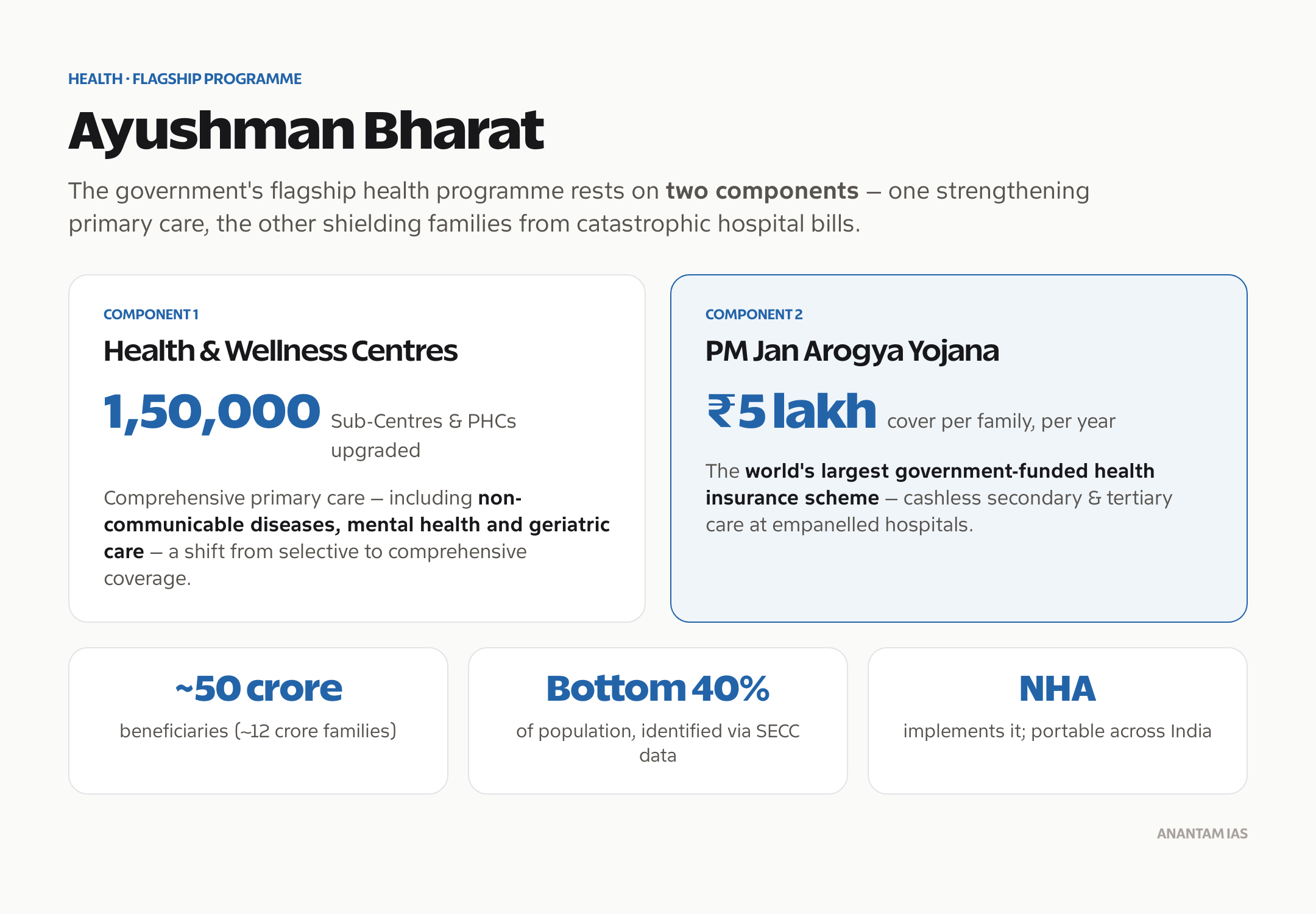
- Upgrades 1,50,000 Sub-Centres and PHCs into HWCs
- Provides comprehensive primary healthcare including non-communicable diseases, mental health, and geriatric care
- Represents a shift from selective to comprehensive primary healthcare
Component 2: Pradhan Mantri Jan Arogya Yojana (PM-JAY)
| Feature | Detail |
|---|---|
| Coverage | Rs 5 lakh per family per year |
| Beneficiaries | ~50 crore individuals (~12 crore families) |
| Target Group | Bottom 40% of population (identified via SECC data) |
| Implementation | National Health Authority (NHA) |
| Cashless Treatment | At empanelled hospitals (public and private) |
| Portability | Available across India |
PM-JAY is the world’s largest government-funded health insurance scheme. It covers secondary and tertiary hospitalization costs, reducing catastrophic health expenditure for vulnerable families.
Ayushman Bharat: Complete Guide
National Health Mission (NHM)
The National Health Mission (launched 2013, combining NRHM and NUHM) is the primary vehicle for public health system strengthening.
| Sub-Mission | Focus |
|---|---|
| National Rural Health Mission (NRHM) | Rural healthcare infrastructure and services |
| National Urban Health Mission (NUHM) | Urban slum and poor population health |
Key NHM Initiatives:
- ASHA workers (Accredited Social Health Activists) — over 10 lakh community health workers
- Janani Suraksha Yojana — institutional delivery incentive
- Free drugs and diagnostics at public facilities
- Mobile Medical Units for remote areas
- Rashtriya Bal Swasthya Karyakram (child health screening)
Other Important Health Schemes
| Scheme | Focus | Year |
|---|---|---|
| Mission Indradhanush | Universal immunization | 2014 |
| National AIDS Control Programme | HIV/AIDS prevention and treatment | Ongoing (Phase V) |
| Poshan Abhiyaan | Nutrition mission | 2018 |
| National Mental Health Programme | Mental health services | 1982 (revised) |
| Pradhan Mantri Bhartiya Janaushadhi Pariyojana | Affordable generic medicines | 2008 (expanded) |
| Pradhan Mantri National Dialysis Programme | Free dialysis for poor | 2016 |
Poshan Abhiyaan: Nutrition Mission
Major Challenges in India’s Health System
1. Low Public Health Expenditure
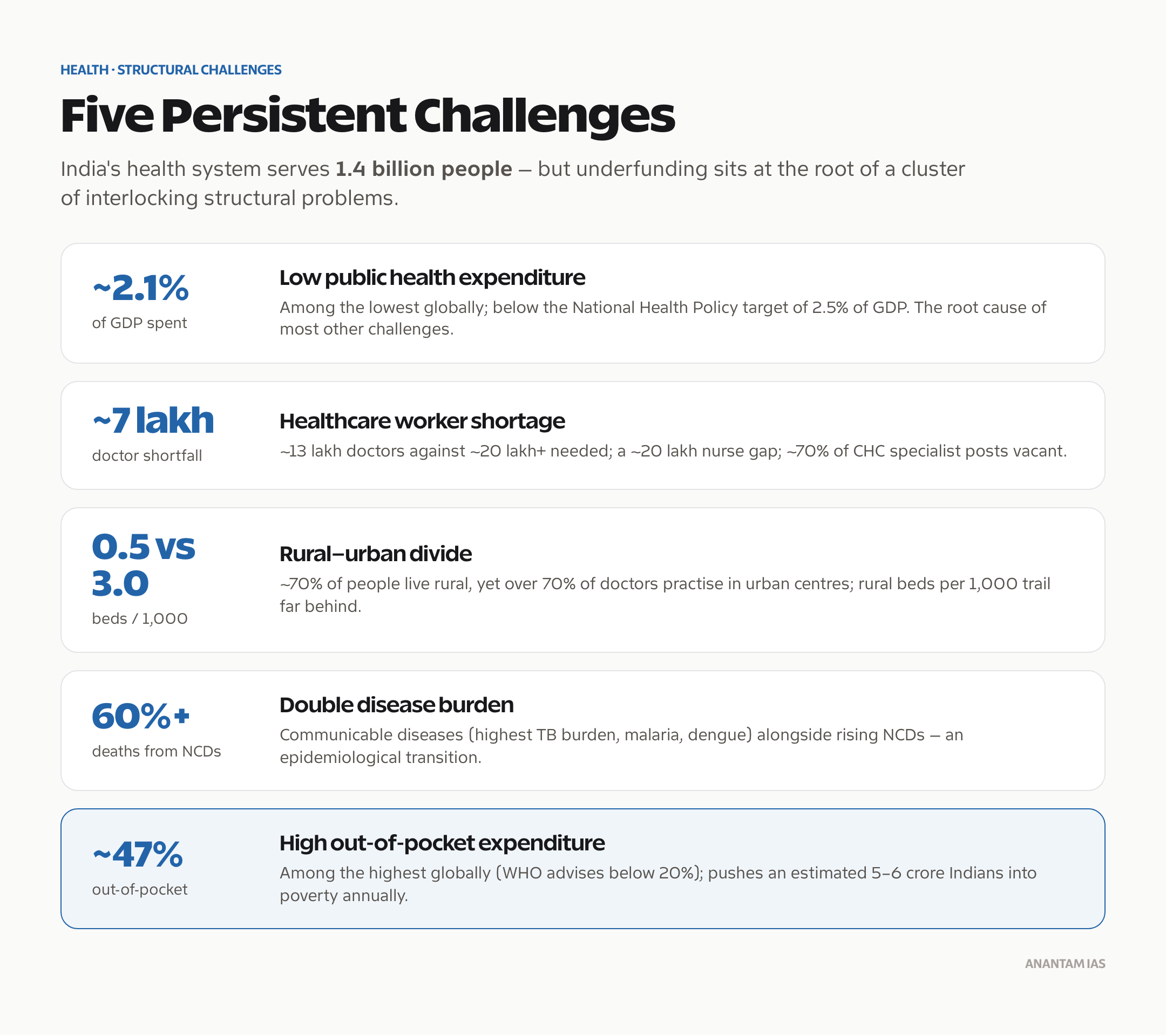
At ~2.1% of GDP, India’s public health spending ranks among the lowest globally. The National Health Policy 2017 set a target of 2.5% by 2025 and 3% eventually, but progress has been slow. Low public spending forces citizens to depend on private healthcare, leading to high out-of-pocket expenditure.
2. Healthcare Worker Shortage
| Category | Available | Required (WHO norms) | Shortfall |
|---|---|---|---|
| Doctors | ~13 lakh | ~20 lakh+ | ~7 lakh |
| Nurses | ~30 lakh | ~50 lakh+ | ~20 lakh |
| Specialists at CHCs | ~30% filled | 100% | ~70% vacant |
| ASHA Workers | ~10 lakh | Adequate | Underpaid, undervalued |
The shortage is acute in rural areas. About 70% of India’s population lives in rural areas, but over 70% of doctors practice in urban centres.
3. Rural-Urban Divide
| Parameter | Rural | Urban |
|---|---|---|
| Hospital Beds per 1,000 | ~0.5 | ~3.0+ |
| Doctor Availability | Severely insufficient | Concentrated |
| Specialist Access | Very limited | Available |
| Diagnostic Facilities | Basic | Advanced |
| Emergency Care | Inadequate | Reasonable |
4. Disease Burden: Double Challenge
India faces a dual disease burden:
Communicable Diseases: Tuberculosis (India has the world’s highest TB burden), malaria, dengue, diarrhoeal diseases Non-Communicable Diseases (NCDs): Diabetes, cardiovascular disease, cancer, chronic respiratory diseases — now accounting for over 60% of deaths
This “epidemiological transition” strains a system still geared toward infectious disease control.
5. Out-of-Pocket Expenditure
At ~47% of total health expenditure, India’s out-of-pocket spending is among the highest globally. The WHO recommends keeping this below 20%. High OOP spending pushes an estimated 5–6 crore Indians into poverty annually.
National Health Policy 2017
The National Health Policy 2017 provides the framework for health sector reform:
| Target | Goal |
|---|---|
| Health Spending | 2.5% of GDP by 2025 |
| Life Expectancy | 70 years by 2025 |
| IMR | 28 per 1,000 by 2019 |
| MMR | 100 per 1,00,000 by 2020 |
| TFR | 2.1 by 2025 |
| TB Elimination | By 2025 (ahead of global 2030 target) |
| OOP Reduction | 25% of total health expenditure |
COVID-19 and Health System Resilience
The COVID-19 pandemic (2020–2023) exposed both weaknesses and strengths in India’s health system:
Strengths Demonstrated:
- Massive vaccination drive (200+ crore doses administered)
- CoWIN digital platform for vaccine management
- ASHA worker network for last-mile delivery
- Rapid scaling of testing infrastructure
Weaknesses Exposed:
- Oxygen shortage during second wave (April–May 2021)
- ICU bed scarcity in public hospitals
- Urban-rural divide in critical care access
- Health worker burnout and inadequate protection
Regulatory Bodies in Healthcare
| Body | Function |
|---|---|
| National Medical Commission (NMC) | Medical education and practice regulation (replaced MCI) |
| Central Drugs Standard Control Organisation (CDSCO) | Drug regulation and approval |
| Food Safety and Standards Authority of India (FSSAI) | Food safety regulation |
| National Health Authority (NHA) | PM-JAY implementation |
| National Pharmaceutical Pricing Authority (NPPA) | Drug price control |
Frequently Asked Questions
What is the doctor-patient ratio in India?
India’s doctor-patient ratio stands at approximately 1:834, which technically meets the WHO recommendation of 1:1000. However, this national average masks severe geographic imbalances — most doctors practice in urban areas while rural India faces acute shortages. Some states like Bihar and Uttar Pradesh have ratios far worse than the national average.
How much does India spend on healthcare?
India spends approximately 2.1% of GDP on public healthcare — one of the lowest among major economies. Total health expenditure (public + private) is about 3.5% of GDP. The National Health Policy 2017 targets increasing public health expenditure to 2.5% of GDP, and out-of-pocket spending remains disproportionately high at ~47%.
What is the National Health Authority?
The National Health Authority (NHA) is the apex body responsible for implementing Ayushman Bharat PM-JAY. It designs the benefit package, sets hospital empanelment standards, manages the IT platform, and monitors scheme implementation across states. NHA operates under the Ministry of Health and Family Welfare.
How has Ayushman Bharat impacted healthcare access?
Ayushman Bharat PM-JAY has provided cashless hospitalization to over 6 crore beneficiaries since 2018, significantly reducing catastrophic health expenditure among the poorest 40% of India’s population. The scheme has empanelled 25,000+ hospitals and covers over 1,900 treatment packages. Challenges remain in awareness, hospital empanelment in underserved areas, and quality assurance.
What is India’s biggest health challenge?
India faces a dual disease burden — simultaneously battling communicable diseases like tuberculosis and dengue while non-communicable diseases like diabetes, heart disease, and cancer are rising rapidly. NCDs now cause over 60% of deaths. Combined with low public health spending, healthcare worker shortages, and the rural-urban divide, this dual burden represents India’s most pressing health challenge.
Tell Google you want more of this.
Add Anantam IAS as a preferred sourceOne tap, and this site shows up more often in your own Top Stories, AI Overviews and AI Mode. Remove it any time.