For about seventy years, artificial intelligence lived behind glass. It played chess, sorted photos, translated languages and, lately, wrote essays — but it did all of this on a screen, a disembodied mind with no hands to touch the world it reasoned about. That is now changing fast. Walk onto BMW’s largest assembly plant and you will find two-legged machines from a company called Figure clocking real shifts beside human workers, billed roughly like a contractor at around twenty-five dollars per robot-hour. A Chinese firm, Unitree, shipped more than five thousand five hundred humanoid robots in 2025 — more than every Western maker combined — and now lists a walking, programmable humanoid on Amazon for under eighteen thousand dollars. Intelligence, in short, is finally getting a body.
The field that makes this possible has a name worth knowing: embodied AI, sometimes called physical AI. And it matters for an Indian aspirant for a simple reason — it sits exactly where two big stories collide. One is the artificial-intelligence revolution that has dominated every science-and-technology discussion of the past few years. The other is the old question of manufacturing, jobs and whether a young, labour-rich country gains or loses when machines learn to do physical work. Humanoid robots are where those two stories become one, which is why they reward a candidate who can explain the underlying idea clearly rather than just listing the companies in the news.
What “Embodied AI” Actually Means
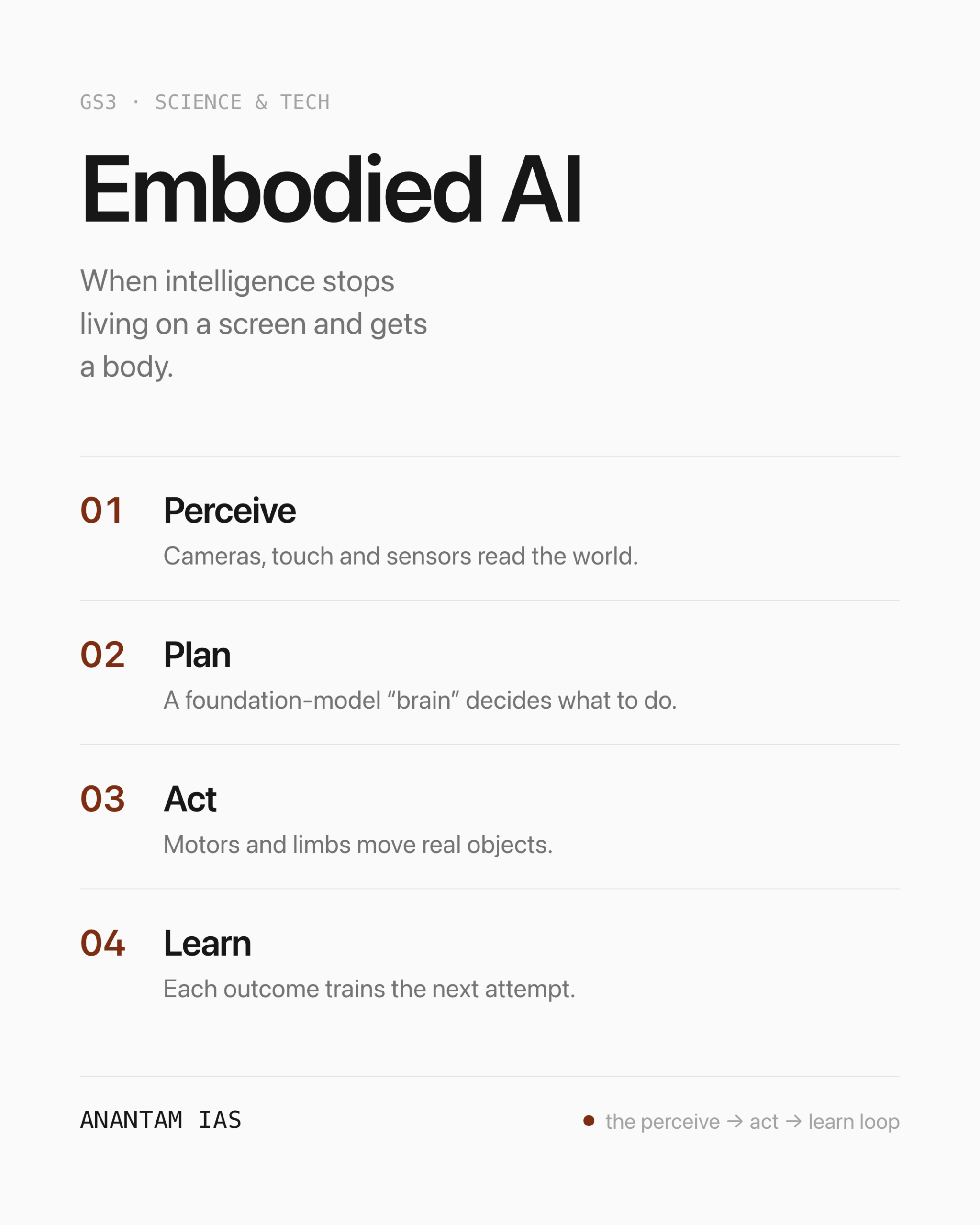
Start with the core distinction, because the whole topic turns on it. Most of the AI you have heard about is disembodied — it lives entirely in data and text, learning patterns from words, images or numbers and producing more words, images or numbers in return. A chatbot has never burned its hand on a stove, never felt a cup slip, never learned that a heavy box tips if you lift it from one side. Embodied AI is the opposite: it is intelligence wrapped in a physical body — sensors, motors, limbs — that learns by acting in the real world and feeling the consequences. The body is not an accessory bolted onto the brain. The body is part of how the thinking happens.
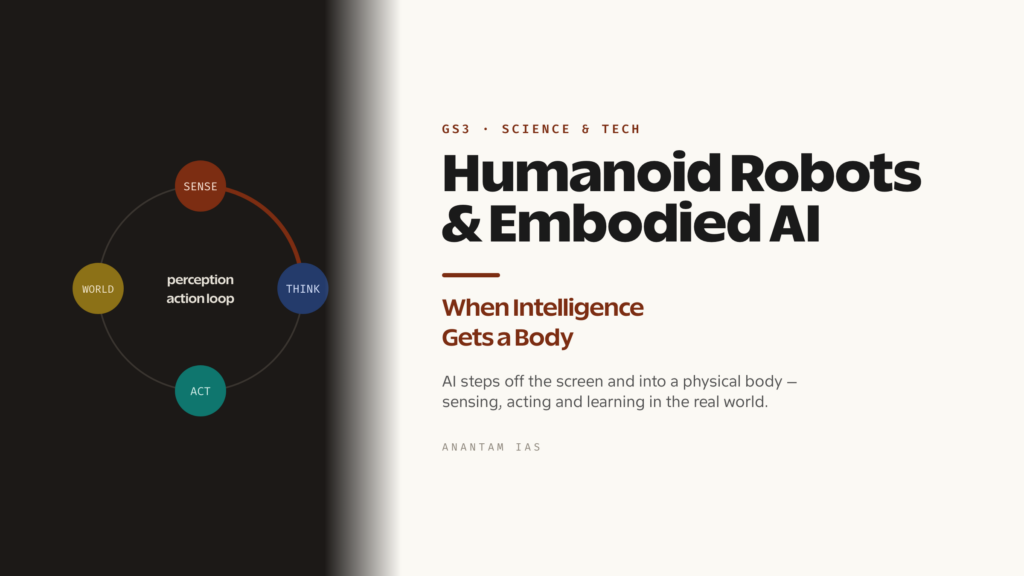
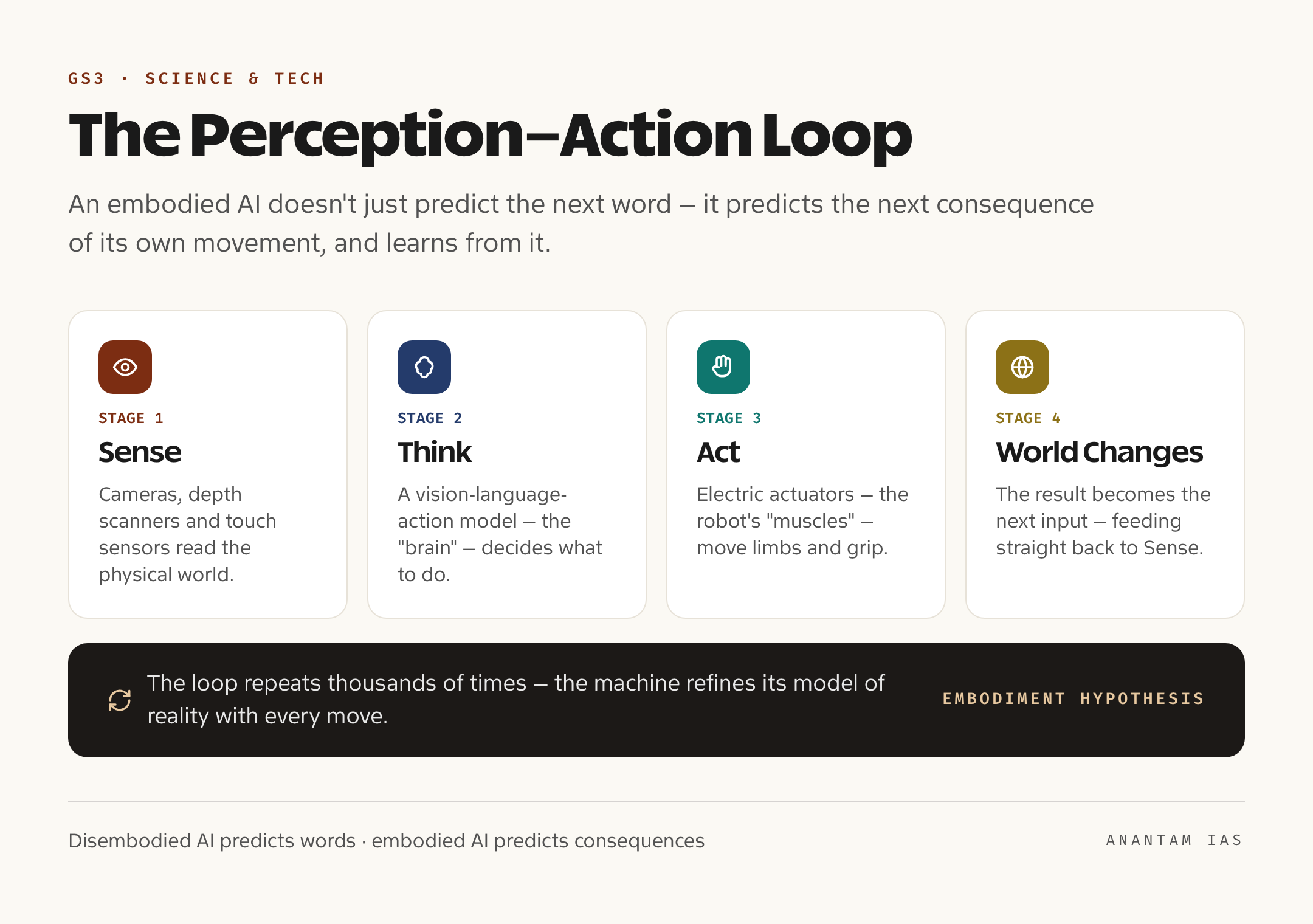
This is the heart of what researchers call the embodiment hypothesis — the idea that real intelligence cannot be separated from having a body and an environment to act in. A child does not learn what “heavy” or “wobbly” or “too hot” means from a dictionary; she learns it by grabbing, dropping and getting it wrong, thousands of times, until her body knows. The claim of embodied AI is that machines must learn the physical world the same way, through a continuous cycle that engineers call the perception-action loop. The robot perceives the world through cameras and touch sensors, decides on an action, moves, and then perceives how the world changed — and that change becomes the next input. Round and round it goes, the machine refining its model of reality with every step. A disembodied AI predicts the next word. An embodied AI predicts the next consequence of its own movement, which is a far harder and far more useful kind of knowing.
So why does this need a humanoid shape at all? A robot arm bolted to a factory floor is technically embodied too. But our entire built world — doorknobs, staircases, tool handles, car interiors, kitchen shelves — was designed around the human form. A machine with two legs, two arms and human-scale reach can, in principle, slot into any space a person works in without rebuilding the space first. That general-purpose promise is exactly what makes humanoid robots so commercially tempting, and so much harder to build than a single-task arm.
The Convergence That Finally Made Humanoids Possible
People have dreamed of walking robots for decades, so why now? The honest answer is that no single breakthrough did it — several separate technologies matured at once and met in the same machine, the way the smartphone needed cheap screens, fast chips and mobile data to arrive together. Four of those threads matter most, and an examiner rewards the candidate who can name them.
The first is hardware. Electric actuators — the “muscles” that move a robot’s joints — have become powerful, precise and far cheaper, while sensors like cameras, depth scanners and force detectors have fallen in price thanks to the smartphone and electric-vehicle supply chains. The second thread is the brain, and this is the genuinely new part. The same foundation models that gave us modern chatbots — and the same wave of autonomous, goal-seeking systems explained in our guide to agentic AI — have been adapted into what researchers call vision-language-action models, or VLA models. A VLA model takes in what the robot sees (vision) and a plain-language instruction (language) and outputs the actual motor commands to carry it out (action) — letting you tell a robot “pick up the red cup and put it in the sink” and have it work out the movements itself. In March 2026, Unitree open-sourced one such model, UnifoLM-VLA-0, that lets a humanoid perform household tasks straight from natural-language commands. This is the leap that turned humanoids from pre-programmed puppets into machines you can simply talk to.
The third thread is how these robots learn. Two methods do most of the work. In imitation learning, the robot copies a human — often a person wearing motion-capture gear or tele-operating the machine — and absorbs the demonstrated skill. In reinforcement learning, the robot learns by trial and error, getting a “reward” signal when it does well and adjusting until it improves, the way a toddler masters walking through countless small failures. The fourth thread ties the other three together and solves a brutal practical problem: a robot cannot fall down ten thousand times in a real factory without destroying itself. So it learns in simulation first. Engineers build a photorealistic, physics-accurate virtual world — NVIDIA’s Isaac platform is the best-known example — let the robot practise millions of times in software where failure is free, and then transfer the trained skill into the physical machine. That transfer is called sim-to-real, and getting it to work reliably is one of the central achievements behind today’s humanoids.
Who Is Building Them, and the New Robotics Race
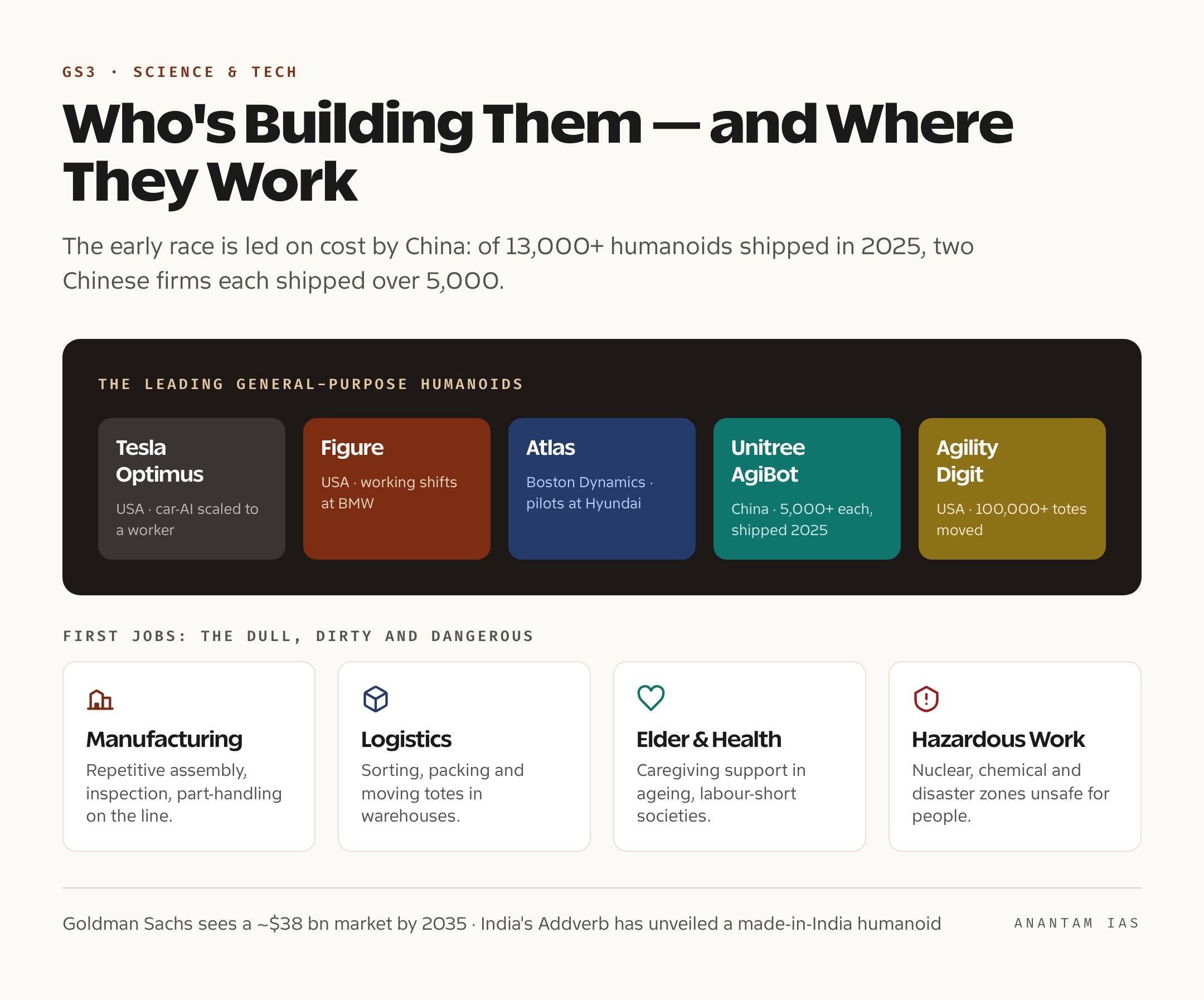
The list of serious builders is now long enough to feel like a race, and a few names anchor it. In the United States, Tesla is developing its Optimus humanoid, betting that the same AI and battery expertise behind its cars can be turned to a general-purpose worker. Figure, a younger company, has gone furthest into real deployment — its robots work at a BMW plant, and it has opened a factory aimed at producing one humanoid per hour. Boston Dynamics, long famous for back-flipping machines, has moved its electric Atlas into pilot testing at a Hyundai facility. Agility Robotics makes Digit, a warehouse-focused humanoid that has already moved more than a hundred thousand storage totes in live commercial use — a rare, concrete proof that these machines can do paid work, not just demos.
But the centre of gravity is shifting east, and this is the part of the story an Indian aspirant must not miss. China has thrown the full weight of an industrial state behind humanoids, treating them as a strategic frontier technology in its national planning. The results are stark. Of more than thirteen thousand humanoid robots shipped worldwide in 2025, two Chinese firms — Unitree and AgiBot — each shipped over five thousand, while American rivals like Tesla and Figure shipped only a few hundred apiece. Analysts at Morgan Stanley expect China’s humanoid sales to roughly double in 2026 to around twenty-eight thousand units. China’s edge is not yet the smartest robot; it is the cheapest one, built on an unmatched supply chain for motors, batteries and sensors. The same advantage that let China dominate electric vehicles and solar panels is now being pointed at robots — which is precisely why this is a geopolitical and not just a technological story.
What are all these machines actually for? The early use-cases are the dull, dirty and dangerous jobs, and they map cleanly onto an answer. In manufacturing and logistics, humanoids handle repetitive assembly, inspection and the endless moving of boxes in warehouses. In hazardous environments — nuclear plants, chemical facilities, disaster zones — they can go where it is unsafe to send a person. And further out, makers point to elder and healthcare support and to service roles, a pitch that resonates in ageing societies short of caregivers. The shape of the rollout is telling: start where the work is physically taxing, highly repetitive and easy to measure, then expand outward as the robots get more capable and cheaper.
What It Means for Jobs, the Economy and Society
Now the hard question, the one that earns marks in a GS3 or essay answer: if machines can do physical labour, what happens to the people who do it now? The optimists and pessimists are both partly right, and a strong answer holds the tension rather than picking a side. The bullish case is enormous. Goldman Sachs Research has sketched a path where the global market for humanoid robots could reach around thirty-eight billion dollars by 2035, with a far larger blue-sky figure if costs and public acceptance fall into place, and projects per-unit prices eventually settling near fifteen to twenty thousand dollars as production scales. The promise is a productivity surge — and, for ageing economies and labour-short factories, robots filling gaps that humans no longer can.
The anxious case is just as real. Repetitive manual work is exactly what these machines are built to absorb, and some industry estimates see such jobs shrinking by a tenth to a fifth globally within a decade. But the fuller picture is one of churn rather than pure loss. The World Economic Forum’s projections, for instance, expect technology to create far more jobs than it destroys over the same window — a large net gain globally — even as the destroyed jobs and the created jobs are rarely held by the same people, in the same places, with the same skills. That mismatch — old work vanishing in one town while new work appears in another, demanding different training — is the true social challenge, far more than any headline about a robot apocalypse.
There are sharper worries stacked behind the jobs question. Safety comes first: a powerful machine moving among people can injure, and the rules for certifying a humanoid as safe to share a workspace are still being written. Then privacy — a household or hospital robot is a walking sensor, watching and recording everything around it. There is the risk of concentration, where a handful of firms and one or two countries own the foundational technology of physical labour itself, much as a few firms now dominate digital AI. And there is the deeper ethical unease about machines in caregiving roles, where the human touch is part of the point. None of these cancel the promise; they are the guardrails a serious policy has to build alongside it.
India’s Stake: From Software Power to Physical AI
For India the question is pointed, because the country built its reputation on software — the disembodied kind of intelligence, and the broader story told in our explainer on artificial intelligence in India — and embodied AI plays to a different strength. India is a manufacturing aspirant with a vast, young workforce, which makes humanoids both an opportunity and a threat at once. The opportunity is to climb the value chain in advanced manufacturing rather than watch the robotics revolution happen elsewhere. The threat is that automation could erode the very labour-cost advantage on which “Make in India” partly rests. Walking the line between the two is the policy puzzle.
The good news is that India is no longer only a spectator. In early 2026, the Noida-based automation firm Addverb Technologies unveiled a made-in-India wheeled industrial humanoid, ELIXIS-W, built by Indian engineers and shown at the AI Impact Summit in New Delhi — with plans to build around a hundred units in its first year for warehouse, electronics and hazardous-industry deployment. Other firms such as GreyOrange in warehouse robotics and a clutch of IIT-linked startups round out a young but real ecosystem. According to NITI Aayog’s own figuring, the Indian robotics market was worth roughly three hundred and fifty million dollars in 2023 and is expected to reach about 1.6 billion dollars by 2028 — small by global standards, but growing fast.
Policy is beginning to catch up. NITI Aayog’s Frontier Tech Hub has laid out a roadmap to make India a leading advanced-manufacturing centre by 2035, folding robotics, AI and digital twins into a list of priority sectors. The Production Linked Incentive schemes that pulled electronics and component-making onshore are the obvious lever to extend toward robotics hardware, where India remains heavily import-dependent for the motors, actuators and high-end sensors a humanoid needs. The honest assessment is that India is early — strong in the AI software layer and in systems integration, weak in the precision-hardware supply chain that China has spent two decades building. Whether India can close that gap, rather than simply importing finished robots, is the single most important thing to watch, and the natural place to land a balanced conclusion in an answer.
For Your Mains Answer
This is a high-value topic for GS Paper 3, which covers science and technology, developments and applications of technology, and indigenisation — and it connects straight to the economy paper’s themes of manufacturing, employment and skilling. It also offers a rich, current example for the Essay paper on technology and society, or on machines and human work. The skill examiners reward is the one this article models: explain the concept of embodiment first, then layer the current facts and the India angle on top, and always hold the optimism and the anxiety in the same answer rather than choosing one.
How to Build the Answer
Move in a clean chain. Define embodied AI against ordinary disembodied AI (a body that learns by acting, not a mind behind a screen). Explain the convergence that enabled it — cheaper actuators and sensors, vision-language-action models as the brain, imitation and reinforcement learning, sim-to-real transfer. Map the global race, with China’s supply-chain lead as the standout fact. Weigh the economy-and-jobs impact as churn, not pure loss. Then bring it home to India — opportunity versus the labour-cost threat, Addverb and the startup base, NITI Aayog’s roadmap, and the hardware-import gap. Close with a judgement on where India should focus. That arc — define, enable, race, impact, India, evaluate — fits almost any question on the topic.
Common Mistakes to Avoid
Don’t treat “humanoid robot” and “AI” as the same thing — the point is the fusion of a physical body with a learning brain. Don’t describe it as pure job destruction; frame it as displacement plus creation, with a skills mismatch as the real problem. Don’t list company names without the underlying idea — Tesla and Unitree are illustrations, not the answer. And don’t ignore China’s lead or India’s hardware dependence; leaving out the supply-chain reality makes an answer read as naive.
A Compact Answer Spine
Embodied AI = intelligence in a body that learns through a perception-action loop, vs disembodied screen AI → enabled by cheaper actuators/sensors + vision-language-action models (the “brain”) + imitation/reinforcement learning + sim-to-real training → global race led on cost by China (Unitree and AgiBot each shipped 5,000+ of 13,000+ units in 2025) with Tesla, Figure, Boston Dynamics Atlas, Agility Digit in the West → economic impact = productivity gains (market ~$38 bn by 2035, Goldman Sachs) but job churn and a skills mismatch → India: opportunity in advanced manufacturing vs threat to labour-cost edge; Addverb’s ELIXIS-W, NITI Aayog roadmap, robotics market ~$1.6 bn by 2028, but import-dependent on precision hardware → verdict: invest in the hardware supply chain and reskilling, not just imports.
Diagram or Flowchart Idea
Sketch the perception-action loop as a simple cycle: Sensors → Perception → a VLA “brain” that Decides → Actuators that Act → the changed World → back to Sensors. Beside it, a tiny two-column “opportunity vs risk” box for India. A clean loop plus a balance box communicates both the concept and the policy tension at a glance.
A Balanced-Conclusion Line
A line that lands the marks: “Humanoid robots give intelligence a body — and hand India a choice: build the hardware and skills to ride the wave of physical AI, or watch its manufacturing ambitions automated by machines made elsewhere.”
How to Use Data Without Cramming
You need only four or five anchors, not a table: over 13,000 humanoids shipped in 2025 with Chinese firms leading; a market of roughly 38 billion dollars by 2035; Digit moving 100,000+ totes as proof of real work; and India’s robotics market at about 1.6 billion dollars by 2028. Attribute each plainly — “as Goldman Sachs estimates”, “according to NITI Aayog” — rather than dropping numbers without a source.
Frequently Asked Questions
What is the difference between embodied AI and ordinary AI?
Ordinary AI is disembodied — it learns from data and produces words, images or predictions on a screen, with no physical interaction. Embodied AI lives in a physical body — sensors, motors, limbs — and learns by acting in the real world through a continuous perception-action loop: it senses, decides, moves, and learns from how the world changes. A chatbot predicts the next word; an embodied AI predicts the next consequence of its own movement. Humanoid robots are the most ambitious form of embodied AI because their human shape lets them work in spaces built for people.
Why are humanoid robots suddenly viable now?
Because several technologies matured together. Electric actuators and sensors became cheaper and better, riding the smartphone and electric-vehicle supply chains. Foundation models were adapted into vision-language-action (VLA) models that let a robot turn a spoken instruction and what it sees into actual movement. And training methods — imitation learning, reinforcement learning, and sim-to-real transfer where robots practise millions of times in simulation before acting in the real world — finally made the skills reliable. No single breakthrough did it; the convergence did.
Which countries and companies lead the humanoid robot race?
The United States has the best-known names — Tesla’s Optimus, Figure, Boston Dynamics’ Atlas and Agility’s Digit. But China leads on volume and cost: of more than 13,000 humanoids shipped in 2025, Chinese firms Unitree and AgiBot each shipped over 5,000, far ahead of Western rivals, backed by state support and an unmatched hardware supply chain. The race is less about whose robot is smartest and more about who can make capable robots cheaply at scale.
Will humanoid robots take away jobs in India?
They will reshape work more than simply erase it. Robots are aimed first at repetitive, hazardous and physically taxing jobs, so some manual roles will shrink — but new roles in building, programming, maintaining and supervising robots will grow. The real challenge is the mismatch: the lost and created jobs are rarely held by the same people, so reskilling matters enormously. For India, automation is both an opportunity to climb the manufacturing value chain and a risk to its labour-cost advantage, which is why policy and skilling responses are as important as the technology itself.
Practice Questions
Prelims MCQs
- With reference to “embodied AI”, which of the following best describes it?
(a) An AI system that exists only as software and processes text or images
(b) Intelligence integrated into a physical body that learns by acting in the real world through a perception-action loop
(c) A method of storing AI models on edge devices
(d) An AI that can only operate inside a simulation
Answer: (b) Embodied AI is intelligence in a physical body — sensors, motors, limbs — that perceives, acts and learns from the consequences in the real world, unlike disembodied screen-based AI. - In the context of robotics, a “vision-language-action (VLA) model” performs which function?
(a) Translates between human languages in real time
(b) Converts what a robot sees plus a natural-language instruction into motor commands
(c) Compresses video for transmission
(d) Encrypts a robot’s sensor data
Answer: (b) A VLA model takes visual input and a plain-language instruction and outputs the actions, letting a robot carry out commands like “pick up the red cup” without explicit programming. - “Sim-to-real” transfer in robotics refers to which of the following?
(a) Selling simulation software to real customers
(b) Training a robot’s skills in a virtual physics simulation and then transferring them to the physical machine
(c) Replacing real robots with virtual avatars
(d) Converting analog sensor signals to digital
Answer: (b) Robots practise millions of times in a photorealistic, physics-accurate simulation where failure is free, then the learned policy is transferred to the real robot — this is sim-to-real. - Which pair correctly matches a learning method with its description?
(a) Imitation learning — learning purely through trial and error with reward signals
(b) Reinforcement learning — copying a human demonstrator’s movements
(c) Imitation learning — copying a human demonstrator; Reinforcement learning — trial and error guided by rewards
(d) Both methods require no data at all
Answer: (c) Imitation learning copies a human demonstrator, while reinforcement learning improves through trial and error guided by a reward signal. - As of 2025, which statement about the global humanoid robot market is correct?
(a) Western firms like Tesla and Figure shipped the most units
(b) No humanoid robots had yet been deployed for paid commercial work
(c) Chinese firms such as Unitree and AgiBot led global shipments, each shipping over 5,000 units
(d) India was the largest manufacturer of humanoid robots
Answer: (c) Of more than 13,000 humanoids shipped in 2025, the Chinese firms Unitree and AgiBot each shipped over 5,000, well ahead of Western makers, helped by state backing and a strong hardware supply chain.
Mains Practice Questions
- Distinguish between disembodied AI and embodied AI. Explain how the “embodiment hypothesis” and the perception-action loop change the way machines learn about the physical world. (15 marks, 250 words)
- “No single breakthrough created the humanoid robot; a convergence did.” Discuss the principal technological threads — actuators and sensors, vision-language-action models, imitation and reinforcement learning, and sim-to-real transfer — that have made general-purpose humanoid robots viable. (15 marks, 250 words)
- Examine the economic and labour-market implications of widespread humanoid-robot adoption. Why is “job churn” a more accurate frame than “job destruction”, and what policy responses does this demand? (15 marks, 250 words)
- Critically analyse the geopolitics of the humanoid robot race, with particular reference to China’s supply-chain advantage and its strategic implications for India. (10 marks, 150 words)
- Evaluate India’s position in the emerging field of embodied AI and humanoid robotics. What are the opportunities and risks for a labour-rich manufacturing aspirant, and what should policy prioritise? (15 marks, 250 words)
Tell Google you want more of this.
Add Anantam IAS as a preferred sourceOne tap, and this site shows up more often in your own Top Stories, AI Overviews and AI Mode. Remove it any time.