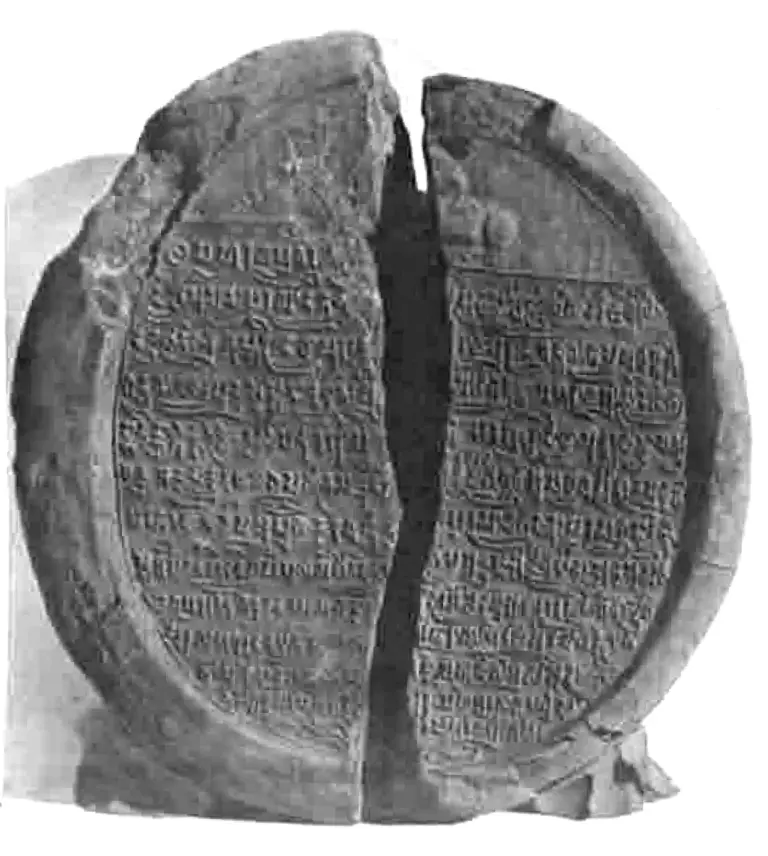
The Jnanpith Award (also spelled Gyanpith) is the highest literary honour in India, conferred annually on an author for their “outstanding contribution towards literature.” Instituted in 1961 by the Bharatiya Jnanpith, a literary and research organisation founded by the Sahu Jain family, the award carries immense prestige and has recognised works in nearly all major Eighth Schedule languages of the Indian Constitution. The award includes a cash prize, a citation, and the iconic Vagdevi (Saraswati) bronze statuette.
For UPSC, the Jnanpith Award frequently appears in Prelims (factual questions on winners, year of institution, and awarding body) and in Art & Culture sections of GS1 Mains.
The most recent laureate is Vinod Kumar Shukla, the Chhattisgarh-based Hindi poet and novelist selected for the 59th Jnanpith Award (for 2024), announced in March 2025 — the first Jnanpith recipient from Chhattisgarh.
Key Facts at a Glance
| Feature | Detail |
|---|---|
| Full name | Jnanpith Award (Jnanpith Puraskar) |
| Instituted | 1961 |
| First awarded | 1965 (for the year 1965) |
| Presented by | Bharatiya Jnanpith (a trust under the Times of India Group / Sahu Jain family) |
| Award components | Cash prize of Rs 11 lakh, a citation plaque, and a Vagdevi (Saraswati) bronze statuette |
| Eligibility | Indian citizen; work must be in any language listed in the Eighth Schedule of the Constitution |
| Selection | By a selection board appointed by the Bharatiya Jnanpith; includes literary experts and past winners |
| Frequency | Annual (though in some years the award was given retrospectively) |
History and Evolution
- 1961: Bharatiya Jnanpith Trust established the award to promote Indian literature in Indian languages
- 1965: First award given to G. Sankara Kurup (Malayalam) for his poetry collection Odakkuzhal (The Bamboo Flute)
- Initially, the award was given for a single work; later the criteria shifted to recognise an author's entire body of work (lifetime contribution)
- English was added as an eligible language in 1982 (Eighth Schedule was not the original constraint; the award body broadened eligibility)
- The award has been presented for works in over 15 Indian languages including Hindi, Kannada, Bengali, Malayalam, Urdu, Gujarati, Tamil, Telugu, Marathi, Odia, Assamese, and Konkani
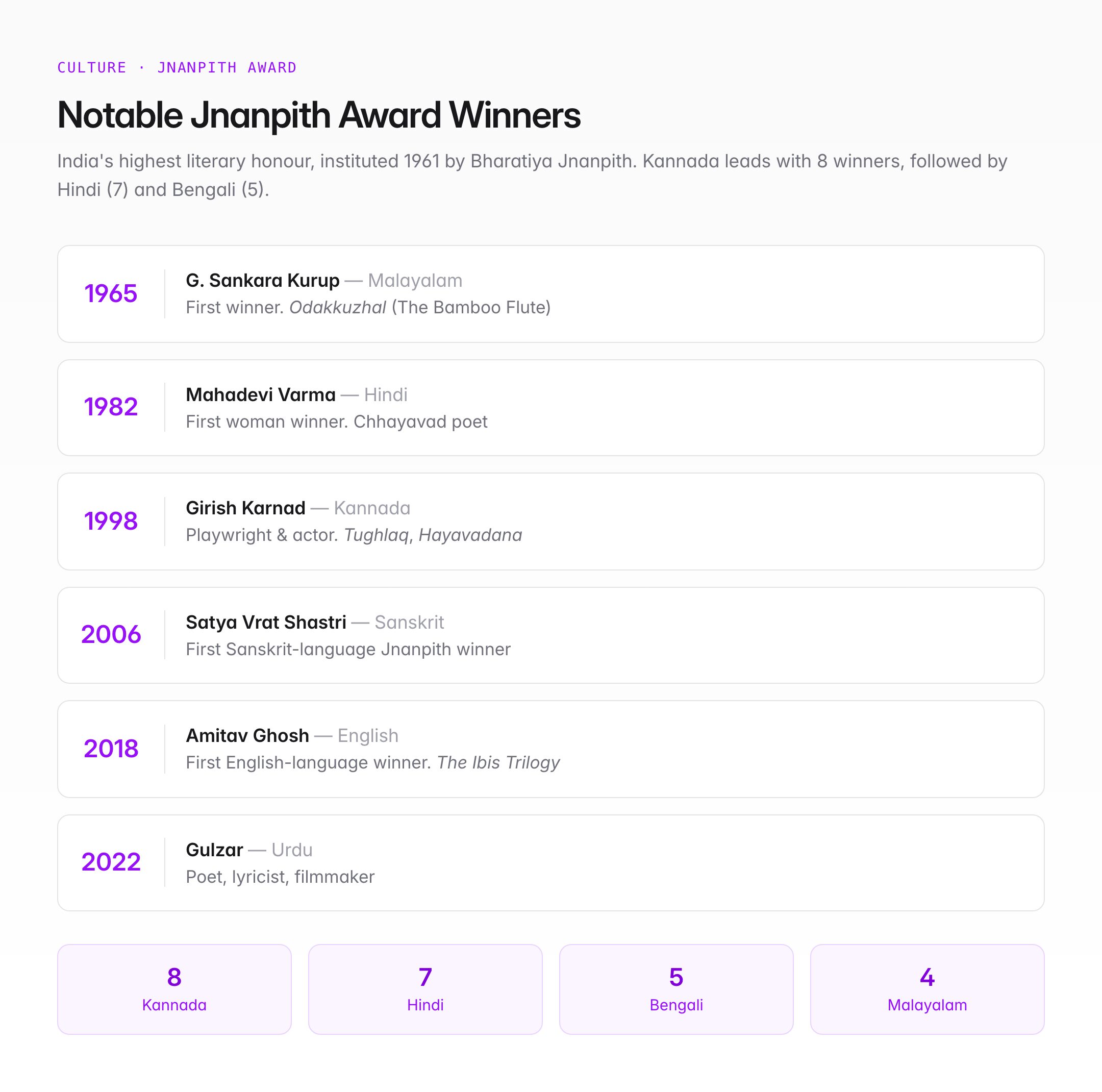
Notable Jnanpith Award Winners
| Year | Winner | Language | Notable Work/Contribution |
|---|---|---|---|
| 1965 | G. Sankara Kurup | Malayalam | Odakkuzhal; pioneer of modern Malayalam poetry |
| 1966 | Tarasankar Bandyopadhyay | Bengali | Ganadevata; chronicler of rural Bengal |
| 1967 | Kuppali Venkatappa Puttappa (Kuvempu) | Kannada | Sri Ramayana Darshanam; "Rashtrakavi" of Karnataka |
| 1968 | Umashankar Joshi | Gujarati | Nishitha; modernist Gujarati poet |
| 1970 | Viswanatha Satyanarayana | Telugu | Ramayana Kalpavriksham; Telugu literary giant |
| 1971 | Bishnu Dey | Bengali | Modernist poet influenced by French symbolism |
| 1973 | Dattatreya Ramachandra Bendre (Da Ra Bendre) | Kannada | Naaku Tanti; "Varakavi" of Kannada literature |
| 1974 | Vishnu Sakharam Khandekar | Marathi | Yayati; philosophical novel |
| 1978 | S.H. Vatsyayan 'Agyeya' | Hindi | Pioneer of Nai Kavita (New Poetry) movement |
| 1982 | Mahadevi Varma | Hindi | First woman winner; Chhayavad poet |
| 1984 | Thakazhi Sivasankara Pillai | Malayalam | Chemmeen, Kayar; realist novelist |
| 1988 | C. Narayana Reddy | Telugu | Viswambhara; modern Telugu poetry |
| 1991 | Subhas Mukhopadhyay | Bengali | Revolutionary Bengali poet |
| 1994 | U.R. Ananthamurthy | Kannada | Samskara; pioneer of Navya literary movement |
| 1998 | Girish Karnad | Kannada | Playwright, actor; Tughlaq, Hayavadana |
| 2006 | Satya Vrat Shastri | Sanskrit | First Sanskrit-language Jnanpith winner |
| 2007 | O.N.V. Kurup | Malayalam | Lyricist and poet of Kerala |
| 2011 | Pratibha Ray | Odia | Yajnaseni; contemporary Odia novelist |
| 2015 | Raghuveer Chaudhari | Gujarati | Amrita; modernist Gujarati fiction |
| 2018 | Amitav Ghosh | English | First English-language Jnanpith winner; The Shadow Lines, The Ibis Trilogy |
| 2021 | Damodar Mauzo | Konkani | Karmelin; chronicler of Goan life |
| 2022 | Gulzar | Urdu | Poet, lyricist, filmmaker |
| 2023 | Jagadguru Rambhadracharya | Sanskrit | Vedic scholar and poet; second Sanskrit recipient |
| 2024 | Vinod Kumar Shukla | Hindi | Naukar Ki Kameez; poet-novelist, first Jnanpith laureate from Chhattisgarh (59th award, announced March 2025) |
Note: Kannada has produced the most Jnanpith winners (8), followed by Hindi (7) and Bengali (5).
Language-Wise Distribution
| Language | Number of Winners |
|---|---|
| Kannada | 8 |
| Hindi | 7 |
| Bengali | 5 |
| Malayalam | 4 |
| Marathi | 4 |
| Gujarati | 3 |
| Telugu | 3 |
| Odia | 2 |
| Urdu | 2 |
| Tamil | 2 |
| Assamese | 2 |
| Sanskrit | 2 |
| Konkani | 1 |
| English | 1 |
Vagdevi Statuette
The physical award is a bronze statuette of Vagdevi (another name for Saraswati, the Hindu goddess of learning and arts). The idol was designed by the sculptor Shanku, and it has remained the symbol of the Jnanpith Award since its inception. The statuette depicts Saraswati seated, holding a veena and a book — representing the twin dimensions of creative and scholarly literature.
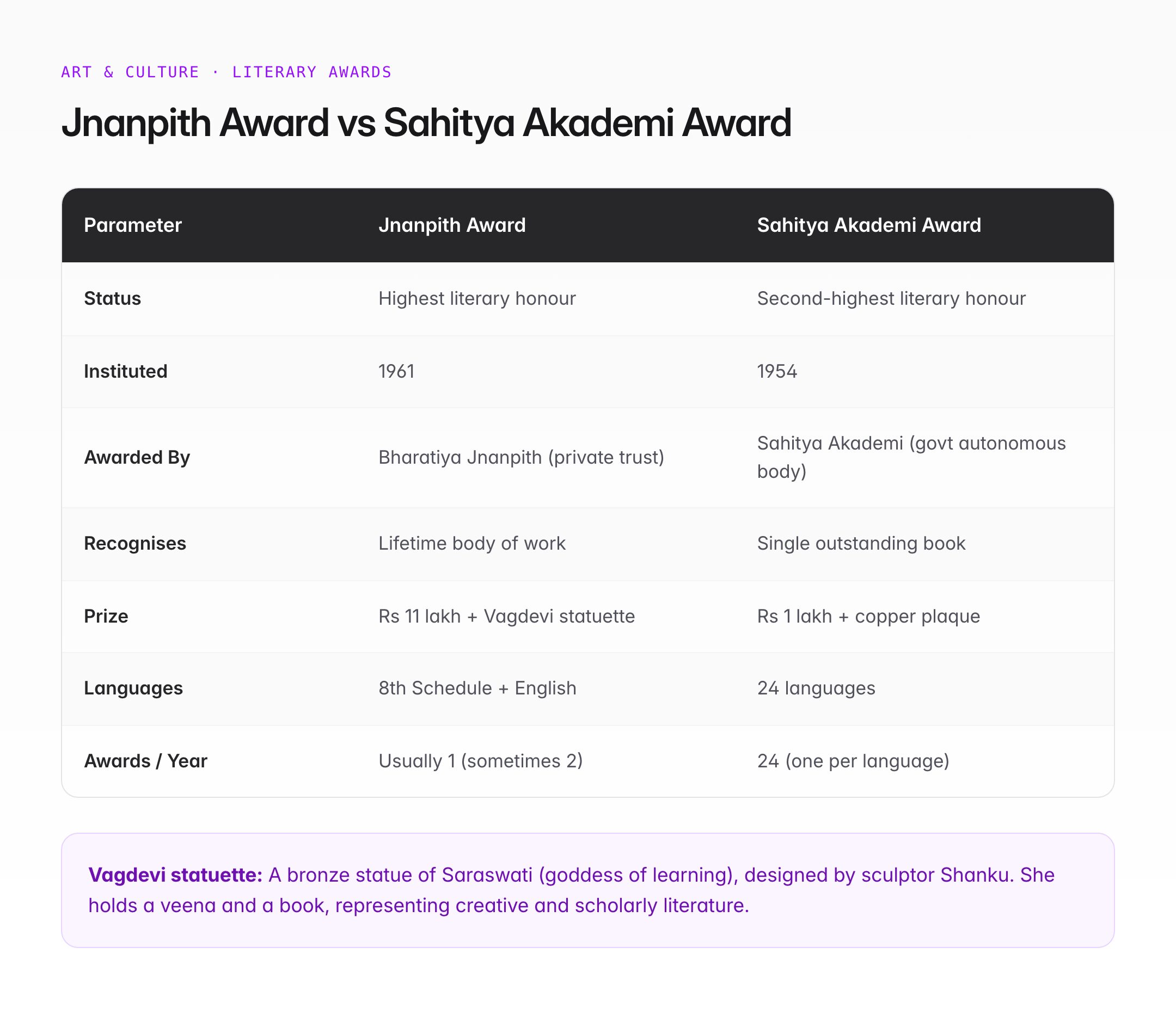
Jnanpith Award vs Sahitya Akademi Award — Comparison
| Parameter | Jnanpith Award | Sahitya Akademi Award |
|---|---|---|
| Status | Highest literary honour in India | Second-highest literary honour |
| Instituted | 1961 | 1954 |
| Awarded by | Bharatiya Jnanpith (private trust) | Sahitya Akademi (autonomous body under Ministry of Culture) |
| Eligibility | Eighth Schedule languages + English; lifetime body of work | 24 languages (22 Eighth Schedule + English + Rajasthani); single published work |
| Prize | Rs 11 lakh + Vagdevi statuette | Rs 1 lakh + copper plaque |
| Scope | Recognises overall contribution to Indian literature | Recognises the most outstanding book published in the preceding six years |
| Number of awards per year | Usually 1 (sometimes 2) | 24 (one per recognised language) |
| Notable distinction | Government recognition but privately administered | Government-funded; has faced controversies over returns of awards |
Selection Process
- An Advisory Committee of literary scholars and past winners nominates candidates
- A Selection Board appointed by the Bharatiya Jnanpith evaluates nominees
- The board considers the author's entire body of work, not a single publication (post-reform)
- The decision is announced publicly, and the award is presented at a formal ceremony, often by the President or Vice President of India
UPSC Relevance
GS Paper I: Art and Culture — Literary awards, Indian languages, contribution of Indian literature to cultural identity.
Prelims: Factual questions on winners, languages, awarding body, first winner, and comparisons with other awards.
Key Points for Prelims
- Jnanpith Award is India's highest literary honour, instituted in 1961
- First winner: G. Sankara Kurup (Malayalam, 1965)
- Awarded by Bharatiya Jnanpith (private trust, Sahu Jain family / Times of India Group)
- Award includes the Vagdevi (Saraswati) bronze statuette
- Kannada has the most winners (8 as of 2023)
- First woman winner: Mahadevi Varma (Hindi, 1982)
- First English-language winner: Amitav Ghosh (2018)
- First Sanskrit winner: Satya Vrat Shastri (2006)
- Latest (59th) laureate: Vinod Kumar Shukla (Hindi, for 2024, announced March 2025)
- The award recognises lifetime contribution, not a single work (post-reform criteria)
- Sahitya Akademi Award is given for a single outstanding work; Jnanpith is for overall body of work
Tell Google you want more of this.
Add Anantam IAS as a preferred sourceOne tap, and this site shows up more often in your own Top Stories, AI Overviews and AI Mode. Remove it any time.