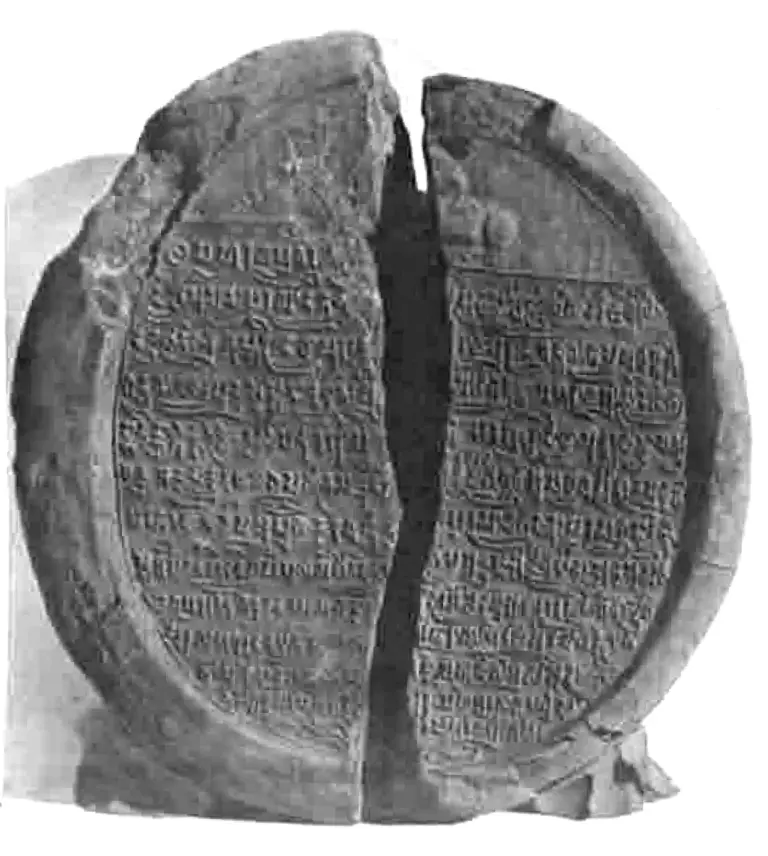
The Sahitya Akademi Award is India's most prestigious literary honour conferred by the Sahitya Akademi (National Academy of Letters). Established in 1954, the award recognises outstanding literary works published in any of the 24 languages recognised by the Akademi. For UPSC aspirants, the Sahitya Akademi Award is relevant to Indian culture, art, and literature — topics that appear in both Prelims and GS Paper I of Mains.
The Sahitya Akademi — An Overview
The Sahitya Akademi was inaugurated on 12 March 1954 by the Government of India as an autonomous body to promote Indian literature across languages. Key facts:
- Headquarters: Rabindra Bhavan, New Delhi.
- Status: Autonomous body under the Ministry of Culture. It is registered as a society under the Societies Registration Act, 1860.
- President: Elected by the General Council from among eminent literary figures.
- Functions:
- Promote and coordinate literary activities across India.
- Publish literary works, translations, and journals.
- Maintain a library of Indian literature.
- Confer awards and fellowships.
The Akademi is not a government department — it functions independently, though it receives a grant from the Government of India.
The 24 Languages
The Sahitya Akademi recognises 24 languages for its awards. These include the 22 languages in the Eighth Schedule of the Constitution, plus English and Rajasthani:
| # | Language | # | Language |
|---|---|---|---|
| 1 | Assamese | 13 | Manipuri |
| 2 | Bengali | 14 | Marathi |
| 3 | Bodo | 15 | Nepali |
| 4 | Dogri | 16 | Odia |
| 5 | English | 17 | Punjabi |
| 6 | Gujarati | 18 | Rajasthani |
| 7 | Hindi | 19 | Sanskrit |
| 8 | Kannada | 20 | Santali |
| 9 | Kashmiri | 21 | Sindhi |
| 10 | Konkani | 22 | Tamil |
| 11 | Maithili | 23 | Telugu |
| 12 | Malayalam | 24 | Urdu |
Note: Rajasthani is not in the Eighth Schedule but is recognised by the Akademi. Conversely, all 22 Eighth Schedule languages are included.
The Sahitya Akademi Award
Nature and Prestige
- Conferred annually since 1955 (first awards announced for works published in the year 1954).
- Given for the most outstanding literary work in each of the 24 recognised languages.
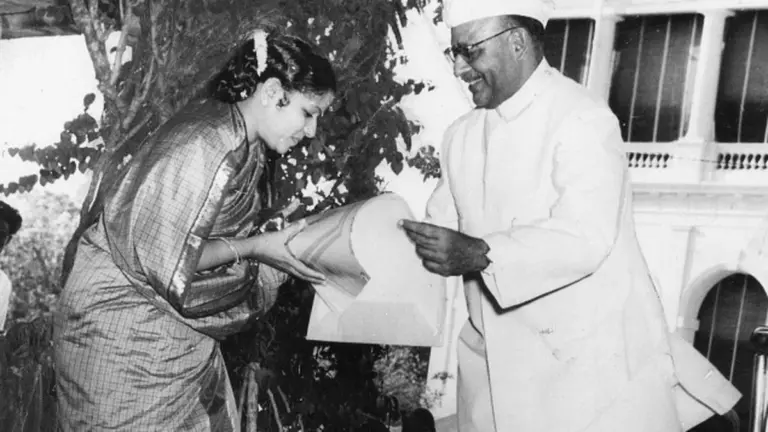
- The award consists of a copper plaque (engraved with the Akademi's emblem) and a cash prize (currently Rs. 1,00,000).
- Up to 24 awards are given each year (one per language), though in some years an award in a particular language may not be given.
Eligible Works
- The work must be published in book form during the five years immediately preceding the year of the award.
- Genres include poetry, fiction (novel/short stories), drama, essay, criticism, literary biography/autobiography, epic poetry, and translation.
- The work must be an original composition or a creative translation.
- Only works by Indian citizens are eligible.
Selection Process
The selection follows a rigorous, multi-stage process:
- Language advisory boards — Each of the 24 languages has an advisory board of literary experts who prepare a preliminary list of eligible works.
- Jury panels — A three-member jury is constituted for each language, comprising eminent scholars and writers. The jury recommends one work from the shortlist.
- Executive Board — The Akademi's Executive Board considers the jury recommendations and approves the final list of awardees.
- No self-nomination — Authors cannot nominate their own works.
- No posthumous awards — The award is given only to living authors (if the author dies after the work's nomination but before the announcement, exceptions may apply).
Award Ceremony
- Awards are presented at a formal ceremony usually held in New Delhi.
- The ceremony is presided over by the President of the Sahitya Akademi and often attended by the President or Vice-President of India.
Other Awards and Fellowships by the Sahitya Akademi
| Award/Fellowship | Description |
|---|---|
| Sahitya Akademi Fellowship | The highest honour; conferred on a "literary immortal." Limited to 21 living fellows at any time. Recipients include R.K. Narayan, Amitav Ghosh, and Girish Karnad. |
| Bhasha Samman | For significant contribution to languages not in the 24 recognised languages (e.g., Tulu, Bhili, Lepcha). |
| Translation Prize | For outstanding translations between Indian languages. |
| Bal Sahitya Puraskar | For children's literature in the 24 languages. |
| Yuva Puraskar | For young writers (below 35 years) in the 24 languages. |
Notable Sahitya Akademi Award Winners
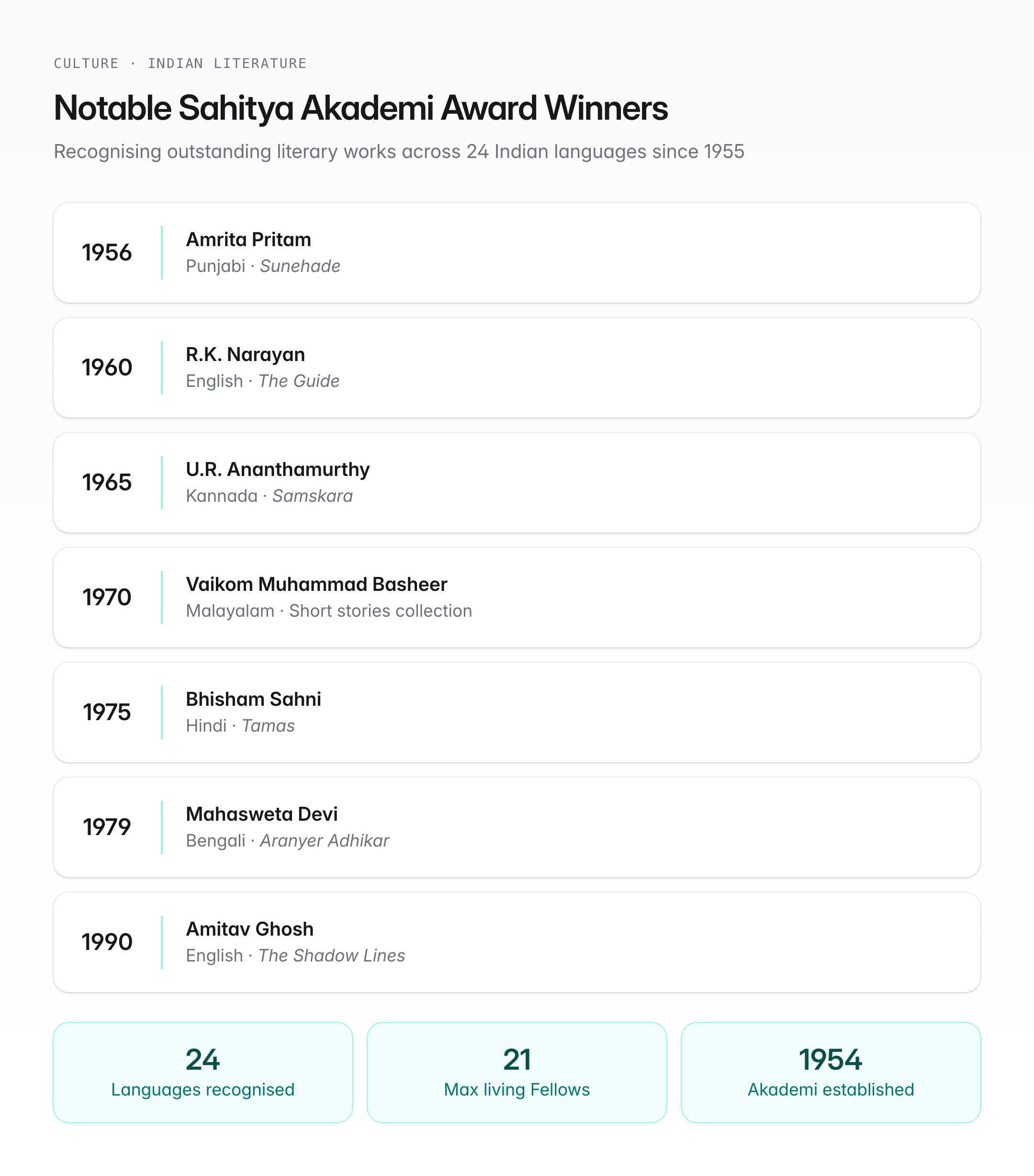
| Winner | Language | Work | Year |
|---|---|---|---|
| R.K. Narayan | English | The Guide | 1960 |
| Amrita Pritam | Punjabi | Sunehade | 1956 |
| Mahasweta Devi | Bengali | Aranyer Adhikar | 1979 |
| Vaikom Muhammad Basheer | Malayalam | Short stories collection | 1970 |
| Bhisham Sahni | Hindi | Tamas | 1975 |
| U.R. Ananthamurthy | Kannada | Samskara | 1965 |
| Amitav Ghosh | English | The Shadow Lines | 1990 |
| Jhumpa Lahiri | English | Translated work (from Italian) | — (Fellowship) |
Sahitya Akademi Award vs Jnanpith Award
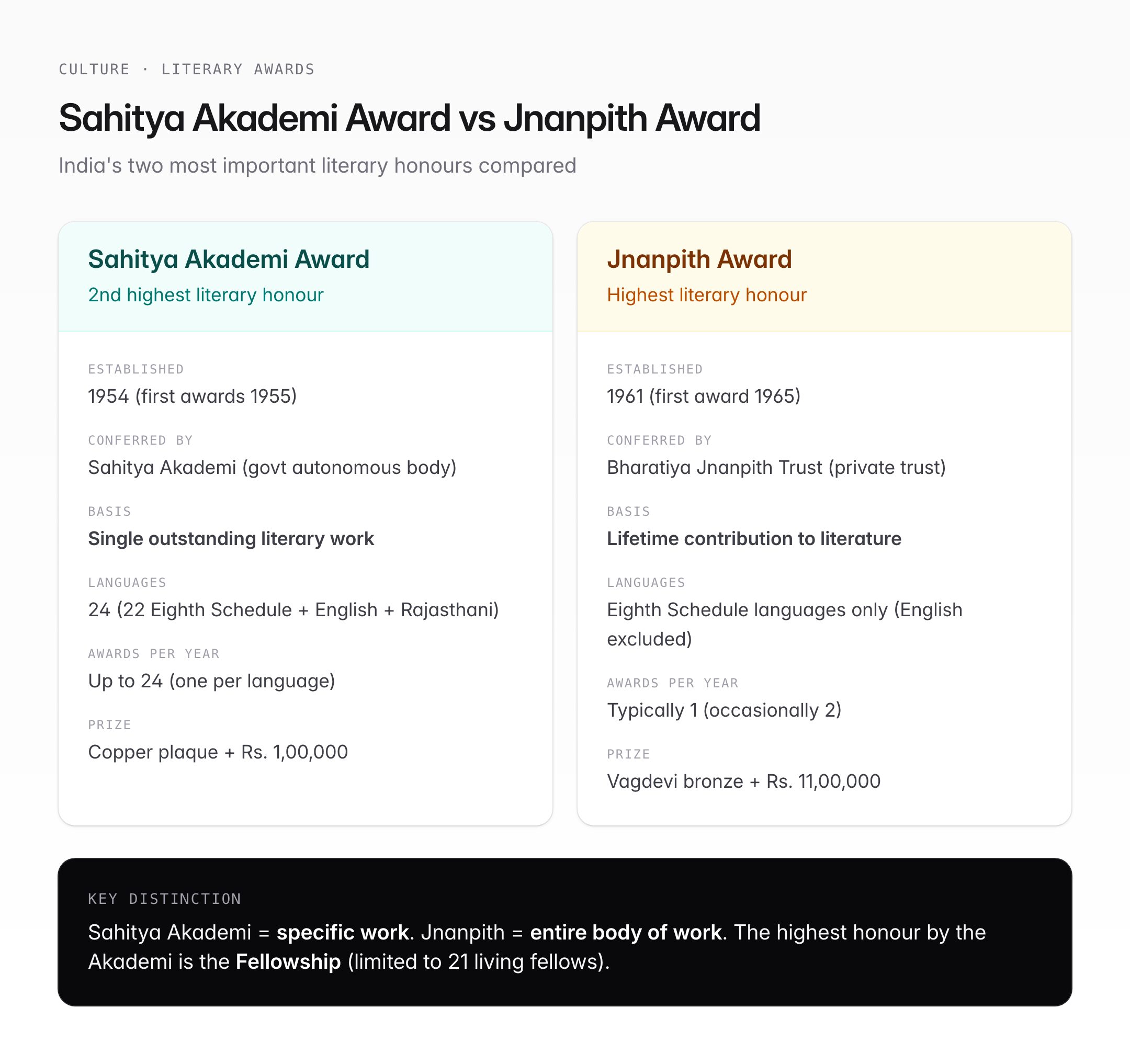
| Feature | Sahitya Akademi Award | Jnanpith Award |
|---|---|---|
| Established | 1954 (first awards 1955) | 1961 (first award 1965) |
| Conferred by | Sahitya Akademi (government autonomous body) | Bharatiya Jnanpith Trust (private trust) |
| Basis | For a single outstanding literary work | For lifetime contribution to literature |
| Languages | 24 languages (22 Eighth Schedule + English + Rajasthani) | Languages listed in the Eighth Schedule only (English excluded until 1982 policy) |
| Number per year | Up to 24 (one per language) | Typically 1 (occasionally 2) |
| Cash prize | Rs. 1,00,000 | Rs. 11,00,000 |
| Award object | Copper plaque | Bronze replica of Vagdevi (Saraswati) |
| Prestige ranking | Second-highest literary honour | Highest literary honour in India |
| English works | Eligible | Not eligible (only Eighth Schedule languages) |
Key distinction: The Sahitya Akademi Award is for a specific work; the Jnanpith Award recognises a writer’s entire body of work. The Jnanpith is considered the higher honour.
Controversies
- Award returns (2015) — Several writers returned their Sahitya Akademi Awards to protest the Akademi's silence on issues of intolerance and attacks on writers/rationalists (including the murder of M.M. Kalburgi). This sparked a nationwide debate on free expression and institutional autonomy.
- Language politics — Occasionally, disputes arise over the inclusion/exclusion of languages and the quality of jury processes.
- Autonomy concerns — Critics have questioned whether the Akademi maintains adequate independence from government influence.
UPSC Relevance
GS Paper I — Culture: Indian literature; art and architecture; cultural institutions.
Prelims key facts:
- The Sahitya Akademi was established in 1954 with headquarters at Rabindra Bhavan, New Delhi.
- It recognises 24 languages — the 22 Eighth Schedule languages plus English and Rajasthani.
- The Sahitya Akademi Award is for the most outstanding work in each language; the Jnanpith Award is for lifetime contribution.
- The Sahitya Akademi Fellowship is the highest honour — limited to 21 living fellows.
- The Jnanpith Award is conferred by the Bharatiya Jnanpith Trust (private), not the government.
- The Akademi is an autonomous body, not a government department.
- The Bhasha Samman is given for contributions to languages outside the 24 recognised languages.
- The 2015 award-return controversy was linked to concerns about intolerance and freedom of expression.
Tell Google you want more of this.
Add Anantam IAS as a preferred sourceOne tap, and this site shows up more often in your own Top Stories, AI Overviews and AI Mode. Remove it any time.