
Administrative biography is usually handled as a list of names attached to adjectives — Seshan the strict, Sreedharan the punctual, Khemka the transferred. An adjective transfers nothing. What transfers is the structure of a decision: what the officer actually had available, which of it they used, and what the institution did to them afterwards.
So the careers below are set out as one lesson each, with the price attached. An account that omits the price is a slogan rather than a lesson. Some of these officers achieved permanent change; others were broken and achieved little beyond demonstrating that the attempt was possible. The difference between the two groups is the most instructive material in the subject, and it is not a difference in character.
Why Careers Teach What Codes Cannot
A conduct code is a list of prohibitions. The All India Services (Conduct) Rules, 1968 tell an officer what not to accept, not to influence and not to say. That is necessary and very limited, because almost no real administrative difficulty takes the form of a temptation the rules name. It takes the form of a lawful instruction, from a person with authority over your career, to reach a defensible conclusion you believe is wrong.
Careers supply three things a code cannot: a repertoire of the moves actually available inside a hierarchy, which nobody writes down; a cost schedule, meaning what the institution does back and how survivable it is; and a counterexample to the belief, which sets in early in most careers, that nothing can be done from where you sit. The worked situations in ethics case studies on political pressure train the same reflex on hypotheticals.
The limitation should be conceded first. Each career is a single case with no control group, remembered selectively and reconstructed after the outcome was known. Read for mechanisms, not for inspiration.
T. N. Seshan: The Power Was Already There
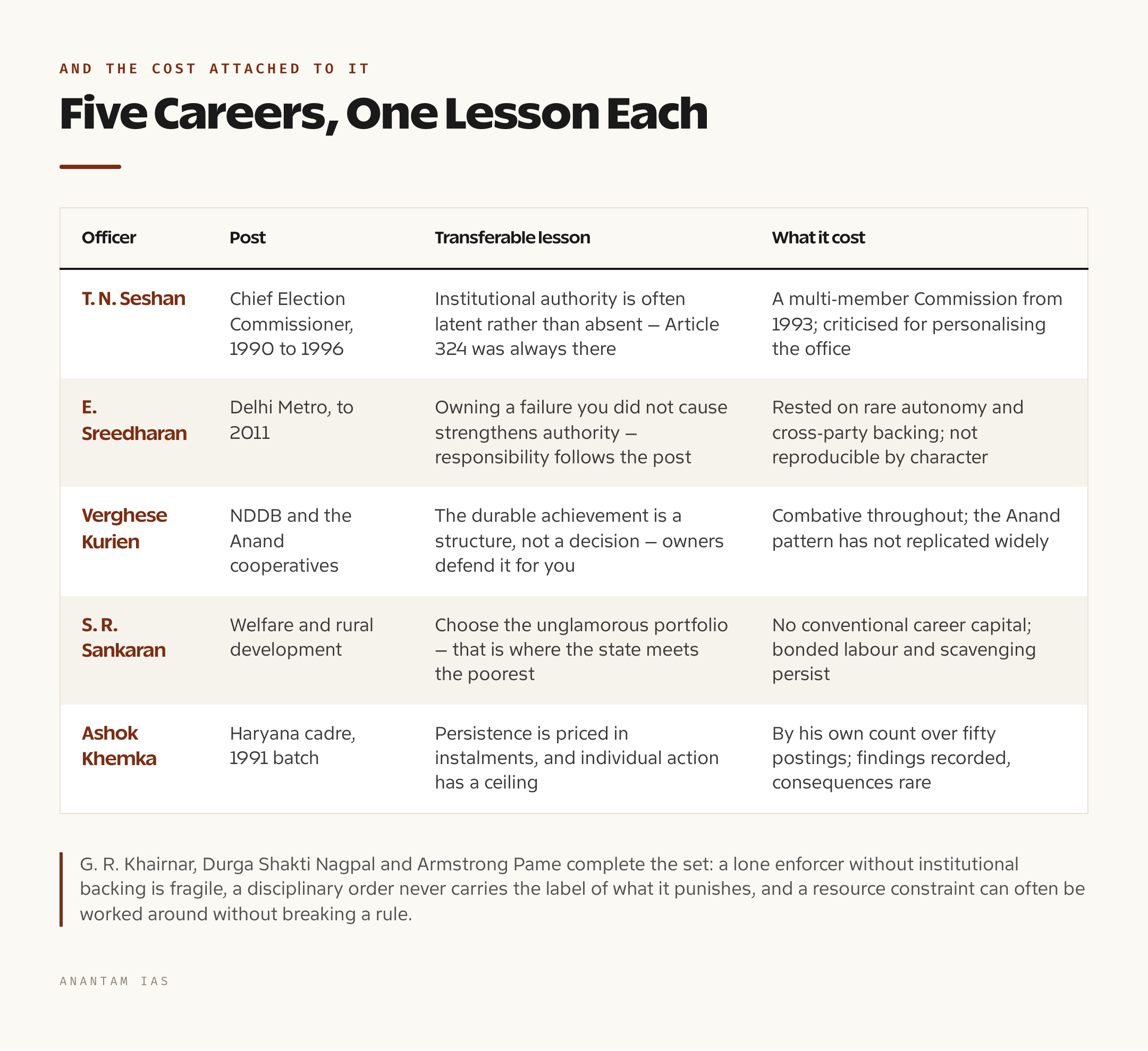
T. N. Seshan was Chief Election Commissioner from December 1990 to December 1996, and almost nothing he used was new. Article 324 had vested the superintendence, direction and control of elections in the Commission since 1950. The Representation of the People Act, 1951 was on the statute book. The model code existed as an understanding. He treated all of it as operative: enforcing the code against ruling parties, requiring candidates to file expenditure accounts and disqualifying those who did not, countermanding polls that had not been free, deferring elections until conditions permitted a real one, and forcing the elector photo identity card into existence against resistance. He received the Ramon Magsaysay Award in 1996.
The lesson is that institutional authority is frequently latent rather than absent. Powers lapse from disuse and are then described as though they had never existed.
Part of the cost was self-inflicted. Seshan was abrasive by choice and spoke of the Commission in the first person. The government’s reply was structural: two additional Election Commissioners were appointed in 1993, and in T. N. Seshan v. Union of India (1995) the Supreme Court upheld the multi-member Commission and held that the Chief Election Commissioner is not superior to his colleagues. Whether that diminished the office or sensibly insulated it from any single occupant is genuinely arguable. He later contested the presidential election of 1997 and a Lok Sabha seat in 1999, losing both, which gave weight to the criticism that he had personalised an office meant to outlast him.
E. Sreedharan: Owning a Failure You Did Not Cause
E. Sreedharan’s record predates the Delhi Metro. In 1963, after a cyclone destroyed part of the Pamban rail bridge, he was given a restoration target measured in months and finished in forty-six days. He worked on the Kolkata Metro, headed the Konkan Railway project, and led the Delhi Metro Rail Corporation from its early years until 2011, receiving the Padma Shri in 1988 and the Padma Vibhushan in 2008.
Two mechanisms did most of the work, and neither is a personality trait. Deadlines were announced publicly in advance, which converted delay from an occupational hazard into a visible failure with an owner. And the corporation was built with functional autonomy, so that the person accountable for the schedule controlled the decisions determining it.
In July 2009 a girder under construction collapsed at Zamrudpur on a Phase II line, killing workers. Sreedharan offered his resignation; it was not accepted. The lesson is that accepting responsibility for a failure you did not cause strengthens authority rather than weakening it, and the reason is structural rather than sentimental. The offer establishes that responsibility follows the post and not the act, which is the only premise on which the head of an organisation can hold subordinates to the same standard. The default Indian response to a public failure — locating a junior at whom it can be aimed — teaches the opposite very efficiently.
The qualification is that his autonomy and cross-party backing were unusual. Read as a lesson about character, the career is not reproducible; read as a lesson about conditions, it is a design specification.
Kurien and Sankaran: A Structure, and the Portfolio Nobody Wants
Verghese Kurien built the Kaira district cooperative milk union into a competitor of established private dairies, became founding chairman of the National Dairy Development Board in 1965, ran Operation Flood from 1970, and set up the Gujarat Cooperative Milk Marketing Federation in 1973. The Anand pattern has three tiers — village society, district union, state federation — and its defining feature is that ownership sits with producers rather than with the state.
The lesson is that the durable ethical achievement is a structure, not a decision. A decision is reversed by a successor; a structure whose owners lose money when it is captured defends itself without anyone having to be brave. Kurien’s insistence on farmer ownership was resisted at the time and is why the system outlived him. The limits are real: he quarrelled constantly with governments, and the pattern has not replicated with comparable success across most other commodities or states, which suggests a dense producing belt and an unusually long unbroken tenure were doing part of the work.
S. R. Sankaran, of the 1956 batch in the Andhra Pradesh cadre, took the opposite route to the same seriousness. He chose social welfare, tribal welfare and rural development — weak budgets, no press, little prestige — and returned to them repeatedly, including as Secretary of Rural Development at the centre and as Chief Secretary of Tripura. His work is associated with implementing the Bonded Labour System (Abolition) Act, 1976, with rehabilitation of manual scavengers, and with Dalit and tribal welfare administration. He remained unmarried, accumulated nothing, and after retirement acted as an interlocutor in the conflict in Andhra Pradesh through the Committee of Concerned Citizens.
The lesson is to choose the unglamorous portfolio, because welfare administration is where the state actually touches the poorest and is systematically the least attractive posting. That also settles what integrity means in a service context: not the absence of corruption, which is compatible with a wholly inert career, but consistency between stated priorities and accepted postings. The cost was a career with almost no conventional capital, and bonded labour and manual scavenging both persist.
Pame, Khairnar and Nagpal: Constraint, Fragility, and the Unlabelled Order
Armstrong Pame, of the 2009 batch in the Manipur cadre, was sub-divisional magistrate of Tousem in Tamenglong district, where villages had no road link and there was no sanction and no budget. He appealed for funds on social media, raised money from donors in India and abroad, and built a road of roughly a hundred kilometres with community labour and hired machinery. A resource constraint can often be worked around without breaking a rule: diversion from another head or informal collection through contractors was available and was not used. The objection is that a road built by donation has no maintenance head, no enforced engineering standard and no claim on the state. It is a lesson about resourcefulness, not a template for infrastructure finance.
G. R. Khairnar, as Deputy Municipal Commissioner in Bombay’s municipal corporation in the early 1990s, ran an aggressive drive against illegal structures and in 1994 publicly accused the then Chief Minister of Maharashtra of shielding organised crime. He was suspended, eventually reinstated, and the allegations were never substantiated in any forum capable of acting on them. A lone enforcer without institutional backing is fragile: his authority over the programme was personal, no committee owned the list and no record survived to demand action once he was gone. The public accusation generated attention and cost him the protection a documented internal case would have given.
Durga Shakti Nagpal, of the 2010 batch in the Uttar Pradesh cadre, acted against illegal sand mining on the Yamuna floodplain as sub-divisional magistrate in Gautam Buddh Nagar and was suspended in July 2013. The ground stated concerned an order about the wall of a religious structure; the reason widely reported was the mining action. The suspension was revoked roughly two months later. A disciplinary instrument almost never carries the label of the thing it is punishing, which is why the claim that no adverse order was ever passed for objecting to something proves very little in either direction, and why victimisation is genuinely hard to establish.
Khemka, and Why Transfer Is the Instrument
Ashok Khemka, of the 1991 batch in the Haryana cadre, has by his own account been moved more than fifty times across roughly three decades. The best-documented episode is October 2012, when as Director General of Land Consolidation and Land Records Holdings he cancelled the mutation of a land transaction in Shikohpur, Gurgaon, and was shifted shortly afterwards. Persistence is priced in instalments, and individual action has a ceiling. He was not dismissed, prosecuted or gagged; he was relocated repeatedly, which kept him out of any post long enough to finish anything, and the findings he recorded largely produced no consequences for the transactions.
The reason transfer is the standard response is legal rather than cultural. Article 311(2) bars dismissal, removal or reduction in rank except after an inquiry with notice of charges and a hearing. Transfer is treated in law as an incident of service, not a punishment, so it requires no charge, no inquiry and no reasons, and courts will not ordinarily interfere unless mala fides or breach of a statutory rule is shown — a standard that is hard to meet against a silent order.
Remedies have been attempted. In T. S. R. Subramanian v. Union of India (2013) the Supreme Court directed Civil Services Boards to advise on postings, a fixed minimum tenure, and that officers not act on oral instructions, which should be recorded in writing. Cadre rules were amended to provide a minimum tenure; compliance is uneven and the incentive untouched. Prakash Singh v. Union of India (2006) did the same for police leadership with a comparable record. The Second Administrative Reforms Commission’s fourth report, Ethics in Governance (2007), treated this as a systems problem, and its analysis is set out in the account of the Second ARC on ethics in governance.
What the Pattern Across Careers Shows
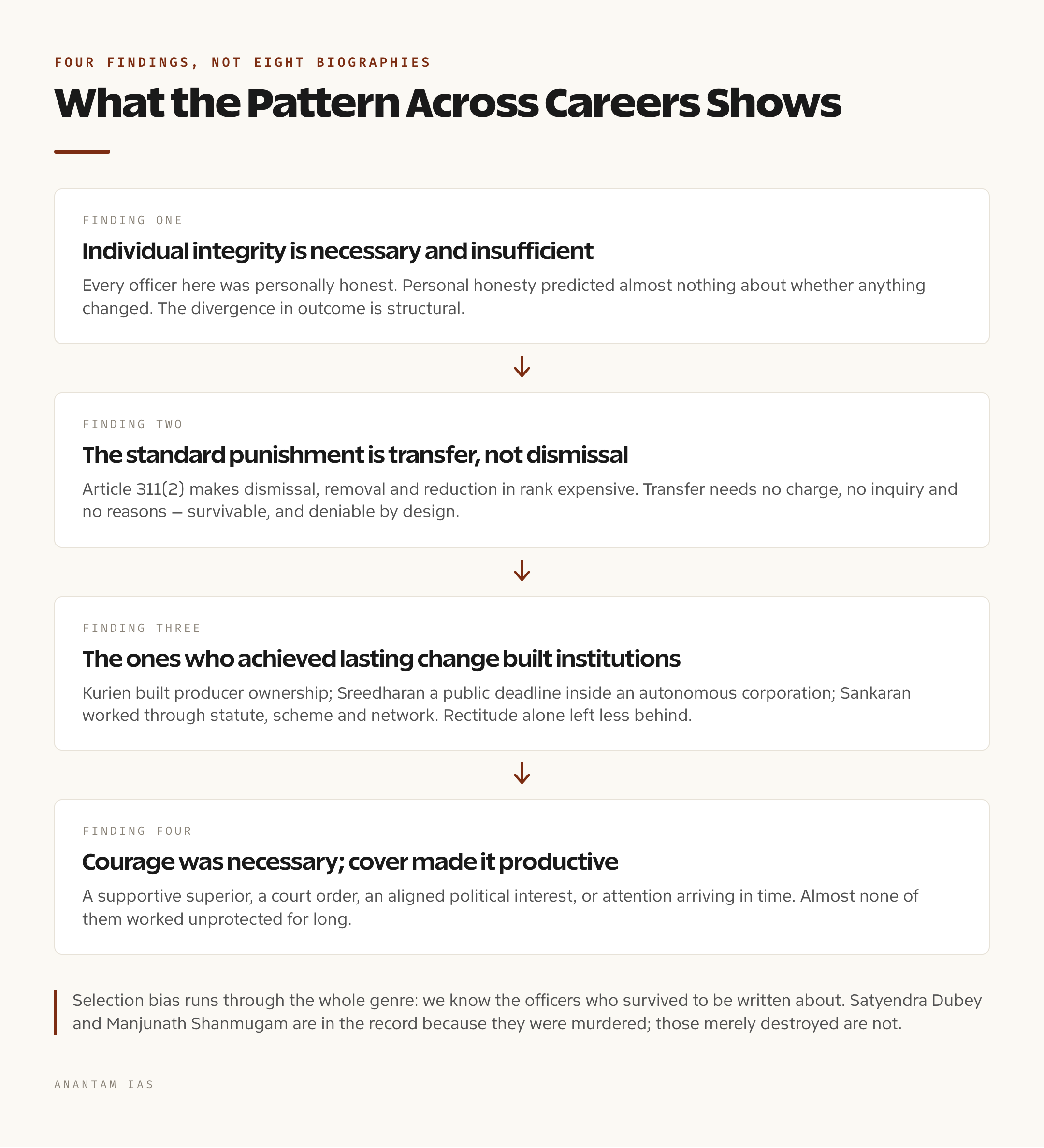
Individual integrity is necessary and insufficient. Every officer named above was personally honest, and personal honesty predicted almost nothing about whether anything changed. Khairnar and Khemka were no less honest than Kurien; the divergence in outcome is structural.
The standard punishment is transfer, not dismissal. Nobody on this list was dismissed for doing the right thing. That cuts both ways: the risk is career-shaped rather than existential, which makes it more survivable than aspirants assume, and the institution’s response is designed to be deniable, which makes it harder to fight.
The officers who achieved lasting change built institutions or coalitions. Kurien built producer ownership. Sreedharan ran an autonomous corporation with a public deadline. Seshan’s durable gains were the ones that became the routine practice of a body that outlived him. Sankaran worked through statute, scheme and network. Those who relied on personal rectitude alone left less behind, because reform that must be re-willed every morning by one person is not reform.
Almost every one of them had a period of cover — a supportive superior, a court order, an aligned political interest, or public attention arriving in time. Courage was necessary; cover made it productive. India’s statutory version of cover remains thin, since the Whistle Blowers Protection Act, 2014 was passed and never brought into full operation, a gap examined in the account of whistleblowing in India.
The Hazards of Hagiography
Selection bias runs through the genre. We know the officers who survived to be written about; those who made the same choice and were quietly finished, or whose case was never reported, are invisible by construction. Satyendra Dubey, the highway engineer murdered in 2003 after writing about corruption, and Manjunath Shanmugam, the oil company officer murdered in 2005 after acting against fuel adulteration, are in the record because they were killed. The ones merely destroyed are not, and cannot be counted.
The heroic-individual model lets the system off. A literature composed of exceptional officers implies the machine is sound and the staffing at fault. The inference runs the other way: if ordinary integrity requires exceptional courage, that is a finding about institutional design, not about the moral quality of the average officer.
Careers are reconstructed backwards. Once an officer becomes famous, ambiguity is smoothed out. Contested decisions acquire an inevitability they never had, judgement calls that could have gone badly are narrated as foresight, and the critics are dropped. Seshan’s critics had arguments; hagiography does not report them.
Most such choices are made with no possibility of publicity. A tehsildar refusing an improper mutation, a junior engineer refusing to certify a measurement — no journalist arrives, no award follows, and the officer has to be right without an audience or a witness. The published lives are the least representative sample available of the ethical life of the service.
Emulation is the wrong aim. Nobody will be given Sreedharan’s autonomy or Kurien’s thirty unbroken years. The transferable content is mechanical: make the deadline public, place ownership where the loss falls, ask for the instruction in writing, take the posting where the work is, and convert what you achieve into a structure before you are moved.
FAQ
What can an administrative career teach that a conduct code cannot? A code lists prohibitions. A career shows the repertoire of moves actually available inside a hierarchy, the cost the institution imposes for using them, and whether that cost was survivable. None of it appears in a rule book.
Why is transfer used against inconvenient officers rather than dismissal? Article 311(2) requires charges, an inquiry and a hearing before dismissal, removal or reduction in rank, while transfer is treated as an incident of service needing no reasons. It is the cheapest instrument and the hardest to challenge.
What is the main lesson from T. N. Seshan’s tenure as Chief Election Commissioner? That institutional authority is often latent rather than absent. The powers he used had existed since 1950; what had been missing was the willingness to exercise them and to absorb the resulting conflict.
Why did E. Sreedharan’s resignation offer after the 2009 girder collapse matter? He accepted responsibility for a failure he had not personally caused, establishing that responsibility follows the post rather than the act. That is the only basis on which the head of an organisation can hold subordinates to the same rule.
What made Verghese Kurien’s achievement durable when others were reversed? He built a structure rather than winning a decision. Ownership of the three-tier cooperative system rested with producers, who lose money if it is captured, so the arrangement defends itself without depending on anyone’s continued courage.
What is the danger in studying administrators as heroes? It selects for survivors, smooths ambiguity out of contested decisions, and implies the institution is sound and only its staffing deficient. If routine integrity demands exceptional courage, the design is the problem.
Practice Questions
Prelims MCQs
- The superintendence, direction and control of elections to Parliament and State Legislatures is vested in the Election Commission by: (a) Article 315 (b) Article 320 (c) Article 324 (d) Article 329 — Answer: (c) Article 324 has vested these powers since the Constitution came into force, so their vigorous use in the 1990s involved no new authority.
- Article 311(2) requires a charge, inquiry and reasonable opportunity of being heard before: (a) transfer of a civil servant (b) dismissal, removal or reduction in rank (c) placing an officer on deputation (d) recording an adverse appraisal entry — Answer: (b) transfer is treated as an incident of service rather than a punishment, which is why it needs no inquiry and is used instead.
- The three tiers of the Anand pattern of dairy cooperatives are: (a) village society, district union and state federation (b) primary society, block union and national board (c) producer group, marketing board and state corporation (d) panchayat unit, district council and apex bank — Answer: (a) ownership rests with producers at the base, which allowed the structure to survive its founders.
- In T. S. R. Subramanian v. Union of India (2013) the Supreme Court directed, among other things: (a) reservation in promotions for civil servants (b) abolition of the appraisal system (c) fixed minimum tenure, Civil Services Boards, and that oral instructions be recorded in writing (d) transfer of disciplinary powers to the Central Vigilance Commission — Answer: (c) the direction on oral instructions restates an obligation already in the All India Services (Conduct) Rules, 1968.
- The statute associated with S. R. Sankaran’s work on freeing and rehabilitating bonded labourers is the Bonded Labour System (Abolition) Act of: (a) 1972 (b) 1976 (c) 1986 (d) 1993 — Answer: (b) the 1976 Act abolished the system and required identification, release and rehabilitation, and its record shows the limits of what one determined secretary can achieve.
Mains Practice Questions
- “Individual integrity is necessary but insufficient for administrative reform.” Examine this proposition with reference to documented Indian administrative careers. (250 words)
- Why is transfer, rather than dismissal, the characteristic response of the Indian administrative system to an inconvenient officer? Discuss the legal basis and the reform attempts. (150 words)
- E. Sreedharan offered to resign after a construction failure he had not personally caused. Analyse what this establishes about the relationship between responsibility and office. (150 words)
- “The durable ethical achievement of an administrator is a structure, not a decision.” Critically examine with examples. (250 words)
- Discuss the hazards of studying administrative ethics through the lives of celebrated officers. What corrective would you apply? (250 words)
Tell Google you want more of this.
Add Anantam IAS as a preferred sourceOne tap, and this site shows up more often in your own Top Stories, AI Overviews and AI Mode. Remove it any time.