
Opens in a new tab
Join Anantam IAS Channel on Telegram

TOPIC

Earth's Internal Structure

3 UPSC Prelims MCQs tagged "Earth's Internal Structure". Free practice with answer keys, explanations, and timed mock tests on Anantam IAS.

  1. Consider the following: 1. Pyroclastic debris 2. Ash and dust 3. Nitrogen compounds 4.…

    Consider the following: 1. Pyroclastic debris 2. Ash and dust 3. Nitrogen compounds 4. Sulphur compounds How many of the above are products of volcanic eruptions?

    1. AOnly one
    2. BOnly two
    3. COnly three
    4. DAll four
    Answer and explanation

    Correct answer: D

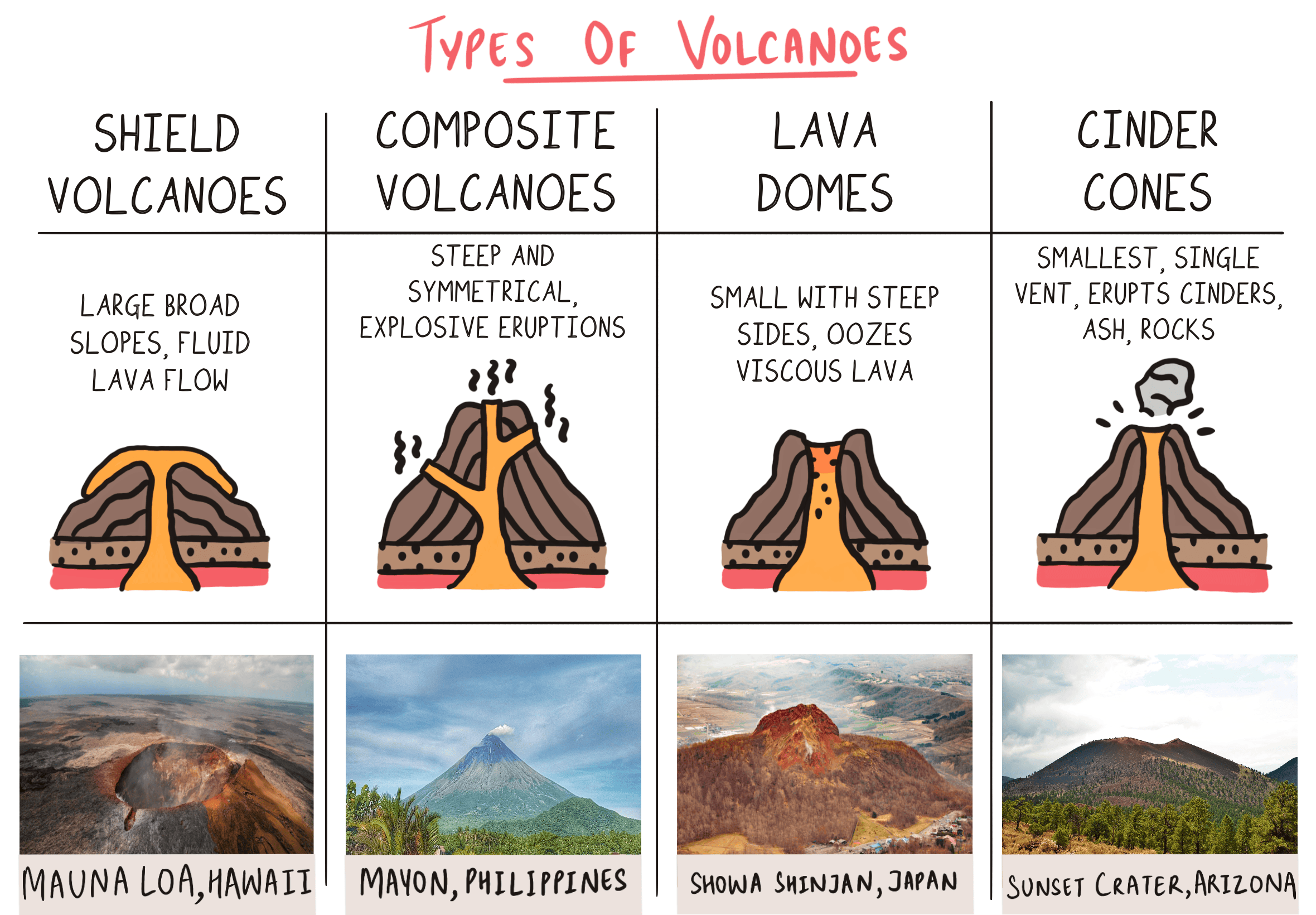
    Pyroclastic debris: This is a general term for fragmental material ejected from a volcano during an eruption. It includes ash, pumice, cinders, and volcanic bombs.

    Ash and dust: These are fine-grained particles of volcanic rock and glass that can be carried long distances by wind.
    ![Volcanoes](https://d39jluplm5thpx.cloudfront.net//types_of_volcanoes_bce782bc45.png)

    Nitrogen compounds: Nitrogen is a common gas released by volcanoes, and it can react with other elements in the atmosphere to form compounds such as ammonia and nitrogen oxides.

    Sulphur compounds: Sulphur dioxide (SO2) is one of the main gases released by volcanoes. It can irritate the respiratory system and contribute to acid rain. Other sulphur compounds, such as hydrogen sulphide (H2S), can also be released in smaller amounts.

    All of the above (1, 2, 3, and 4) are products of volcanic eruptions.

  2. Consider the following statements: 1. The Earth’s magnetic field has reversed every few hundred…

    Consider the following statements: 1. The Earth's magnetic field has reversed every few hundred thousand years. 2. When the Earth was created more than 4000 million years ago, there was 54% oxygen and no carbon dioxide. 3. When living organisms originated, they modified the early atmosphere of the Earth. Which of the statements given above is/are correct?

    1. A1 only
    2. B2 and 3 only
    3. C1 and 3 only
    4. D1, 2 and 3
    Answer and explanation

    Correct answer: C

    Statement 1 is correct. The Earth's magnetic field does reverse polarity every few hundred thousand years, on average.

    Statement 2 is incorrect. The early Earth's atmosphere did not have significant oxygen and likely had a lot of carbon dioxide and other greenhouse gases.

    Statement 3 is correct. The rise of photosynthetic organisms like cyanobacteria significantly increased the amount of oxygen in the atmosphere over time.

    Therefore, the correct answer is (c) 1 and 3 only.

  3. Consider the following: 1. Electromagnetic radiation 2. Geothermal energy 3. Gravitational force 4. Plate…

    Consider the following: 1. Electromagnetic radiation 2. Geothermal energy 3. Gravitational force 4. Plate Movements 5. Rotation of the earth 6. Revolution of the earth Which of the above are responsible for bringing dynamic changes on the surface of the earth?

    1. A1, 2, 3 and 4 only
    2. B1, 3, 5 and 6 only
    3. C2, 4, 5 and 6 only
    4. D1, 2, 3, 4, 5 and 6
    Answer and explanation

    Correct answer: D

    All of the listed phenomena (1-6) are responsible for bringing dynamic changes on the surface of the Earth.

    Electromagnetic Radiation: Sunlight drives weather patterns, influences temperatures, and is crucial for plant life (photosynthesis).

    Geothermal Energy: Heat from the Earth's core fuels volcanic activity, drives plate tectonics, and shapes landforms.

    Gravitational Force: The Moon's gravity creates tides in our oceans, influencing coastlines and erosion.

    Plate Movements: The movement of tectonic plates causes mountain formation, earthquakes, and continental drift, constantly reshaping the Earth's surface.

    Rotation of the Earth: Earth's rotation creates day and night cycles, affecting weather patterns and influencing wind and ocean currents.

    Revolution of the Earth: Earth's revolution around the Sun causes seasons, impacting temperatures and weather patterns globally.

    These forces act together in a complex interplay, constantly sculpting and reshaping the Earth's surface over vast timescales.