
UPSC CSE 2026 Essay Paper Discussion

YEAR ASKED IN

2018

Practice UPSC 2018 previous year questions on Anantam IAS: 100 Prelims MCQs and 80 Mains Q&A with answer keys, explanations and topic-wise links.

Prelims MCQs 100

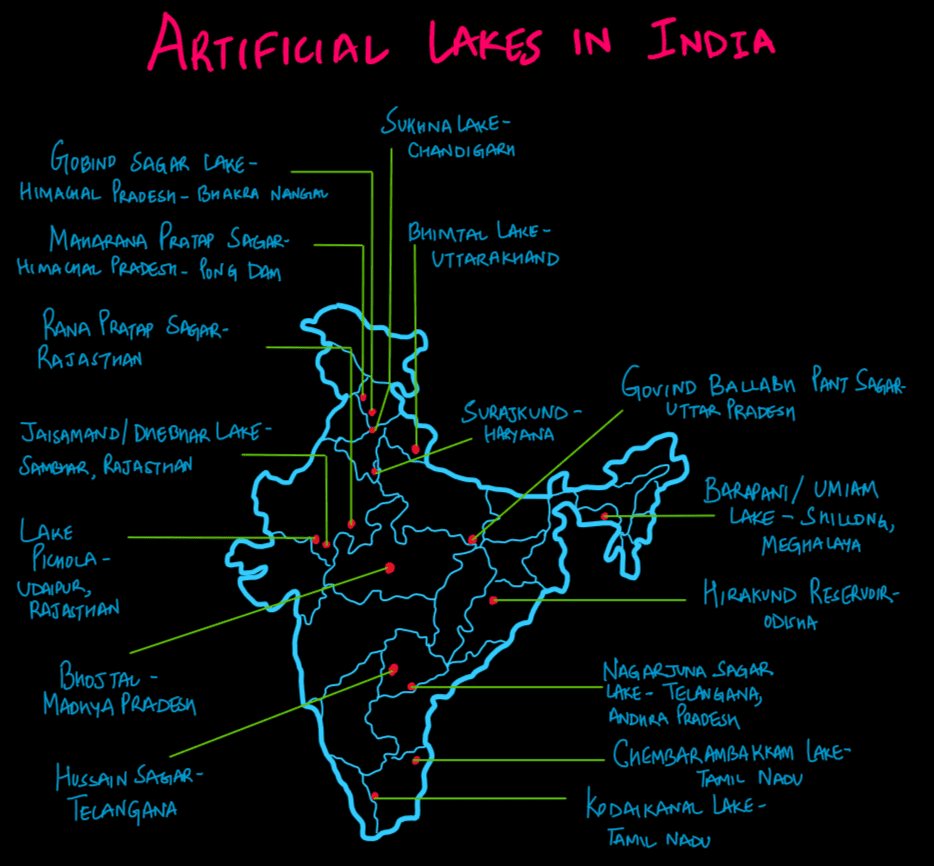
  1. Which one of the following is an artificial lake?

    Which one of the following is an artificial lake?

    1. AKodaikanal Tamil Nadu
    2. BKolleru Andhra Pradesh
    3. CNainital Uttarakhand
    4. DRenuka Himachal Pradesh
    Answer and explanation

    Correct answer: A

    Kodaikanal Lake, also known as Kodai Lake is a manmade lake located in the Kodaikanal city in Dindigul district in Tamil Nadu, India.

    Sir Vere Henry Levinge, the then Collector of Madurai, was instrumental in creating the lake in 1863, amidst the Kodaikanal town which was developed by the British and early missionaries from the USA.
    ![Artificial Lakes in India](https://d39jluplm5thpx.cloudfront.net//Artificial_Lakes_a3a92310ea.PNG)

  2. With reference to the circumstances in Indian agriculture, the concept of “Conservation Agriculture” assumes…

    With reference to the circumstances in Indian agriculture, the concept of "Conservation Agriculture" assumes significance. Which of the following fall under the Conservation Agriculture? 1. Avoiding monoculture practices 2. Adopting minimum tillage 3. Avoiding the cultivation of plantation crops 4. Using crop residues to cover the soil surface 5. Adopting spatial and temporal crop sequencing/crop rotations Select the correct answer using the code given below:

    1. A1, 3 and 4
    2. B2, 3, 4 and 5
    3. C1, 2, 3 and 5
    4. D2, 4 and 5
    Answer and explanation

    Correct answer: D

    Conservation Agriculture is a set of practices aimed at minimizing soil disturbance, maintaining permanent soil cover, and adopting crop rotations or intercropping.

    ![Conservation Agriculture](https://d39jluplm5thpx.cloudfront.net//Conservation_Agriculture_c7064fc344.PNG)

    Avoiding monoculture practices: This does not directly fall under Conservation Agriculture. Monoculture refers to the cultivation of a single crop over a wide area.

    Adopting minimum tillage: Minimum or no tillage is one of the key principles of Conservation Agriculture, as it reduces soil disturbance.

    Avoiding the cultivation of plantation crops: This is not a part of Conservation Agriculture. Plantation crops like tea, coffee, or rubber can be cultivated using conservation agriculture practices.

    Using crop residues to cover the soil surface: Maintaining soil cover with crop residues or mulches is a crucial component of Conservation Agriculture.

    Adopting spatial and temporal crop sequencing/crop rotations: Crop rotations and intercropping are recommended practices under Conservation Agriculture to improve soil fertility and reduce pest and disease incidence.

    Therefore, the correct options that fall under Conservation Agriculture are 2, 4, and 5.

  3. Which of the following statements best describes “carbon fertilization”?

    Which of the following statements best describes "carbon fertilization"?

    1. AIncreased plant growth due to increased concentration of carbon dioxide in the atmosphere
    2. BIncreased temperature of Earth due to increased concentration of carbon dioxide in the atmosphere
    3. CIncreased acidity of oceans as a result of increased concentration of carbon dioxide in the atmosphere
    4. DAdaptation of all living beings on Earth to the climate change brought about by the increased concentration of carbon dioxide in the atmosphere
    Answer and explanation

    Correct answer: A

    * Carbon fertilization is the increased rate of photosynthesis in plants due to the higher concentration of carbon dioxide in the atmosphere.

    * During Photosynthesis plants absorb carbon dioxide (CO₂) from the atmosphere, along with water and sunlight, to produce sugars (glucose) that provide energy for growth. This process releases oxygen (O₂) as a byproduct.

    * The concentration of CO₂ in the atmosphere is currently at its highest level in millions of years, primarily due to human activities such as fossil fuel combustion and deforestation.

    * Many plants respond to higher CO₂ levels with an increased rate of photosynthesis, enabling them to produce more sugars, which can lead to faster growth and higher biomass production.

  4. Consider the following statements: 1. In India, State Governments do not have the power…

    Consider the following statements: 1. In India, State Governments do not have the power to auction non-coal mines. 2. Andhra Pradesh and Jharkhand do not have gold mines. 3. Rajasthan has iron ore mines. Which of the statements given above is/are correct?

    1. A1 and 2
    2. B2 only
    3. C3 only
    4. D1 and 3
    Answer and explanation

    Correct answer: C

    The correct statement is 3 only.

    Statement 1 is incorrect. Under the Mines and Minerals (Development and Regulation) Amendment Act of 2015, state governments conduct auctions for non-coal mine licenses.

    Statement 2 is incorrect. Both Andhra Pradesh and Jharkhand have gold deposits and ongoing mining activities.

    Statement 3 is correct. Rajasthan is known for its rich iron ore deposits and mining.

    ![Minerals in India](https://d39jluplm5thpx.cloudfront.net//Minerals_d655c9137d.PNG)

  5. Consider the following statements: 1. The definition of “Critical Wildlife Habitat” is incorporated in…

    Consider the following statements: 1. The definition of "Critical Wildlife Habitat" is incorporated in the Forest Rights Act, 2006. 2. For the first time in India, Baigas have been given Habitat Rights. 3. Union Ministry of Environment, Forest and Climate Change officially decides and declares Habitat Rights for Primitive and Vulnerable Tribal Groups in any part of India. Which of the statements given above is/are correct ?

    1. A1 and 2 only
    2. B2 and 3 only
    3. C3 only
    4. D1, 2 and 3
    Answer and explanation

    Correct answer: A

    Statement 1 is correct: The Scheduled Tribes and Other Traditional Forest Dwellers (Recognition of Forest Rights) Act, 2006, commonly known as the Forest Rights Act (FRA), 2006, introduces the concept of Critical Wildlife Habitat (CWH). These are areas within National Parks and Wildlife Sanctuaries that must be kept inviolate to ensure wildlife protection. CWHs can only be declared based on scientific evidence and after completing the due process of rehabilitation and resettlement of affected communities.

    ![Critical wildlife habitat](https://d39jluplm5thpx.cloudfront.net//Critical_wildlife_habitat_4c10198b48.PNG)

    Statement 2 is correct: In 2015, the Baiga tribal community in Madhya Pradesh became the first to be granted Habitat Rights under the Forest Rights Act, 2006. This recognition allowed them to continue living within the Kanha Tiger Reserve while accessing forest resources for their bonafide livelihood needs.

    Statement 3 is incorrect: According to the Forest Rights Act, 2006, it is the respective State governments that have the authority to declare and vest Habitat Rights for Primitive Tribal Groups and pre-agricultural communities over critical wildlife habitats, after obtaining consent from the tribal communities and establishing measures for their resettlement and rehabilitation.

    Hence, correct answer is option (a) 1 and 2 only.

  6. Consider the following pairs : |Tradition|State| |– |–| |1. Chapchar Kut festival | Mizoram|…

    Consider the following pairs : |Tradition|State| |-- |--| |1. Chapchar Kut festival | Mizoram| |2. Khongjom Parba ballad|Manipur| |3. Thang-Ta dance | Sikkim| Which of the pairs given above is/are correct ?

    1. A1 only
    2. B1 and 2
    3. C3 only
    4. D2 and 3
    Answer and explanation

    Correct answer: B

    Pair 1 is correct: Chapchar Kut is a harvest festival celebrated in Mizoram.

    Pair 2 is correct: Khongjom Parba is a ballad commemorating the Battle of Khongjom, which took place in Manipur.

    Pair 3 is incorrect: Thang-Ta is a martial art form that originated in Manipur, not Sikkim.

    So, only options 1 and 2 are correct.

  7. Which one of the following foreign travellers elaborately discussed about diamonds and diamond mines…

    Which one of the following foreign travellers elaborately discussed about diamonds and diamond mines of India?

    1. AFrancois Bernier
    2. BJean-Baptiste Tavernier
    3. CJean de Thevenot
    4. DAbbe Barthelemy Carre
    Answer and explanation

    Correct answer: B

    Jean-Baptiste Tavernier, a French traveller and gem merchant, extensively documented his travels to India in the 17th century. He wrote about various aspects of Indian society, culture, and economy, including detailed descriptions of diamond mines and the diamond trade in India. Tavernier's writings provided valuable insights into the diamond industry of India during his time.

    Francois Bernier (1625–1688): A French physician and traveler who visited India during the reign of Mughal Emperor Aurangzeb

    Jean de Thévenot (1633–1667): A French traveler who visited India in the 17th century.

    Abbe Barthelemy Carre (17th Century): A French traveler and envoy who visited India in the late 17th century.

    ![Foreign Travelers in Medieval India](https://d39jluplm5thpx.cloudfront.net//Travelers_of_Medieval_India_c7c06d2ef0.PNG)

  8. With reference to the Genetically Modified mustard (GM mustard) developed in India, consider the…

    With reference to the Genetically Modified mustard (GM mustard) developed in India, consider the following statements : 1. GM mustard has the genes of a soil bacterium that gives the plant the property of pest-resistance to a wide variety of pests. 2. GM mustard has the genes that allow the plant cross-pollination and hybridization. 3. GM mustard has been developed jointly by the IARI and Punjab Agricultural University. Which of the statements given above is/are correct?

    1. A1 and 3 only
    2. B2 only
    3. C2 and 3 only
    4. D1, 2 and 3
    Answer and explanation

    Correct answer: B

    Dhara Mustard Hybrid-11, otherwise known as DMH - 11, is a genetically modified hybrid variety of the mustard species Brassica juncea.

    Statement 1 is incorrect. The GM mustard developed in India does not have the property of pest-resistance. It has been genetically modified for hybridization and increased yield, not for pest-resistance.

    Statement 2 is correct. The GM mustard has been developed with genes that allow it to cross-pollinate, leading to hybridization and increased yield.

    Statement 3 is incorrect. The GM mustard was developed by scientists at Delhi University's Centre for Genetic Manipulation of Crop Plants (CGMCP), not by the IARI and Punjab Agricultural University.

    So, only statement 2 is correct.

    ![Genetic Engineering](https://d39jluplm5thpx.cloudfront.net//Genetic_engineering_ef04398d50.PNG)

  9. Consider the following statements – 1. Most of the world’s coral reefs are in…

    Consider the following statements - 1. Most of the world's coral reefs are in tropical waters. 2. More than one-third of the world's coral reefs are located in the territories of Australia, Indonesia and the Philippines. 3. Coral reefs host far more number of animal phyla than those hosted by tropical rainforests. Which of the statements given above is/are correct?

    1. A1 and 2 only
    2. B3 only
    3. C1 and 3 only
    4. D1, 2 and 3
    Answer and explanation

    Correct answer: D

    Statement 1 is Correct: Coral reefs primarily thrive in warm, shallow, clear tropical waters between 30°N and 30°S latitudes, where sea surface temperatures typically remain between 20°C and 30°C.

    Statement 2 is Correct: These three countries account for over 40% of the world's coral reef area, with Indonesia holding approximately 18%, Australia 17%, and the Philippines 9%.

    Statement 3 is Correct: While rainforests have a higher number of species, coral reefs have greater phyletic diversity, hosting 32 of the 34 recognized animal phyla compared to only about 9 phyla found in tropical rainforests.

  10. International Labour Organization’s Conventions 138 and 182 are related to –

    International Labour Organization's Conventions 138 and 182 are related to -

    1. AChild labour
    2. BAdaptation of agricultural practices to global climate change
    3. CRegulation of food prices and food security
    4. DGender parity at the workplace
    Answer and explanation

    Correct answer: A

    The International Labour Organization's Conventions 138 and 182 are both related to child labour.

    Convention No. 138 is the Minimum Age Convention. It requires member countries to set a minimum age for employment and work towards the elimination of child labour.

    Convention No. 182 deals with the Worst Forms of Child Labour. It calls for the prohibition and elimination of the most severe forms of child labour, such as slavery, forced labour, and trafficking.

    These conventions are considered fundamental by the ILO, meaning all member states must respect, promote, and work towards their aims regardless of ratification.

  11. Which of the following leaf modifications occur(s) in the desert areas to inhibit water…

    Which of the following leaf modifications occur(s) in the desert areas to inhibit water loss? 1. Hard and waxy leaves 2. Tiny leaves 3. Thorns instead of leaves Select the correct answer using the code given below:

    1. A2 and 3 only
    2. B2 only
    3. C3 only
    4. D1, 2 and 3
    Answer and explanation

    Correct answer: D

    Plants in arid environments have evolved adaptive features to minimize water loss through transpiration:

    ![Plant Modifications](https://d39jluplm5thpx.cloudfront.net//Plant_Modifications_ca54c03077.PNG)

    - Hard and waxy leaves have a thick cuticle and fewer stomata, reducing water loss by limiting evaporation. - Tiny leaves have a smaller surface area, which decreases the area exposed to transpiration. - Thorns, though primarily modified branches for protection, can also replace leaves in some desert plants (e.g., cacti), further reducing transpiration by limiting leaf surface area.

    Therefore, the correct answer is option (d) 1, 2 and 3.

  12. The Partnership for Action on Green Economy (PAGE), a UN mechanism to assist countries…

    The Partnership for Action on Green Economy (PAGE), a UN mechanism to assist countries transition towards greener and more inclusive economies, emerged at

    1. AThe Earth Summit on Sustainable Development 2002, Johannesburg
    2. BThe United Nations Conference on Sustainable Development 2012, Rio de Janeiro
    3. CThe United Nations Framework Convention on Climate Change 2015, Paris
    4. DThe World Sustainable Development Summit 2016, New Delhi
    Answer and explanation

    Correct answer: B

    The Partnership for Action on Green Economy (PAGE) was established in response to the United Nations Conference on Sustainable Development (UNCSD) 2012, also known as Rio+20, held in Rio de Janeiro, Brazil.

    The Rio+20 conference aimed to reaffirm global commitment to sustainable development and highlight the importance of transitioning to green economies i.e. economic systems that promote environmental sustainability, social inclusion, and economic growth.

    PAGE was launched as a collaborative initiative to support countries in developing policies and strategies for sustainable and inclusive economic growth.

  13. With reference to organic farming in India, consider the following statements: 1. The National…

    With reference to organic farming in India, consider the following statements: 1. The National Programme for Organic Production (NPOP) is operated under the guidelines and directions of the Union Ministry of Rural Development. 2. The Agricultural and Processed Food Products Export Development Authority (APEDA) functions as the Secretariat for the implementation of NPOP. 3. Sikkim has become India's first fully organic State. Which of the statements given above is/are correct?

    1. A1 and 2 only
    2. B2 and 3 only
    3. C3 only
    4. D1, 2 and 3
    Answer and explanation

    Correct answer: B

    Statement 1 is incorrect: The National Programme for Organic Production (NPOP) is operated under the guidelines and directions of the Ministry of Commerce and Industry, not the Ministry of Rural Development or the Ministry of Agriculture. It provides the framework for the accreditation of certification bodies and standards for organic production.

    Statement 2 is correct: The Agricultural and Processed Food Products Export Development Authority (APEDA) functions as the Secretariat for the implementation of NPOP. APEDA is a statutory body under the Ministry of Commerce and Industry responsible for the export promotion of agricultural products.

    Statement 3 is correct: In 2016, Sikkim became India's first fully organic state, having successfully converted all its cultivable land to organic farming practices.

    Therefore, the correct answer is 2 and 3 only.

  14. Regarding Wood’s Dispatch, which of the following statements are true ? 1. Grants-in-Aid system…

    Regarding Wood's Dispatch, which of the following statements are true ? 1. Grants-in-Aid system was introduced. 2. Establishment of universities was recommended. 3. English as a medium of instruction at all levels of education was recommended. Select the correct answer using the code given below :

    1. A1 and 2 only
    2. B2 and 3 only
    3. C1 and 3 only
    4. D1, 2 and 3
    Answer and explanation

    Correct answer: A

    Statement 1 is correct: Wood's Dispatch advocated for a Grant-in-aid system to support private schools alongside government schools. This aimed to expand educational opportunities even with limited government resources.

    Statement 2 is correct: The Dispatch recommended establishing universities in major cities like Bombay, Calcutta, and Madras. These universities would follow the model of the University of London.

    Statement 3 is incorrect: While Wood's Dispatch acknowledged the importance of vernacular languages in primary education, it did not recommend English as the medium of instruction at all levels.

    The Dispatch proposed a tiered system - Primary schools - Vernacular languages - Secondary schools - Both English and vernacular languages - Colleges - Primarily English

    So, statements 1 and 2 are true, while statement 3 is not entirely accurate.

  15. What is “Terminal High Altitude Area Defense (THAAD)”, sometimes seen in the news?

    What is "Terminal High Altitude Area Defense (THAAD)", sometimes seen in the news?

    1. AAn Israeli radar system
    2. BIndia's indigenous anti-missile programme
    3. CAn American anti-missile system
    4. DA defence collaboration between Japan and South Korea
    Answer and explanation

    Correct answer: C

    * THAAD is a missile defense system developed by the United States to intercept and destroy short, medium, and intermediate-range ballistic missiles during their terminal phase of flight.

    * It is designed to defend against threats both within and outside the Earth's atmosphere, providing protection against potential missile attacks.

    * THAAD has been deployed by the United States military and has also been sold to allied countries such as South Korea and Saudi Arabia.

  16. With reference to the cultural history of India, consider the following statements : 1.…

    With reference to the cultural history of India, consider the following statements : 1. White marble was used in making Buland Darwaza and Khankah at Fatehpur Sikri. 2. Red sandstone and marble were used in making Bara Imambara and Rumi Darwaza at Lucknow. Which of the statements given above is/are correct?

    1. ANone
    2. B2 only
    3. CBoth 1 and 2
    4. D1 Only
    Answer and explanation

    Correct answer: A

    Statement 1 (Incorrect): Buland Darwaza and Khankah at Fatehpur Sikri were primarily constructed using red sandstone, not white marble. While the structures might incorporate some decorative elements with white marble inlay, red sandstone is the dominant material.

    Statement 2 (Incorrect): Bara Imambara in Lucknow is primarily constructed using brick with stucco plaster, not red sandstone and marble. Rumi Darwaza, on the other hand, is built mainly with bricks and lime plaster.

  17. With reference to India’s decision to levy an equalization tax of 6% on online…

    With reference to India's decision to levy an equalization tax of 6% on online advertisement services offered by non-resident entities, which of the following statements is/are correct? 1. It is introduced as a part of the Income Tax Act. 2. Non-resident entities that offer advertisement services in India can claim a tax credit in their home country under the "Double Taxation Avoidance Agreements". Select the correct answer using the code given below:

    1. ANone
    2. B2 only
    3. CBoth 1 and 2
    4. D1 only
    Answer and explanation

    Correct answer: A

    The equalization levy on online advertisement services offered by non-resident entities is introduced as a separate tax under the Finance Act, not as a part of the Income Tax Act.

    Non-resident entities cannot claim a tax credit in their home country under the "Double Taxation Avoidance Agreements" because the equalization levy is not an income tax. It is a separate tax levied on specified services provided by non-residents to residents.

    Hence, option A is the correct answer.

    Note: The Indian government has abolished the 6% Equalization Levy on online advertisements, with effective from April 1, 2025.

  18. Consider the following pairs: | Craft | Heritage of | |———————–|—————-| | 1. Puthukkuli…

    Consider the following pairs: | Craft | Heritage of | |-----------------------|----------------| | 1. Puthukkuli shawls | Tamil Nadu | | 2. Sujni embroidery | Maharashtra | | 3. Uppada Jamdani saris | Karnataka | Which of the pairs given above is/are correct?

    1. A1 only
    2. B1 and 2
    3. C3 only
    4. D2 and 3
    Answer and explanation

    Correct answer: A

    Puthukkuli shawls: These embroidered textiles are a traditional craft of the Toda people in the Nilgiri Hills of Tamil Nadu.

    Sujni embroidery: This embroidery style originates from the Bhusura village in Bihar, not Maharashtra.

    Uppada Jamdani saris: Uppada Jamdani saris are known for their diaphanous silk and are native to Uppada in Andhra Pradesh, not Karnataka.

    ![Fabric of India](https://d39jluplm5thpx.cloudfront.net//Fabrics_of_India_97c71e09bc.PNG)

  19. With reference to the ‘Global Alliance for Climate-Smart Agriculture (GACSA)’, which of the following…

    With reference to the 'Global Alliance for Climate-Smart Agriculture (GACSA)', which of the following statements is/are correct. 1. GACSA is an outcome of the Climate Summit held in Paris in 2015. 2. Membership of GACSA does not create any binding obligations. 3. India was instrumental in the creation of GACSA. Select the correct answer using the code given

    1. A1 and 3 only
    2. B2 only
    3. C2 and 3 only
    4. D1, 2 and 3
    Answer and explanation

    Correct answer: B

    Statement 1 is incorrect. GACSA was launched in 2014 at the UN Climate Summit in New York, not at the Paris Climate Summit in 2015.

    Statement 2 is correct. GACSA is a voluntary partnership, and membership does not create any legally binding obligations for its members.

    Statement 3 is incorrect. GACSA was launched by the Netherlands and several other countries, but India was not among the founding members or instrumental in its creation.

  20. Which of the following is/are the possible consequence/s of heavy sand mining in riverbeds?…

    Which of the following is/are the possible consequence/s of heavy sand mining in riverbeds? 1. Decreased salinity in the river 2. Pollution of groundwater 3. Lowering of the water-table Select the correct answer using the code given below :

    1. A1 only
    2. B2 and 3 only
    3. C1 and 3 only
    4. D1, 2 and 3
    Answer and explanation

    Correct answer: B

    Statement 1 is Incorrect: Sand mining does not decrease salinity. In coastal and estuarine regions, excessive sand mining can lead to saltwater intrusion from the sea into the river system, which actually increases the salinity of the river water.

    Statement 2 is Correct: River sand acts as a natural filter for water percolating through the riverbed. Removing this sand layer reduces the filtration capacity, allowing pollutants, heavy metals, and contaminants to seep more easily into the underlying groundwater aquifers.

    Statement 3 is Correct: Heavy sand mining causes riverbed incision (deepening of the river channel). As the riverbed drops, the surrounding groundwater drains into the deepened channel to maintain hydrological equilibrium, leading to a significant lowering of the water table in the adjacent areas.

  21. With reference to the governance of public sector banking in India, consider the following…

    With reference to the governance of public sector banking in India, consider the following statements 1. Capital infusion into public sector banks by the Government of India has steadily increased in the last decade. 2. To put the public sector banks in order, the merger of associate banks with the parent State Bank of India has been affected. Which of the statements given above is/are correct?

    1. A1 only
    2. B1 and 2
    3. C2 only
    4. DNeither 1 nor 2
    Answer and explanation

    Correct answer: C

    Statement 1 is incorrect. The govt has been infusing large amounts in seven public sector banks through recapitalisation bonds but this has not been steady as statement 1 says.

    Statement 2 is correct. To put the public sector banks in order, the merger of associate banks with the parent State Bank of India has been affected. For example, the merger of SBI associate banks will result in the creation of a stronger merger entity.

    Hence, option C is the correct answer.

  22. Which among the following events happened earliest?

    Which among the following events happened earliest?

    1. ASwami Dayanand established Arya Samaj.
    2. BDinabandhu Mitra wrote Neeldarpan.
    3. CBankim Chandra Chattopadhyay wrote Anandmath.
    4. DSatyendranath Tagore became the first Indian to succeed in the Indian Civil Services Examination.
    Answer and explanation

    Correct answer: B

    The chronological order of the events is as follows:

    1. Dinabandhu Mitra wrote Neeldarpan (1858-59): This play, which depicted the oppression of indigo farmers by British planters, was published in 1858-59. 2. Satyendranath Tagore cleared the ICS (1863): He became the first Indian to succeed in the Indian Civil Service (ICS) examination in 1863. The examination was conducted by the Civil Service Commissioners in London. 3. Swami Dayanand established Arya Samaj (1875): This Vedic reform movement was founded by Swami Dayanand Saraswati in Bombay in 1875. 4. Bankim Chandra Chattopadhyay wrote Anandmath (1882): This famous Bengali novel, set against the backdrop of the Sannyasi Rebellion and containing the song 'Vande Mataram', was published in 1882.

    Therefore, the writing of Neeldarpan is the earliest event among the choices provided.

  23. The staple commodities of export by the English East India Company from Bengal in…

    The staple commodities of export by the English East India Company from Bengal in the middle of the 18th century were -

    1. ARaw cotton, oil-seeds and opium
    2. BSugar, salt, zinc and lead
    3. CCopper, silver, gold, spices and tea
    4. DCotton, silk, saltpetre and opium
    Answer and explanation

    Correct answer: D

    In the middle of the 18th century (c. 1750s), Bengal was the most prosperous province of the Mughal Empire and the primary base for the English East India Company's trade. The staple commodities exported from Bengal were:

    - Cotton and Silk: Bengal was world-renowned for its high-quality textiles, including fine muslins and silk fabrics, which were the most sought-after Indian exports in European and Asian markets. - Saltpetre: This was a strategic commodity used as a key ingredient in the manufacture of gunpowder. Bengal was the primary source of saltpetre for European powers during the frequent wars of the 18th century. - Opium: Bengal was a major producer of opium, which the East India Company exported primarily to China and Southeast Asia. While the Company's formal monopoly was established in 1773, it was already a staple export item by the mid-18th century.

    Note on other options: During this period, India was a 'sink' for precious metals; therefore, copper, silver, and gold (Option C) were typically imported into India as bullion to pay for Indian goods, rather than being exported.

  24. With reference to agricultural soils, consider the following statements : 1. The high content…

    With reference to agricultural soils, consider the following statements : 1. The high content of organic matter in soil drastically reduces its water holding capacity. 2. Soil does not play any role in the sulphur cycle. 3. Irrigation over a period of time can contribute to the salinization of some agricultural lands. Which of the statements given above is/are correct?

    1. A1 and 2 only
    2. B3 only
    3. C1 and 3 only
    4. D1, 2 and 3
    Answer and explanation

    Correct answer: B

    Statement 1 is incorrect: High organic matter content in soil actually increases its water-holding capacity. Organic matter helps to bind soil particles together, creating pore spaces that can hold water. It acts like a sponge, absorbing and retaining moisture effectively.

    Statement 2 is incorrect: Soil plays a crucial role in the sulphur cycle. Soil contains various forms of sulfur compounds, including sulfates, which are essential nutrients for plant growth. Microorganisms in the soil participate in the transformation of sulfur compounds through processes like mineralization and immobilization.

    Statement 3 is correct: Excessive or improper irrigation practices can lead to the salinization of agricultural lands. When irrigation water contains high levels of dissolved salts, and there is inadequate drainage, these salts can accumulate in the soil over time, leading to soil salinization. This can adversely affect crop growth and productivity.

    Therefore, among the given statements, only statement 3 is correct.

  25. With reference to India’s satellite launch vehicles, consider the following statements: 1. PSLVs launch…

    With reference to India's satellite launch vehicles, consider the following statements: 1. PSLVs launch the satellites useful for Earth resources monitoring whereas GSLVs are designed mainly to launch communication satellites. 2. Satellites launched by PSLV appear to remain permanently fixed in the same position in the sky, as viewed from a particular location on Earth. 3. GSLV Mk III is a four-stage launch vehicle with the first and third stages using solid rocket motors, and the second and fourth stages using liquid rocket engines. Which of the statements given above is/are correct?

    1. A1 only
    2. B2 and 3
    3. C1 and 2
    4. D3 only
    Answer and explanation

    Correct answer: A

    Statement 1 is correct. PSLV (Polar Satellite Launch Vehicle) is primarily used to launch Earth observation/monitoring satellites, while GSLV (Geosynchronous Satellite Launch Vehicle) is designed to launch communication satellites into geosynchronous transfer orbits.

    Statement 2 is incorrect. Satellites launched by PSLV are typically placed in polar or sun-synchronous orbits, which are not geosynchronous. These satellites appear to move across the sky as viewed from a particular location on Earth.

    Statement 3 is incorrect. The GSLV Mk III is a three-stage launch vehicle, not a four-stage one. The first stage uses solid rocket motors, the second stage uses liquid rocket engines, and the third stage uses a cryogenic rocket engine.

    ![Launching Vehicles](https://d39jluplm5thpx.cloudfront.net//types_of_launching_vehicle_2571649076.jpg)

  26. “Rule of Law Index” is released by which of the following?

    "Rule of Law Index" is released by which of the following?

    1. AAmnesty International
    2. BInternational Court of Justice
    3. CThe Office of UN Commissioner for Human Rights
    4. DWorld Justice Project
    Answer and explanation

    Correct answer: D

    The Rule of Law Index is published annually by the World Justice Project (WJP), an independent, multidisciplinary organization. It measures how the rule of law is experienced and perceived in countries worldwide based on eight primary factors: Constraints on Government Powers, Absence of Corruption, Open Government, Fundamental Rights, Order and Security, Regulatory Enforcement, Civil Justice, and Criminal Justice. The index relies on data from household and expert surveys to provide a comprehensive picture of the rule of law in practice.

  27. Economically, one of the results of the British rule in India in the 19th…

    Economically, one of the results of the British rule in India in the 19th century was the -

    1. Aincrease in the export of Indian handicrafts
    2. Bgrowth in the number of Indian owned factories
    3. Ccommercialization of Indian agriculture
    4. Drapid increase in the urban population
    Answer and explanation

    Correct answer: C

    The main aim of the colonisation of India by the Britishers was the economic exploitation of India. The commercialisation of Agriculture was an outcome of colonial exploitation. Various cash crops such as Indigo, Tea, and Cotton were forced on Indian farmers to meet the needs for raw materials for the Industrial Revolution in England.

    On the other hand, the Handicraft of India was ruined thus exports decreased. Ruralisation of India led to a decrease in factories in the 19th century.

  28. In which of the following areas can GPS technology be used? 1. Mobile phone…

    In which of the following areas can GPS technology be used? 1. Mobile phone operations 2. Banking operations 3. Controlling the power grids Select the correct answer using the code given below:

    1. A1 only
    2. B2 and 3 only
    3. C1 and 3 only
    4. D1, 2 and 3
    Answer and explanation

    Correct answer: D

    GPS, or Global Positioning System, is a satellite-based navigation system that provides geolocation and time information to a GPS receiver anywhere on or near the Earth. It has a wide range of applications.

    Statement 1 is correct. GPS is used in mobile phones for various purposes such as location tracking, navigation, and location-based services.

    Statement 2 is correct. GPS is used in banking operations for ATM location services and for time-stamping transactions, which is crucial for maintaining accurate records.

    Statement 3 is correct. GPS is used for time-stamping power system measurements, which is vital for grid stability and synchronization. Therefore, GPS technology can be used in all the three areas mentioned.

  29. Consider the following statements: 1. The Speaker of the Legislative Assembly shall vacate his/her…

    Consider the following statements: 1. The Speaker of the Legislative Assembly shall vacate his/her office if he/she ceases to be a member of the Assembly. 2. Whenever the Legislative Assembly is dissolved, the Speaker shall vacate his/her immediately. Which of the statements given above is/are correct?

    1. A1 only
    2. B2only
    3. CBoth 1 and 2
    4. DNeither 1 nor 2
    Answer and explanation

    Correct answer: A

    Statement 1 is correct: The Speaker of the Legislative Assembly shall vacate their office if they cease to be a member of the Assembly. This is explicitly provided under Article 179 of the Indian Constitution.

    Statement 2 is incorrect: It is incorrect to say that the Speaker vacates office immediately upon the dissolution of the Legislative Assembly.

    When the Assembly is dissolved, the Speaker does not vacate office immediately. Instead, the Speaker continues in office until the newly elected Assembly convenes for the first time and elects a new Speaker. This ensures continuity in the legislative process and prevents a vacuum in constitutional functions. So, only the first statement is correct.

  30. He wrote biographies of Mazzini, Garibaldi, Shivaji and Shrikrishna; stayed in America for some…

    He wrote biographies of Mazzini, Garibaldi, Shivaji and Shrikrishna; stayed in America for some time, and was also elected to the Central Assembly. He was

    1. AAurobindo Ghosh
    2. BBipin Chandra Pal
    3. CLala Lajpat Rai
    4. DMotilal Nehru
    Answer and explanation

    Correct answer: C

    Lala Lajpat Rai was a prolific nationalist leader and writer who authored biographies of Giuseppe Mazzini, Giuseppe Garibaldi, Shivaji, and Shrikrishna to inspire the Indian youth with ideals of patriotism and self-sacrifice. He stayed in the United States from 1914 to 1920, during which time he founded the Indian Home Rule League of America in New York (1917) and wrote 'Young India'. Following his return to India, he was elected to the Central Legislative Assembly in 1923 as a member of the Swaraj Party. It is a common historical distinction that while Lala Lajpat Rai was a prominent member of the Assembly, Vithalbhai Patel was the first Indian to be elected as its President (Speaker) in 1925.

Mains Q&A 80

  1. Edward Snowden, a computer expert and former CIA systems administrator, released confidential Government documents to the press about the existence of Government surveillance programmes. According to many legal experts and the US Government, his actions violated the Espionage Act of 1917, which identified the leak of State secrets as an act of treason. Yet, despite the fact that he broke the law, Snowden argued that he had a moral obligation to act. He gave a justification for his “whistle blowing” by stating that he had a duty “to inform the public as to that which is done in their name and that which is done against them.” According to Snowden, the Government’s violation of privacy had to be exposed regardless of legality since more substantive issues of social action and public morality were involved here. Many agreed with Snowden. Few argued that he broke the law and compromised national security, for which he should be held accountable. Do you agree that Snowden’s actions were ethically justified even if legally prohibited? Why or why not? Make an argument by weighing the competing values in this case.

  2. Dr. X is a leading medical practitioner in a city. He has set up a charitable trust through which he plans to establish a super-speciality hospital in the city to cater to the medical needs of all sections of the society. Incidentally, that part of the State had been neglected over the years. The proposed hospital would be a boon for the region. You are heading the tax investigation agency of that region. During an inspection of the doctor’s clinic, your officers have found out some major irregularities. A few of them are substantial which had resulted in considerable withholding of tax that should be paid by him now. The doctor is cooperative. He undertakes to pay the tax immediately. However, there are certain other deficiencies in his tax compliance which are purely technical in nature. If these technical defaults are pursued by the agency, considerable time and energy of the doctor will be diverted to issues which are not so serious, urgent or even helpful to the tax collection process. Further, in all probability, it will hamper the prospects of the hospital coming up. There are two options before you: (i) Taking a broader view, ensure substantial tax compliance and ignore defaults that are merely technical in nature. (ii) Pursue the matter strictly and proceed on all fronts, whether substantial or merely technical. As the head of the tax agency, which course of action will you opt for and why?

  3. A big corporate house is engaged in manufacturing industrial chemicals on a large scale. It proposes to set up an additional unit. Many States rejected its proposal due to detrimental effect on the environment. But one State government acceded to the request and permitted the unit close to a city, brushing aside all opposition. The unit was set up 10 years ago and was in full swing till recently. The pollution caused by the industrial effluents was affecting the land, water and crops in the area. It was also causing serious health problems to human beings and animals. This gave rise to a series of agitations demanding the closure of the plant. In a recent agitation thousands of people took part, creating a law and order problem necessitating stern police action. Following the public outcry, the State government ordered the closure of the factory. The closure of the factory resulted in the unemployment of not only those workers who were engaged in the factory but also those who were working in the ancillary units. It also very badly affected those industries which depended on the chemicals manufactured by it. As a senior officer entrusted with the responsibility of handling this issue, how are you going to address it?

  4. Rakesh is a responsible district level officer, who enjoys the trust of his higher officials. Knowing his honesty, the government entrusted him with the responsibility of identifying the beneficiaries under a healthcare scheme meant for senior citizens. The criteria to be a beneficiary are the following: (a) 60 years of age or above. (b) Belonging to a reserved community. (c) Family income of less than ₹ 1 lakh per annum. (d) Post-treatment prognosis is likely to be high to make a positive difference to the quality of life of the beneficiary. One day, an old couple visited Rakesh’s office with their application. They have been the residents of a village in his district since their birth. The old man is diagnosed with a rare condition that causes obstruction in the large intestine. As a consequence, he has severe abdominal pain frequently that prevents him from doing any physical labour. The couple have no children to support them. The expert surgeon whom they contacted is willing to do the surgery without charging any fee. However, the couple will have to bear the cost of incidental charges, such as medicines, hospitalization, etc., to the tune of ₹ 1 lakh. The couple fulfills all the criteria except criterion ‘b’. However, any financial aid would certainly make a significant difference in their quality of life. How should Rakesh respond to the situation?

  5. It is a State where prohibition is in force. You are recently appointed as the Superintendent of Police of a district notorious for illicit distillation of liquor. The illicit liquor leads to many deaths, reported and unreported, and causes a major problem for the district authorities. The approach till now had been to view it as a law and order problem and tackle it accordingly. Raids, arrests, police cases, criminal trials – all these had only limited impact. The problem remains as serious as ever. Your inspections show that the parts of the district where the distillation flourishes are economically, industrially and educationally backward. Agriculture is badly affected by poor irrigation facilities. Frequent clashes among communities gave boost to illicit distillation. No major initiatives had taken place in the past either from the government’s side or from social organizations to improve the lot of the people. Which new approach will you adopt to bring the problem under control?

  6. What do each of the following quotations mean to you in the present context? (a) “The true rule, in determining to embrace, or reject any thing, is not whether it has any evil in it; but whether it has more evil than good. There are few things wholly evil or wholly good. Almost every thing, especially of governmental policy, is an inseparable compound of the two; so that our best judgment of the preponderance between them is continually demanded.” – Abraham Lincoln (10 marks, 150 words) (b) “Anger and intolerance are the enemies of correct understanding.” – Mahatma Gandhi (10 marks, 150 words) (c) “Falsehood takes the place of truth when it results in unblemished common good.” – Tirukkural (10 marks, 150 words)