
Opens in a new tab
Join Anantam IAS Channel on Telegram

TOPIC

Functions of Ecosystem

8 UPSC Prelims MCQs tagged "Functions of Ecosystem". Free practice with answer keys, explanations, and timed mock tests on Anantam IAS.

  1. Which one of the following shows a unique relationship with an insect that has…

    Which one of the following shows a unique relationship with an insect that has coevolved with it and that is the only insect that can pollinate this tree?

    1. AFig
    2. BMahua
    3. CSandalwood
    4. DSilk cotton
    Answer and explanation

    Correct answer: A

    Fig-Wasp Mutualism: Figs and fig wasps share an obligate mutualistic relationship, meaning they are entirely dependent on each other for survival and reproduction. Fig wasps are the only insects that can pollinate fig trees, and fig trees are the sole source of food and shelter for developing fig wasps.

    Highly Specialized Pollination: The fig fruit (technically a syconium) has its flowers enclosed within. Female fig wasps enter the syconium through a tiny opening called the ostiole. They lay eggs inside and pollinate the flowers in the process.
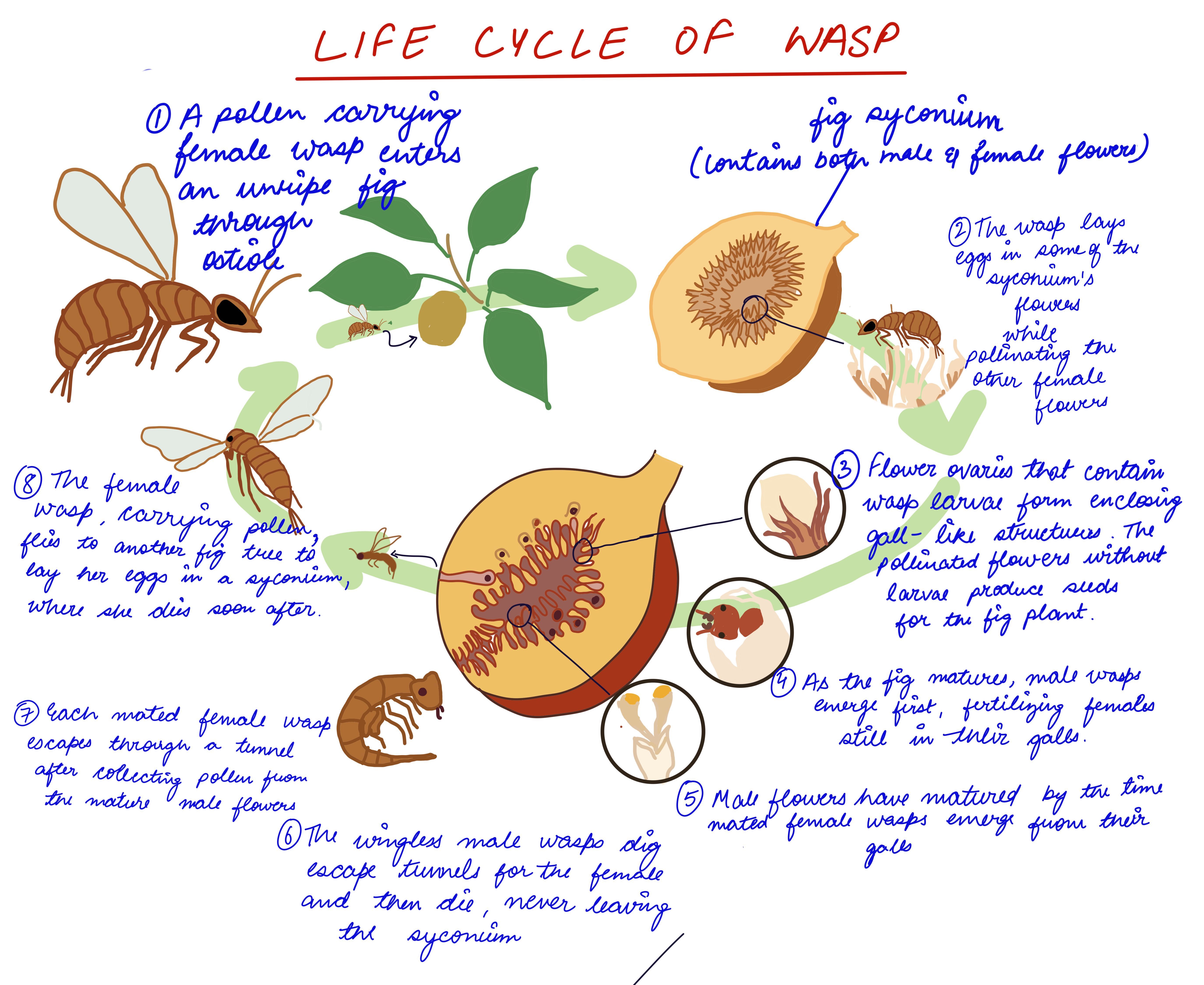
    ![Fig-Wasp Mutualism](https://d39jluplm5thpx.cloudfront.net//fig_wasp_mutualism_37a5eafd2a.jpeg)

    Coevolution: This intricate relationship is a classic example of coevolution, where two species have evolved together over millions of years, with each species' adaptations influencing the other's.

    _The other options are incorrect:_

    * Mahua (B): It is pollinated by various insects and even bats. Mahua (Madhuca indica) is found in the dry deciduous type of forests like the Forests of Chhattisgarh and Jharkhand.

    * Sandalwood (C): It is primarily pollinated by bees and flies. Sandalwood is a dry deciduous forest species native to China, India, Indonesia, Australia, and the Philippines. Sandalwood is listed as Vulnerable in the IUCN Red list. Sandalwood grows as a partial or hemiparasite, relying on the presence of four or five other trees nearby. Beneath the ground, its roots develop a haustorium, an octopus-like structure that attaches to the host tree's roots, drawing water and nutrients from them.

    * Silk cotton (D): It is pollinated by bats and birds. The Silk Cotton Tree is a tropical deciduous tree native to the Indian subcontinent and other parts of Southeast Asia. It produces a capsule that, when ripe, contains white fibres like cotton.

  2. In case of which one of the following biogeochemical cycles, the weathering of rocks…

    In case of which one of the following biogeochemical cycles, the weathering of rocks is the main source of release of nutrient to enter the cycle?

    1. ACarbon cycle
    2. BNitrogen cycle
    3. CPhosphorus Cycle
    4. DSulphur Cycle
    Answer and explanation

    Correct answer: C

    The Phosphorus Cycle is unique among major biogeochemical cycles because it does not involve a gaseous phase. Instead, phosphorus primarily moves through the lithosphere (rocks), hydrosphere (water), and biosphere (organisms).

    - Weathering of Rocks: The main source of phosphorus in this cycle comes from the weathering of phosphate-rich rocks. Over time, geological processes break down these rocks, releasing phosphate ions (PO₄³⁻) into the soil and water. - Absorption by Plants: Plants absorb phosphorus from the soil, and it moves up the food chain as herbivores and carnivores consume plants and other organisms. - Return to the Soil: When organisms die, decomposition releases phosphorus back into the environment, where it can re-enter the cycle. ![Phosphorus Cycle](https://d39jluplm5thpx.cloudfront.net//phosphorus_cycle_46e60589a9.jpg)

    - Carbon Cycle: The main source of carbon is atmospheric CO₂, released by respiration, combustion, and volcanic activity. ![Carbon Cycle](https://d39jluplm5thpx.cloudfront.net//carbon_cycle_326ba82622.jpg)

    - Nitrogen Cycle: Nitrogen is primarily cycled through the atmosphere, with nitrogen fixation (by bacteria) being a key process. ![Nitrogen Cycle](https://d39jluplm5thpx.cloudfront.net//nitrogen_cycle_e29b12f7a6.JPG)

    - Sulphur Cycle: Sulfur is mainly released from volcanic eruptions, decaying organic matter, and fossil fuel combustion, rather than rock weathering. ![Sulphur Cycle](https://d39jluplm5thpx.cloudfront.net//sulfur_cycle_ca4db2b2c8.jpg)

  3. Lichens, which are capable of initiating ecological succession even on a bare rock, are…

    Lichens, which are capable of initiating ecological succession even on a bare rock, are actually a symbiotic association of

    1. Aalgae and bacteria
    2. Balgae and fungi
    3. Cbacteria and fungi
    4. DFungi and mosses
    Answer and explanation

    Correct answer: B

    In organisms called lichens, a chlorophyll-containing partner, which is an algae, and a fungus live together. Fungus provides shelter, water, and minerals to the algae. In return, the algae provides food which it prepares by photosynthesis.

  4. With reference to food chains in ecosystems, consider the following statements : 1. A…

    With reference to food chains in ecosystems, consider the following statements : 1. A food chain illustrates the order in which a chain of organisms feeds upon each other. 2. Food chains are found within the populations of a species. 3. A food chain illustrates the numbers of each organism which are eaten by others. Which of the statements given above is/are correct?

    1. A1 only
    2. B1 and 2 only
    3. C1, 2 and 3
    4. DNone
    Answer and explanation

    Correct answer: A

    Statement 1 is correct: A food chain shows the linear sequence of organisms through which energy and nutrients pass, from producer → herbivore → carnivore → decomposer.

    Statement 2 is incorrect: Food chains are not found within the populations of a species, because technically, the food chain is the sequence of organisms through which the energy flows.

    Statement 3 is incorrect: A food chain does not show the number of organisms, it only shows the feeding relationship and energy flow.

  5. In the grasslands, trees do not replace the grasses as a part of an…

    In the grasslands, trees do not replace the grasses as a part of an ecological succession because of

    1. AInsects and fungi
    2. BLimited sunlight and the paucity of nutrients
    3. CWater limits and fire
    4. DNone of the above
    Answer and explanation

    Correct answer: C

    The precipitation is so erratic that drought and fire prevent large forests from growing.

    - Grasses can survive fires because they grow from the bottom instead of the top.

    - Their stems can grow again after being burned off.

    - The soil of most grasslands is also too thin and dry for trees to survive.

  6. Which of the following are detritivores? 1. Earthworms 2. Jellyfish 3. Millipedes 4. Seahorses…

    Which of the following are detritivores? 1. Earthworms 2. Jellyfish 3. Millipedes 4. Seahorses 5. Woodlice Select the correct answer using the code given below.

    1. A1, 2 and 4 Only
    2. B2, 3, 4 and 5 Only
    3. C1, 3 and 5 Only
    4. D1, 2, 3, 4 and 5
    Answer and explanation

    Correct answer: C

    Detritivores: These are organisms that feed on dead and decaying organic matter (detritus).

    Earthworms: They are classic detritivores, breaking down organic matter in soil and aiding in decomposition.

    Millipedes: They feed on decaying leaves and other organic debris on the forest floor.

    Woodlice: These small crustaceans are also detritivores, consuming decaying plant and animal matter.

    Jellyfish: While they might incidentally ingest some detritus while filtering water for food, they are primarily carnivores, feeding on plankton and small fish.

    Seahorses: These are also not detritivores. They are carnivores, feeding on small shrimp, plankton, and other invertebrates.

    Therefore, 1,3 and 5 are detritivores.

  7. With reference to the food chains in ecosystems, which of the following kinds of…

    With reference to the food chains in ecosystems, which of the following kinds of an organism is/are known as decomposer organism/organisms? 1. Virus 2. Fungi 3. Bacteria Select the correct answer using the codes given below.

    1. A1 only
    2. B2 and 3 only
    3. C1 and 3 only
    4. D1, 2 and 3
    Answer and explanation

    Correct answer: B

    - Fungi and Bacteria are decomposers. They breakdown organic matter into simple inorganic substances.

    - Virus represents dormant life. They are metabolically inactive as long as they are outside a host body. They are not decomposers. They invade host cells and use their nucleus (DNA machinery) to carry out their life processes.

  8. Which of the following adds/add nitrogen to the soil? 1. Excretion of urea by…

    Which of the following adds/add nitrogen to the soil? 1. Excretion of urea by animals 2. Burning of coal by man 3. Death of vegetation Select the correct answer using the codes given below.

    1. A1 only
    2. B2 and 3 only
    3. C1 and 3 only
    4. D1, 2 and 3
    Answer and explanation

    Correct answer: C

    Excretion of urea by animals - Correct: Urea (CO(NH₂)₂) contains nitrogen. When animals excrete urea, microbes in the soil convert it into ammonia, and later into nitrates and nitrites — forms usable by plants. Thus, urea adds nitrogen to the soil indirectly.

    Burning of coal by man - Incorrect: Burning coal releases nitrogen oxides (NOₓ) into the atmosphere, not into the soil. These contribute to air pollution and acid rain, not direct soil enrichment.

    Death of vegetation - Correct: When plants die, their tissues decompose. Decomposers (bacteria and fungi) break down organic matter, releasing nitrogen compounds back into the soil. Hence, this process adds nitrogen to the soil naturally.