

Disclosure: this guide contains Amazon affiliate links. As an Amazon Associate, Anantam IAS earns from qualifying purchases — at no extra cost to you.
Menstrual leave — paid time off from work during menstruation — has moved from a fringe demand to a mainstream policy debate in India. It sits at the intersection of gender justice, labour law, public health, workplace inclusion, and constitutional rights, especially Article 42's directive on just and humane conditions of work and maternity relief. From Bihar's 1992 menstrual leave policy for state government women employees (two days a month) to Zomato's 2020 corporate "period leave", to the Supreme Court's 2023 ruling that menstrual leave policy is for the Executive, not the judiciary, the issue has matured into a serious policy question.
For UPSC GS-I (society, gender) and GS-II (welfare schemes, labour rights), menstrual leave is a high-value topic because it crystallises the larger question of substantive equality vs. formal equality, the female labour-force participation rate (LFPR) at 41.7% in PLFS 2023-24, and the cultural taboo around menstruation that NFHS-5 reports as gradually weakening — 64% of young women now use hygienic methods, up from 57.6% in NFHS-4.
This guide unpacks the concept, the legal-constitutional framework, the global comparison, the Indian context, the arguments on both sides, the recent policy and judicial moves, and the way forward.
What is Menstrual Leave?
Menstrual leave is paid or unpaid leave granted to menstruating employees specifically for menstrual cramps, dysmenorrhea, or related health needs. It can be:
- Sectoral (e.g., for state employees, teachers).
- Corporate / voluntary (e.g., Zomato, Swiggy, Byju's, Magzter, Culture Machine, IndustryARC).
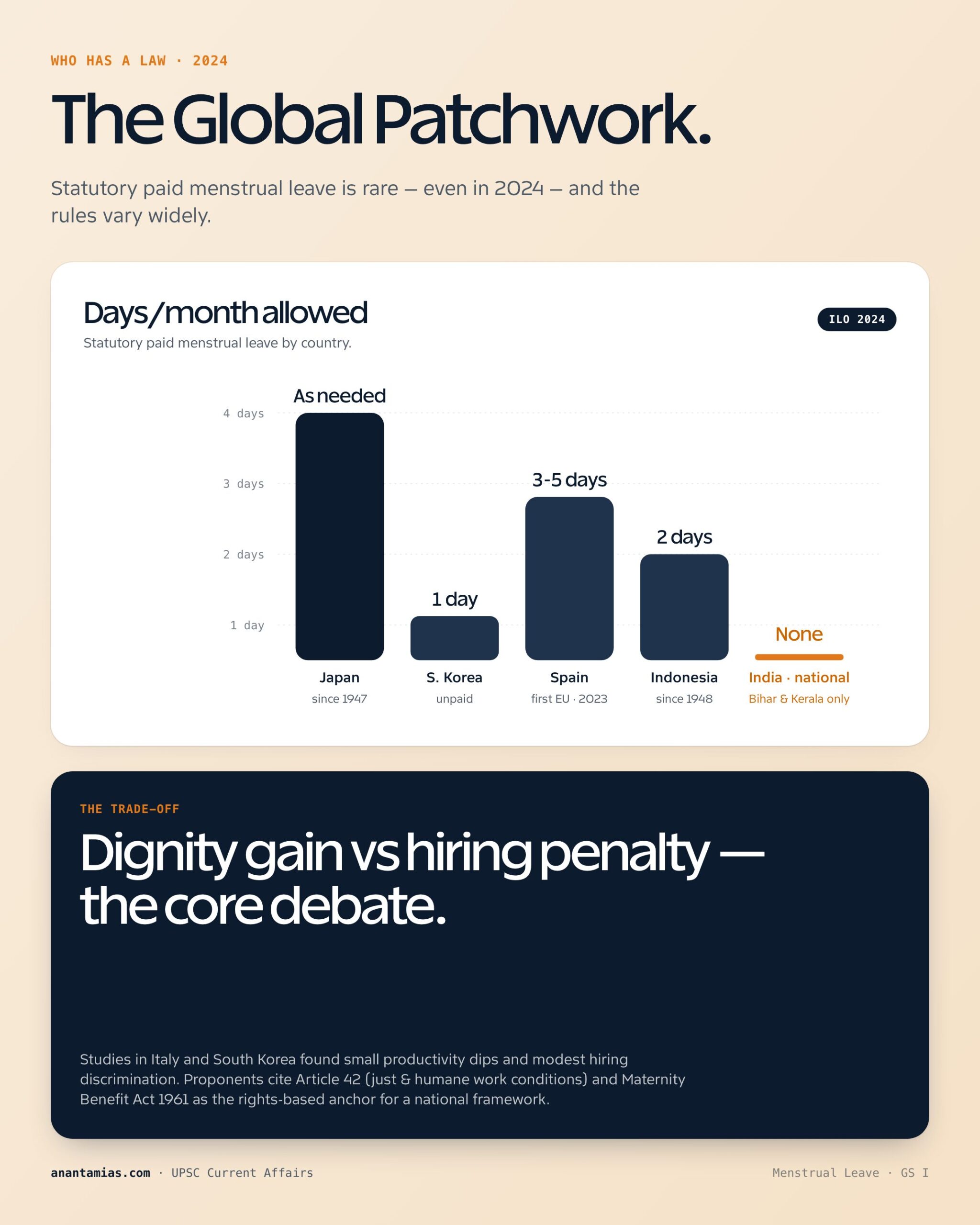
- Statutory, mandated by law (proposed in India; existing in Spain, Japan, South Korea, Indonesia, Taiwan, Zambia, Vietnam).
Distinguishing Concepts
- Menstrual leave: Paid/unpaid leave during periods.
- Maternity leave: 26 weeks under the Maternity Benefit (Amendment) Act 2017.
- Sick leave: General health.
- Casual leave: Generic short leave.
- Menstrual health management: Sanitary product access, sanitation, awareness.
Constitutional and Legal Anchors
| Provision | Coverage |
|---|---|
| Article 14 | Equality before the law |
| Article 15(3) | Special provisions for women |
| Article 21 | Right to life and dignity (incl. menstrual dignity per Delhi HC and SC observations) |
| Article 39(d) | Equal pay for equal work |
| Article 39(e) | Workers not abused; special protection for women's health |
| Article 42 | Just and humane conditions of work; maternity relief |
| Article 47 | Improvement of public health |
| Maternity Benefit (Amendment) Act 2017 | 26 weeks leave; crèche facility |
| POSH Act 2013 | Workplace harassment redress |
| Code on Wages 2019; OSH Code 2020; Industrial Relations Code 2020; Social Security Code 2020 | Consolidate labour protection |
Specific Menstrual Leave Provisions in India
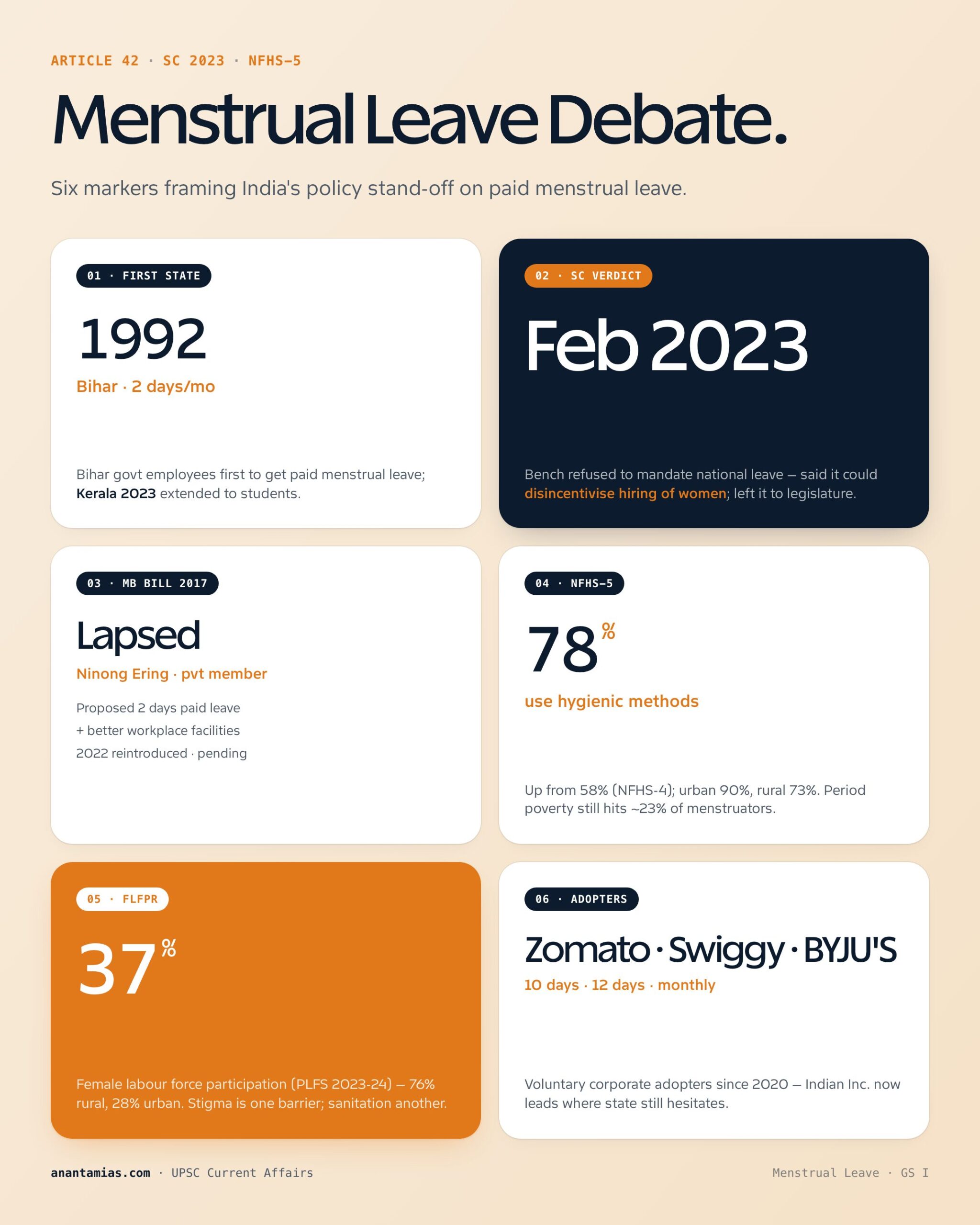
- Bihar (1992): 2 days menstrual leave per month for state government women employees.
- Kerala (2023): Menstrual leave for female students in state higher education institutions; Kerala State Disaster Management Authority also extended it to women employees.
- Sikkim (2023): Menstrual leave for state government women employees.
- Karnataka (2024): 6-day annual menstrual leave proposed; under draft.
- Odisha (2024): 1-day monthly menstrual leave announced for women employees of state and private sectors.
Corporate Adopters in India
- Zomato (2020): First major Indian corporate to adopt "period leave" — 10 days/year.
- Swiggy, Magzter, Culture Machine, Byju's, IndustryARC: Have similar policies (ranging 1-2 days/month or 12 days/year).
- Big Four consulting & IT majors: Mostly do not have explicit menstrual leave but flexible/sick-leave policies.
The Supreme Court 2023 Ruling
In Shailendra Mani Tripathi v. Union of India (February 2023), the Supreme Court declined to direct the Union Government to frame menstrual leave rules, holding that:
- Menstrual leave is a policy matter for the Executive.
- A judicial direction could discourage employers from hiring women, defeating the very objective of gender equality.
- The petitioner was directed to approach the Ministry of Women and Child Development and the Ministry of Health.
In July 2024, the SC reiterated this position when a fresh PIL came up — the bench encouraged the Centre to consult states and stakeholders to evolve a national policy.
Global Comparison
| Country | Menstrual Leave Provision | Year |
|---|---|---|
| Spain | 3 days paid (extendable to 5) — first European country | 2023 |
| Japan | "Physiologic leave" — unpaid, since 1947 Labour Standards Act | 1947 |
| South Korea | 1 day/month (paid if used) | 1953 |
| Indonesia | 2 days/month (paid) | 2003 |
| Taiwan | 3 days/year (1 day/month) | 2014 |
| Zambia | 1 day/month — "Mother's Day" | 2017 |
| Vietnam | 30 minutes/day during menstruation, 3 days/month | Labour Code |
| Italy | Proposed 2017, not enacted | — |
| France, UK, US, Australia | No statutory menstrual leave | — |
The global picture suggests menstrual leave is statutorily uncommon in advanced industrial democracies but common in East Asian and some developing economies.
Sociological and Public Health Lens
- Émile Durkheim: Menstruation is socially constructed — taboo or sacred — depending on cultural codes.
- Mary Douglas (Purity and Danger, 1966): Menstrual taboos reflect "matter out of place" — boundary anxieties.
- Veena Das: Indian feminist anthropology — body, ritual, exclusion.
- Public health view (WHO 2022): Menstrual health is a public health and human rights issue.
- Capabilities approach (Sen, Nussbaum): Bodily integrity, dignity, and health are core capabilities.
Indian Context: Why It Matters
Female Workforce Participation
- PLFS 2023-24: Female LFPR (15+) is 41.7% — up from 23.3% (PLFS 2017-18).
- Women face role overload: paid work + domestic work + caregiving.
- NSO Time Use Survey 2019: Women spend 7.2 hours/day on domestic work; men spend 2.8.
Menstrual Health Indicators (NFHS-5)
- 64% of women aged 15-24 use hygienic menstrual methods (up from 57.6% in NFHS-4).
- Rural-urban gap: 58% rural vs. 78% urban.
- States below national average: Bihar (59%), Madhya Pradesh (61%), UP (61%).
Period Poverty
- ~23 million women per year drop out of school after menarche (Dasra 2018).
- High prevalence of dysmenorrhea: 30-70% of women in various studies.
- 71% of girls report no awareness of menstruation till menarche (UNICEF 2018).
Arguments in Support of Menstrual Leave
- Substantive equality: Article 14 read with Article 15(3) — treating differently what is different.
- Health and productivity: 30-70% women experience dysmenorrhea; severe cases reduce productivity.
- Article 42 mandate: Just and humane conditions of work.
- Reduces stigma and taboo: Public policy normalises menstruation.
- Aligns with Sustainable Development Goals: SDG 3 (health), SDG 5 (gender), SDG 8 (decent work).
- Global best practice: Multiple countries have functional models.
- Improves retention: Reduces women's attrition from formal employment.
- Constitutional morality: Dignity of women workers as a Preamble value.
- Inclusive workplaces: Consistent with POSH Act, Maternity Benefit Act trajectory.
- Trade unions support: AITUC, CITU, INTUC have endorsed it in principle.
Arguments Against
- Reinforces gender stereotypes: Risks framing women as biologically less "work-fit".
- Hiring discrimination: Employers may prefer male candidates to avoid the cost.
- Privacy infringement: Requires women to disclose menstruation status.
- Misuse risk: Without medical certification, leave may be misused.
- Variability: Menstrual experience varies; not all women need leave.
- Existing leave categories: Sick leave, casual leave already cover this.
- Trans-inclusive concerns: How does the policy treat trans men, non-binary persons?
- Cost burden on small enterprises: MSMEs may struggle.
- Lack of robust Indian data: No large-scale study on productivity loss.
- Better alternative: Workplace infrastructure (sick rooms, sanitary products, hygiene).
The Menstruation Benefit Bill 2017 (Pending)
- Introduced by MP Ninong Ering (2017) as a Private Member's Bill.
- Provided 2 days paid menstrual leave per month to women working in public/private sector.
- Lapsed with dissolution of 16th Lok Sabha.
- Women's Sexual, Reproductive and Menstrual Rights Bill 2022 (Shashi Tharoor) is broader but not yet passed.
Government Initiatives Adjacent to Menstrual Leave
- Menstrual Hygiene Scheme (2011) under NHM — subsidised sanitary napkins for adolescent girls in rural areas.
- Suvidha sanitary napkins at ₹1 each via Janaushadhi Kendras (2018).
- Swachh Bharat Mission + Jal Jeevan Mission — sanitation infrastructure.
- POSHAN 2.0 — adolescent girl nutrition.
- Mission Shakti — women workers' welfare.
- Beti Bachao Beti Padhao 2.0 (2024) — adolescent girl focus.
2024-26 Policy Movement
- Karnataka draft policy 2024: 6-day annual menstrual leave for state employees.
- Odisha 2024: 1-day monthly menstrual leave for state and private sector women employees.
- Kerala (2023): Menstrual leave for higher-ed students.
- Sikkim 2023: Menstrual leave for state government women employees.
- Maharashtra 2024: Considering policy for women in informal sector.
- Centre's draft Menstrual Hygiene Policy for adolescent girls (December 2023, MoHFW) — under public consultation.
Sociological Perspectives Applied
| Theorist | Concept | Application |
|---|---|---|
| Mary Douglas | Purity and danger | Menstrual taboo |
| Sherry Ortner | Nature/culture binary | Female biology = nature, devalued |
| Iris Marion Young | Politics of difference | Recognition + redistribution |
| Amartya Sen | Capabilities | Health and bodily integrity as freedom |
| Martha Nussbaum | Functioning + capability | Equal access to dignity |
| Veena Das | Body and politics | Indian women's lived experience |
Data Snapshot (2024-26)
| Indicator | Value | Source |
|---|---|---|
| Female LFPR (15+) | 41.7% | PLFS 2023-24 |
| Hygienic method use (15-24) | 64% | NFHS-5 |
| Crimes against women | 4,45,256 (2022) | NCRB |
| Global Gender Gap | 129/146 | WEF GGGR 2024 |
| Maternity Benefit duration | 26 weeks | MBA 2017 |
| Period poverty dropouts | ~23 million/year | Dasra 2018 |
| Suvidha pad price | ₹1 | Janaushadhi |
| States with menstrual leave (2025) | Bihar, Kerala, Sikkim, Odisha (announced) | State govts |
Challenges in Implementing Menstrual Leave
- Risk of employer bias at hiring.
- Privacy and disclosure issues.
- Trans inclusion in policy language.
- MSME compliance burden.
- Federalism: State-by-state patchwork or central law?
- Quality of supporting infrastructure: sick rooms, sanitary products.
- Cultural shift: Workplace attitudes still stigmatising.
Way Forward
- Centre-state dialogue to evolve a national framework — per SC 2024 nudge.
- Pilot programmes in central PSUs and government departments before universalisation.
- Trans-inclusive language ("menstruating persons" or "employees who menstruate").
- Workplace infrastructure: sick rooms, free sanitary products, mental health support.
- Awareness programmes in schools and workplaces, building on NEP 2020.
- Gender budgeting in Union and state budgets to fund infrastructure.
- Robust data: ICMR/MoHFW longitudinal studies on dysmenorrhea, productivity, retention.
- Anti-discrimination safeguards: amendments to Equal Remuneration provisions in Code on Wages 2019.
Mains Hook
"Menstrual leave is a question of substantive equality, not paternalism." Critically examine the case for a national menstrual leave policy in India, addressing concerns about gender stereotyping and workplace participation. (GS-I/GS-II, 250 words, 15 marks)
Prelims Pointers
- Article 42: Just and humane conditions of work, maternity relief.
- Maternity Benefit (Amendment) Act: 2017 — 26 weeks paid leave.
- First state with menstrual leave: Bihar, 1992.
- First major Indian corporate: Zomato, 2020.
- Spain: First European country to enact menstrual leave (2023).
- Menstruation Benefit Bill: 2017 (Ninong Ering, lapsed).
- Shailendra Mani Tripathi: 2023 SC declined directive — Executive's domain.
- Hygienic menstrual method use: 64% (NFHS-5).
- Suvidha pads: ₹1 at Janaushadhi.
- Female LFPR: 41.7% (PLFS 2023-24).
Menstrual leave is a textbook example of how gender equality moves from formal rights to substantive enabling conditions. UPSC answers should braid Article 42 + NFHS-5 data + global best practice + SC 2023 ruling + state pilots to demonstrate full-spectrum policy understanding.
Tell Google you want more of this.
Add Anantam IAS as a preferred sourceOne tap, and this site shows up more often in your own Top Stories, AI Overviews and AI Mode. Remove it any time.





