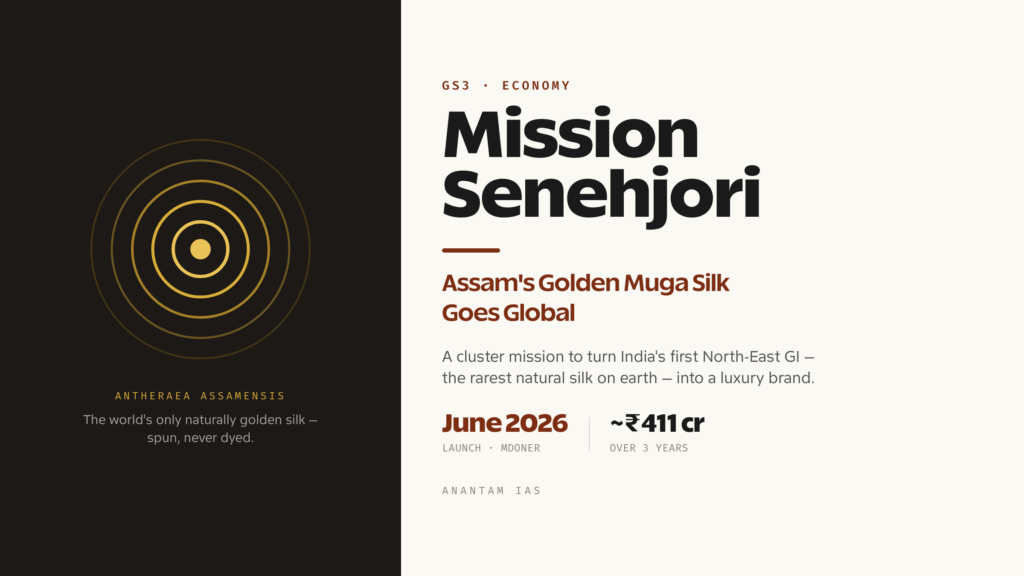
In early June 2026, a thread that has been spun in the Brahmaputra valley for more than two thousand years got a national mission of its own. Union Minister Jyotiraditya Scindia, who heads the Ministry of Development of North Eastern Region, joined Assam Chief Minister Himanta Biswa Sarma to launch Mission Senehjori — a cluster-based programme built around a single, very specific fibre: Assam’s golden Muga silk. The name itself carries the intent. Senehjori is an Assamese word for affection, the gentle bond of love, and the minister has said the idea took shape at a 2024 Ashtalakshmi Mahotsav stall in Delhi where Muga silk was on display. The mission’s whole bet is that a fibre this rare, with a story this old, can become a global luxury brand rather than a fading craft.
And that bet matters far beyond Assam. Muga is the world’s only naturally golden silk, India’s first Geographical Indication from the North-East, and a livelihood for roughly 2.6 lakh rearer and weaver families. But its acreage has been shrinking, climate change is hammering the silkworm, and the fabric that should command a premium is fighting cheap imitation. So Mission Senehjori is really a test case for a much larger idea India keeps repeating — that a GI tag, careful branding and “vocal for local” can turn a rural, tribal craft into export earnings without hollowing out the people who make it. For a UPSC aspirant, that puts this one mission at the crossroads of GS Paper 3 (agriculture and allied sectors, economy, GI) and GS Paper 1 (art and culture).
What Muga Silk Actually Is
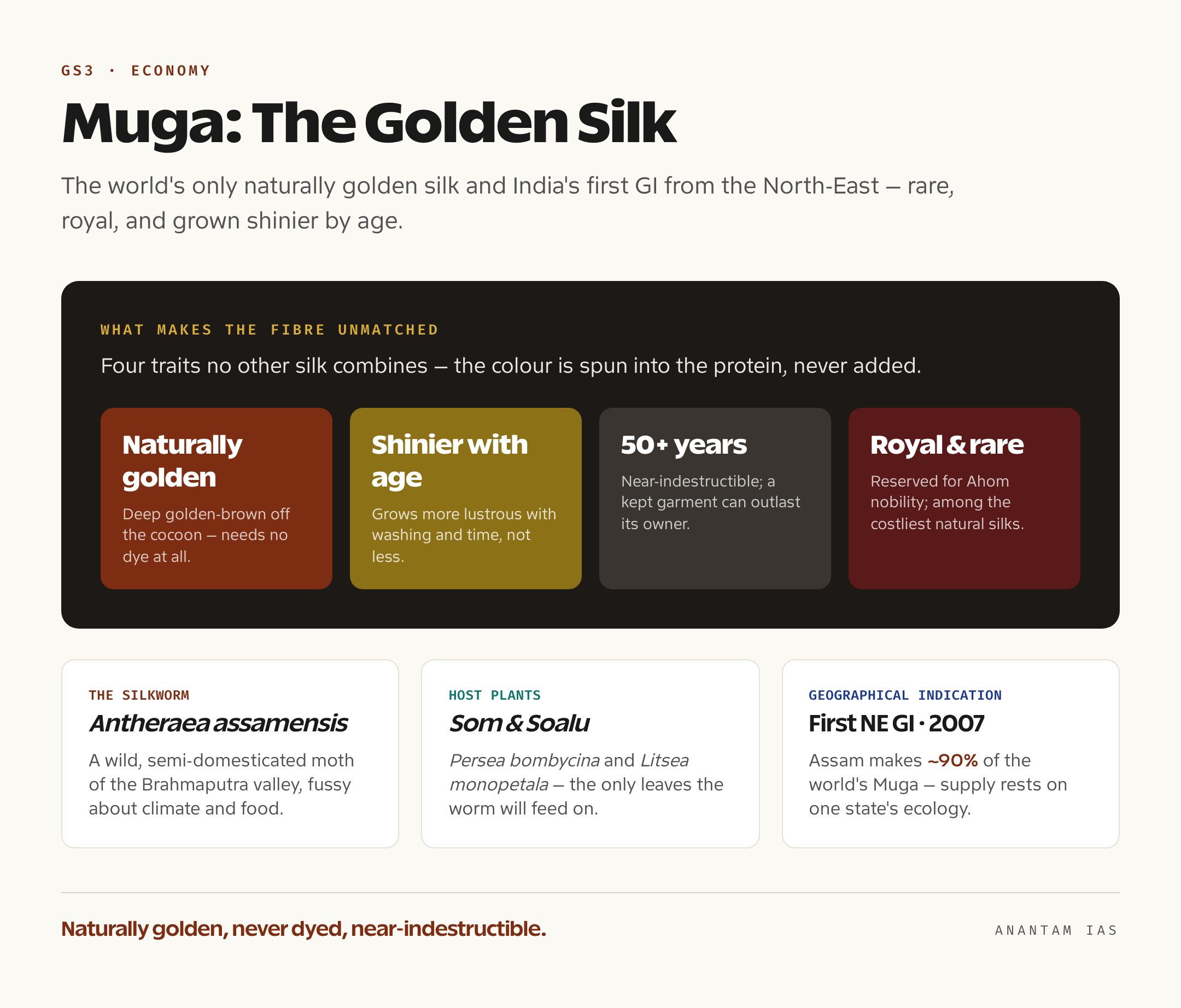
Start with the fibre, because almost everything about the mission flows from how unusual it is. Muga silk is produced by the silkworm Antheraea assamensis, a wild, semi-domesticated moth that lives almost entirely in the Brahmaputra valley and a few adjoining pockets. The worm feeds on the leaves of two host trees — Som (Persea bombycina) and Soalu (Litsea monopetala) — and it is fussy about both climate and food. That fussiness is the first reason Muga is so rare: you cannot simply farm it anywhere the way you can ordinary mulberry silk. Assam accounts for roughly 90 per cent of the world’s Muga output, which is another way of saying the world’s supply rests on one Indian state’s ecology.
The fibre’s signature is its colour. Muga means “yellowish” in Assamese, and the silk comes off the cocoon a deep golden-brown without any dyeing at all — the colour is built into the protein the worm spins. That alone makes it a curiosity. What turns curiosity into luxury is what happens next: unlike almost every other textile, Muga gets more lustrous with washing and age rather than fading, and a well-kept Muga garment can outlast its owner, often lasting 50 years or more. It is also exceptionally strong and dense, with more crystalline content than common silk, which is why it drapes with that heavy, liquid-gold sheen. Put those traits together — naturally golden, never needs dye, grows shinier with age, near-indestructible — and you have a fibre routinely described as the rarest and one of the most expensive natural silks on earth.
This is silk with a royal past. Under the Ahom dynasty, which ruled Assam from 1228 to 1826, Muga was reserved for nobility, and commoners were once forbidden from wearing it. Today it lives on in the mekhela chador, the two-piece Assamese drape that is the heart of the state’s festive wardrobe, and in the silk woven at Sualkuchi — the famous weaving town on the north bank of the Brahmaputra, often called the “Manchester of the East.” So Muga is not just an export commodity. It is a piece of Assamese identity worn at weddings and Bihu, which is exactly why a mission named for affection makes emotional sense.
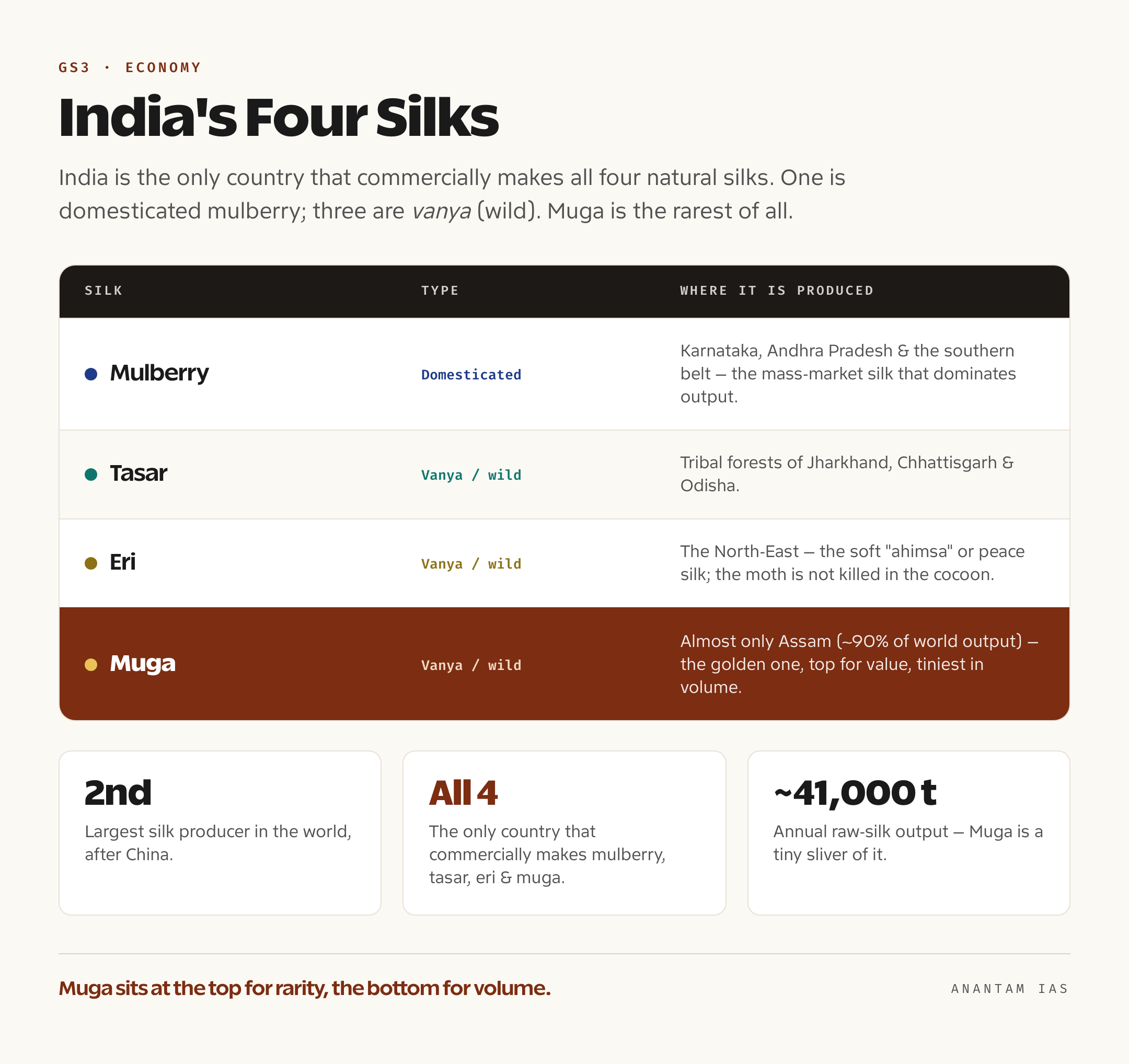
It helps to place Muga inside India’s wider silk family, because UPSC loves this classification. India is the world’s second-largest silk producer after China, and it is the only country that commercially produces all four natural silks: mulberry, tasar, eri and muga. Mulberry is the domesticated, mass-market silk that dominates output from Karnataka, Andhra Pradesh and the southern belt. The other three are “vanya” or wild (non-mulberry) silks — tasar from the tribal forests of Jharkhand, Chhattisgarh and Odisha; eri, the soft “ahimsa” or peace silk of the North-East where the moth is not killed in the cocoon; and muga, the golden one. Muga sits at the very top of this pyramid for value and rarity, and at the very bottom for volume — it is a tiny sliver of India’s roughly 41,000-tonne annual raw-silk production. Scarce, prized and culturally loaded: that is the raw material Mission Senehjori is working with.
What Mission Senehjori Sets Out to Do
Mission Senehjori is best understood not as a subsidy scheme but as a value-chain mission — an attempt to fix every weak link from the silkworm to the showroom. It carries an outlay of roughly Rs 396-411 crore over three years, with a sizeable share coming from the Ministry of Development of North Eastern Region, and it concentrates on the eight districts that actually grow Muga: Jorhat, Sivasagar, Lakhimpur, Dhemaji, Dibrugarh, Tinsukia, Majuli and the weaving hub of Sualkuchi. The cluster approach matters because Muga’s problems are not evenly spread; they are local, district by district, and a blanket scheme would miss them.
The mission rests on a handful of clear pillars. The first is ecology and raw material — regenerating 5,000 hectares of Som and Soalu host plants and strengthening silkworm-seed production, because without healthy host trees there is no Muga at all. The second is modern infrastructure — five modernised reeling units and a dedicated Muga Spun Mill, so that the cocoon can be turned into yarn efficiently instead of through slow, lossy traditional reeling. The third is institution-building at the farm gate — 30 Farmer Producer Organisations and more than 1,180 Farmer Interest Groups, so that scattered rearers gain bargaining power and access to credit and markets the way an individual weaver never could.
The fourth pillar is the one that turns craft into brand: GI authentication and digital traceability. The mission wants more than 80 per cent of traded Muga to carry verified GI-linked authentication, with QR-coded traceability reaching over 8,000 households so a buyer in Tokyo or Milan can confirm a scarf is genuine Assam Muga and not a synthetic look-alike. That is the difference between selling a generic fabric and selling a protected luxury good — the same logic that lets Champagne or Darjeeling tea command a premium. The fifth pillar is demand and storytelling: export promotion targeting more than 2,000 kilograms of Muga exports a year, plus silk tourism through a planned Muga Silk Trail, a Silk Tourism Park and an annual Muga Utsav. By 2028, those are the headline targets the government has put on the table. And the human goal behind all of it is blunt — Scindia has noted that a Muga rearer or weaver today earns only about Rs 18,000-21,000 a year from this work, and the mission’s real test is whether that number rises.
Why a Single Silk Deserves a National Mission
It can look odd that the Union government is building a mission around one boutique fibre when India produces 41,000 tonnes of silk overall. But the significance is exactly in the smallness. Muga ticks almost every box the government wants a model rural industry to tick. It is geographically unique — it literally cannot be produced anywhere else, which makes it the perfect candidate for GI-led branding and immune to being undercut by a factory in another country. It is labour-intensive and decentralised, sustaining around 2.6 lakh families across rural and tribal Assam, many of them women weavers for whom the loom at home is the main source of cash income. And it is “vocal for local” made tangible: a homegrown product with a built-in global luxury story, the kind of thing the Ashtalakshmi Mahotsav was designed to showcase to the world.
There is also a hard economic case. India’s silk trade is lopsided — the country exported around 246 million dollars of silk and silk goods in FY25 but still imports raw silk and silk yarn, largely from China and Vietnam, to feed its weavers. High-value, can’t-be-copied products like Muga are precisely where India can earn more without importing more. A genuine Muga stole sells at a steep premium in luxury markets, so even modest export volumes translate into serious value per kilogram. Capturing that premium for Assamese weavers — rather than letting middlemen or imitators take it — is the economic heart of the mission.
Then there is the cultural and strategic layer that UPSC examiners care about. The North-East has long felt peripheral to India’s growth story, and textiles are one of the few sectors where the region holds a genuine global edge. Backing Muga is a way of weaving the North-East into the national economy through its own strengths rather than transplanted ones, which connects the mission to the broader push for North-East integration and connectivity. Heritage, livelihoods, women’s economic empowerment, export earnings and regional integration all run through one golden thread — which is why a single silk gets a mission named after affection.
The Challenges That Made the Mission Necessary
A mission like this exists because the underlying industry is in trouble, and an honest answer says so. The biggest threat is climate. The Muga silkworm is extraordinarily sensitive to temperature and humidity, and rising heat, erratic rainfall and longer dry spells have pushed conditions past what the worm tolerates well. Rearers report higher larval mortality, smaller and poorer cocoons, and weaker fibre as temperatures climb and host-plant leaves lose quality. Researchers studying the Jorhat belt have documented exactly this squeeze, and it explains why “regenerate 5,000 hectares of host plants” sits at the very front of the mission — the ecological base is eroding.
Disease is the second hammer. The seed crop is vulnerable to a whole catalogue of viral, bacterial, fungal and protozoan infections, and a single disease such as flacherie can wipe out a large share of a crop — losses of up to around 40 per cent have been recorded for individual diseases. Combine fragile worms with fragile host trees and you get the third problem: declining acreage and stubbornly low yields. Production has been creeping up far more slowly than demand; against a Central Silk Board ambition of around 470 tonnes, output has been tracking closer to 300, leaving a persistent gap between what the market wants and what Assam can spin.
Around these biological problems sits a cluster of economic ones. Reeling and rearing are slow and labour-intensive, so margins are thin and the young are walking away from the craft. Genuine GI Muga is undercut by cheaper power-loom imitations and blended fabrics that borrow the “golden silk” name without the substance, which erodes both price and trust — a textbook case of why GI enforcement, not just GI registration, is what actually protects a product. And the whole chain has historically lacked modern infrastructure and organised marketing, leaving weavers at the mercy of intermediaries. Mission Senehjori is essentially a point-by-point response to this list. Whether it works depends on execution — on host plants actually regenerated, FPOs that function rather than exist on paper, and GI authentication that is enforced in the market and not just printed on a tag. The way forward is the mission delivered, plus the unglamorous follow-through of climate-resilient silkworm breeds, fair prices and real protection against counterfeits.
For Your Mains Answer
This topic is a clean fit for GS Paper 3 under agriculture and allied sectors (sericulture), the economy, and Geographical Indications, and it doubles as GS Paper 1 material on Indian art and culture and the heritage of the North-East. It can also feed an Essay on heritage-as-economy or vocal-for-local. The smartest framing treats Mission Senehjori as a case study that lets you argue a bigger point — how India can convert unique, GI-protected rural crafts into livelihoods and exports — rather than just describing one scheme.
How to Build the Answer
Open by anchoring the fibre, not the scheme: Muga is the world’s only naturally golden silk, India’s first North-East GI, produced almost only in Assam by Antheraea assamensis. Then introduce Mission Senehjori (June 2026, MDoNER-led, roughly Rs 411 crore, cluster-based) as a value-chain response. Build the body around three moves — the significance (livelihoods for 2.6 lakh families, women weavers, exports, North-East integration), the challenges (climate, disease, declining acreage, imitation), and the way forward (the mission’s pillars plus enforcement and climate-resilient breeds). Close on the larger lesson about GI-led, branded rural industrialisation.
Common Mistakes to Avoid
Don’t confuse the silks — Muga is a vanya (non-mulberry, wild) silk, distinct from eri (peace silk) and tasar, and very distinct from mulberry. Don’t claim India is the world’s largest silk producer; it is the second after China, though it is the only country that makes all four commercial silks. Don’t treat a GI tag as a magic wand — registration without enforcement does little, and saying so shows maturity. And don’t drown the answer in figures; two or three anchors are plenty.
A Compact Answer Spine
Muga = world’s only golden silk, first NE GI (2007), Assam-only, Antheraea assamensis on Som/Soalu → Mission Senehjori (June 2026, MDoNER, ~Rs 411 cr, cluster-based, eight districts) → pillars: host-plant regeneration, modern reeling + spun mill, FPOs, GI authentication + QR traceability, exports + silk tourism → significance: 2.6 lakh families, women weavers, vocal-for-local, NE integration → challenges: climate, disease, low yields, imitation → way forward: mission delivered + GI enforcement + climate-resilient breeds.
Diagram or Flowchart Idea
Draw a simple value-chain arrow with five boxes — Host plants (Som/Soalu) → Silkworm rearing (A. assamensis) → Reeling/spinning → Weaving (Sualkuchi) → Branding & export — and tag each box with the mission’s intervention beneath it (5,000 ha regenerated; FPOs; spun mill; GI/QR authentication; Muga Utsav and exports). A chain diagram like this shows the examiner you understand the mission as a system, not a slogan.
A Balanced-Conclusion Line
Something like: “Mission Senehjori shows that India’s edge lies not in competing on volume but in protecting and branding what only it can make — but a golden thread is only as strong as its weakest link, and the mission will be judged by the weaver’s income, not the brochure.”
How to Use Data Without Cramming
Pick a few sticky numbers and use them with purpose: Assam makes around 90 per cent of the world’s Muga; the mission supports about 2.6 lakh rearer-weaver families; the outlay is roughly Rs 411 crore to 2028; India is the 2nd-largest silk producer and the only one making all four silks. Keep quotable keywords ready — GI authentication, vanya silk, cluster-based mission, value chain, vocal for local, climate-resilient sericulture — and deploy them where they earn marks.
FAQ
What is Mission Senehjori and who launched it? Mission Senehjori is a cluster-based mission launched in early June 2026 to transform Assam’s Muga silk into a global luxury brand. It was launched by Union Minister Jyotiraditya Scindia of the Ministry of Development of North Eastern Region together with Assam Chief Minister Himanta Biswa Sarma, with an outlay of roughly Rs 396-411 crore over three years. Senehjori is an Assamese word for affection.
Why is Muga silk so special? Muga is the world’s only naturally golden silk, produced by the Antheraea assamensis worm almost exclusively in Assam. It needs no dye, grows more lustrous with washing and age, can last 50 years or more, and was India’s first Geographical Indication from the North-East (2007). Its rarity and durability make it one of the costliest natural silks on earth.
How does Muga fit into India’s silk industry? India is the world’s second-largest silk producer after China and the only country that commercially makes all four natural silks — mulberry, tasar, eri and muga. Muga is a “vanya” or wild (non-mulberry) silk, tiny in volume but the highest in value and rarity, and it is overseen alongside the others by the Central Silk Board under schemes like Silk Samagra-2.
What are the main challenges facing Muga silk? Climate change is the biggest threat — heat, erratic rain and humidity raise silkworm mortality and reduce cocoon quality. The worm is also hit by viral, bacterial and fungal diseases that can destroy large parts of a crop, while host-plant acreage has declined, yields remain low, and cheap power-loom imitations undercut genuine GI Muga. Mission Senehjori is designed to tackle each of these.
Practice Questions
Prelims MCQs
- With reference to Muga silk, consider the following statements. Which is/are correct?
(a) It is produced by the silkworm Antheraea assamensis
(b) It is a mulberry silk
(c) It received a Geographical Indication tag and was India’s first GI from the North-East
(d) It requires chemical dyeing to achieve its golden colour.
Answer:
(a) and (c) — Muga is a vanya (non-mulberry) wild silk and is naturally golden, so it is not mulberry silk and needs no dye. - Mission Senehjori, in the news in 2026, is associated with which of the following?
(a) Eri silk in Meghalaya
(b) Muga silk in Assam
(c) Tasar silk in Jharkhand
(d) Mulberry silk in Karnataka.
Answer: (b) — Mission Senehjori is a cluster-based mission to promote Assam’s Muga silk. - India produces all four commercial natural silks.
Which of the following is the correct set?
(a) Mulberry, tasar, eri, muga
(b) Mulberry, tasar, spider, muga
(c) Mulberry, eri, muga, sea silk
(d) Tasar, eri, muga, angora.
Answer: (a) — India is the only country that commercially produces mulberry, tasar, eri and muga silk. - Consider the host plants of the Muga silkworm. Which pair is correct?
(a) Mulberry and castor
(b) Som and Soalu
(c) Arjun and asan
(d) Oak and sal.
Answer: (b) — The Muga worm feeds on Som (Persea bombycina) and Soalu (Litsea monopetala); castor feeds the eri worm, and oak/arjun feed tasar varieties. - With reference to India’s silk sector, consider the following statements. Which is/are correct? (a) India is the world’s largest producer of raw silk (b) The Central Silk Board functions under the Ministry of Textiles (c) Eri silk is also known as “ahimsa” or peace silk. Answer: (b) and (c) — India is the second-largest silk producer after China, not the largest; the Central Silk Board is under the Ministry of Textiles; eri is the peace silk.
Mains Practice Questions
- “A Geographical Indication is only as valuable as its enforcement.” Discuss this statement in the context of Assam’s Muga silk and Mission Senehjori. (15 marks, 250 words)
- India is the only country that commercially produces all four natural silks. Examine the significance of vanya (non-mulberry) sericulture for rural and tribal livelihoods in India, and the challenges it faces. (15 marks, 250 words)
- Discuss how climate change is affecting sericulture in India, with special reference to Muga silk in Assam, and suggest measures to build climate resilience in the sector. (10 marks, 150 words)
- “Branding heritage crafts can convert cultural capital into export earnings without displacing the artisans who create them.” Critically evaluate this idea using Mission Senehjori as a case study. (15 marks, 250 words)
- Examine the role of textiles and Geographical Indications in integrating the North-East into India’s national economy. (10 marks, 150 words)
Tell Google you want more of this.
Add Anantam IAS as a preferred sourceOne tap, and this site shows up more often in your own Top Stories, AI Overviews and AI Mode. Remove it any time.