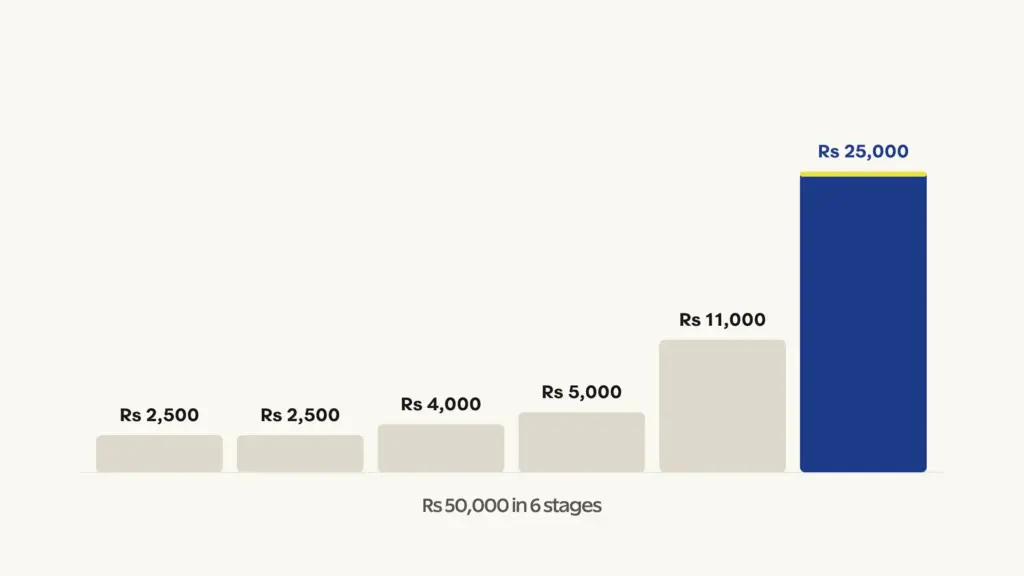
Mukhyamantri Rajshri Yojana is a Rajasthan government scheme that pays ₹50,000 for a girl child in six instalments, starting at birth and ending after Class 12. Each instalment is released only when a milestone is met — institutional delivery, full immunisation at one year, and then admission into Class 1, Class 6, Class 10 and Class 12. The money is transferred directly to the parent’s or guardian’s bank account. One thing to know before you read further: for girls born on or after 1 August 2024, this scheme has been folded into the newer Lado Protsahan Yojana.
Where the scheme stands today
Rajshri Yojana began on 1 June 2016 under the Department of Women and Child Development. It covers girls born on or after that date, and it is still paying out — because a girl born in, say, 2017 is only now reaching the Class 6 instalment, and one born in 2016 has more than a decade of instalments still ahead.
What has changed is the front end. Rajasthan launched Lado Protsahan Yojana on 1 August 2024, and Rajshri was merged into it. So:
- Girls born between 1 June 2016 and 31 July 2024 who were enrolled under Rajshri continue in the scheme and keep receiving their remaining instalments on the original six-stage ladder.
- Girls born on or after 1 August 2024 are registered under Lado Protsahan Yojana instead, which pays a larger total in seven instalments running up to graduation or age 21. The state announced an increase in that total to ₹1.50 lakh during the 2025-26 budget discussion. Since the stage-wise split has been revised since launch, confirm the current figures with the Department of Women and Child Development, Rajasthan or your Anganwadi centre before planning around them.
Everything below describes the Rajshri ladder, which is what most families with school-going daughters in Rajasthan are actually drawing on right now.
The six instalments
| Stage | When it is paid | Amount |
|---|---|---|
| 1 | On the birth of the girl child in a government hospital or a private institution registered under Janani Suraksha Yojana | ₹2,500 |
| 2 | On completing one year of age with the full course of immunisation | ₹2,500 |
| 3 | On admission to Class 1 in a government or state-recognised school | ₹4,000 |
| 4 | On admission to Class 6 | ₹5,000 |
| 5 | On admission to Class 10 | ₹11,000 |
| 6 | On reaching Class 12 and completing it | ₹25,000 |
Total: ₹50,000. More than seventy per cent of it lands in the last two instalments, which is deliberate — the money arrives at exactly the ages when families under pressure are most likely to pull a daughter out of school or marry her early.
Who is eligible
- The girl child must be born on or after 1 June 2016.
- The delivery must be institutional — in a government hospital or health institution, or in a private medical institution registered under Janani Suraksha Yojana. A home delivery does not qualify for the first instalment.
- The mother must be a resident of Rajasthan and hold the required state identity linkage. The scheme originally ran on the Bhamashah card; Rajasthan has since replaced Bhamashah with the Jan Aadhaar card, which is what families are asked for now.
- Benefits are available for the first two living girl children of a family. For a third girl child, only the first two instalments are payable.
- From the third instalment onward, the girl must be studying in a government school or a school recognised by the state government. Instalments are released at admission and verified through the school.
How the money reaches you
Nothing is paid in cash and there is no cheque to collect.
- First instalment — the hospital or health institution records the delivery in the state health system at the time of discharge. The amount is credited by Direct Benefit Transfer to the mother’s account linked to her Jan Aadhaar.
- Second instalment — released after the girl completes one year of age and her immunisation record is updated by the ANM or Anganwadi worker.
- Third to sixth instalments — released through the school. The school enters the girl’s details in the Rajshree module on the Shala Darpan portal, the entry is verified, and the amount is transferred to the account on record.
Because instalments three onward depend entirely on a school clerk making a correct entry, the single most useful thing a parent can do is walk into the school office at admission time and ask, in writing, that the child be entered in the Rajshree module.
Documents to keep ready
- Birth certificate of the girl child
- Jan Aadhaar card of the family (and Aadhaar of the mother and the child)
- Proof of institutional delivery — the hospital discharge slip or delivery record
- Immunisation card for the second instalment
- Bank passbook of the mother or guardian, with the account seeded to Aadhaar
- Residence proof of the mother in Rajasthan
- School admission proof or bonafide certificate for the third instalment onward
The account has to be Aadhaar-seeded at the NPCI mapper for a DBT credit to succeed. This is the most common silent failure: the application is approved, the transfer is attempted, and it bounces because the bank account was never linked.
If an instalment has not arrived
- Check the entry first, not the money. Ask the school (or, for the first two instalments, the Anganwadi centre or the health institution) whether the child’s record has actually been submitted and verified.
- Check the bank account. Confirm that the account is active, that Aadhaar is seeded and mapped, and that the account has not been frozen or gone dormant. A dormant account will reject a DBT credit.
- Check the name and date of birth on the school record against the Jan Aadhaar and birth certificate. A single mismatched spelling can hold up verification indefinitely.
- Escalate to the block level. The Child Development Project Officer (CDPO) at the block ICDS office handles Rajshri grievances for the first two instalments; the block education office handles the school-linked ones.
- Use Rajasthan Sampark. The state’s grievance portal and its 181 helpline accept complaints against a department and give you a traceable reference number, which is more useful than repeated visits.
How Rajshri fits with other benefits
Rajshri is a state scheme and does not cancel out central benefits. A family can receive maternity benefit under Pradhan Mantri Matru Vandana Yojana for the same birth and still draw the Rajshri instalments, because the two are paid by different governments for different milestones.
For long-term savings in the daughter’s own name, the Sukanya Samriddhi account is a separate track altogether — you deposit into it and it earns interest, whereas Rajshri pays out. Many families use the Class 10 and Class 12 instalments to seed exactly that kind of account. A broader view of what a household may be entitled to is in this list of government schemes.
Frequently Asked Questions
Is Mukhyamantri Rajshri Yojana still running in 2026?
Yes, for girls already enrolled. Girls born between 1 June 2016 and 31 July 2024 continue to receive their remaining instalments on the six-stage ladder. New registrations for girls born on or after 1 August 2024 happen under Lado Protsahan Yojana, into which Rajshri was merged.
Do I have to apply separately for each instalment?
There is no separate online application form for the family to fill. Each instalment is triggered by the institution that certifies the milestone — the hospital for birth, the health worker for immunisation, and the school at admission. Your job is to make sure each of those records is entered correctly and that the bank account is Aadhaar-seeded.
Is a home delivery eligible?
No. The first instalment specifically requires delivery in a government health institution or a private institution registered under Janani Suraksha Yojana. This condition is central to the scheme’s design, which is aimed at raising institutional deliveries alongside supporting the girl child.
What if the family has a third daughter?
Benefits are meant for the first two living girl children. For a third girl child, only the first two instalments — ₹2,500 at birth and ₹2,500 at one year — are payable.
Can a girl in a private school get the later instalments?
Only if the school is recognised by the state government. Instalments from Class 1 onward are released through the school’s entry in the Shala Darpan Rajshree module, so an unrecognised private school cannot process them.
Where do I check the status?
Instalments linked to school admission can be tracked through the Rajshree module on the Shala Darpan portal, usually via the school. For the first two instalments, the Anganwadi centre or the health institution that recorded the delivery is the right place to ask.
Is the Bhamashah card still needed?
Rajasthan has replaced Bhamashah with the Jan Aadhaar card. If your records still carry an old Bhamashah number, get the family enrolled in Jan Aadhaar and make sure the mother’s bank account is linked to it, or DBT credits will fail.
Tell Google you want more of this.
Add Anantam IAS as a preferred sourceOne tap, and this site shows up more often in your own Top Stories, AI Overviews and AI Mode. Remove it any time.