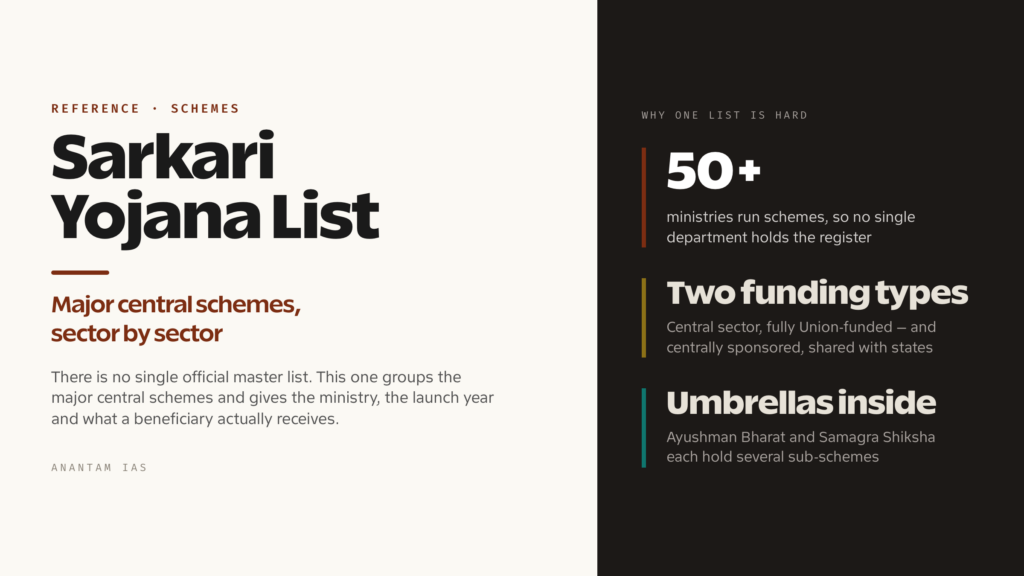
There is no single official master list of Indian government schemes, which is why searching for one is so frustrating. Schemes sit across more than fifty ministries, some are central sector programmes funded entirely by the Union government, others are centrally sponsored with state cost-sharing, and several well-known names are umbrellas holding half a dozen sub-schemes inside them. The government’s own aggregator, the myScheme portal, lists thousands of entries once state schemes are counted.
This page is a working reference rather than an exhaustive catalogue. It groups the major central schemes by sector, and for each one gives the implementing ministry, the launch year and what a beneficiary actually receives. Where a scheme has been renamed or absorbed into an umbrella, that is noted, because the old name is usually what people still search for.
How This List Is Organised
Two distinctions are worth holding on to before reading the tables.
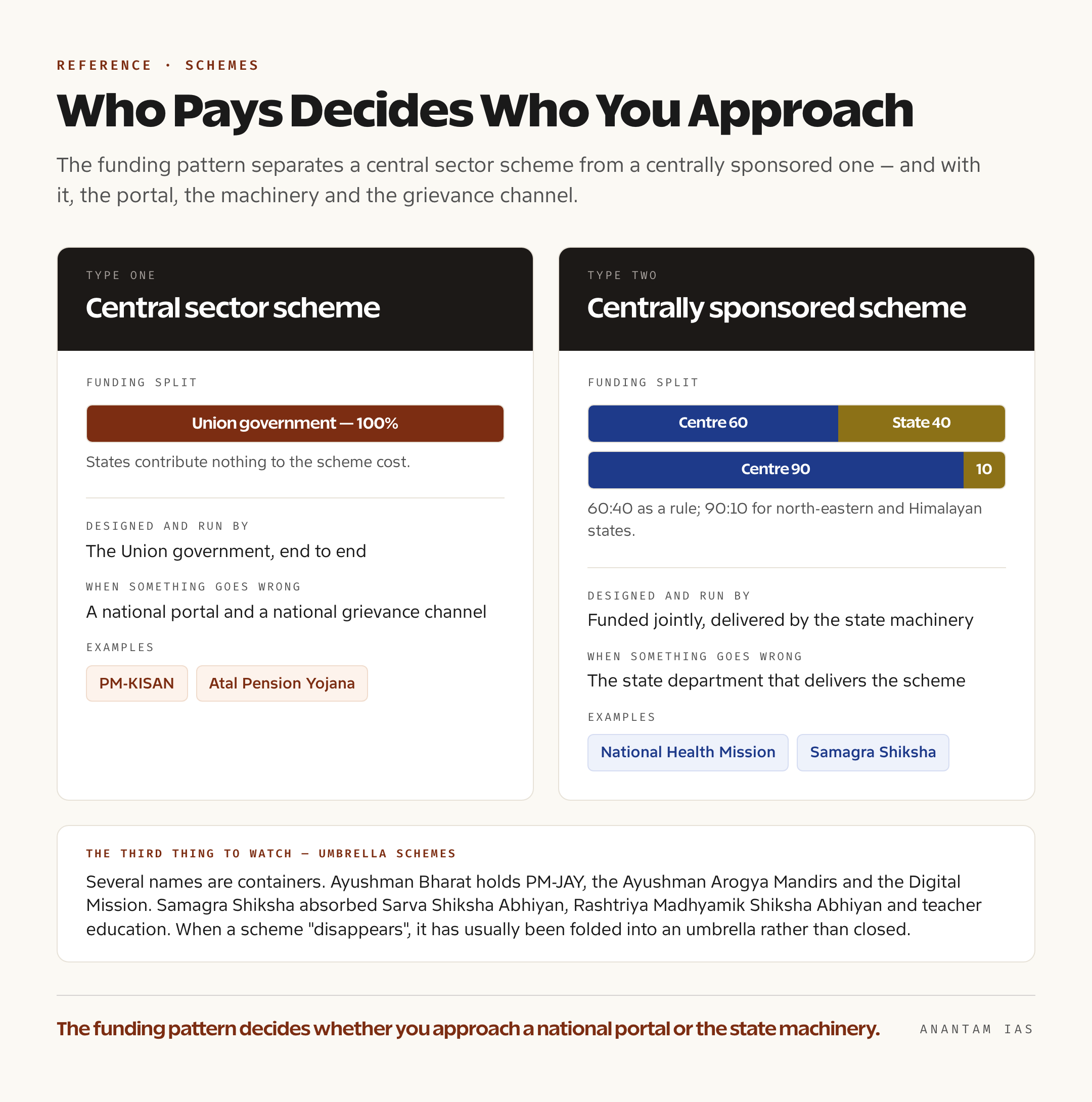
Central sector versus centrally sponsored. A central sector scheme is designed and funded entirely by the Union government — PM-KISAN and Atal Pension Yojana sit here. A centrally sponsored scheme is funded jointly, usually in a 60:40 ratio with states and 90:10 for north-eastern and Himalayan states — the National Health Mission and Samagra Shiksha work this way. The distinction decides who you approach when something goes wrong: a central sector scheme has a national portal and grievance channel, a centrally sponsored one is delivered by the state machinery.
Umbrella schemes. Several names in this list are containers. Ayushman Bharat holds PM-JAY, the Ayushman Arogya Mandirs and the Digital Mission. Samagra Shiksha absorbed Sarva Shiksha Abhiyan, Rashtriya Madhyamik Shiksha Abhiyan and teacher education. When a scheme “disappears”, it has usually been folded into an umbrella rather than closed.
Launch years below refer to the year the scheme was announced or launched, which is not always the year the first rupee moved. Benefit amounts and coverage change with cabinet approvals and budget cycles, so treat the figures as the position at the time of writing and check the scheme’s own portal before acting on any of them.
Agriculture and Farmer Welfare
Agriculture carries the largest concentration of direct-transfer and insurance schemes, mostly under the Ministry of Agriculture and Farmers Welfare.
| Scheme | Ministry | Launched | What it gives |
|---|---|---|---|
| PM Kisan Samman Nidhi (PM-KISAN) | Agriculture and Farmers Welfare | 2019 | Rs 6,000 a year to landholding farmer families in three instalments |
| Pradhan Mantri Fasal Bima Yojana | Agriculture and Farmers Welfare | 2016 | Crop insurance at a farmer premium of 2% for kharif, 1.5% for rabi and 5% for commercial and horticultural crops |
| Kisan Credit Card | Agriculture, with RBI and NABARD | 1998 | Short-term crop credit at a concessional interest rate |
| Soil Health Card Scheme | Agriculture and Farmers Welfare | 2015 | Soil nutrient status and crop-wise fertiliser recommendations for each holding |
| National Agriculture Market (e-NAM) | Agriculture and Farmers Welfare | 2016 | Electronic trading platform linking regulated mandis across states |
| PM Krishi Sinchayee Yojana | Jal Shakti with Agriculture | 2015 | Irrigation coverage and micro-irrigation support under “Har Khet Ko Pani” |
| PM Kisan Maandhan Yojana | Agriculture and Farmers Welfare | 2019 | Rs 3,000 monthly pension from age 60 for small and marginal farmers |
| PM Matsya Sampada Yojana | Fisheries, Animal Husbandry and Dairying | 2020 | Investment in fisheries infrastructure, aquaculture and fisher welfare |
| Rashtriya Krishi Vikas Yojana | Agriculture and Farmers Welfare | 2007 | Flexible funding to states for agriculture and allied sector projects |
| PM-AASHA | Agriculture and Farmers Welfare | 2018 | Price support and deficiency payment mechanisms for oilseeds and pulses |
| PM Dhan-Dhaanya Krishi Yojana | Agriculture and Farmers Welfare | 2025 | Convergence programme in 100 low-productivity districts, with an annual outlay of Rs 24,000 crore over six years |
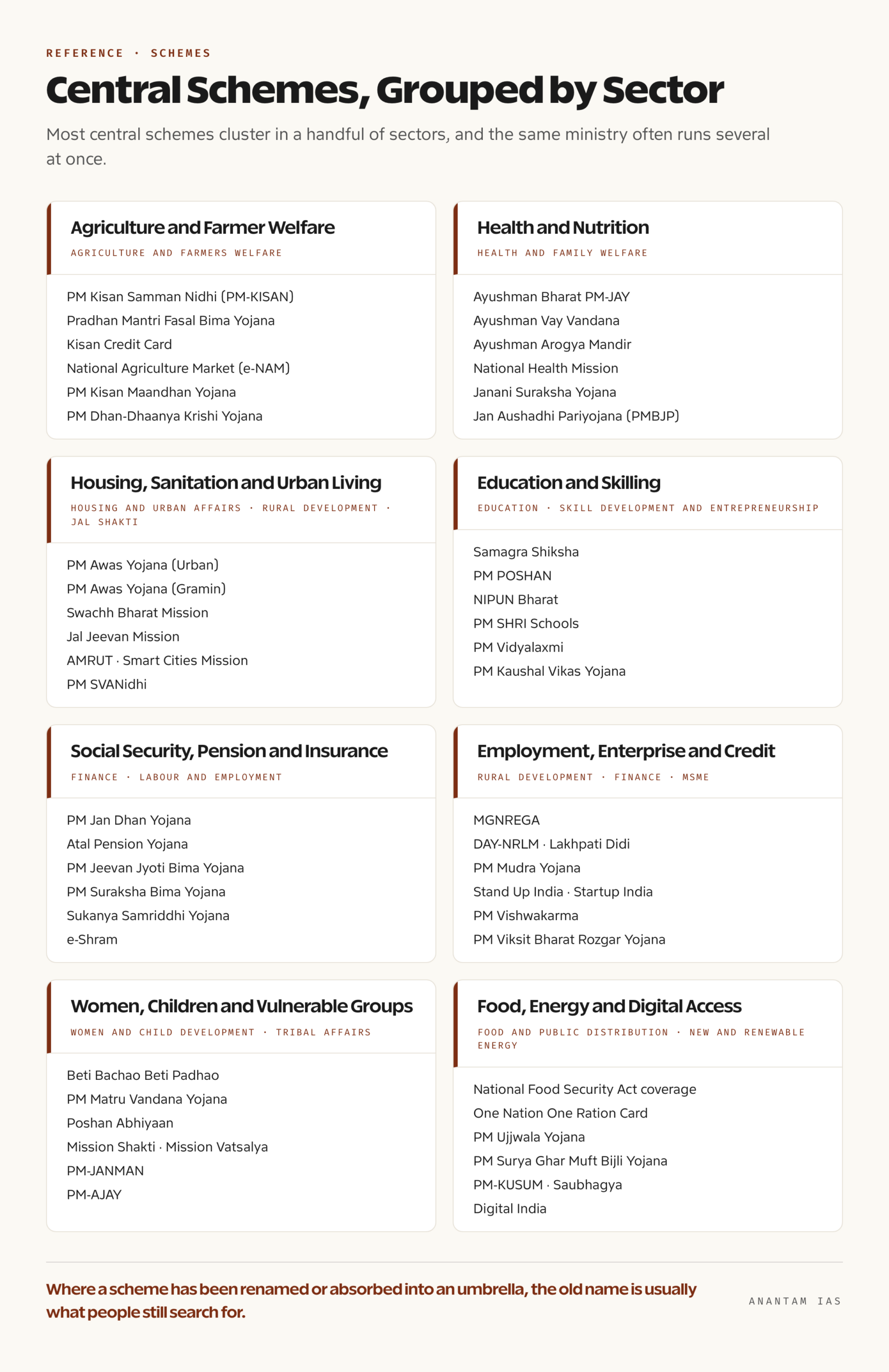
Health and Nutrition
| Scheme | Ministry | Launched | What it gives |
|---|---|---|---|
| Ayushman Bharat PM-JAY | Health and Family Welfare | 2018 | Health cover of Rs 5 lakh per family per year for secondary and tertiary hospitalisation |
| Ayushman Vay Vandana | Health and Family Welfare | 2024 | Rs 5 lakh annual cover for every citizen aged 70 and above, irrespective of income |
| Ayushman Arogya Mandir | Health and Family Welfare | 2018 | Comprehensive primary care at upgraded sub-centres and PHCs, formerly Health and Wellness Centres |
| National Health Mission | Health and Family Welfare | 2013 | Umbrella for the rural and urban health missions, covering infrastructure, staffing and disease programmes |
| Janani Suraksha Yojana | Health and Family Welfare | 2005 | Cash incentive to pregnant women for institutional delivery |
| Mission Indradhanush | Health and Family Welfare | 2014 | Catch-up drive for full immunisation of children and pregnant women |
| PM Ayushman Bharat Health Infrastructure Mission | Health and Family Welfare | 2021 | Investment in critical care blocks, public health labs and surveillance |
| Ayushman Bharat Digital Mission | Health and Family Welfare | 2021 | ABHA digital health account and interoperable health records |
| Jan Aushadhi Pariyojana (PMBJP) | Chemicals and Fertilizers | 2008 | Generic medicines at sharply lower prices through Jan Aushadhi Kendras |
| Central Government Health Scheme | Health and Family Welfare | 1954 | Outpatient and inpatient care for central government employees and pensioners in notified cities |
The Ayushman Bharat package is the most consequential of these by spending and by coverage. Nutrition schemes sit partly here and partly under the Ministry of Women and Child Development, which is covered further down.
Housing, Sanitation and Urban Living
| Scheme | Ministry | Launched | What it gives |
|---|---|---|---|
| PM Awas Yojana (Urban) | Housing and Urban Affairs | 2015 | Assistance for house purchase, construction or interest subsidy for urban households |
| PM Awas Yojana (Gramin) | Rural Development | 2016 | Assistance for a pucca house with basic amenities to eligible rural households |
| Swachh Bharat Mission | Jal Shakti (rural) and Housing and Urban Affairs (urban) | 2014 | Sanitation coverage, toilet construction and solid waste management |
| Jal Jeevan Mission | Jal Shakti | 2019 | Functional tap water connection to every rural household |
| AMRUT | Housing and Urban Affairs | 2015 | Water supply, sewerage and urban infrastructure in selected cities |
| Smart Cities Mission | Housing and Urban Affairs | 2015 | Area-based urban redevelopment and technology-led city services |
| PM Gram Sadak Yojana | Rural Development | 2000 | All-weather road connectivity to eligible rural habitations |
| PM SVANidhi | Housing and Urban Affairs | 2020 | Collateral-free working capital loans to street vendors, with an interest subsidy |
| DAY-NULM | Housing and Urban Affairs | 2013 | Skills, self-employment support and shelters for the urban poor |
The Swachh Bharat Mission is the reference case for how a behaviour-change campaign was fused with an infrastructure target, and it remains the most studied of the group.
Education and Skilling
| Scheme | Ministry | Launched | What it gives |
|---|---|---|---|
| Samagra Shiksha | Education | 2018 | Integrated school education programme from pre-school to Class 12 |
| PM POSHAN | Education | 2021 | Hot cooked meals in government and aided schools, renaming and widening the mid-day meal scheme |
| NIPUN Bharat | Education | 2021 | Mission for foundational literacy and numeracy by Grade 3 |
| PM SHRI Schools | Education | 2022 | Upgrading selected schools as exemplar schools under the National Education Policy |
| PM Vidyalaxmi | Education | 2024 | Collateral-free, guarantor-free education loans for students in 860 top-quality institutions, with interest subvention linked to family income |
| PM Kaushal Vikas Yojana | Skill Development and Entrepreneurship | 2015 | Short-term skill training and certification with placement linkage |
| PM Internship Scheme | Corporate Affairs | 2024 | Twelve-month internships in large companies with a monthly stipend of Rs 5,000 for youth aged 21 to 24 |
| Eklavya Model Residential Schools | Tribal Affairs | 1998 | Residential schooling for tribal students in tribal-majority blocks |
The stipend under the PM Internship Scheme is shared — the government pays Rs 4,500 through direct benefit transfer and the host company adds Rs 500 from its CSR funds.
Social Security, Pension and Insurance
| Scheme | Ministry | Launched | What it gives |
|---|---|---|---|
| PM Jan Dhan Yojana | Finance | 2014 | Zero-balance bank account with RuPay card and accident cover |
| Atal Pension Yojana | Finance, through PFRDA | 2015 | Guaranteed monthly pension of Rs 1,000 to Rs 5,000 from age 60, based on contribution |
| PM Jeevan Jyoti Bima Yojana | Finance | 2015 | Rs 2 lakh life cover on an annual premium, for account holders aged 18 to 50 |
| PM Suraksha Bima Yojana | Finance | 2015 | Rs 2 lakh accidental death and disability cover at a nominal annual premium |
| PM Shram Yogi Maandhan | Labour and Employment | 2019 | Rs 3,000 monthly pension from age 60 for unorganised sector workers |
| National Social Assistance Programme | Rural Development | 1995 | Old-age, widow and disability pensions to households below the poverty line |
| Sukanya Samriddhi Yojana | Finance | 2015 | Small savings account for a girl child with a higher notified interest rate and tax benefit |
| e-Shram | Labour and Employment | 2021 | National database and universal account number for unorganised workers |
Employment, Enterprise and Credit
| Scheme | Ministry | Launched | What it gives |
|---|---|---|---|
| MGNREGA | Rural Development | 2005 | Legal guarantee of 100 days of unskilled wage employment per rural household per year |
| DAY-NRLM | Rural Development | 2011 | Self-help group formation, revolving funds and bank linkage for rural women |
| Lakhpati Didi | Rural Development | 2023 | Livelihood support aimed at raising self-help group members’ annual household income to Rs 1 lakh |
| PM Employment Generation Programme | MSME, through KVIC | 2008 | Margin money subsidy on bank credit for new micro enterprises |
| PM Mudra Yojana | Finance | 2015 | Collateral-free loans to non-farm micro enterprises under the Shishu, Kishore and Tarun categories |
| Stand Up India | Finance | 2016 | Bank loans between Rs 10 lakh and Rs 1 crore for SC, ST and women entrepreneurs |
| Startup India | Commerce and Industry (DPIIT) | 2016 | Recognition, tax benefits and fund-of-funds support for recognised startups |
| PM Vishwakarma | MSME | 2023 | Toolkit incentive, skill training with stipend and collateral-free credit for artisans in 18 traditional trades |
| PM Viksit Bharat Rozgar Yojana | Labour and Employment | 2025 | Employment-linked incentive of up to Rs 15,000 for first-time EPFO-registered employees, and up to Rs 3,000 a month per additional employee to employers |
Credit-side schemes such as Mudra Yojana address the collateral problem rather than the capital problem — the borrower still repays. State schemes that give an outright capital grant work differently.
Women, Children and Vulnerable Groups
| Scheme | Ministry | Launched | What it gives |
|---|---|---|---|
| Beti Bachao Beti Padhao | Women and Child Development | 2015 | Campaign and district action against declining child sex ratio, with a focus on girls’ education |
| PM Matru Vandana Yojana | Women and Child Development | 2017 | Conditional maternity benefit in instalments for pregnant and lactating mothers |
| Poshan Abhiyaan | Women and Child Development | 2018 | Targets and technology-based monitoring for stunting, wasting, anaemia and low birth weight |
| Mission Shakti | Women and Child Development | 2021 | Umbrella for women’s safety and empowerment, with the Sambal and Samarthya sub-schemes |
| Mission Vatsalya | Women and Child Development | 2021 | Child protection services, care institutions and foster care support |
| PM-JANMAN | Tribal Affairs | 2023 | Mission for 75 particularly vulnerable tribal groups across 18 states and a union territory, covering 11 interventions through nine ministries |
| PM-AJAY | Social Justice and Empowerment | 2021 | Adarsh Gram development, grants-in-aid and hostels for Scheduled Caste students |
Food, Energy and Digital Access
| Scheme | Ministry | Launched | What it gives |
|---|---|---|---|
| National Food Security Act coverage | Consumer Affairs, Food and Public Distribution | 2013 | Subsidised foodgrain entitlement to about two-thirds of the population |
| PM Garib Kalyan Anna Yojana | Consumer Affairs, Food and Public Distribution | 2020 | Free foodgrain over and above the regular NFSA entitlement |
| One Nation One Ration Card | Consumer Affairs, Food and Public Distribution | 2019 | Portability of ration entitlement across states for migrant households |
| PM Ujjwala Yojana | Petroleum and Natural Gas | 2016 | Deposit-free LPG connection to women from poor households |
| PM Surya Ghar Muft Bijli Yojana | New and Renewable Energy | 2024 | Rooftop solar subsidy of up to Rs 78,000 and up to 300 free units of electricity a month |
| PM-KUSUM | New and Renewable Energy | 2019 | Solar pumps and grid-connected solar capacity for farmers |
| Saubhagya | Power | 2017 | Last-mile household electrification |
| Digital India | Electronics and Information Technology | 2015 | Umbrella for digital infrastructure, governance services and digital literacy |
FAQ
How many government schemes are there in India? There is no fixed number. The Union government’s myScheme portal lists thousands of entries once state schemes are included, and the count changes every budget as schemes are launched, merged into umbrellas or wound up. What stays stable is the sectoral structure — agriculture, health, housing, education, social security, employment and welfare of specific groups.
What is the difference between a central sector scheme and a centrally sponsored scheme? A central sector scheme is fully funded and run by the Union government, such as PM-KISAN. A centrally sponsored scheme is jointly funded with states, typically 60:40 and 90:10 for north-eastern and Himalayan states, and delivered through state machinery — the National Health Mission and Samagra Shiksha are examples.
Where can I check whether I am eligible for a scheme? The government’s myScheme portal lets you filter central and state schemes by age, income, occupation, gender and state. For any scheme you shortlist, confirm the details on that scheme’s own official portal, since aggregators can lag behind the latest guidelines.
Why do some schemes disappear from official lists? Usually because they were merged into an umbrella rather than closed. Sarva Shiksha Abhiyan became part of Samagra Shiksha, and the mid-day meal scheme was renamed PM POSHAN. The benefit often continues under a new name.
Which ministry runs the most schemes? No single ministry dominates, but Agriculture and Farmers Welfare, Rural Development, Health and Family Welfare, and Women and Child Development between them account for a large share of both the number of schemes and the money spent on direct benefits.
Practice Questions
Prelims MCQs
- PM Kisan Samman Nidhi provides an annual income support of: (a) Rs 4,000 in two instalments (b) Rs 6,000 in three instalments (c) Rs 9,000 in three instalments (d) Rs 12,000 in four instalments Answer: (b) Landholding farmer families receive Rs 6,000 a year in three equal instalments.
- Ayushman Bharat PM-JAY provides health cover of: (a) Rs 1 lakh per family per year (b) Rs 2 lakh per family per year (c) Rs 5 lakh per family per year (d) Rs 10 lakh per family per year Answer: (c) The cover is Rs 5 lakh per family per year for secondary and tertiary hospitalisation.
- Which ministry implements the Pradhan Mantri Awas Yojana (Gramin)? (a) Housing and Urban Affairs (b) Rural Development (c) Panchayati Raj (d) Jal Shakti Answer: (b) The rural component is run by the Ministry of Rural Development; the urban component sits with Housing and Urban Affairs.
- Under a centrally sponsored scheme, the usual Centre-state funding pattern for north-eastern and Himalayan states is: (a) 50:50 (b) 60:40 (c) 75:25 (d) 90:10 Answer: (d) These states typically contribute 10 per cent against the Centre’s 90 per cent, compared with 60:40 elsewhere.
- The Atal Pension Yojana guarantees a monthly pension from age 60 in the range of: (a) Rs 500 to Rs 2,000 (b) Rs 1,000 to Rs 5,000 (c) Rs 2,000 to Rs 8,000 (d) Rs 3,000 to Rs 10,000 Answer: (b) Subscribers choose a pension between Rs 1,000 and Rs 5,000 a month, with contributions set accordingly.
Mains Practice Questions
- India runs a very large number of centrally funded welfare schemes across ministries. Examine the case for rationalisation and convergence, and the risks such consolidation carries. (15 marks, 250 words)
- Direct benefit transfer has become the default delivery mode for central schemes. Assess its impact on leakage, exclusion errors and beneficiary agency. (15 marks, 250 words)
- Distinguish between central sector and centrally sponsored schemes, and discuss how the funding pattern shapes Centre-state relations in welfare delivery. (10 marks, 150 words)
- “Scheme proliferation reflects political incentives more than programme design.” Critically examine this view with examples from the social sector. (15 marks, 250 words)
- Evaluate the shift in recent central schemes from universal entitlement towards targeted, district-level convergence programmes, using agriculture and health as illustrations. (15 marks, 250 words)
Tell Google you want more of this.
Add Anantam IAS as a preferred sourceOne tap, and this site shows up more often in your own Top Stories, AI Overviews and AI Mode. Remove it any time.