
The Mullaperiyar Dam is a gravity masonry dam built in 1895 across the Periyar River in the Idukki district of Kerala, close to the Tamil Nadu border. Over more than a century, it has become the centre of one of India's most complex interstate water disputes – between Kerala, which owns the land on which it stands, and Tamil Nadu, which operates the dam and receives its water for irrigation and power. The dispute combines colonial-era treaties, federal tensions, dam safety science, and Supreme Court adjudication, making Mullaperiyar an important case in UPSC Geography, Polity and Governance syllabi.
Location and Basic Facts
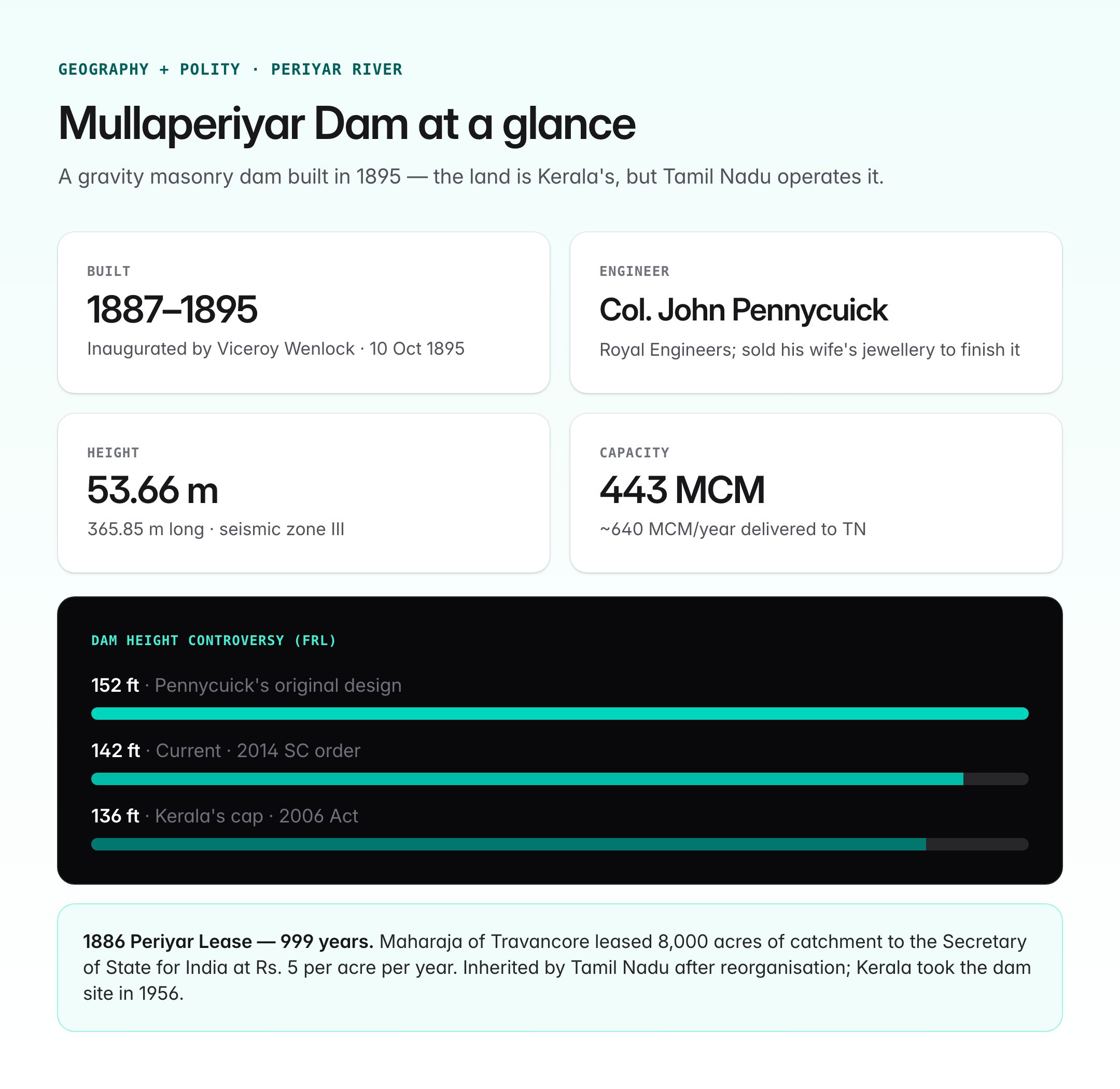
| Parameter | Detail |
|---|---|
| River | Periyar (longest river of Kerala, 244 km) |
| Location | Idukki district, Kerala; near Thekkady |
| Operating state | Tamil Nadu |
| Owner of land | Kerala (Periyar Tiger Reserve) |
| Built | 1887-1895 |
| Engineer | Colonel John Pennycuick, British Army |
| Length | 365.85 m |
| Height | 53.66 m (176 ft) |
| Full Reservoir Level (FRL) | 152 ft (originally), 142 ft (SC interim), 142 ft (current restored level per 2014 SC order) |
| Capacity | Around 443 million cubic metres |
| Purpose | Irrigation in Tamil Nadu's rain-shadow districts; power generation |
Geographic Background
The Periyar River flows westwards into the Arabian Sea through Kerala. The dam diverts part of its waters eastwards through a 5,704-ft tunnel to the Vaigai River basin in Tamil Nadu’s Theni, Madurai, Dindigul, Sivaganga and Ramanathapuram districts – semi-arid regions that lie in the rain shadow of the Western Ghats.
The diversion irrigates around 2.23 lakh hectares and supports a population of over 50 lakh Tamils. The water also drives the Periyar Power Station (175 MW), operated by the Tamil Nadu Electricity Board.
The 1886 Periyar Lease Agreement
The dam owes its existence to a 999-year lease agreement dated 29 October 1886 between the Maharaja of Travancore, Visakham Thirunal Rama Varma, and the Secretary of State for India in Council.
| Clause | Content |
|---|---|
| Term | 999 years, renewable |
| Area leased | 8,000 acres of the Periyar catchment |
| Rent | Rs. 5 per acre per year (negligible by modern standards) |
| Purpose | Irrigation of dry tracts of Madurai and Ramnad |
| Maintenance | By the British (later Madras Presidency, now Tamil Nadu) |
After Independence, the lease was inherited by Tamil Nadu when Madras Presidency was reorganised. Kerala, formed in 1956, took possession of the dam site. A supplementary agreement in 1970 reconfirmed the arrangement and added power generation rights for Tamil Nadu.
Construction and Colonial Context
The dam was built under the direction of Colonel John Pennycuick (1841-1911) of the Royal Engineers. The work was exceptionally difficult – remote forest terrain, monsoon floods, labour shortages and disease. When British colonial funding dried up, Pennycuick famously sold his wife's jewellery to complete the project.
| Technology | Notes |
|---|---|
| Lime and surkhi (burnt brick powder) mortar | Pre-cement masonry dam |
| Outer shell of rubble masonry | Granite and local stone |
| No modern seismic design | Engineering predates scientific seismology |
When inaugurated by the Viceroy Lord Wenlock on 10 October 1895, it was celebrated as an engineering triumph.
Economic Significance for Tamil Nadu
The diversion transformed the arid Vaigai basin into a productive agricultural belt growing rice, sugarcane, banana and vegetables. Cities like Madurai, Dindigul, Theni depend on the Periyar-Vaigai system for drinking water and industries.
| Area irrigated | 2.23 lakh hectares | | Districts covered | Theni, Madurai, Dindigul, Sivaganga, Ramnad | | Annual water allocation to TN | About 640 million cubic metres | | Power generated | Up to 175 MW from Periyar Power Station |
Kerala's Concerns
Kerala has raised three distinct concerns over decades.
| Concern | Description |
|---|---|
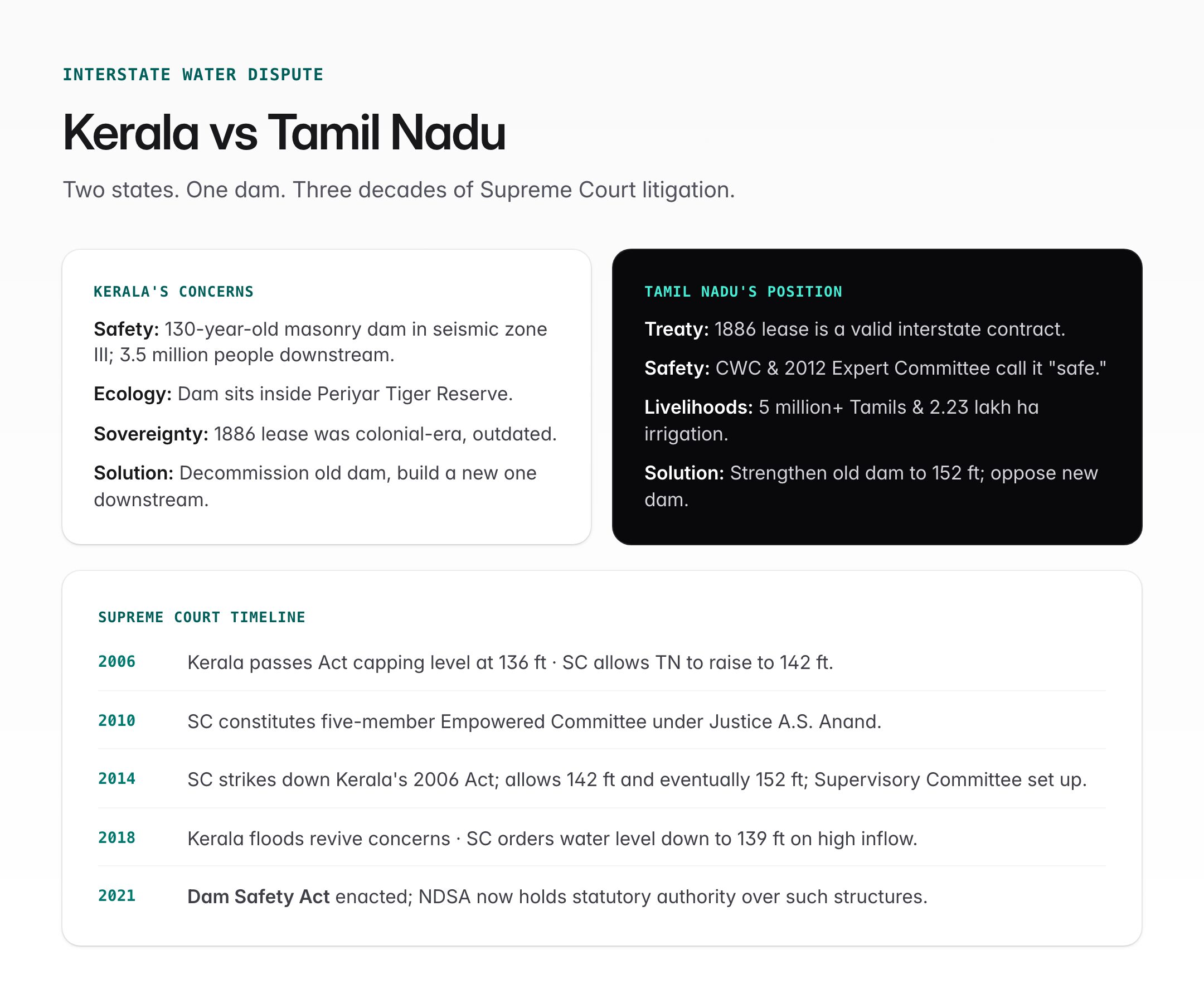
| Safety | The 130-year-old masonry dam lies in seismic zone III; Kerala argues it poses catastrophic risk to downstream districts of Idukki, Ernakulam and Kottayam (roughly 3.5 million people and Idukki arch dam below) |
| Sovereignty | Kerala argues the 1886 lease was signed under colonial coercion and is outdated |
| Ecological | Dam is within the Periyar Tiger Reserve; raising the water level would inundate forest and tribal habitats |
| Revenue | Rs. 5 per acre is absurdly low; Kerala wants renegotiation |
Kerala has proposed building a new dam downstream in its own territory and decommissioning the old one.
Tamil Nadu's Position
| Argument | Description |
|---|---|
| Treaty obligation | 1886 lease is a valid interstate contract, ratified post-Independence |
| Dam safety | Central Water Commission (CWC) and an Expert Committee (2012) found the dam "hydrologically, structurally and seismically safe" |
| Livelihoods | Over five million Tamils depend on this water for agriculture and drinking |
| Against new dam | Would cause years of disruption and Tamil Nadu mistrusts Kerala's commitments on future water-sharing |
Tamil Nadu has undertaken periodic strengthening works (1979-80) approved by the Central Water Commission to ensure safety.
Key Supreme Court Cases and Timeline
| Year | Development |
|---|---|
| 1979 | CWC recommends temporary lowering of water level from 152 ft to 136 ft while strengthening work is undertaken |
| 1979-81 | Strengthening works phase I and II |
| 1998 | Kerala declines to allow raising level; Tamil Nadu approaches SC |
| 2000 | SC asks for a joint committee report |
| 2006 | Kerala enacts Kerala Irrigation and Water Conservation (Amendment) Act, 2006 – caps the water level at 136 ft. Tamil Nadu challenges it |
| 27 February 2006 | Mullaperiyar Dam case (I): SC allows TN to raise level to 142 ft |
| 18 February 2010 | SC constitutes a five-member Empowered Committee under Justice A S Anand |
| 7 May 2014 | Mullaperiyar Dam case (II): SC strikes down Kerala's 2006 Act as unconstitutional; permits TN to raise level to 142 ft in phases and eventually 152 ft after strengthening; constitutes a three-member Supervisory Committee |
| 2018 | Catastrophic Kerala floods revive public concerns; SC orders water level to be brought down to 139 ft during high inflow |
| 2021-22 | SC emphasises dam safety; directs NDMA and CWC to conduct independent review |
| 2023-24 | Supreme Court-appointed Supervisory Committee continues periodic monitoring |
Dam Height Controversy
Three reference levels matter:
| Level | Feet | Relevance |
|---|---|---|
| Original FRL | 152 ft | Designed by Pennycuick in 1895 |
| Interim FRL | 136 ft | After CWC concerns in 1979 |
| Restored FRL | 142 ft | 2006 and 2014 SC orders |
Kerala wants to cap the level permanently at 136 ft or decommission the dam; Tamil Nadu seeks restoration of full design level of 152 ft.
Safety Concerns
Multiple scientific concerns have been raised.
- Age – over 130 years old, exceeding the normal 50-100 year design life
- Seismicity – Earthquakes of 4-4.5 magnitude reported in the Idukki region in recent years
- Leakage – Seepage observed during monitoring
- Hydraulic overload – 2018 floods overwhelmed storage capacity in Idukki and surrounding dams
- Downstream risk – A breach could inundate the Idukki arch dam and large parts of Ernakulam and Kottayam
However, CWC and Central Soil and Materials Research Station studies find the dam can withstand the Maximum Credible Earthquake with strengthening.
Interstate Water Disputes Framework
Mullaperiyar is a contract-based dispute unlike the tribunal-based disputes on major rivers (Cauvery, Krishna, Godavari). It has not been referred to an Interstate River Water Disputes Tribunal under the ISRWD Act, 1956. This is because technically the lease is a bilateral contract rather than a dispute over river water allocation between states.
| Constitutional basis |
|---|
| Article 262 – Parliament may provide by law for adjudication of interstate water disputes |
| Interstate River Water Disputes Act, 1956 |
| River Boards Act, 1956 |
| Entry 56, List I (Union List) and Entry 17, List II (State List) |
Political and Social Dimensions
- Languages and identity – The dispute has been sharpened by Malayalam vs Tamil linguistic identity politics.
- Public mobilisation – Protests, hunger strikes and demonstrations recur in both states, particularly after every SC hearing.
- Cinema and culture – Films, books and newspaper columns have deepened public emotion on both sides, not always with accurate science.
- Central role – The Centre has maintained a neutral position and relies on CWC findings.
Way Forward
| Option | Description |
|---|---|
| Strengthen the existing dam to 152 ft | Tamil Nadu's preferred solution, backed by CWC |
| Joint management board | Similar to Krishna-Godavari Management Boards |
| New downstream dam in Kerala | Kerala's demand; opposed by TN |
| Comprehensive risk assessment | Under the Dam Safety Act, 2021 – passed after this dispute, with a National Dam Safety Authority (NDSA) that now has statutory authority over such structures |
| Interstate federal dialogue | Through the Inter-State Council under Article 263 |
The Dam Safety Act, 2021 is particularly relevant – it makes safety inspection, risk assessment, emergency action plans, and periodic review of all large dams mandatory and statutory, potentially depoliticising the issue.
UPSC Relevance
Prelims: Expect factual questions on – river (Periyar), states (Kerala and Tamil Nadu), year of construction (1895), engineer (John Pennycuick), lease term (999 years signed in 1886), and the key Supreme Court decisions (2006 and 2014). Questions linking the dam to seismic zone III, Periyar Tiger Reserve or the Dam Safety Act 2021 are common.
Mains GS-1 (Geography): Use Mullaperiyar in answers on interstate water sharing, the Western Ghats, rivers of Kerala and Tamil Nadu, and rain shadow irrigation. It highlights the west-to-east water diversion rare in peninsular India.
Mains GS-2 (Polity, Governance, Federalism): Mullaperiyar is a textbook example of cooperative and combative federalism, role of the Supreme Court in interstate disputes, validity of colonial treaties, and Article 262 and Interstate River Water Disputes Act, 1956. The Dam Safety Act, 2021 is an important recent enactment to discuss.
GS-3 (Disaster Management): Candidates can use Mullaperiyar as a case study on dam safety, hazard risk reduction, and the need for emergency action plans post-2018 Kerala floods.
GS-4 (Ethics): Dimensions include intergenerational equity, duty of care towards downstream populations, loyalty to the Constitution vs loyalty to regional identity, and the role of public servants in defusing inflammatory interstate politics.
Candidates should remember the twin pillars of the dispute – the 1886 lease and the 2014 Supreme Court judgement – plus the Dam Safety Act, 2021 to handle any Mullaperiyar question confidently across GS papers.
Tell Google you want more of this.
Add Anantam IAS as a preferred sourceOne tap, and this site shows up more often in your own Top Stories, AI Overviews and AI Mode. Remove it any time.