Nalanda university is the name most people give to Nalanda Mahavihara, a Buddhist monastery in Bihar that ran as a residential center of higher learning from the 5th century CE into the 13th. It was founded under the Gupta ruler Kumaragupta I, drew monks from as far as China and Korea, and by the 7th century held a community that Xuanzang’s biographer put at 10,000. Its ruins became a UNESCO World Heritage Site in 2016, and a new Nalanda University opened its campus at nearby Rajgir in 2024.
The popular version ends in one line: Bakhtiyar Khalji burned Nalanda in 1193 and its library smoldered for months. The chronicle every later telling leans on, by Minhaj-i-Siraj, never names Nalanda and mentions no fire. And a Tibetan monk who studied there in 1235 found an abbot past 90 still teaching about 70 students. Read the sources side by side and the question of who destroyed Nalanda gets a precise answer instead of a slogan.
What Nalanda University was, at a glance
Nalanda was a mahavihara, literally a “great monastery”: a Buddhist complex where monks lived and worshipped, and where the teaching went well beyond scripture. These are the facts worth fixing first.
| Fact | Detail |
|---|---|
| What it was | A Buddhist mahavihara that ran as a residential center of higher learning |
| Location | Nalanda district, Bihar: about 15 km south of Bihar Sharif and 95 km south-east of Patna (ASI) |
| Founded | 5th century CE, under the Gupta ruler Kumaragupta I (ASI); Xuanzang calls the founding king Shakraditya |
| Later patrons | Harshavardhana of Kannauj (606 to 647 CE), then the Pala kings (8th to 12th centuries) |
| Eyewitnesses | Xuanzang (7th century); Yijing (lived there about 675 to 685); the Tibetan monk Dharmasvamin (1235) |
| End | Damaged in Turkish raids around 1200; about 70 students still there in 1235; abandoned in the 13th century |
| Excavation | Archaeological Survey of India, 1915 to 1937 and 1974 to 1982 |
| UNESCO | Archaeological Site of Nalanda Mahavihara at Nalanda, Bihar; inscribed 2016 under criteria (iv) and (vi) |
| Modern revival | Nalanda University Act, 2010; new campus at Rajgir inaugurated on 19 June 2024 |
Calling it a university is a modern label, but it isn’t a loose one. Nalanda had the working parts of one:
- an entrance test at the gate;
- a curriculum that ran from grammar to medicine;
- resident scholars ranked by how much they could teach;
- an endowment of villages that paid for all of it.
Who founded Nalanda, and who paid for it
The ASI credits Kumaragupta I, who ruled in the first half of the 5th century CE, at the height of the Gupta Empire. After the Guptas, a relay of patrons kept adding buildings and villages.
Kumaragupta I and the Gupta builders
The oldest list of Nalanda’s builders is Xuanzang’s. He says a king named Shakraditya built the first monastery, and each successor added one:
- Buddhagupta, to the south;
- Tathagatagupta, to the east;
- Baladitya, to the north-east;
- Vajra, to the west;
- finally a king of central India, who built one more and ringed the whole complex with a high wall and a single gate.
The names end in -gupta, and the seals agree. Hirananda Sastri’s 1942 memoir for the ASI published a clay sealing from the site that names Shakraditya, along with seals of later Gupta rulers such as Budhagupta. Historians read Shakraditya as another name for Kumaragupta I.
Xuanzang’s dates are the trap. He says Shakraditya built the monastery “not long after the nirvana of the Buddha”, and his biographer speaks of 700 years since the foundation, which the translator Samuel Beal reckoned would put the founder around the 1st century BCE. Keep Xuanzang’s list and drop his dates; the Gupta names and the seals settle the 5th century. The year 427 CE, repeated in many accounts, is an estimate, since the ASI gives only Kumaragupta I’s reign.
The place is older than the monastery. The ASI records it as the birthplace of Sariputta, one of the Buddha’s chief disciples, and Taranatha’s Tibetan history of 1608 makes Ashoka the builder of its first vihara. That’s tradition. The dated evidence starts with the Guptas.
Harsha, the Palas and a king from Suvarnadvipa
Patronage outlived the Guptas. The ASI names Harshavardhana of Kannauj and then the Pala kings of eastern India, and what they gave was mostly land revenue. Huili, Xuanzang’s biographer, says the king had assigned the revenues of about 100 villages, so the students never had to ask for the four requisites, the basic supplies a monk would otherwise beg for.
The most specific grant survives on copper. At the request of Balaputradeva, the Shailendra king of Suvarnadvipa in the Java-Sumatra region, the Pala king Devapala granted five villages for the monastery Balaputradeva had built at Nalanda, to support its monks and the copying of Buddhist texts. A king from the Indonesian islands was paying for a monastery in Bihar. That one inscription shows how far Nalanda’s name had traveled by the 9th century.
What Xuanzang and Yijing recorded about Nalanda
Almost every famous fact about Nalanda comes from two Chinese monks who lived there. Knowing who said what keeps the numbers straight.
Xuanzang in the 7th century
Xuanzang, also written Hiuen Tsang, came to India in the reign of Harsha and studied under Nalanda’s aged head, Shilabhadra. His travel record, the Si-yu-ki, describes the site and its entrance test, and his biography by the monk Huili adds the figures. Residents, members and visitors together, “always reach to the number of 10,000”, and Huili sorts the scholars by how much they could teach:
- about 1,000 could explain 20 collections of sutras and shastras;
- 500 could explain 30;
- about 10, Xuanzang among them, could explain 50;
- Shilabhadra alone had mastered them all.
That’s a ladder of learning, not a staff list. The round figure of 2,000 teachers in many notes, the modern university’s history page among them, isn’t in this passage.
Yijing a generation later
Yijing, also written I-tsing, lived at Nalanda for about ten years, probably from 675 to 685. His figures are smaller:
- more than 3,000 residents (3,500 in another of his works);
- more than 200 endowed villages;
- eight halls and 300 apartments, so worship ran in separate groups.
He also noticed the clock. Large Indian monasteries kept time with a clepsydra, a water clock: a thin copper bowl with a pinhole floats in a vessel of water and slowly fills, and boys watched it to call the hours.
So is it 10,000 or 3,000? They’re reports from different decades by different counters, and Huili’s figure includes visitors. Quote each number with its witness.
How Nalanda taught: admission, subjects and teachers
Nalanda taught by argument, and the argument began at the gate. Xuanzang says the gatekeeper put hard questions to every newcomer, and those who failed outnumbered those who passed “as seven or eight to ten”. That’s an admission rate of about 2 or 3 in 10, decided by an oral test at the door.
Besides the Mahayana and the works of the 18 early Buddhist schools, Huili lists:
- the Vedas;
- hetuvidya, the “science of reasons”, or logic;
- shabdavidya, the “science of words”, or grammar;
- chikitsavidya, the “science of healing”, or medicine;
- Samkhya philosophy.
A Buddhist monastery teaching the Vedas surprises most readers. The likeliest reason is debate: nobody can defeat a rival school without knowing its texts. Huili counts about 100 pulpits set up for preaching every day, and UNESCO notes that Nalanda’s method survives best in Tibetan monasteries, where learning still runs through debate and dialectics.
Xuanzang also names the masters whose fame the college carried:
- Dharmapala and Chandrapala;
- Gunamati and Sthiramati;
- Prabhamitra and Jinamitra;
- Jnanachandra and Shighrabuddha;
- Shilabhadra, the head of the house in his own day.
Shilabhadra came from the royal family of Samatata in eastern Bengal and became Dharmapala‘s disciple at Nalanda. A generation later he was Xuanzang’s teacher. Sastri’s ASI memoir adds that Shantarakshita went from Nalanda to Tibet to spread Buddhism.
Who destroyed Nalanda University?
The ASI’s summary gives the standard answer: the decline began in the later Pala period, and the final blow came around 1200 with the invasion of Bakhtiyar Khalji. Bakhtiyar was a commander in the Ghurid conquest of north India that followed the battles of Tarain, and Minhaj says he later reported to Qutb-ud-Din Aibak. That answer works as a headline. The texts behind it say something narrower.
What Minhaj-i-Siraj actually wrote
The source is the Tabaqat-i-Nasiri of Minhaj-i-Siraj, who had the story from Samsam-ud-Din, a soldier in the raid, whom he met at Lakhnauti in 641 H (1243-44 CE). In Raverty’s 1881 translation (volume 1, pages 551-52) the account runs like this:
- Bakhtiyar, after raiding Bihar for some time, attacked “the fortress of Bihar” with about 200 horsemen and forced his way in through the postern of its gate.
- Most of the inhabitants were “Brahmans” with shaven heads, and all of them were killed.
- There were a great number of books, but no one was left alive to explain them.
- Once the books were understood, “the whole of that fortress and city was a college, and in the Hindui tongue, they call a college Bihar.”
Now look at what’s missing. The passage never names Nalanda. It mentions no fire. It gives no year either: Raverty’s notes place Bakhtiyar’s move from Bihar into Bengal in 589 H, about 1193 CE, while the ASI writes “around 1200”. Both are reconstructions, so “around 1200” is the safe way to write it.
Two words need decoding. “Bihar” is the Persian spelling of vihara, a monastery, as Raverty’s own note explains. And the shaven-headed “Brahmans” were Buddhist monks, which is how the modern editors of Taranatha’s history read them.
Odantapuri, the monastery at Bihar Sharif
So which monastery was it? The editors of the 1970 English translation of Taranatha identify Minhaj’s fortress with Odantapuri, a monastery at what is now Bihar Sharif, and note that the raiders took it for a fort. Taranatha, writing in 1608, explains why: the last Sena kings had partly turned Odantapuri and Vikramashila into fortresses and posted soldiers in them. The Turks then massacred many monks at Odantapuri and “at last built a fort on the ruins of the Odanta-vihara”. In 1235 Dharmasvamin found a Muslim garrison stationed there. All three accounts point to Bihar Sharif.
That doesn’t mean Nalanda escaped. It means the famous passage is about its neighbor.
What a Tibetan monk found at Nalanda in 1235
The best witness for Nalanda itself is Dharmasvamin, a Tibetan monk who was in Bihar from 1234 to 1236 and whose biography George Roerich translated in 1959. At Nalanda in 1235 he found:
- the abbot Rahula Shribhadra, more than 90 years old, teaching about 70 students;
- patrons still paying, among them the local Raja Buddhasena;
- about 80 small viharas damaged by the Turushkas, the Turks, though many of the brick ones stood.
Then the danger reached him. The commander of the garrison at Odantapuri imprisoned Jayadeva, a lay patron of the abbot, who smuggled out a warning. The students fled. Dharmasvamin carried his teacher on his shoulders to a nearby temple, and about 300 armed soldiers searched the monastery without finding them.
Taranatha also records Rahulashribhadra at Nalanda with about 70 listeners. Nalanda was raided and stripped, not wiped out in a night, and UNESCO dates its end as a working institution to the 13th century.
The fire legend, and where it belongs
The library in flames comes from a different kind of source: a Tibetan legend that Taranatha tells and the 18th-century Tibetan historian Sumpa Khenpo retells. At a temple consecration, young novices threw slops at two non-Buddhist beggars. One of them spent 12 years in a sun ritual and then scattered charmed ashes, and a fire burned 84 temples and the books of the library called the Dharmaganja. Only water pouring from the top of its nine-story Ratnodadhi building saved some tantric texts.
Taranatha sets this in a chapter before his account of Asanga and Vasubandhu, centuries before the Palas, with a miracle at its center. It’s legend, and it’s where the nine-story library comes from. It isn’t evidence for 1200: the ASI’s summary speaks of fire, but Minhaj’s passage mentions none.
Put together, the evidence supports a four-part answer:
- Nalanda declined as Pala patronage ended.
- Turkish raids around 1200, in Bakhtiyar Khalji’s campaigns in Magadha, did the decisive damage.
- Minhaj’s famous passage describes the sack of Odantapuri, not Nalanda by name.
- Nalanda kept a few dozen students into the 1230s and was abandoned during the 13th century.
That’s more accurate than a single name, and it still names who did the damage.
How Nalanda was found again
Nalanda was rediscovered with Xuanzang’s record in hand. The ASI credits Francis Buchanan-Hamilton with identifying the site in the 19th century and Alexander Cunningham, the ASI’s founder, with surveying it in the 1860s. Cunningham used Xuanzang’s distances to place Nalanda at the village of Baragaon, about 7 miles north of Rajgir.
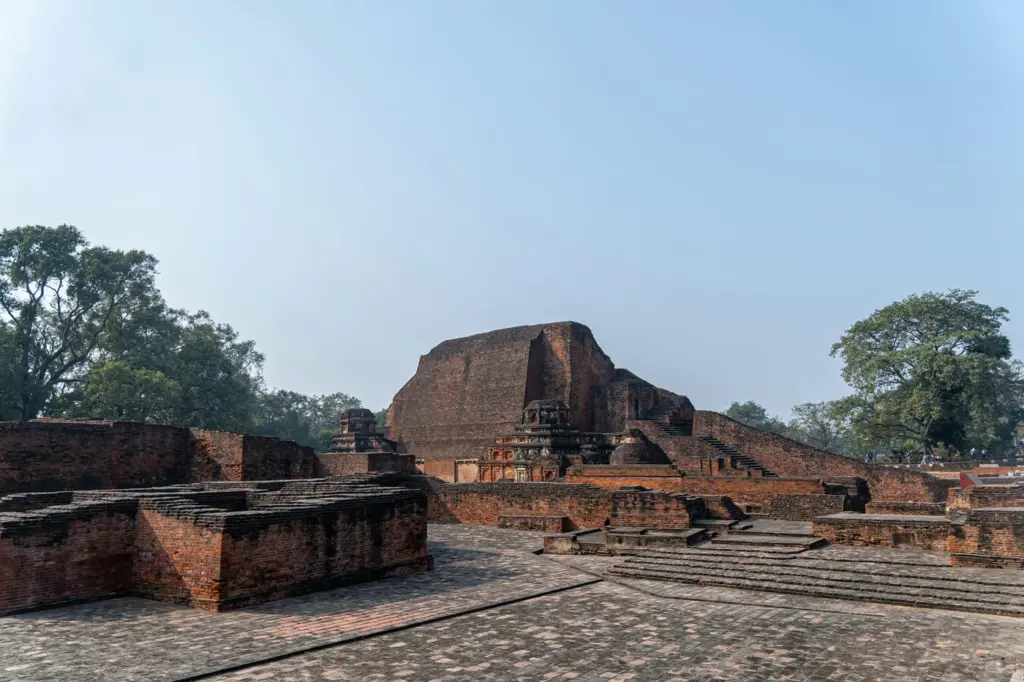
The ASI excavated in 1915 to 1937 and again in 1974 to 1982, exposing six major brick temples and eleven monasteries on a planned layout:
- a passage about 100 feet wide runs north to south through the middle;
- the monasteries line the east side, nearly all with cells ringing a central courtyard behind a common verandah;
- the temples line the west, and the largest, Temple Site 3, closes the row at the southern end, ringed by votive stupas and decorated with Gupta-style stucco images of the Buddha and Bodhisattvas.
Among the finds are the seals and the copper plate quoted above, and a Khasarpana Avalokiteshvara found in 1915-16, now in the site museum.
Nalanda today: UNESCO status and the new university
The ruins are a protected World Heritage Site, and the name now belongs to two modern institutions as well.
UNESCO inscribed the Archaeological Site of Nalanda Mahavihara at Nalanda, Bihar on 15 July 2016, at the 40th session of the World Heritage Committee in Istanbul, under two criteria:
- (iv): its plan became a model, and later monastic cities such as Vikramashila and Odantapuri borrowed its quadrangular vihara and its five-fold temple form;
- (vi): it was the earliest and longest-serving institution of higher learning of its kind in the subcontinent, and it still inspires universities.
The 23-hectare property, with a buffer zone of 57.88 hectares, is owned and managed by the ASI under the Ancient Monuments and Archaeological Sites and Remains Act, 1958. The listing is on the UNESCO World Heritage Centre site. Nalanda shares Bihar with the Mahabodhi Temple at Bodh Gaya, and both appear in the full list of India’s World Heritage Sites.
Three institutions now carry the name, and they’re easy to mix up:
| Institution | What it is | Date and legal basis | Where |
|---|---|---|---|
| Nalanda Mahavihara | The ancient monastery, now an archaeological site | 5th to 13th centuries; ASI-protected; UNESCO 2016 | Nalanda district, Bihar |
| Nava Nalanda Mahavihara | An institute for Pali and Buddhist studies | Founded 1951 with Bihar government support; deemed university since 13 November 2006; under the Ministry of Culture | Beside the ruins, on the Indrapushkarini lake |
| Nalanda University | An international university | Nalanda University Act, 2010; first students in September 2014; new campus opened on 19 June 2024 | A 455-acre campus at Rajgir |
The 2010 Act is diplomacy as much as education. Its preamble says it implements decisions of the East Asia Summit at Cebu in the Philippines in January 2007 and at Hua Hin in Thailand in October 2009, and it makes the university an institution of national importance. The first students enrolled in September 2014, and on 19 June 2024 Prime Minister Narendra Modi inaugurated the Rajgir campus. The PIB release notes that heads of mission from 17 countries attended and that students from more than 20 countries were already enrolled.
Two developments in 2026 tie the new university back to the old one:
- In May 2026 the university held Shastrarth 2026, reviving the classical tradition of formal debate ahead of its third convocation, and put it in its academic calendar for the first time.
- In June 2026, India and China were reported to be exploring a joint UNESCO Memory of the World nomination linked to Xuanzang.
How to study Nalanda University for exams
Nalanda sits in GS Paper I under art and culture and ancient history, and it returns in History optional Paper I. It ties the Gupta and Pala chapters to the spread of Buddhism across Asia, and the 2010 Act brings it into current affairs.
Mains tests it as a lens on institutions of learning. Mains 2014 GS Paper I asked: “Taxila university was one of the oldest universities of the world with which were associated a number of renowned learned personalities of different disciplines. Its strategic location caused its fame to flourish, but unlike Nalanda, it is not considered as a university in the modern sense. Discuss.” Mains 2020 GS Paper I asked: “Pala period is the most significant phase in the history of Buddhism in India. Enumerate.” On the objective side, History accounts for 184 of the 1,403 questions in the Prelims question bank from 2013 to 2026, and Art and Culture for 94.
These are the facts to revise:
- Founder: Kumaragupta I, 5th century CE; Xuanzang names the founding king Shakraditya.
- Patrons: Harshavardhana, then the Palas; Devapala granted five villages for Balaputradeva’s monastery.
- Xuanzang: pupil of Shilabhadra; 10,000 residents in Huili’s biography; 2 or 3 in 10 passed the gate test.
- Yijing: about 675 to 685; more than 3,000 residents and over 200 villages.
- The sack: Minhaj’s “fortress of Bihar” is read as Odantapuri; Dharmasvamin found about 70 students at Nalanda in 1235.
- Site: ASI excavations 1915 to 1937 and 1974 to 1982; UNESCO 2016, criteria (iv) and (vi).
- Revival: Nalanda University Act, 2010, from East Asia Summit decisions; Rajgir campus inaugurated on 19 June 2024.
Four confusions cost marks:
- Bakhtiyar Khalji is not the Khalji dynasty. He was a Ghurid commander around 1200; the Khalji dynasty of Delhi ruled from 1290 to 1320.
- Minhaj’s “Bihar” is a vihara. It is neither the modern state nor Nalanda by name.
- 10,000 against 3,000. Huili and Yijing counted in different decades, so quote each figure with its witness.
- Three Nalandas. The ruins are not the 1951 Nava Nalanda Mahavihara, and neither is the university created in 2010.
Nalanda also had neighbors, and questions often set them side by side:
| Center | Where | What the sources say about its end | Remember it for |
|---|---|---|---|
| Nalanda | Nalanda district, Bihar | Damaged in the raids around 1200; about 70 students still there in 1235 | Xuanzang and Yijing; UNESCO 2016 |
| Odantapuri | Bihar Sharif, about 15 km away | Monks massacred and a fort built on its ruins (Taranatha); a garrison there in 1235 (Dharmasvamin) | The likely “fortress of Bihar” in Minhaj |
| Vikramashila | Bihar, on the Delhi-Bengal highway (Altekar) | Partly fortified by a Sena king, then destroyed by the Turks along with Odantapuri (Taranatha) | A later monastic city that UNESCO counts among Nalanda’s borrowers |
Takshashila, the older center in Gandhara, is the usual contrast, and the 2014 question shows why: it had renowned teachers but not the organized, endowed institution that Nalanda was. For the exam, Nalanda rewards the aspirant who reads witnesses rather than slogans. Put each witness in the right century, keep Minhaj’s Bihar apart from Nalanda, and your answer will stand out from the hundreds that stop at a name and a date.
Frequently Asked Questions
Who founded Nalanda University?
The ancient Nalanda Mahavihara was founded in the 5th century CE under the Gupta ruler Kumaragupta I, whom the ASI names as founder. Xuanzang calls the founding king Shakraditya, and historians read that as another name for Kumaragupta I. The often-quoted year 427 CE is an estimate, not a recorded date.
Who destroyed Nalanda University?
The ASI’s summary says the final blow came around 1200 with the invasion of Bakhtiyar Khalji, after a decline that began in the late Pala period. The chronicle usually cited, Minhaj-i-Siraj’s Tabaqat-i-Nasiri, describes the sack of a monastery-fortress it calls Bihar, which scholars identify with nearby Odantapuri. Nalanda itself was damaged but still had about 70 students in 1235, and it was abandoned later in the 13th century.
What did Xuanzang write about Nalanda?
Xuanzang, who studied there under the abbot Shilabhadra in the 7th century, described its founding kings and an entrance test that only 2 or 3 candidates in 10 passed. His biographer Huili put the number of residents at 10,000 and listed subjects ranging from Mahayana philosophy to medicine. Their accounts are the main written evidence for how Nalanda worked.
How many students studied at Nalanda?
The two eyewitness figures differ. Xuanzang’s biographer Huili gives 10,000 residents in the 7th century, while Yijing, who lived there from about 675 to 685, counted more than 3,000. Read them as reports from different decades rather than a census, and quote the source with the number.
What subjects were taught at Nalanda?
Huili says residents studied the Mahayana and the texts of the 18 early Buddhist schools, along with secular sciences such as logic and medicine. He adds the Vedas and Samkhya philosophy from outside Buddhism. The ASI’s summary also mentions astronomy and metaphysics.
When did Nalanda become a UNESCO World Heritage Site?
The Archaeological Site of Nalanda Mahavihara at Nalanda, Bihar was inscribed on 15 July 2016 at the 40th session of the World Heritage Committee in Istanbul. It was listed under criteria (iv) and (vi), for its influential monastic plan and its place as an early institution of higher learning. The ASI protects and manages the 23-hectare property.
Is the new Nalanda University the same as the ancient one?
No. The new Nalanda University was created by the Nalanda University Act, 2010, following decisions of the East Asia Summit, and it admitted its first students in September 2014. Its campus at Rajgir, near the ancient ruins, was inaugurated on 19 June 2024. A separate institution, Nava Nalanda Mahavihara, has worked beside the ruins since 1951.
Where is Nalanda located?
The ruins of Nalanda lie in Nalanda district of Bihar, about 15 km south of Bihar Sharif and about 95 km south-east of Patna. Alexander Cunningham identified the site with the village of Baragaon, about 7 miles north of Rajgir, by following Xuanzang’s directions.
Practice Questions
Prelims
1. Consider the following statements about the Chinese accounts of Nalanda:
1. Xuanzang names the king who built the first monastery at Nalanda as Shakraditya.
2. Yijing lived at Nalanda for about ten years.
3. Yijing put the number of residents above 10,000.
Which of the statements given above is/are correct?
- (a) 1 only
- (b) 1 and 2 only
- (c) 2 and 3 only
- (d) 1, 2 and 3
Answer: (b) Yijing counted more than 3,000 residents; the figure of 10,000 comes from Huili’s biography of Xuanzang.
2. Consider the following statements about the account of Minhaj-i-Siraj in the Tabaqat-i-Nasiri:
1. It names Nalanda as the monastery that Bakhtiyar Khalji attacked.
2. It says the attackers found a great number of books at the place.
3. It says most of the inhabitants had shaven heads.
Which of the statements given above is/are correct?
- (a) 1 and 2 only
- (b) 2 and 3 only
- (c) 1 and 3 only
- (d) 1, 2 and 3
Answer: (b) The passage speaks of the fortress of Bihar, read as Odantapuri, and never names Nalanda.
3. Which Pala ruler granted five villages at the request of Balaputradeva of Suvarnadvipa for a monastery at Nalanda?
- (a) Gopala
- (b) Dharmapala
- (c) Devapala
- (d) Mahipala
Answer: (c) The grant is recorded on the Nalanda copper plate of Devapala.
4. Under which criteria was the Archaeological Site of Nalanda Mahavihara inscribed on the World Heritage List?
- (a) (i) and (iii)
- (b) (ii) and (iv)
- (c) (iv) and (vi)
- (d) (iii) and (vi)
Answer: (c) UNESCO cited its influential plan (iv) and its association with higher learning (vi) in 2016.
5. Consider the following pairs:
1. Nava Nalanda Mahavihara : founded in 1951 beside the ruins
2. Nalanda University : created by an Act of Parliament in 2010
3. Dharmasvamin : Chinese pilgrim who studied at Nalanda in the 7th century
How many of the pairs given above are correctly matched?
- (a) Only one
- (b) Only two
- (c) All three
- (d) None
Answer: (b) Dharmasvamin was a Tibetan monk who was at Nalanda in 1235.
Mains
- “Royal patronage and religious institutions significantly contributed to the development of Nalanda, Vikramashila and Vallabhi into prominent centres of learning.” Elucidate. (20 marks, 250 words) Previous year: Mains 2026, History Optional Paper I.
- The popular story of Nalanda’s destruction rests on thinner evidence than its fame suggests. Examine the textual evidence for the end of Nalanda Mahavihara, keeping record and legend apart. (15 marks, 250 words)
- What do the accounts of Xuanzang and Yijing reveal about the organization of learning at Nalanda, and how far can their figures be relied upon? (15 marks, 250 words)
- Nalanda is often called a university in a sense that Takshashila is not. Explain the basis of this distinction with reference to its admission test and its endowment. (10 marks, 150 words)
- The revival of Nalanda through the Nalanda University Act, 2010 was as much an act of regional diplomacy as of education. Comment. (10 marks, 150 words)
Tell Google you want more of this.
Add Anantam IAS as a preferred sourceOne tap, and this site shows up more often in your own Top Stories, AI Overviews and AI Mode. Remove it any time.