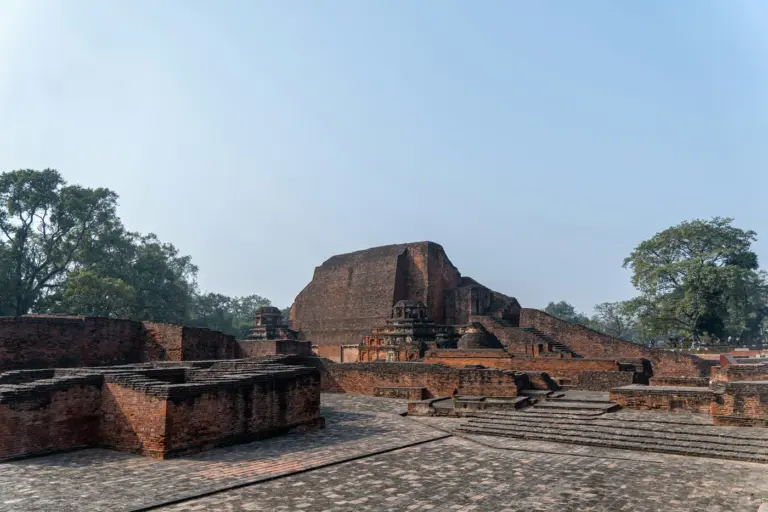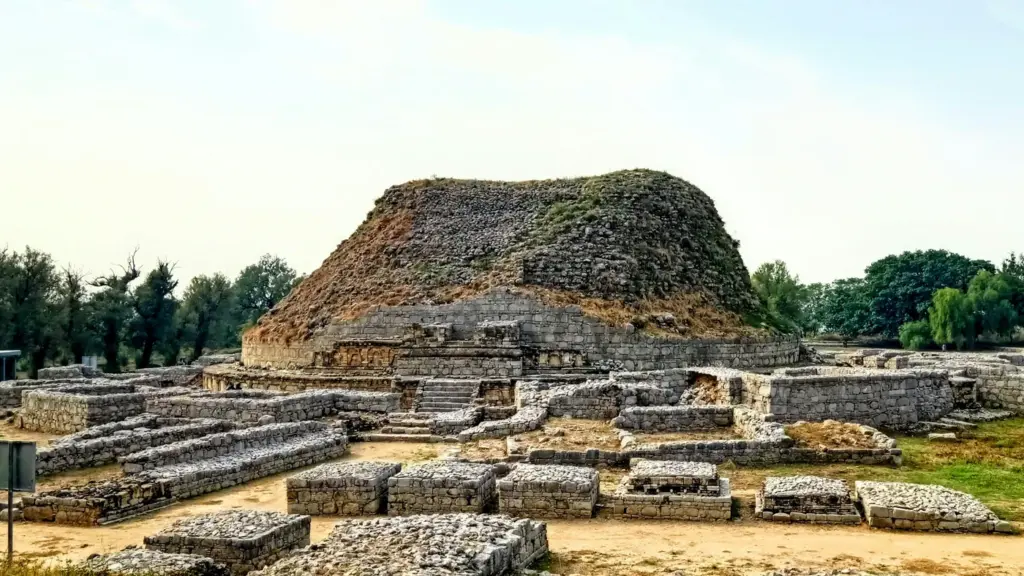
Takshashila university is what most people search for when they mean Taxila, the ancient capital of Gandhara, whose ruins lie about 35 km northwest of Rawalpindi in Pakistan’s Punjab province. Buddhist stories remember it as the city where princes and brahmin boys from as far as Benares went to study with famous teachers. Its ruins, three successive cities ringed by Buddhist monasteries, have been a UNESCO World Heritage Site since 1980, and they show how higher learning worked in early India before it moved into organized monasteries such as Nalanda.
The trouble is the word university. Taxila had no campus and gave no degrees, only famous teachers living in one city, each teaching his own pupils at home. The historian A.S. Altekar put it plainly in Education in Ancient India: Taxila “did not possess any college or university in the modern sense of the term.” Settle that, and the famous names attached to it, Chanakya first among them, fall into place as traditions of uneven strength.
Where Takshashila was and what it was
Takshashila was a city, not a campus. It was the capital of Gandhara, one of the mahajanapadas of the Buddha’s time, and UNESCO places it on a branch of the Silk Road that linked China to the West. Takshashila is the Sanskrit name and Taxila the Greek rendering; this note uses the first for the city of the texts and the second for the excavated site.
| Fact | Detail |
|---|---|
| Location | Rawalpindi district, Punjab province, Pakistan; ruins about 35 km northwest of Rawalpindi |
| Names | Takshashila in Sanskrit, Takkasila in Pali, Taxila in Greek writing |
| Meaning | “City of cut stone” or “Rock of Taksha”; the Ramayana makes Taksha, son of Bharata, its first ruler |
| Political role | Capital of Gandhara; under Achaemenid Persian rule, then a Mauryan provincial capital |
| As a seat of learning | Independent teachers, each housing his own pupils; no college, hostels or degrees |
| City sites | Bhir Mound (from about the 6th century BCE), Sirkap (Indo-Greek, 2nd century BCE), Sirsukh (Kushan) |
| Decline | Sacked by the Huns in the 5th century CE; ruined when Xuanzang saw it in the 7th |
| Rediscovery | Identified by Alexander Cunningham (1863-64 and 1872-73); excavated by John Marshall, 1913 to 1934 |
| UNESCO | Inscribed in 1980 under criteria (iii) and (vi); 18 component sites across two provinces |
The listing is wider than the famous name suggests: its 18 sites run from a Mesolithic cave at Khanpur to a medieval mosque and madrassa in the Giri complex.
Was Takshashila a university?
No, not in the sense that Nalanda was one, and the texts and the excavations point the same way. Britannica puts it directly: Taxila was a center of learning, but not a university town with lecture halls and residential quarters of the kind found at Nalanda in Bihar.
Altekar reached the same verdict from the Jatakas, the Buddhist stories of the Buddha’s past lives that are the main source for Taxila’s schools. In his reading:
- the teachers were not members of any institution, the way professors belong to a college;
- no central body prescribed what they taught;
- there were no degree examinations, and so no degrees or diplomas;
- every teacher, helped by his advanced students, formed an institution by himself.
The excavations add physical proof: Altekar noted that the digs had turned up no big hostels or lecture halls, the buildings a college holding the Jatakas’ stock 500 students would need. He thought a teacher normally had about 20 pupils at most.
The nearest modern picture is a town known for its teachers, where students arrive for particular names but no single body owns the town or awards certificates. The picture breaks because a Takshashila pupil usually lived in his teacher’s household and, as Britannica notes, could pay for his board in service instead of cash.
Why the university label stuck
Scholars kept using the word loosely. G.P. Malalasekera’s Dictionary of Pali Proper Names speaks of three rulers who were “classmates in the university of Takkasila.” Altekar himself, a couple of pages after denying Taxila any college, calls Panini an alumnus of “Taxila university.” Even UNESCO’s summary shifts with the language: the English text calls Taxila “an important Buddhist centre of learning,” while the French version calls it the seat of a flourishing Buddhist university, une université bouddhique florissante.
So if your notes say “the world’s oldest university,” you’re in good company. Hold both halves together instead: Altekar calls Taxila the most important seat of learning in ancient India, and it was never a university in the modern sense. When you meet the phrase “Takshashila university,” read it as “the famous teachers of Takshashila.”
That’s the whole correction.
How teaching worked at Takshashila
Teaching happened in the teacher’s household, and almost everything known about it comes from the Jatakas and Buddhist commentaries. That source needs a warning. Malalasekera’s dictionary points out that Takkasila, the Pali form of the name, is never mentioned in the suttas, the Buddha’s recorded discourses. What follows is what the stories take for granted, not a register kept at the time.
Read together, the stories describe a steady routine:
- Entry at about 16. Students came only for higher study, usually at 16, by Altekar’s reading.
- A fee or service. The usual admission fee was 1,000 gold pieces; a pupil who couldn’t pay served the teacher by day and was taught at night.
- Subjects. The three Vedas and the “eighteen sciences,” practical arts that ran from archery and elephant lore to medicine and surgery.
- Teachers. The head of a school was the disapamokkha acariya, the “world-renowned teacher,” helped by senior pupils acting as assistants.
- Discipline. Rules were strict, and a pupil who broke them could be flogged with a bamboo stick, whatever his rank.
The named pupils matter because, if the stories are right, they put Taxila’s teachers in the Buddha’s own lifetime:
- Jivaka, later physician to King Bimbisara of Magadha, studied medicine at Takkasila for 7 years. The Vinaya, the Buddhist monastic code, tells his story.
- Prasenajit (Pali Pasenadi), king of Kosala and a contemporary of the Buddha, appears in the Dhammapada commentary as a classmate of Mahali of the Licchavis and Bandhula of the Mallas.
- The Sutasoma Jataka puts 103 princes under one archery teacher, a figure Altekar trusts more than the stock 500.
Did Chanakya, Panini and Charaka study at Takshashila?
Perhaps, but the evidence runs from firm tradition to plain inference, and the texts behind these links, where any exist, came long after the men lived. The strongest case belongs to a less famous name, Jivaka; the weakest to Charaka.
| Person | What the sources say | How firm |
|---|---|---|
| Jivaka | The Vinaya says he studied medicine at Takkasila for 7 years | Buddhist canonical text |
| Chanakya (Kautilya) | Pali chronicles from Sri Lanka call him a brahmin of Takkasila; Britannica says he was educated at Taxila | Later tradition, widely repeated |
| Panini | Xuanzang records his birthplace as Salatura, near Attock on the Indus; Altekar infers he “must have been” a Taxila student | Inference from geography |
| Charaka | Britannica dates him only to between the 2nd century BCE and the 2nd century CE and doesn’t place him at Taxila | Tradition only |
The Chanakya link is the one everyone carries. The Pali chronicle tradition calls him a brahmin of Takkasila who, insulted at Dhana Nanda’s court, took his revenge by putting Chandragupta on the throne, and Britannica says plainly that he was educated at Taxila. The story fits the map, since Taxila passed to the Mauryas within a decade of Alexander’s death, but it is still tradition and should be written as such. The Kautilya note covers the man and the Arthashastra on firmer ground.
Panini shows how such links get made. Xuanzang was shown Salatura, a town near the Indus crossing, as the grammarian’s birthplace. Altekar then reasoned that a scholar born there “must have been” a Taxila student, and he extended the same reasoning to Kautilya. That is an inference from a map. The firmer link runs the other way: Panini’s grammar itself uses the name Takshashila in its rules, as Samuel Beal’s notes on Xuanzang record, so the city’s name was familiar to him.
Charaka has the thinnest case: “Charaka taught at Takshashila” is a line to mention as tradition, never one to build an argument on.
What Greek writers and Chinese pilgrims recorded
Outsiders saw Taxila first as a rich city on Alexander’s road and later as a Buddhist holy place, and none of them describes anything like a college. The city was famous for its philosophers in Alexander’s day, Altekar notes, but the Greek accounts dwell on wealth and power and the Chinese ones on stupas.
What the Greek writers saw
Arrian, the Greek historian of Alexander’s campaign, calls the ruler Taxiles; Britannica names him Ambhi (Omphis). Before Alexander crossed the Indus, Taxiles sent word that he would surrender Taxila, “the largest town between the rivers Indus and Hydaspes,” the Hydaspes being the modern Jhelum. Arrian lists what came with the message:
- 200 talents of silver;
- 3,000 oxen and more than 10,000 sheep for sacrifice;
- 30 elephants;
- 700 Indian horsemen as reinforcements.
In 326 BCE Alexander reached Taxila and was received “in a friendly manner,” and Greek historians with him described a wealthy and well-governed city. Ambhi’s choice is the mirror image of Porus, the king beyond the Jhelum who fought Alexander at the Hydaspes. Later, Philostratus, biographer of the sage Apollonius of Tyana, described a fortified city on a symmetrical plan, and Altekar notes that excavation confirmed some of his details.
What the Chinese pilgrims saw
Faxian reached Taxila at about the start of the 5th century CE and gives it only a few lines. He translates the name as “the severed head,” after a Jataka in which the Buddha, in a past life, gave his head away, and describes great stupas where the region’s kings and ministers competed in making offerings. He mentions no teachers and no schools. His translator, James Legge, even doubted that Faxian’s Takshasila was Arrian’s Taxila.
Xuanzang, in the 7th century, found a different place. The royal family had died out and the nobles fought for power, and the kingdom, once subject to Kapisa, now paid tribute to Kashmir. It had many sangharamas, or monasteries, but they were “ruinous and deserted,” with very few monks, who studied the Mahayana, the Great Vehicle. He also recorded the legend of Kunala, a prince sent to govern Taxila whom a forged letter from his stepmother ordered blinded. In June 2026 India and China were reported to be discussing a joint nomination of his writings to UNESCO’s Memory of the World register, as this current affairs brief explains.
Side by side, the two pilgrims show the decline: Faxian found stupas where the lamps and flowers never stopped, and Xuanzang, two centuries or more later, found ruins. F before X, flourishing before ruin.
The three cities of Taxila, from the Persians to the Kushans
Taxila moved twice, and each move follows a change of rulers, so the site has three cities side by side instead of one deep mound. UNESCO calls it the only site of its kind on the subcontinent for showing that evolution. The phases run from the Achaemenids through the post-Mauryan dynasties of the northwest:
| Period | Power at Taxila | What it left |
|---|---|---|
| 6th to 4th century BCE | Achaemenid Persia; Gandhara appears as a province in the inscriptions of Darius I | The Bhir Mound city |
| 326 BCE | Alexander, received by Ambhi | UNESCO’s criterion (vi) link to the Bhir Mound |
| Late 4th century BCE, for 3 generations | The Mauryas | A provincial capital named in Ashokan inscriptions |
| 2nd century BCE | Indo-Greeks from Bactria | Sirkap, on a Hellenistic grid |
| 1st century BCE to later 1st century CE | Shakas, then Parthians | The Jandial temple, with Ionic columns |
| From the later 1st century CE | Kushans, beginning with Kujula Kadphises | Sirsukh |
| 5th century CE | Huns | The sack the city never recovered from |
Within a decade of Alexander’s death, Taxila passed into the empire of Chandragupta Maurya and became a provincial capital. NCERT counts it among the five political centers of the empire named in Ashokan inscriptions, and notes that Taxila and Ujjayini both sat on important long-distance trade routes. Buddhist legend adds that Bindusara sent the young Ashoka to put down a revolt there, and Malalasekera reads the inscriptions as placing a kumara, a royal prince serving as viceroy, at Taxila.
On the ground, the three cities are easy to tell apart:
- Bhir Mound, the oldest historic city, probably founded under the Achaemenid Persians in the 6th century BCE, with winding streets and stone house foundations. UNESCO ties Alexander’s entry to this mound.
- Sirkap, founded in the mid-2nd century BCE on the Hellenistic grid, the Greek pattern of straight streets crossing at right angles. Its shrine of the double-headed eagle carries Corinthian pilasters on its front, and the Kushans destroyed the city in the 1st century CE.
- Sirsukh, the Kushan city to the north, credited to Kanishka by Britannica, with walls of ashlar (squared, dressed stone) and rounded bastions that UNESCO reads as an early Central Asian influence.
Around the cities stand the monasteries, and they matter for the university question. The Dharmarajika stupa, locally called Chir Tope, yielded a gold relic casket and a silver scroll inscribed in Kharoshthi, the script of the northwest. Britannica notes that such monasteries looked after students as well as monks, the closest Taxila came to residential learning. The head of the current Punjab excavation calls Taxila a core hub of Gandhara art, the school set beside Mathura and Amaravati in this comparison.
Why Takshashila declined, and how it was found again
The record is short: Taxila lost its trade and then its monasteries. Britannica ties the city’s wealth to three routes that met there:
- the road from eastern India, which Megasthenes called the Royal Highway;
- the route from western Asia;
- the route from Kashmir and Central Asia.
When those routes ceased to matter, the city sank, and shortly after Faxian’s visit the Huns sacked it. Taxila never recovered.
Don’t borrow Nalanda’s ending for it. Nalanda was sacked and abandoned in the 13th century, about 800 years later; Taxila faded between the Hun raids of the 5th century and the ruins Xuanzang saw in the 7th.
How Cunningham and Marshall found it
Taxila had to be found before it could be dug, and the Chinese pilgrims helped. On his return journey Xuanzang counted 3 days’ travel from Takshasila to the Indus. Alexander Cunningham, whom Britannica calls the father of Indian archaeology, looked for ruins at about that distance and placed the city near Shah-dheri, where he counted 55 stupas and 28 monasteries among the ruins. Britannica dates his work there to 1863-64 and 1872-73.
The full excavation came under Sir John Marshall, Director-General of archaeology in India from 1902 to 1931, whose teams dug at Taxila between 1913 and 1934 and exposed the city sites and their monasteries. His report, Taxila (1951), is counted by Britannica among his most valuable works. Just as telling is what his trenches never produced: the hostels and lecture halls of a university.
Takshashila today: UNESCO status and recent finds
Taxila is a protected World Heritage property in Pakistan, run by two provinces and still being dug. UNESCO inscribed it in 1980 under two criteria, in plain words:
- Criterion (iii), exceptional evidence of a civilization: the four settlement sites, from the prehistoric mound of Saraikala to Sirsukh, show how cities evolved on the subcontinent over more than five centuries.
- Criterion (vi), association with events of world importance: the Bhir Mound is tied to Alexander’s entry into Taxila.
The property is a protected antiquity under Pakistan’s Antiquities Act, 1975. Since the 18th Amendment of 2010, the provincial governments of Punjab and Khyber Pakhtunkhwa have held full charge of it, on funding UNESCO calls inadequate. UNESCO’s statement of the site’s value also lists what threatens it:
- industrial estates growing in the Taxila valley;
- limestone blasting and quarrying;
- illegal digging by looters at the monastery sites;
- uncontrolled plant growth on the masonry;
- earthquakes and climate extremes.
The newest evidence came from the Bhir Mound. On 2 January 2026, Dawn and PTI reported that a Punjab Department of Archaeology team led by Aasim Dogar had found lapis lazuli fragments of the 6th century BCE and bronze Kushan coins of the 2nd century CE bearing the image of Vasudeva, the last of the great Kushan rulers. Officials called it the most significant find at the site in a decade. The lapis, the excavators said, points to long-distance trade with Badakhshan in present-day Afghanistan.
Nalanda got a modern revival by Act of Parliament, the Nalanda University Act, 2010, and its first students enrolled in September 2014; this current affairs report covers the new university’s revival of an old debate format. Taxila’s news comes from trenches, not classrooms.
How to study Takshashila for exams
Takshashila sits in GS Paper I, where ancient history meets art and culture, and it ties together four themes usually taught apart:
- education in early India and the comparison with Nalanda;
- the Mauryan provinces and the Alexander episode;
- the foreign dynasties of the northwest, from the Indo-Greeks to the Kushans;
- Gandhara art.
The theme is tested as a judgment, not a date. Mains 2014 GS Paper I asked: “Taxila university was one of the oldest universities of the world with which were associated a number of renowned learned personalities of different disciplines. Its strategic location caused its fame to flourish, but unlike Nalanda, it is not considered as a university in the modern sense. Discuss.” The question hands you the word “university” and asks you to take it apart, so an answer that only praises the oldest university misses its second half. In the Prelims question bank, History accounts for 184 and Art and Culture for 94 of the 1,403 questions from 2013 to 2026; Taxila sits where the two overlap.
The facts worth revising:
- Taxila lies in Rawalpindi district, Punjab, Pakistan, and was the capital of Gandhara.
- It was a center of learning run by independent teachers, not a university.
- Pupils entered at about 16 and paid 1,000 gold pieces or worked for the teacher; Jivaka studied medicine there for 7 years.
- The oldest city is the Bhir Mound; Sirkap is Indo-Greek and Sirsukh is Kushan.
- Faxian (early 5th century) saw stupas; Xuanzang (7th century) saw ruins and a kingdom paying tribute to Kashmir.
- UNESCO inscribed it in 1980 under criteria (iii) and (vi); Cunningham identified it and Marshall excavated it.
These confusions cost the most, and each has a simple fix:
- University or center of learning? Write “center of learning with famous teachers,” and keep “university” for Nalanda-type institutions.
- Faxian or Xuanzang? F before X: the earlier pilgrim saw flourishing stupas, the later one saw ruins.
- Sirkap or Sirsukh? K comes before S: Sirkap is the earlier Indo-Greek grid city, Sirsukh the later Kushan city to the north.
- Ambhi or Porus? Ambhi of Taxila welcomed Alexander; Porus fought him at the Hydaspes.
The sibling to compare is Nalanda:
| Point | Taxila (Takshashila) | Nalanda |
|---|---|---|
| Where | Rawalpindi district, Punjab, Pakistan | Bihar, India |
| Form | Independent teachers housing their own pupils | A monastic and scholastic establishment with planned buildings |
| Main period | Buddhist center of learning, 5th century BCE to 2nd century CE (UNESCO) | 5th to 13th century CE (UNESCO) |
| Main evidence | Jatakas, Greek historians, Chinese pilgrims, excavation | Excavated viharas, chaityas and stupas |
| End | Sacked by the Huns, 5th century CE | Sacked and abandoned, 13th century CE |
| UNESCO | 1980; criteria (iii) and (vi) | 2016; criteria (iv) and (vi) |
Takshashila rewards the aspirant who can hold two ideas at once: it was the most famous place to study in early India, and it was not a university. Write both halves, label the famous names as tradition unless a text says otherwise, and the answer reads as history rather than a slogan.
Frequently Asked Questions
Where is Takshashila university located?
Takshashila, or Taxila, is in the Rawalpindi district of Punjab province in Pakistan, about 35 km northwest of Rawalpindi. In ancient times it was the capital of Gandhara. The World Heritage property covers 18 sites, 10 in Punjab and 8 in Khyber Pakhtunkhwa.
Was Takshashila really a university?
Not in the modern sense. It was a city of independent teachers, each teaching his own pupils at home, with no college buildings and no degrees. Historians such as A.S. Altekar and the excavation record both point that way, which is why Nalanda, an organized monastery, is the better example of an ancient university.
Did Chanakya study at Takshashila?
According to Buddhist tradition, yes. Sri Lankan Pali chronicles describe Chanakya as a brahmin of Takkasila, and modern reference works such as Britannica say he was educated there. The claim rests on these later texts, so it is best written as tradition.
Who founded Takshashila?
The Ramayana credits Bharata, Rama’s younger brother, who named the city after his son Taksha. Archaeology gives a plainer answer: the Bhir Mound, the oldest historic city on the site, was probably founded in the 6th century BCE under Achaemenid Persian rule.
Who destroyed Takshashila?
The Huns sacked Taxila in the 5th century CE, and the city never recovered. When Xuanzang passed through in the 7th century, its monasteries were ruinous and deserted and very few monks remained.
What subjects were taught at Takshashila?
The Jataka stories speak of the three Vedas and the ‘eighteen sciences’, practical arts that ran from archery to medicine and surgery. Students usually arrived at about 16 and paid a fee or worked for their teacher in return.
When did Taxila become a UNESCO World Heritage Site?
Taxila was inscribed on the World Heritage List in 1980 under criteria (iii) and (vi). The first recognizes how its settlement sites show a city evolving over more than five centuries, and the second its association with Alexander’s entry in 326 BCE.
Which Chinese pilgrims visited Takshashila?
Faxian came at about the start of the 5th century CE and Xuanzang in the 7th. Faxian recorded great stupas and explained the name as ‘the severed head’, while Xuanzang found the monasteries ruined and the kingdom paying tribute to Kashmir.
Practice Questions
Prelims
1. Consider the following statements about Takshashila (Taxila): 1. Its ruins lie in the Punjab province of Pakistan. 2. It was inscribed as a UNESCO World Heritage Site in 1980. 3. Excavations there have revealed large hostels and lecture halls like those at Nalanda. Which of the statements given above is/are correct?
- (a) 1 only
- (b) 1 and 2 only
- (c) 2 and 3 only
- (d) 1, 2 and 3
Answer: (b) Taxila is in Rawalpindi district of Punjab and was inscribed in 1980, but no Nalanda-type hostels or lecture halls have been found there.
2. Which one of the following pairs of a city site at Taxila and the power associated with it is correctly matched?
- (a) Bhir Mound: Kushans
- (b) Sirkap: Indo-Greeks
- (c) Sirsukh: Achaemenid Persians
- (d) Sirkap: Huns
Answer: (b) Sirkap was founded in the 2nd century BCE on a Hellenistic grid under the Indo-Greeks; Sirsukh is Kushan and the Bhir Mound is the oldest of the three.
3. The ruler of Taxila who submitted to Alexander in 326 BCE was:
- (a) Porus
- (b) Ambhi
- (c) Dhana Nanda
- (d) Menander
Answer: (b) Ambhi, called Taxiles by Arrian, surrendered the city, while Porus fought Alexander at the Hydaspes.
4. Consider the following statements: 1. The Chinese pilgrim Faxian found Taxila’s monasteries ruinous and deserted. 2. Xuanzang recorded that the kingdom of Taxila had become tributary to Kashmir. Which of the statements given above is/are correct?
- (a) 1 only
- (b) 2 only
- (c) Both 1 and 2
- (d) Neither 1 nor 2
Answer: (b) Faxian, early in the 5th century, described great stupas receiving offerings; it was Xuanzang in the 7th century who found ruined monasteries and a kingdom paying tribute to Kashmir.
5. According to the Buddhist Vinaya, which one of the following studied medicine at Takkasila (Taxila) for seven years?
- (a) Charaka
- (b) Sushruta
- (c) Jivaka
- (d) Nagarjuna
Answer: (c) The Vinaya says Jivaka, later physician to King Bimbisara, studied medicine at Takkasila for seven years; the Charaka link rests on tradition alone.
Mains
- Assess the importance of the accounts of the Chinese and Arab travellers in the reconstruction of the history of India. (10 marks, 150 words) Previous year: Mains 2018, GS Paper I.
- Highlight the Central Asian and Greco-Bactrian elements in the Gandhara art. (10 marks, 150 words) Previous year: Mains 2019, GS Paper I.
- “Takshashila was a city of teachers, not a university.” Examine this statement with reference to the literary and archaeological evidence. (15 marks, 250 words)
- How far can the traditions linking Chanakya, Panini and Charaka to Takshashila be treated as historical evidence? (10 marks, 150 words)
- Trace how Taxila’s position on long-distance trade routes shaped its rise under successive foreign rulers and its decline after the 5th century CE. (15 marks, 250 words)
Tell Google you want more of this.
Add Anantam IAS as a preferred sourceOne tap, and this site shows up more often in your own Top Stories, AI Overviews and AI Mode. Remove it any time.