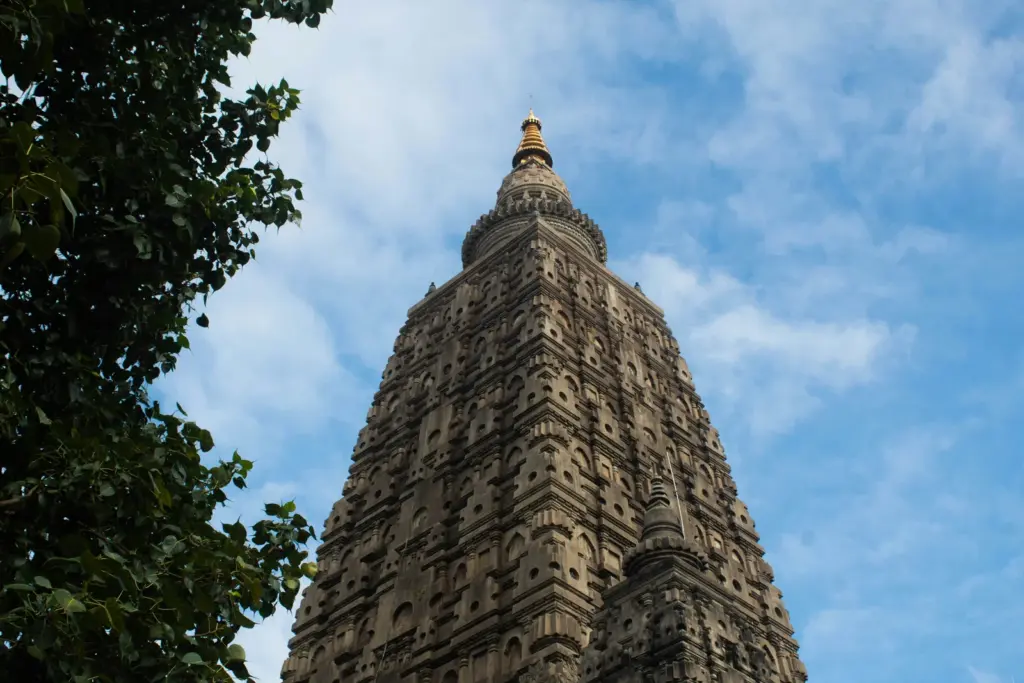
The confusion that catches most aspirants is the temple’s age. Ask when the Mahabodhi Temple was built and the honest answer has two parts that seem to fight each other. The site was consecrated by Emperor Ashoka in the third century BCE, but the soaring brick tower you see in every photograph is not Ashoka’s. It belongs to the Gupta period, roughly the fifth to sixth century CE, seven or eight centuries later. So when a question asks who “built” Mahabodhi, the trap is to pick one date. The precise answer is that Ashoka founded the shrine and the Guptas raised the temple that survives, and knowing that seam is the difference between a full mark and a half.
Standing at Bodh Gaya in Bihar, on the bank of the Phalgu (or Niranjana) river, the Mahabodhi Temple marks the single most sacred spot in the Buddhist world: the place where Siddhartha Gautama, seated under a peepal tree, became the Buddha, “the awakened one.” It is a UNESCO World Heritage Site, one of the earliest brick temples still standing in India, and the anchor of a pilgrimage and diplomacy circuit that spans a dozen countries. Below, we untangle its history, its architecture, the Bodhi Tree and the Vajrasana, and why this one temple keeps turning up in both art-and-culture and international-relations questions.
What happened at Bodh Gaya
Bodh Gaya is where the enlightenment, or *bodhi*, took place, and everything else about the site radiates from that event. Buddhist tradition holds that Prince Siddhartha, having left his palace and tried extreme asceticism without success, sat in meditation under a peepal tree (*Ficus religiosa*) on the bank of the Phalgu and resolved not to rise until he understood the nature of suffering. After a night of meditation he attained enlightenment and became the Buddha. The tree became the Bodhi Tree, and the spot beneath it the holiest ground in Buddhism.
This is one of the four defining moments and places of the Buddha’s life, and examiners expect you to hold the set together. He was born at Lumbini in present-day Nepal, was enlightened at Bodh Gaya, delivered his first sermon at Sarnath near Varanasi, and attained *parinirvana*, or death, at Kushinagar in Uttar Pradesh. Bodh Gaya is the second of the four and, for most Buddhists, the most sacred. To place the enlightenment inside the wider story of the religion, its schools, and its royal patrons, our note on Buddhism in India traces the arc from the Buddha’s teaching to Ashoka’s evangelism.
The temple Ashoka started and the Guptas finished
The building history is the heart of the topic, so slow down here. Around 250 BCE, roughly two centuries after the enlightenment, Emperor Ashoka of the Maurya dynasty visited Bodh Gaya and built a shrine and a monastery at the site, along with the Diamond Throne that still sits there. Ashoka’s original structure was almost certainly modest, and it does not survive in its first form.
The temple that stands today is a Gupta-period construction, dated to about the fifth to sixth century CE. This matters for a specific reason that examiners love: it is one of the earliest and most imposing structures in India built entirely in brick, from an age when most surviving monuments were cut in stone. Its central tower, a straight-sided pyramid capped by a small stupa-like finial, rises to about 55 metres. Four smaller towers echo the central spire at the corners of the platform, giving the whole the tiered, upward-thrusting silhouette that later influenced temple design across Asia.
Why does the brick matter so much? Most of ancient India’s monumental religious art that survives, the Ashokan pillars, the rock-cut caves, the great stupas, is in stone or living rock, which endures. Brick is fragile by comparison, and few brick structures of comparable age have come through the centuries intact. The Mahabodhi tower is therefore a rare window into how ancient Indian builders worked in a humbler, cheaper material at monumental scale, plastering and moulding the surface into tiers of niches that once held images. That it stands at all, after burial, weathering, and heavy-handed restoration, is part of what earned it World Heritage recognition.
The style is worth naming carefully because it does not fit neatly into the categories aspirants memorise for Hindu temples. Its tall curvilinear-to-straight tower prefigures elements of the north Indian Nagara tradition, and Mahabodhi is often discussed alongside the evolution of Indian temple architecture as an early, transitional form. If you want the framework that this fits into, our explainers on temple architecture in India and specifically the Nagara style set out the shikhara, the tiers, and the regional schools that came later. To see how the site connects backward to the Mauryan world that first sanctified it, the notes on Samrat Ashoka, the Maurya Empire, and the region of Magadha fill in the political ground on which Bodh Gaya sat.
The Vajrasana and the Bodhi Tree
Two objects inside the complex carry more devotional weight than the building itself, and both are frequently tested.
The Vajrasana, meaning the “Diamond Throne” or “thunderbolt seat,” is a polished sandstone slab that Ashoka placed at the exact spot where the Buddha is believed to have sat during his enlightenment, between about 250 and 233 BCE. It marks the *bodhimanda*, the seat of awakening, and its Mauryan polish links it stylistically to the famous Ashokan pillars. If the Mauryan stone-working tradition interests you, our piece on the Ashoka Pillar explains that mirror-like finish and the imperial art it belonged to.
The Bodhi Tree behind the temple is a peepal, and it is treated as a direct descendant of the original tree under which the Buddha meditated. The lineage is a story in itself. According to tradition the original tree was propagated by a sapling that Ashoka’s daughter, Sanghamitra, carried to Sri Lanka, where it was planted at Anuradhapura and still grows as the Sri Maha Bodhi. When the tree at Bodh Gaya was later damaged, saplings from the Sri Lankan tree were brought back to re-establish it. So the peepal shading pilgrims today is, in a sense, a great-grandchild returned home, and it is one of the oldest documented sacred trees in continuous veneration anywhere.
Inside the complex: the seven sacred weeks
The temple does not stand alone. It anchors a walled complex of shrines, platforms, and hundreds of small votive stupas left by pilgrims over the centuries, and the layout maps onto a story that pilgrims still walk. Tradition holds that after his enlightenment the Buddha stayed at Bodh Gaya for seven weeks, spending each week meditating at a different spot, and six of those spots survive within or beside the complex alongside the Vajrasana itself.
Two of them are worth naming because they turn up in guided descriptions and occasionally in questions. The Animeshlochana Chaitya marks the second week, where the Buddha is said to have stood gazing at the Bodhi Tree without blinking, in gratitude to the tree that had sheltered him. The Chankramana, or “Jewel Walk,” marks the third week, a raised stone platform lined with carved lotuses commemorating the belief that lotuses bloomed where the Buddha’s feet touched the ground as he paced in walking meditation. Together these spots make the complex a place you move through rather than simply look at, which is part of why it remains a living pilgrimage site and not a museum.
The complex also preserves some of the earliest surviving stone sculptural railings in India. The oldest of these balustrades date to around the first century BCE, in the Shunga period, and the reliefs on them, medallions, lotus motifs, and scenes of devotion, are prized as early examples of Indian narrative sculpture. Because the site accumulated additions across the Mauryan, Shunga, Kushana, Gupta, and Pala periods, walking the boundary is like reading a timeline of ancient Indian art in one enclosure.
From ruin to World Heritage
For a place this sacred, Mahabodhi spent centuries in decline. As Buddhism faded in the land of its birth after the early medieval period, the complex fell into neglect and was partly buried and forgotten. Its survival owes much to nineteenth-century archaeology and to Buddhist Asia.
Burmese Buddhist missions attempted repairs in the nineteenth century, and the major scientific restoration was carried out under the British Archaeological Survey by Sir Alexander Cunningham and Joseph David Beglar in the 1880s. They excavated, documented, and rebuilt the crumbling structure, and a large Pala-period Buddha image was reinstated in 1884. The restoration is a mixed legacy, admired for saving the temple and criticised for the liberties of Victorian reconstruction, but without it the building would very likely not stand.
The temple was inscribed as a UNESCO World Heritage Site in June 2002, recognised as the finest surviving example of early brick temple architecture and as a place of exceptional testimony to the life of the Buddha. To situate Mahabodhi among the country’s other inscribed treasures, our roundup of UNESCO World Heritage Sites in India shows where it sits alongside monuments like the Sanchi Stupa, another Ashokan-origin Buddhist site, and older cultural landscapes such as Dholavira.
Who runs the temple: the Bodh Gaya Temple Act
Here is where art and culture spills into governance, and it is a genuinely contested topic worth understanding rather than memorising blindly. The complex is administered under the Bodh Gaya Temple Act, 1949, a Bihar state law that created a management committee for the site.
As originally framed, the committee had eight members with the District Magistrate of Gaya as chairman, and it was structured with equal Hindu and Buddhist representation, four members each. The design reflected the awkward reality on the ground: for centuries a Hindu monastic order, the Bodh Gaya Math under a Mahant, had controlled the site, and the 1949 law was a compromise that shared management rather than handing it wholly to the Buddhist community. This arrangement has drawn sustained protest from Buddhist groups who argue that the holiest site in their religion should be managed by Buddhists, much as major Hindu, Sikh, and Muslim shrines are managed by their own communities. A notable feature of the original Act was that the chairman, the District Magistrate, was required to be a Hindu, a clause later amended to allow a District Magistrate of any faith to hold the post. The debate over the temple’s governance remains live, and it is the kind of society-and-polity angle a Mains question can open up.
Soft power: Bodh Gaya and Buddhist diplomacy
The reason Mahabodhi appears in international-relations preparation, not just history, is Buddhist diplomacy. India is the birthplace of Buddhism, and Bodh Gaya is its single most sacred site, which gives New Delhi a cultural asset that money cannot buy in its relations with Buddhist-majority and Buddhist-influenced nations: Sri Lanka, Myanmar, Thailand, Cambodia, Bhutan, Japan, South Korea, Mongolia, and, importantly, in the quiet contest for influence across Asia.
You can see the strategy in the built landscape of Bodh Gaya itself, ringed by monasteries and temples funded by governments and communities from across the Buddhist world, each a small embassy in brick and gold. Thai, Bhutanese, Japanese, Tibetan, Burmese, and Chinese monasteries cluster around the sacred core, so a walk through the town is effectively a tour of Buddhist Asia. India hosts international Buddhist conclaves, has promoted a Buddhist Circuit tourism corridor linking Bodh Gaya, Sarnath, Kushinagar, and Rajgir with dedicated trains and upgraded airports, and repeatedly invokes its Buddhist heritage in summit diplomacy with countries where the faith shapes national identity. The subtext is often strategic: as another large Asian power presents itself as a Buddhist patron, India’s ability to point to the actual ground of the enlightenment is a card no one else can play. For a country seeking to project a civilisational identity abroad, a temple where an Indian prince became a teacher revered by hundreds of millions is one of the most effective instruments of soft power it possesses.
The temple’s reach is architectural too, not just diplomatic. The distinctive Mahabodhi form, a tall straight-sided tower over a shrine, was copied and reinterpreted across Asia, and full-scale replicas of the temple were built in places such as Bagan in Myanmar and, in modern times, in Thailand and beyond. A pilgrim who cannot reach Bihar can stand before a copy of Bodh Gaya’s tower closer to home, which tells you how central this single silhouette became to the Buddhist imagination. That afterlife in stone and brick across a continent is itself a measure of the site’s importance, and a neat point to drop into an answer on cultural transmission along Asia’s trade and pilgrimage routes.
How to study Mahabodhi for the exam
Study this temple as a crossroads, because its marks are scattered across three or four sections of the syllabus and the same facts answer very different questions.
Start by fixing the non-negotiable data points: Bodh Gaya, Bihar, on the Phalgu river; the site of the Buddha’s enlightenment; founded by Ashoka in the third century BCE; the present brick temple from the Gupta period, fifth to sixth century CE; a central tower around 55 metres; UNESCO World Heritage in 2002; managed under the Bodh Gaya Temple Act, 1949. If you can recite that chain, the objective questions take care of themselves.
Next, build the “four sites” reflex. Whenever Bodh Gaya appears, your mind should immediately produce Lumbini, Sarnath, and Kushinagar with their events, because prelims loves the matching format and interview panels love the quick recall. Attach one architectural point too: Mahabodhi is important as an early brick temple, a rarity from an era of stone.
Then push into analysis for Mains. Two ready arguments carry marks. One is the governance debate under the 1949 Act, framed as a question about who should control a community’s holiest shrine, which lets you write with nuance rather than opinion. The other is Buddhist soft power, where Bodh Gaya becomes evidence in an essay on cultural diplomacy and India’s civilisational statecraft. The habit to cultivate is asking, for every heritage site you study, “what does this connect to beyond history?” Mahabodhi answers that question in three directions at once, which is exactly why it repays deeper study than its size suggests.
Frequently Asked Questions
Where is the Mahabodhi Temple located?
It is at Bodh Gaya in the Gaya district of Bihar, on the bank of the Phalgu (Niranjana) river, in the historical region of Magadha.
Why is the Mahabodhi Temple important?
It marks the exact site where Siddhartha Gautama attained enlightenment under the Bodhi Tree and became the Buddha. It is the most sacred site in Buddhism and a UNESCO World Heritage Site.
Who built the Mahabodhi Temple?
Emperor Ashoka founded the original shrine at the site in about 250 BCE, but the present brick temple was built during the Gupta period, around the fifth to sixth century CE.
When was the Mahabodhi Temple made a UNESCO World Heritage Site?
It was inscribed on the UNESCO World Heritage List in June 2002, recognised as one of the earliest and finest brick temples of ancient India.
What is the Vajrasana at Bodh Gaya?
The Vajrasana, or Diamond Throne, is a polished sandstone slab that Ashoka placed at the spot where the Buddha sat during his enlightenment. It marks the seat of awakening.
Is the Bodhi Tree the original tree?
The present tree is considered a direct descendant of the original peepal tree. When the tree was damaged over the centuries, it was re-established from saplings, including from the Sri Maha Bodhi at Anuradhapura in Sri Lanka, itself grown from a sapling carried there by Ashoka’s daughter.
Who manages the Mahabodhi Temple?
It is administered under the Bodh Gaya Temple Act, 1949, through a management committee that has historically included both Hindu and Buddhist members, with the District Magistrate of Gaya as chairman. The arrangement has been the subject of long-running demands for exclusively Buddhist control.
Practice Questions
1. The Mahabodhi Temple is associated with which event in the life of the Buddha?
a) Birth
b) Enlightenment
c) First sermon
d) Parinirvana
Answer: b) Enlightenment
2. The present Mahabodhi Temple structure primarily dates to which period?
a) Maurya period
b) Kushana period
c) Gupta period
d) Pala period
Answer: c) Gupta period
- Consider the following statements about the Mahabodhi Temple:
- It is located at Bodh Gaya in Bihar on the bank of the Phalgu river.
- It is built largely of brick.
- It was inscribed as a UNESCO World Heritage Site in 2002.
Which of the statements are correct?
a) 1 and 2 only
b) 2 and 3 only
c) 1 and 3 only
d) 1, 2 and 3
Answer: d) 1, 2 and 3
4. The Vajrasana at Bodh Gaya is best described as:
a) A monastery built by the Guptas
b) The Diamond Throne placed by Ashoka at the enlightenment spot
c) A pillar edict of Ashoka
d) A stupa containing the Buddha’s relics
Answer: b) The Diamond Throne placed by Ashoka at the enlightenment spot
- Match the site with the event in the Buddha’s life:
- Lumbini, 2. Bodh Gaya, 3. Sarnath, 4. Kushinagar
a) Birth, Enlightenment, First sermon, Parinirvana
b) Enlightenment, Birth, Parinirvana, First sermon
c) First sermon, Birth, Enlightenment, Parinirvana
d) Birth, First sermon, Enlightenment, Parinirvana
Answer: a) Birth, Enlightenment, First sermon, Parinirvana
- The Mahabodhi Temple has been called one of the earliest brick temples of India. Discuss its architectural significance and its place in the evolution of Indian temple design.
- Trace how a single site, Bodh Gaya, connects the Mauryan and Gupta ages, and explain what its building history reveals about the patronage of Buddhism in ancient India.
- The management of the Mahabodhi Temple under the Bodh Gaya Temple Act, 1949 has been a subject of continuing debate. Examine the issue and the questions of religious autonomy it raises.
- “Bodh Gaya is among India’s most valuable instruments of soft power.” Critically evaluate this statement in the context of Buddhist diplomacy and India’s cultural outreach in Asia.
- Discuss the role of nineteenth-century archaeology in the survival of India’s Buddhist heritage, using the restoration of the Mahabodhi Temple as an example.
Mahabodhi is deceptively simple to file away as “the enlightenment temple,” and that shortcut is exactly what costs marks. It is a Mauryan foundation wearing a Gupta tower, a brick landmark in an age of stone, a governance dispute a century old, and a working tool of Indian diplomacy, all standing on one patch of ground in Bihar. Learn it in those layers, and you will find that the temple where a prince became the Buddha answers questions the examiner asks in history, in art, in polity, and in international relations alike.
Tell Google you want more of this.
Add Anantam IAS as a preferred sourceOne tap, and this site shows up more often in your own Top Stories, AI Overviews and AI Mode. Remove it any time.