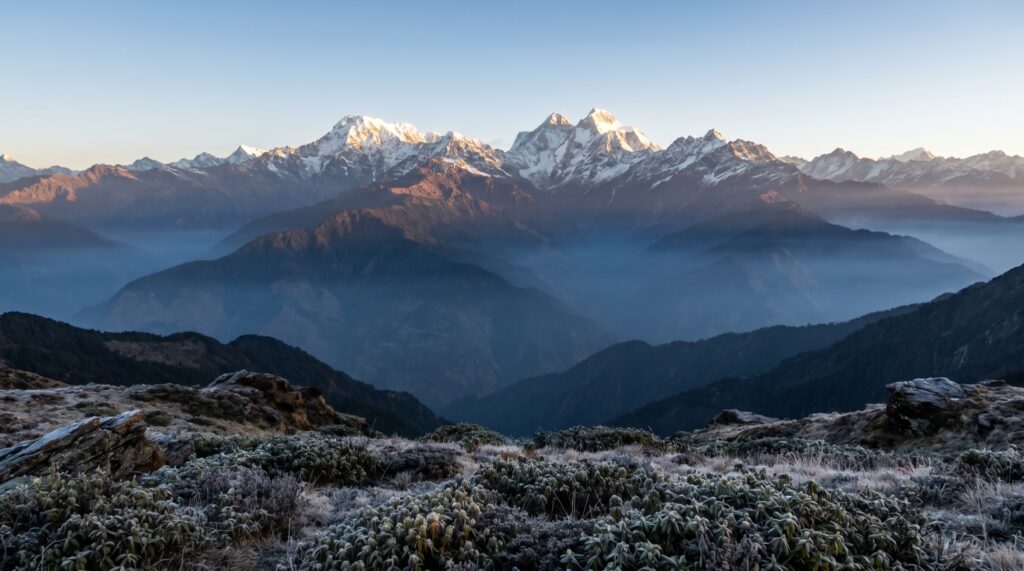
There is a slippery phrase that trips up almost everyone who studies Indian geography: “the highest mountain in India.” The honest answer is Kanchenjunga at 8,586 metres, but Kanchenjunga sits on the Sikkim border with Nepal, so half of it is not really India’s at all. Ask instead which peak lies wholly inside Indian territory, from base to summit, and the answer changes to Nanda Devi, standing at 7,816 metres in Uttarakhand. That distinction, highest overall versus highest entirely within the country, is the single fact that makes Nanda Devi worth learning properly rather than filing away as “India’s second peak.”
And there is far more to it than a number. Nanda Devi is a goddess before she is a mountain to the people who live beneath her. She is ringed by a wall of peaks so complete that the basin at her foot stayed unexplored until 1934. She anchors a national park and a biosphere reserve that UNESCO recognized as world heritage. And she once swallowed a plutonium-powered spying device that the CIA and Indian intelligence lost on her slopes during the Cold War. Get these layers straight and the peak stops being a runner-up and becomes one of the richest single entries in the whole physical-geography syllabus.
Where Nanda Devi ranks and why “highest within India” matters
Nanda Devi is the second-highest mountain in India at 7,816 metres (25,643 feet), and the highest peak located entirely inside Indian territory. The one taller Indian summit, Kanchenjunga, straddles the international boundary with Nepal, which is exactly why the two claims can both be true without contradicting each other. Hold them as a pair: Kanchenjunga is India’s highest point, Nanda Devi is India’s highest self-contained peak.
The gap between them is real but not huge. About 770 metres separate the two, roughly the height of the Burj Khalifa stacked on top of Nanda Devi’s summit. Line the peaks up worldwide and Nanda Devi comes in as the 23rd-highest mountain on Earth, which sounds modest until you remember that everything above it is in the Himalaya or the Karakoram, and most of those are shared borders or foreign soil.
There is a second reason the “entirely within India” tag carries weight. It made Nanda Devi the highest mountain in the British Empire until Nepal’s peaks and the 1947 borders reshuffled the accounting, and for decades it was the loftiest summit any purely Indian expedition could claim as home ground. If you have already worked through the companion note on the world’s third-highest peak, slot Nanda Devi in beside it: same top tier of the Himalaya, different side of the “is it really India’s?” question.
| Attribute | Detail |
|---|---|
| Height | 7,816 m (25,643 ft) |
| Rank in India | 2nd highest; highest lying entirely within India |
| Global rank | 23rd highest on Earth |
| Location | Chamoli district, Uttarakhand (Garhwal Himalaya) |
| Range | Garhwal Himalaya, Great Himalaya (Himadri) |
| Name meaning | “Bliss-Giving Goddess” |
| Twin summits | Nanda Devi Main (7,816 m) and Nanda Devi East (7,434 m) |
| Guarding feature | Nanda Devi Sanctuary, a glacial basin ringed by high peaks |
| River fed | Rishi Ganga, a tributary of the Alaknanda (Ganga system) |
| First ascent | 29 August 1936, Noel Odell and Bill Tilman |
| Protected status | Nanda Devi National Park; Biosphere Reserve; UNESCO World Heritage Site (1988) |
What the name Nanda Devi actually means
The name Nanda Devi translates as the “Bliss-Giving Goddess,” and that is not a poetic label bolted on after the fact. To the people of Garhwal and Kumaon, the two hill regions of Uttarakhand, the mountain is the goddess Nanda, a form of Parvati and the patron deity of the entire region. When a local says Nanda Devi, they may mean the peak, the goddess, or both at once, because in the older way of thinking the two were never separate.
That devotion drives one of the longest religious processions in the Himalaya, the Nanda Devi Raj Jat, held roughly once every twelve years. Pilgrims escort the goddess on a journey of around 280 kilometres on foot from the plains of Garhwal up towards the high meadows near Roopkund and Homkund, traditionally led by a four-horned ram, before the deity is symbolically sent on to her mountain home. It is often called the Himalayan Kumbh for its scale, and it shows how completely the peak and the goddess remain one thing in local practice.
That fusion of rock and religion has a practical consequence you will meet again in the exam-relevant sections below: the sanctity of the peak shaped who was allowed to climb it, when, and how the surrounding land was later protected. A mountain worshipped as a living goddess is treated differently from a mountain seen as a sporting objective.
The peak also comes as a pair. There is Nanda Devi Main at 7,816 m and, about two kilometres to the east across a high connecting ridge, Nanda Devi East at 7,434 m. Local tradition reads the twin summits as the goddess and her sister or companion, which is the tidy way to remember that Nanda Devi is a two-peaked massif and not a single spire.
The Nanda Devi Sanctuary, the ring of peaks that kept it hidden
The most extraordinary thing about Nanda Devi is not the summit but the fortress around it. The peak sits at the centre of the Nanda Devi Sanctuary, a roughly circular glacial basin walled in by a near-continuous ring of high mountains, more than a dozen of them above 6,000 metres, forming a natural amphitheatre about 380 square kilometres across. From the outside it looks sealed. For centuries it effectively was.
The only chink in that wall is the Rishi Ganga gorge, a savage, near-vertical slot on the western side through which the sanctuary’s meltwater escapes. This is why the interior stayed a blank on the map long after the rest of the Himalaya had been surveyed. Expedition after expedition tried to force a way in and failed, defeated not by the summit but by the approach. It was only in 1934 that the British climbers Eric Shipton and Bill Tilman, with three Sherpa companions, finally threaded the Rishi Ganga and reached the inner sanctuary. Reaching the basin was itself a mountaineering landmark, quite apart from climbing the peak two years later.
Follow the water out of that gorge and you connect Nanda Devi to the wider drainage you already study. The Rishi Ganga feeds the Dhauliganga, which joins the Alaknanda, one of the two great headstreams of the Ganga. So the ice locked inside this hidden basin is, quite literally, source water for the Ganga system. When you revise the Himalayan rivers and drainage system, Nanda Devi’s sanctuary is a clean, memorable node near the top of the Alaknanda’s family tree, and the 2021 Chamoli flash flood that tore down the Rishi Ganga valley is the modern reminder that this terrain is anything but static.
Nanda Devi National Park and the biosphere reserve around it
The land in and around the sanctuary carries a stack of protections, and keeping them in order is where marks are won or lost. The core is the Nanda Devi National Park, established in 1982, covering the sanctuary basin itself. Six years later, in 1988, it was inscribed on the UNESCO World Heritage List for its wilderness and its high-altitude ecosystem. Then in 2005 UNESCO extended the site to fold in the neighbouring Valley of Flowers National Park, so the World Heritage property is now formally called “Nanda Devi and Valley of Flowers National Parks.”
Wrapped around both parks is the larger Nanda Devi Biosphere Reserve, notified in 1988 and admitted to UNESCO’s World Network of Biosphere Reserves in 2004. So the same landscape wears three hats at once: two national parks at the core, a World Heritage listing over them, and a biosphere reserve as the outer ring. Confusing these three is the most common slip aspirants make, so if your notes on national parks of India and biosphere reserves of India keep the labels apart, you are ahead of the pack. You can check the official inscription on the UNESCO World Heritage Centre page.
One detail sets Nanda Devi’s park apart from most others: its core zone has been closed to human entry since 1983. Years of expeditions had left the fragile sanctuary littered and eroded, and the authorities shut it to let the ecosystem recover. That closure is why the park is often described as one of the most pristine high-altitude wildernesses left in the Himalaya, and it is a rare Indian example of conservation by keeping people out entirely rather than managing their access.
The ecology inside the wall
Because the sanctuary climbs from around 3,500 metres to nearly 7,800, its life sorts itself by altitude into a set of species every conservation list flags. The high crags and glaciers hold the snow leopard, the ghost cat that anchors any Himalayan predator question. The alpine meadows and slopes below carry bharal, the blue sheep that is the snow leopard’s main prey, along with Himalayan tahr, Himalayan musk deer, and serow.
The vegetation is a story of scarcity turning into abundance and back. Above the tree line, alpine meadows bloom for a few short weeks after the snow melts, which is exactly the spectacle the adjoining Valley of Flowers is famous for. Lower down, the slopes carry birch, rhododendron, and juniper before thinning out into rock and ice. The isolation created by that ring of peaks means the sanctuary functions almost as an island, which is part of why UNESCO valued it so highly.
For the conservation angle worth carrying into an answer, note that the snow leopard and the Himalayan musk deer are both listed as threatened on the IUCN Red List, and the sealed Nanda Devi core is one of their safest refuges in India. That is the sentence that ties this peak to the wildlife syllabus rather than leaving it as scenery.
The mountaineering history and the plutonium the mountain kept
Nanda Devi Main was first climbed on 29 August 1936 by Noel Odell and Bill Tilman, part of a small British-American expedition, and at 7,816 m it stood as the highest peak humans had climbed anywhere on Earth until the French summited Annapurna in 1950. That is a striking record to attach to the peak: for fourteen years, the highest mountain ever climbed was this one. Nanda Devi East, the lower twin, was first climbed in 1939 by a Polish team.
Then comes the strangest chapter, and it is genuine history rather than legend. In 1965, at the height of the Cold War and just after China’s first nuclear test, the American CIA and India’s Intelligence Bureau ran a joint operation to plant a plutonium-powered sensing device high on Nanda Devi. The plan was to use the peak’s height to eavesdrop on Chinese missile and nuclear activity across the border. A storm forced the climbers to leave the device, powered by a plutonium-238 generator, cached on a ledge below the summit, meaning to retrieve it the next season.
When they returned in 1966, it was gone, swept away, most likely by an avalanche, and never recovered. That is the part that turned an intelligence footnote into an environmental worry: the lost device sat somewhere in the snows that feed the Rishi Ganga and, downstream, the Ganga. Fears that plutonium could contaminate the headwaters of India’s most sacred river surfaced when the story broke publicly in 1978, and a replacement device was later placed on the neighbouring peak of Nanda Kot instead. Whether any radioactive material still lies in the ice remains unresolved, which is the honest place to leave it.
How to lock Nanda Devi into your notes
The efficient way to revise this peak is to build it as a five-fact spine and hang everything else off it: height and the “highest entirely within India” tag, the goddess and the twin summits, the sanctuary and its Rishi Ganga gorge, the national park and biosphere reserve stack, and the plutonium episode. Nearly every question worth asking about Nanda Devi is a variation on one of those five.
Start with the ranking, because it is the highest-yield trap. Drill the pair “Kanchenjunga is India’s highest point; Nanda Devi is the highest peak lying wholly within India,” and never collapse them into one sentence. Examiners love the gap between those two statements precisely because careless notes blur it.
Then separate the three conservation labels the way you would for any Himalayan site. Nanda Devi National Park (core, 1982), the World Heritage listing (1988, extended to include the Valley of Flowers in 2005), and the biosphere reserve (1988, UNESCO network 2004) are three designations for one landscape. A three-row table fixes this faster than a paragraph, and it lets you compare Nanda Devi against Khangchendzonga and the other UNESCO World Heritage sites in India on the same axis. Tie the physical facts to a “so what,” the sanctuary to the Ganga’s headwaters, the closure to conservation policy, the plutonium to river-safety, and the facts will survive revision instead of evaporating.
Frequently Asked Questions
Is Nanda Devi the highest mountain in India?
No. Kanchenjunga at 8,586 m is India’s highest point, but it sits on the border with Nepal. Nanda Devi at 7,816 m is the second-highest peak overall and the highest mountain lying entirely within Indian territory.
Where is Nanda Devi located?
In the Chamoli district of Uttarakhand, in the Garhwal Himalaya. It stands at the centre of the Nanda Devi Sanctuary, a glacial basin walled in by a ring of high peaks.
What does the name Nanda Devi mean?
It means the “Bliss-Giving Goddess.” To the people of Garhwal and Kumaon the mountain is the goddess Nanda, a form of Parvati and the patron deity of the region.
Why was the Nanda Devi Sanctuary so hard to reach?
It is enclosed by an almost unbroken ring of peaks, with the only entrance being the near-vertical Rishi Ganga gorge. The inner basin was not reached until 1934, by Eric Shipton and Bill Tilman.
What protected areas cover Nanda Devi?
Nanda Devi National Park (1982) at the core, a UNESCO World Heritage listing (1988, extended in 2005 to include the Valley of Flowers), and the wider Nanda Devi Biosphere Reserve. The park’s core zone has been closed to visitors since 1983.
What is the story about a nuclear device on Nanda Devi?
In 1965 the CIA and India’s Intelligence Bureau tried to plant a plutonium-powered sensing device near the summit to monitor Chinese nuclear tests. A storm forced them to leave it, and it was lost, probably in an avalanche, raising later fears about contamination of the Rishi Ganga.
Which river does Nanda Devi feed?
The Rishi Ganga, which drains the sanctuary through its gorge and flows into the Dhauliganga and then the Alaknanda, a headstream of the Ganga.
When was Nanda Devi first climbed?
On 29 August 1936, by Noel Odell and Bill Tilman. At 7,816 m it remained the highest peak ever climbed until Annapurna was summited in 1950.
Practice Questions
1. Nanda Devi is best described as:
a) The highest peak in India
b) The second-highest peak in India and the highest lying entirely within Indian territory
c) A peak on the India-Nepal border
d) The highest peak in the Karakoram
Answer: b
2. In which state and district is Nanda Devi located?
a) Sikkim, North Sikkim
b) Himachal Pradesh, Lahaul-Spiti
c) Uttarakhand, Chamoli
d) Jammu and Kashmir, Leh
Answer: c
3. The only natural entrance into the Nanda Devi Sanctuary is through the:
a) Zoji La
b) Rishi Ganga gorge
c) Rohtang Pass
d) Lipulekh Pass
Answer: b
4. The UNESCO World Heritage property that includes Nanda Devi was extended in 2005 to add which adjoining park?
a) Corbett National Park
b) Rajaji National Park
c) Valley of Flowers National Park
d) Gangotri National Park
Answer: c
5. The 1965 secret operation on Nanda Devi involved planting a device powered by:
a) A solar panel
b) A plutonium-238 generator
c) A hydroelectric turbine
d) A wind turbine
Answer: b
Mains-style questions
1. Distinguish between “the highest mountain in India” and “the highest mountain lying entirely within India,” using Kanchenjunga and Nanda Devi to illustrate why the distinction matters. 2. The Nanda Devi core zone has been closed to human entry since 1983. Evaluate conservation by exclusion as a strategy for fragile high-altitude ecosystems. 3. Explain how a single landscape can simultaneously be a national park, a World Heritage Site, and a biosphere reserve, using the Nanda Devi example. 4. “Sacred geography has shaped the protection of Himalayan peaks as much as ecology has.” Examine this statement with reference to Nanda Devi. 5. Discuss the ecological significance of the Nanda Devi Sanctuary as a source region for the Ganga system, and the risks the terrain poses, drawing on the Rishi Ganga.
Nanda Devi rewards the aspirant who refuses to treat her as merely the peak that came second. The height and the “entirely within India” tag are only the entry ticket. What earns the mountain a permanent place in your preparation is how many threads she ties together at once: Himalayan physiography and the Alaknanda’s headwaters, a sealed sanctuary that is a rare experiment in conservation by exclusion, a threatened-species refuge, a first-of-its-kind extended World Heritage listing, a living goddess cult, and a genuinely bizarre Cold-War secret still lodged somewhere in her ice. Learn her as that bundle, not as a runner-up number, and Nanda Devi becomes one of the few peaks you can actually explain rather than merely name.
Tell Google you want more of this.
Add Anantam IAS as a preferred sourceOne tap, and this site shows up more often in your own Top Stories, AI Overviews and AI Mode. Remove it any time.