Domestic work is the largest single source of paid female employment in urban India. It is also one of the most poorly regulated. The cook, the cleaner, the childcare worker, the elderly-care worker, and the live-in housekeeper together form a workforce that is invisible to the labour law statistics, dispersed across millions of private households, and partially covered by a patchwork of laws that together do not amount to a coherent legal regime. The result is a sector in which minimum wages are not enforced, working hours are not regulated, social security is uneven, and the worst abuses, including trafficking and physical violence, are difficult to detect and prosecute.
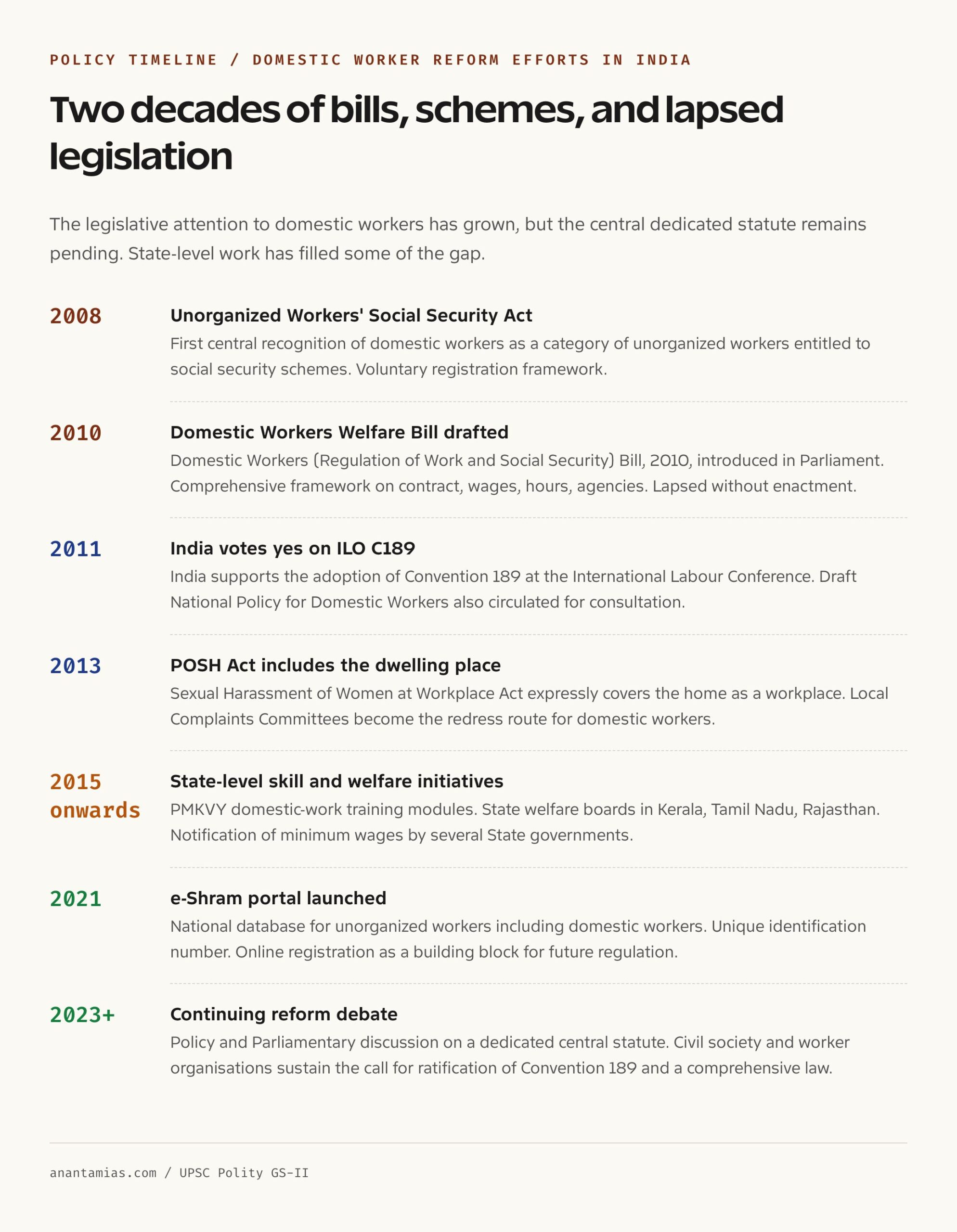
The proposed remedy is a dedicated central law on domestic workers. The international standard exists in the form of the International Labour Organization’s Convention 189 of 2011, which India voted in favour of but has not ratified. Successive draft Bills have been introduced in the Indian Parliament, including the Domestic Workers (Regulation of Work and Social Security) Bill, 2010, but none has reached the statute book. The legal vacuum sits uneasily with the constitutional commitment to dignified work under Article 21 and the Directive Principles in Articles 39 and 43.
This guide walks through the existing legal framework, the international standard set by ILO Convention 189, the specific gaps that a dedicated law would fill, the comparative experience of state-level minimum wage notifications, and the reform options that have been on the policy table for over a decade. The topic connects with the wider law on reservation in India when caste and gender intersect with domestic work, and with the constitutional jurisprudence on the directive principles and dignity under Article 21.
Quick Facts on Domestic Workers Law
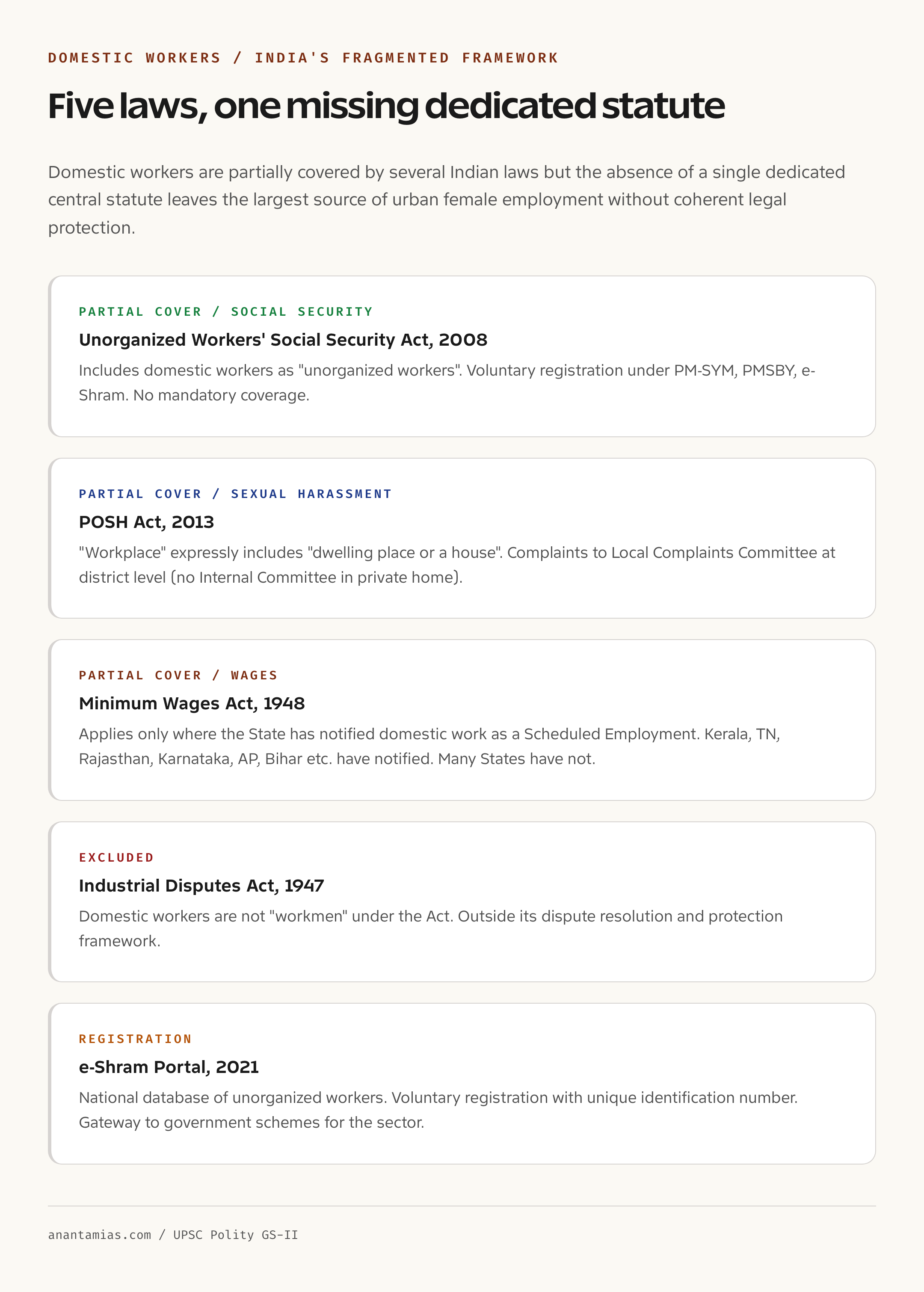
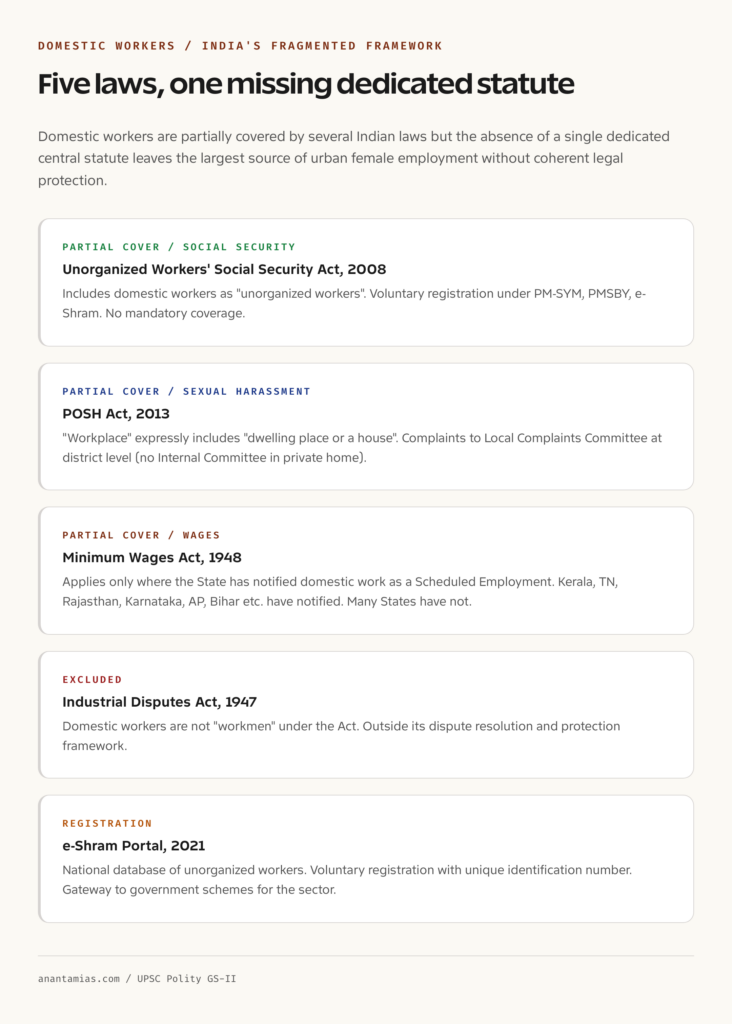
Domestic workers are partially covered under several Indian laws but lack a dedicated central statute. The Unorganized Workers’ Social Security Act, 2008, includes domestic workers in the definition of “unorganized workers” and entitles them to social security schemes such as PM-SYM. The Sexual Harassment of Women at Workplace (Prevention, Prohibition and Redressal) Act, 2013, includes “dwelling place or a house” in the definition of workplace; complaints by domestic workers go to the Local Complaints Committee at the district level. The Minimum Wages Act, 1948, applies only in states that have included domestic work in the Schedule of Employment, with implementation uneven across India. India is not covered by the Industrial Disputes Act, 1947, because domestic workers are excluded from the definition of “workmen.” India voted in favour of ILO Convention 189 in 2011 but has not ratified it. The Domestic Workers (Regulation of Work and Social Security) Bill, 2010, lapsed without enactment. India launched the e-Shram portal in 2021 to register unorganized workers including domestic workers.
What the Existing Framework Covers
The current Indian legal framework treats domestic work in a fragmented manner. The default position is that domestic workers are outside most of the standard labour statutes. The Industrial Disputes Act, 1947, the Factories Act, 1948, the Trade Unions Act, 1926, and the Employees’ State Insurance Act, 1948, do not apply to domestic workers because they are not “workmen” or are not employed in factories or industrial establishments. The exclusion is structural and reflects the historical understanding of labour law as governing industrial employment rather than household work.
Three statutes do partially apply. The Unorganized Workers’ Social Security Act, 2008, includes domestic workers in the definition of “unorganized workers” and entitles them to enrol in social security schemes. The benefits include access to schemes such as the Pradhan Mantri Shram Yogi Maandhan pension scheme, the Pradhan Mantri Suraksha Bima Yojana accidental insurance, and others. Enrolment is voluntary and depends on awareness and access. The e-Shram portal, launched in 2021, provides an online registration mechanism for unorganized workers including domestic workers, with a unique identification number and access to government schemes.
The Sexual Harassment of Women at Workplace Act, 2013, popularly called the POSH Act, explicitly includes “dwelling place or a house” in the definition of workplace. The inclusion was a deliberate response to the reality that domestic workers face harassment in their workplace and need a redress mechanism. Because a private household does not have an Internal Committee, complaints are filed with the Local Complaints Committee at the district level, presided over by a person nominated by the District Magistrate. The Local Complaints Committee investigates and recommends action.
The Minimum Wages Act, 1948, applies only where the State Government has notified domestic work as a Scheduled Employment. Several States, including Kerala, Tamil Nadu, Rajasthan, Karnataka, Andhra Pradesh, and Bihar, have notified minimum wages for domestic workers. Many other States have not. The fragmented coverage means that a domestic worker in Delhi may have a notified minimum wage while a worker in Madhya Pradesh may not, even though the work is identical.
Background and the Scale of the Sector
The exact size of the Indian domestic worker sector is contested. Government estimates put the number at around 4 to 5 million workers, while civil society organisations and the National Sample Survey Office have at various points estimated the sector at 10 to 20 million. The discrepancy reflects the difficulty of counting workers in private households. The sector is overwhelmingly female, with women estimated to constitute over 70 percent of the workforce. A significant proportion of workers come from Scheduled Caste, Scheduled Tribe, and Other Backward Class communities, and from migrant streams from rural areas.
The work is typically informal, with no written contract. Wages are negotiated individually between the worker and the employer household, often through a placement agency. Working hours are not fixed. Social security benefits, where available, depend on whether the worker has registered under the Unorganized Workers’ Social Security Act or e-Shram. Trade union organisation is limited but growing, with organisations like the National Domestic Workers’ Movement and the Self-Employed Women’s Association operating at scale.
Placement agencies are a particular source of concern. The agencies recruit workers, typically young women from rural districts, and place them in households in metropolitan cities. The recruitment can be exploitative, with high agency fees, deception about the nature and conditions of work, and limited or no contact between the worker and her family. In the worst cases, the agencies operate as fronts for trafficking. The lack of regulation of placement agencies is one of the strongest arguments for a dedicated central law.
ILO Convention 189: The International Standard
The ILO Convention concerning Decent Work for Domestic Workers, popularly known as Convention 189, was adopted in June 2011 at the International Labour Conference. The Convention is the first international instrument specifically dedicated to domestic workers. Its core principle is that domestic work is “work” and domestic workers are “workers” entitled to the same basic labour rights as other workers.
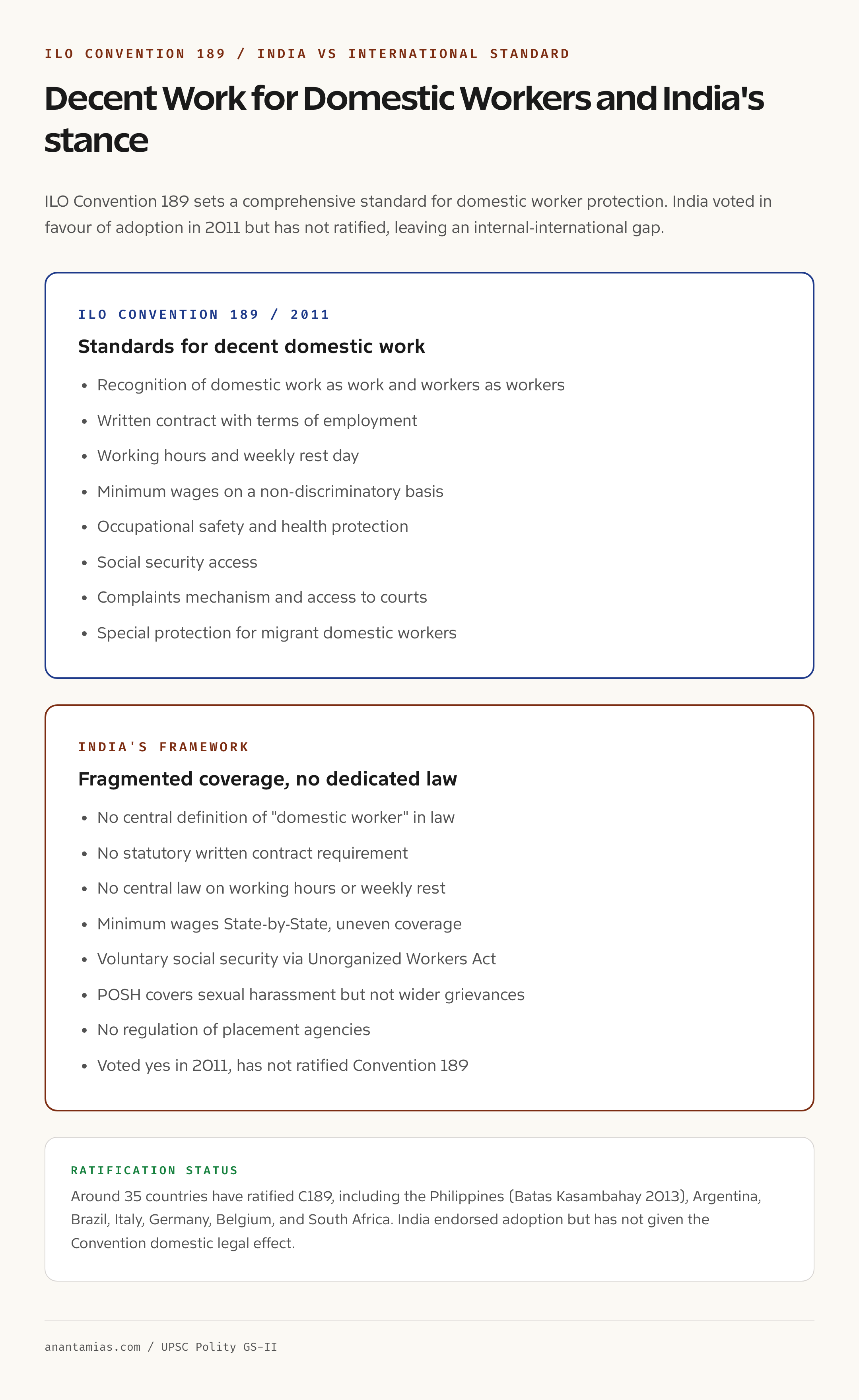
Convention 189 sets out a framework that covers the recognition of domestic work, written contracts of employment, fair terms of employment, working hours and weekly rest, minimum wages, occupational safety and health, social security, complaints and access to courts, and protection of migrant domestic workers. The accompanying Recommendation 201 elaborates on the Convention’s standards and offers guidance on implementation.
India voted in favour of the adoption of Convention 189 in June 2011. The vote at the International Labour Conference reflected the policy direction toward stronger protection for domestic workers. India has not, however, ratified the Convention. Ratification would obligate India to bring its domestic legal framework in conformity with the Convention’s standards. The Government’s position has been that India needs to first develop its own domestic framework before ratifying. The result is that India remains in a position of having endorsed the Convention internationally without giving it domestic legal effect.
As of recent years, around 35 countries have ratified Convention 189, including the Philippines, Argentina, Brazil, Italy, Germany, Belgium, and South Africa. The ratifying countries have introduced specific domestic worker statutes that align with the Convention. India is among the major sending and receiving countries that has not yet ratified.
Why It Matters
The case for a dedicated law rests on three foundations. The first is the constitutional commitment to dignity at work. Article 21 has been interpreted to include a right to live with dignity. The Directive Principles in Articles 39 and 43 commit the State to securing decent conditions of work, a living wage, and a decent standard of life for workers. The fragmented coverage of domestic workers under existing laws is inconsistent with this constitutional vision.
The second foundation is the labour economics of an enormous and growing sector. Urban India’s middle class is expanding, and the demand for paid domestic work is rising. A regulatory regime that does not keep pace with the size of the sector creates a permanent informal layer of the labour market that is shielded from the wage and welfare protections enjoyed by other workers. The economic case for regulation is strengthened by the gendered composition of the sector: legal protection for domestic workers is, in practical terms, legal protection for a large segment of working women.
The third foundation is the social cost of unregulated work. The most extreme cases of abuse, trafficking, and modern slavery in the domestic worker sector arise precisely because the sector is invisible to the formal labour law machinery. A dedicated law that requires registration of placement agencies, written contracts, and a redress mechanism would not eliminate the worst abuses but would reduce the space in which they can occur.
Detailed Analysis: What a Dedicated Law Would Cover
A dedicated central law on domestic workers, modelled on Convention 189 and the various draft Bills that have circulated since 2010, would cover several elements. The first is the legal definition of a domestic worker, including live-in workers, part-time workers, multiple-employer workers, and migrant workers. The definition determines who falls within the law’s protection.
The second element is the working conditions framework. This includes a maximum number of working hours per week, a minimum weekly rest day, paid annual leave, and protection against arbitrary dismissal. The framework would require a written contract or letter of appointment that records the basic terms of employment.
The third element is the wage framework. The law would extend the Minimum Wages Act framework uniformly across the country, removing the State-by-State unevenness. It would also address the practical question of how minimum wages are calculated in a sector where the worker is paid in cash and may receive in-kind benefits like food and lodging.
The fourth element is the social security framework. The law would build on the Unorganized Workers’ Social Security Act and the e-Shram portal but would ensure mandatory rather than voluntary registration. The contributions could be shared between the worker, the employer household, and the State, with simplified payment mechanisms suitable for individual employers.
The fifth element is the regulation of placement agencies. Agencies would require registration, would be subject to fee caps, and would be prohibited from holding the worker’s identity documents. The agency would be jointly liable for any breach of contract by the household employer. Enforcement would lie with the State Labour Department.
The sixth element is the redress mechanism. The Local Complaints Committee under the POSH Act would be retained for sexual harassment complaints. A Domestic Workers’ Welfare Board, with worker, employer, and government representatives, would handle complaints on wages, working conditions, and contract terms.
Comparative Look: State-Level Initiatives
Several Indian states have moved ahead of the central legislative process. Kerala has had domestic workers’ welfare boards and minimum wage notifications for many years. Tamil Nadu has notified minimum wages and has organised registration of domestic workers under the Manual Workers (Regulation of Employment and Conditions of Work) Act. Rajasthan has notified minimum wages and has constituted welfare boards. Karnataka, Maharashtra, and Andhra Pradesh have similar structures with varying levels of implementation.
The state-level experience offers two lessons. The first is that minimum wage notification by itself is not enough. Without a registration system, employer awareness, and an enforcement mechanism, the notified wage remains aspirational. The second lesson is that welfare board models work better when they are funded through a small employer contribution rather than from State budget alone, because the contribution creates a registry of employers and a continuous funding stream.
The international comparative material is also instructive. The Philippines enacted the Batas Kasambahay (Domestic Workers Act) in 2013, after ratifying ILO Convention 189. The Act provides a written contract, minimum wage, weekly rest, social security, and a complaints mechanism. South Africa has similar provisions under its sectoral determinations for domestic work. The implementation experience in both countries shows that legal coverage is necessary but must be accompanied by registration, awareness, and accessible redress.
Challenges and Reform Options
Three challenges complicate the path to a dedicated central law. The first is federal. Labour is in the Concurrent List, and a central law would interact with the existing State-level framework. A federal design that builds on rather than overrides the State framework is essential.
The second challenge is enforceability. A law that requires written contracts and minimum wages must be enforceable in millions of private households. Traditional labour inspection cannot operate at that scale. The reform proposals therefore lean on registration through the e-Shram portal, on welfare boards that can enforce by holding employer contributions, and on grievance mechanisms accessible to workers.
The third challenge is political. The employer constituency is the urban middle class, which is politically influential. Reforms that impose contributions and contractual obligations on private households face quiet resistance. The successful reform proposals in other countries have built a coalition of worker organisations, women’s rights groups, and civil society to push the agenda forward over multiple legislative cycles.
Prelims Pointers
There is no dedicated central law for domestic workers in India. Partial coverage exists under the Unorganized Workers’ Social Security Act, 2008, the POSH Act, 2013 (which includes “dwelling place or a house” in workplace), and the Minimum Wages Act, 1948 (where the State has notified domestic work as a Scheduled Employment). Domestic workers are excluded from the definition of “workmen” under the Industrial Disputes Act, 1947. India voted in favour of ILO Convention 189 in 2011 but has not ratified. The Domestic Workers (Regulation of Work and Social Security) Bill, 2010, lapsed. The e-Shram portal, launched in 2021, registers unorganized workers including domestic workers. Complaints by domestic workers under POSH go to the Local Complaints Committee at the district level.
A common trap statement: “India has ratified ILO Convention 189.” This is incorrect. India voted in favour of the Convention’s adoption but has not ratified. Another trap: “Domestic workers cannot file sexual harassment complaints because they work in private households.” This is incorrect. The POSH Act explicitly includes dwelling place in the workplace definition, and complaints go to the Local Complaints Committee.
Mains Practice Questions
- The case for a dedicated central law on domestic workers in India rests on constitutional, economic, and social grounds. Discuss with reference to the existing framework and ILO Convention 189. (GS Paper 2, 250 words)
- Examine the partial coverage of domestic workers under the Unorganized Workers’ Social Security Act, 2008, the POSH Act, 2013, and the Minimum Wages Act, 1948. What gaps remain? (GS Paper 2, 150 words)
- India voted in favour of ILO Convention 189 but has not ratified it. Examine the policy reasons for this position and the consequences for domestic workers’ rights in India. (GS Paper 2, 150 words)
- The regulation of placement agencies is a critical element of any reform of the domestic worker sector. Discuss with reference to the trafficking risks and proposed reform models. (GS Paper 2, 250 words)
Way Forward
A dedicated central law on domestic workers would build on the partial coverage already in place rather than replace it. The most credible reform pathway combines four elements. The first is a central enabling statute that sets minimum standards on working hours, weekly rest, written contracts, and social security. The second is mandatory registration through the e-Shram portal, with employer registration triggered by tax filings. The third is mandatory employer contribution to a welfare board that funds social security and a grievance mechanism. The fourth is the registration and regulation of placement agencies, with statutory fee caps and prohibition on retention of identity documents.
For UPSC aspirants, the topic offers a useful integration of constitutional law, labour law, gender studies, and international labour standards. The connection with the directive principles, the dignity jurisprudence under Article 21, and the broader politics of tribal issues in India and inter-State migration makes the topic a high-yield area for both Prelims and Mains.
Frequently Asked Questions
Is there a dedicated central law for domestic workers in India?
No. India does not have a dedicated central statute for domestic workers. The sector is partially covered by the Unorganized Workers’ Social Security Act, 2008, the POSH Act, 2013, and the Minimum Wages Act, 1948 (where the State has notified domestic work as a Scheduled Employment). The Domestic Workers (Regulation of Work and Social Security) Bill, 2010, was introduced but lapsed without enactment.
Are domestic workers covered by the Industrial Disputes Act, 1947?
No. Domestic workers are not u0022workmenu0022 within the meaning of the Industrial Disputes Act and are therefore outside its protection. The exclusion reflects the historical understanding of labour law as covering industrial rather than household employment.
Does the POSH Act cover sexual harassment of domestic workers?
Yes. The Sexual Harassment of Women at Workplace (Prevention, Prohibition and Redressal) Act, 2013, explicitly includes u0022dwelling place or a houseu0022 in the definition of workplace. Domestic workers can file complaints with the Local Complaints Committee at the district level, which is the relevant mechanism because a private household does not have an Internal Committee.
Has India ratified ILO Convention 189?
No. India voted in favour of the adoption of ILO Convention 189 at the International Labour Conference in 2011, but has not ratified the Convention. Ratification would obligate India to bring its domestic framework in conformity with the Convention’s standards.
What is ILO Convention 189?
ILO Convention 189 is the Convention concerning Decent Work for Domestic Workers, adopted in 2011. It is the first international instrument specifically dedicated to domestic workers. The Convention’s core principle is that domestic work is work and domestic workers are workers entitled to the same basic rights as other workers, including written contracts, working hours regulation, weekly rest, minimum wages, social security, and access to grievance mechanisms.
What is the e-Shram portal?
The e-Shram portal, launched in 2021 by the Ministry of Labour and Employment, is a national database of unorganized workers, including domestic workers. Workers register on the portal and receive a unique identification number, which gives access to government schemes for unorganized workers. Registration is voluntary at present.
Why is the regulation of placement agencies important for domestic workers?
Placement agencies recruit workers, often young women from rural districts, and place them in households in metropolitan cities. The recruitment can be exploitative, with high agency fees, deception about the nature and conditions of work, and in the worst cases, trafficking. Regulation of placement agencies, including registration, fee caps, and a prohibition on retention of identity documents, is therefore a critical element of reform.
Which Indian States have notified minimum wages for domestic workers?
Several States have notified minimum wages for domestic work, including Kerala, Tamil Nadu, Rajasthan, Karnataka, Andhra Pradesh, and Bihar, among others. The coverage is uneven across India. Many States have not yet notified domestic work as a Scheduled Employment under the Minimum Wages Act.
What would a dedicated domestic workers’ law cover?
A dedicated law, modelled on ILO Convention 189 and the draft Indian Bills, would cover the legal definition of a domestic worker, working hours and weekly rest, written contracts, minimum wages, social security, regulation of placement agencies, and a grievance mechanism. The implementation framework would build on the e-Shram portal and welfare board models that some States already operate.
How do welfare boards for domestic workers operate where they exist?
Welfare boards in States like Kerala and Tamil Nadu register workers and employers, collect contributions, and disburse benefits such as accidental insurance, maternity benefits, and pension. The boards typically include worker representatives, employer representatives, and government officials. The funding model often combines a small employer contribution with State support, which keeps the board solvent and creates a continuous registry of the workforce.
Tell Google you want more of this.
Add Anantam IAS as a preferred sourceOne tap, and this site shows up more often in your own Top Stories, AI Overviews and AI Mode. Remove it any time.