India is trying to subsidise manufacturing output while taxing the inputs that manufacturing requires. That is the central tension in the country’s new industrial policy instruments, and no amount of incentive design resolves it, because the two policies are pulling in opposite directions.
The Government has increasingly relied on industrial policy interventions to promote domestic manufacturing, increase value addition and reduce import dependence. The instruments themselves are well constructed. Their interaction with trade policy is not.
The Main Instruments
Production Linked Incentive scheme. Provides an incentive of roughly 4 to 6 percent on incremental sales over a base year in eligible sectors. It aims to attract investment and expand manufacturing capacity. The important design feature is that it rewards output, not investment, so a firm that builds a plant and does not sell receives nothing.
Design Linked Incentive scheme. Promotes indigenous semiconductor design, with financial support of up to 50 percent of eligible expenditure subject to a cap, plus a 4 to 6 percent incentive on net sales of designed chips. It complements the India Semiconductor Mission by strengthening the design end of the ecosystem, which is the part that requires talent rather than capital.
Tariff protection. Applied increasingly across intermediate and final goods to shelter domestic producers.
Where the Instruments Work Against Each Other
Industrial policy under PLI is not aligned with trade policy. High tariffs on intermediate goods increase production costs and reduce the competitiveness of domestic manufacturers.
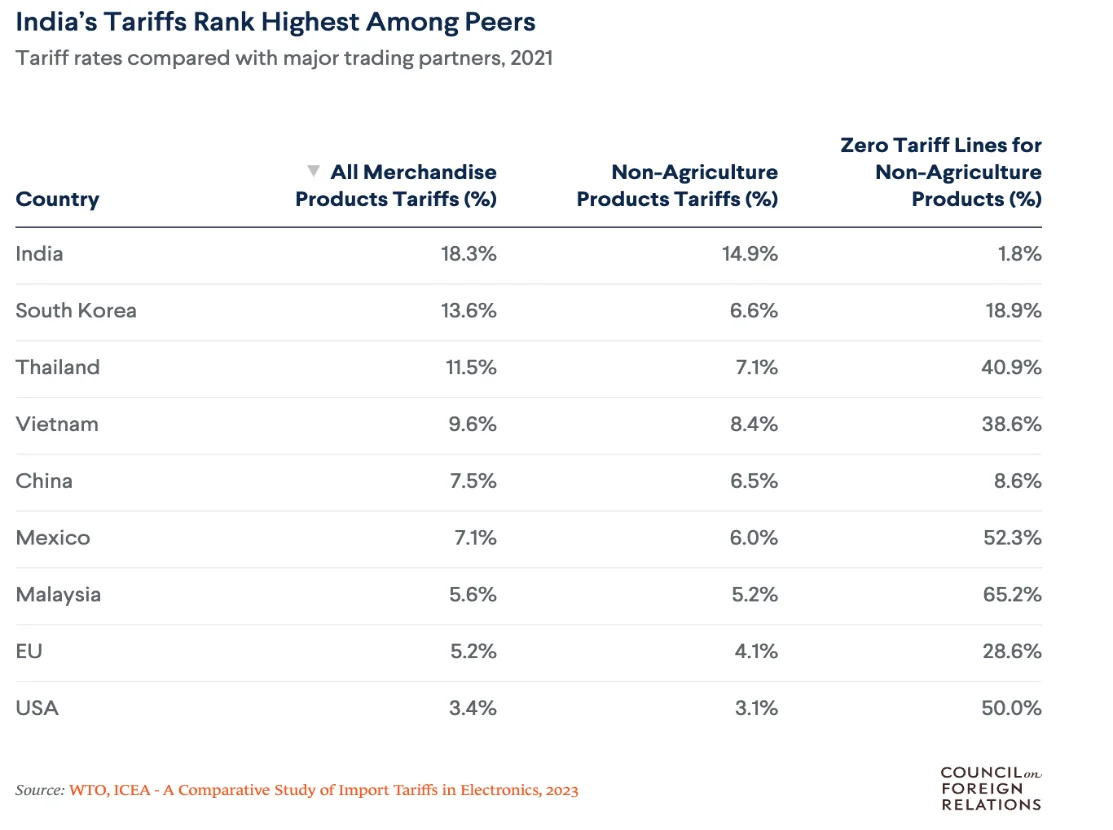
The numbers make the point. WTO data show India’s average industrial import tariff rising from 9.7 percent in 2014 to 14.7 percent in 2022. Simple average tariff on all merchandise stands at about 18.3 percent, non-agriculture tariffs at about 14.9 percent, and only about 1.8 percent of non-agriculture tariff lines carry zero duty.
The comparison with peers is unflattering.
- South Korea: non-agriculture tariffs about 6.6 percent, zero-duty lines about 18.9 percent
- Thailand: about 7.1 percent, with about 40.9 percent zero-duty lines
- Vietnam: about 8.4 percent, with about 38.6 percent zero-duty lines
- Mexico: about 6.0 percent, with about 52.3 percent zero-duty lines
- Malaysia: about 5.2 percent, with about 65.2 percent zero-duty lines
Every economy India competes with for relocated manufacturing capacity imports its components more cheaply than India does. A subsidy of 4 to 6 percent on incremental sales does not offset a structurally higher input cost.
Stricter rules of origin under free trade agreements add a second layer, raising compliance and documentation costs for manufacturers with globally sourced inputs.
The Design Risks Within PLI Itself
Rent-seeking and subsidy dependence. Firm-specific incentives can push firms to optimise for eligibility conditions rather than for productivity, innovation and technological upgradation. Sustained dependence on subsidy weakens the market discipline that was supposed to follow from the investment.
One-size-fits-all design. Sectors face different binding constraints. Electronics needs research and technology support. Labour-intensive industries need skilling and export facilitation. A production incentive addresses none of those directly; it addresses volume, and volume is not always the constraint.
Base year gaming. Any incremental-sales scheme creates an incentive to manage the base year, which is a general problem with output-linked support.
The Honest Assessment
PLI has genuinely moved capacity in mobile phone assembly and pharmaceuticals, and the design of an output-linked incentive is better than the capital subsidies that preceded it, because it pays only for results.
But assembly is not the same as value addition. High import tariffs on components, combined with an incentive on final sales, produce exactly the outcome that structure rewards: import the parts, assemble locally, claim the incentive. Deepening the value chain requires the opposite tariff structure, low duties on inputs, and that has not happened.
The Way Forward
- Align trade policy with industrial policy. Reduce duties on intermediate and capital goods that domestic industry does not produce competitively.
- Publish sunset clauses. Every incentive should carry a defined withdrawal path, so that dependence is not an option.
- Differentiate instruments by sector. Research support for electronics and deep tech, skilling and logistics support for labour-intensive sectors, rather than a single production incentive everywhere.
- Measure value addition, not output. The metric should be domestic content share, since that is the actual policy objective.
- Simplify rules of origin compliance, which currently penalises the firms most integrated into global supply chains.
The instruments are not the problem. The contradiction between them is.
Frequently Asked Questions
What are the main new industrial policy instruments in India?
The Production Linked Incentive scheme, the Design Linked Incentive scheme for semiconductors, tariff protection, industrial corridors and cluster development, and public procurement preference. They are used together to promote domestic manufacturing, increase value addition and reduce import dependence.
How does the Production Linked Incentive scheme work?
PLI provides an incentive of about 4 to 6 percent on incremental sales over a base year for eligible sectors and eligible firms. It rewards output rather than investment, which means a firm only receives support if it actually produces and sells more.
What is the Design Linked Incentive scheme?
DLI promotes indigenous semiconductor design. It provides financial support of up to 50 percent of eligible expenditure, subject to a cap, along with a 4 to 6 percent incentive on net sales of designed chips. It complements the India Semiconductor Mission by strengthening the design end of the ecosystem rather than only fabrication.
What is the tariff contradiction in Indian industrial policy?
Industrial policy under PLI is not fully aligned with trade policy. High tariffs on intermediate goods raise production costs and reduce the competitiveness of domestic manufacturers. WTO data show India’s average industrial import tariff rising from 9.7 percent in 2014 to 14.7 percent in 2022, so the state subsidises output while taxing the inputs required to produce it.
How do India’s tariffs compare with peer economies?
India’s simple average tariff on all merchandise was about 18.3 percent, with non-agriculture tariffs about 14.9 percent and only about 1.8 percent of non-agriculture tariff lines at zero. South Korea, Vietnam, Thailand, Mexico and Malaysia all have lower non-agriculture tariffs and vastly higher shares of zero-duty lines.
What is the rent-seeking risk in firm-specific incentives?
Firm-specific incentives can encourage firms to optimise for meeting eligibility conditions rather than for productivity, innovation and technological upgradation. Continued dependence on subsidy can weaken market-driven efficiency, so the design question is how support is withdrawn, not only how it is granted.
Why is a one-size-fits-all incentive design a problem?
Because sectors have different binding constraints. Electronics needs research and technology support; labour-intensive industries need skilling and export facilitation. Production incentives alone cannot address bottlenecks that are not about the volume of output.
How do rules of origin affect manufacturers?
Stricter rules of origin under free trade agreements require manufacturers to demonstrate a minimum level of domestic value addition to claim preferential tariff treatment. This raises compliance and documentation costs, particularly for firms with globally sourced components.
Practice Questions
Prelims MCQs
- The Production Linked Incentive scheme provides an incentive of approximately
(a) 1 to 2 percent on total sales
(b) 4 to 6 percent on incremental sales over a base year
(c) 10 percent on capital investment
(d) 20 percent on export earnings
Answer: (b) PLI rewards incremental sales over a base year at roughly 4 to 6 percent, making it an output-linked rather than investment-linked subsidy. - The Design Linked Incentive scheme is associated with
(a) Textile design
(b) Semiconductor design
(c) Automobile styling
(d) Pharmaceutical formulation
Answer: (b) DLI supports indigenous semiconductor design and complements the India Semiconductor Mission. - According to WTO data cited in policy discussion, India's average industrial import tariff moved from 9.7 percent in 2014 to
(a) 8.2 percent in 2022
(b) 11.1 percent in 2022
(c) 14.7 percent in 2022
(d) 21.5 percent in 2022
Answer: (c) The rise to 14.7 percent is the basis of the argument that trade policy is working against industrial policy. - The share of zero-duty non-agriculture tariff lines in India is approximately
(a) 1.8 percent
(b) 18.9 percent
(c) 38.6 percent
(d) 65.2 percent
Answer: (a) India's roughly 1.8 percent contrasts sharply with Malaysia at about 65 percent and Mexico at about 52 percent. - Rules of origin under free trade agreements primarily determine
(a) The tariff rate applicable to all imports
(b) Whether a good qualifies for preferential treatment based on domestic value addition
(c) The currency of invoicing
(d) The port of entry
Answer: (b) They establish the domestic value addition needed to claim preferential tariff treatment under an FTA.
Mains Questions
- Industrial policy and trade policy in India are working against each other. Critically examine with reference to PLI and tariff structure. (250 words)
- Evaluate the Production Linked Incentive scheme as an instrument of industrial policy. What determines whether such schemes succeed? (250 words)
- Sector-specific bottlenecks cannot be addressed by a uniform production incentive. Discuss. (150 words)
- Discuss the risk of subsidy dependence in firm-specific industrial incentives, and suggest safeguards. (150 words)
- High tariffs on intermediate goods are a tax on domestic manufacturing. Examine this proposition in the Indian context. (250 words)
Tell Google you want more of this.
Add Anantam IAS as a preferred sourceOne tap, and this site shows up more often in your own Top Stories, AI Overviews and AI Mode. Remove it any time.