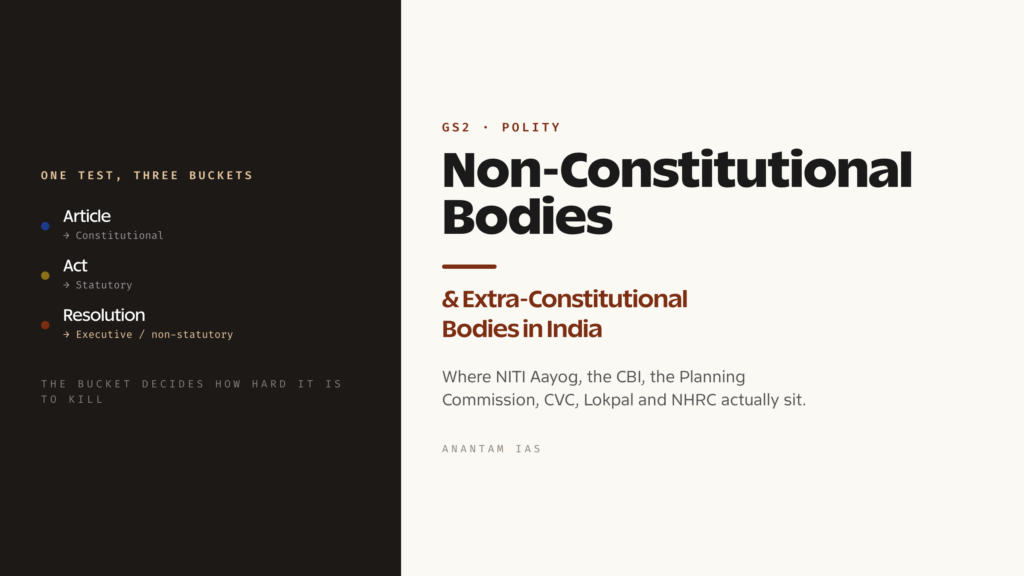
Ask ten aspirants whether NITI Aayog is a constitutional, statutory, or non-constitutional body, and you’ll get three confident answers and a lot of hedging. The truth is that NITI Aayog has no Article and no Act behind it. It exists because the Union Cabinet passed a resolution on 1 January 2015. That single fact puts it in a category most polity books mention in passing and then never explain properly.
This is the article that explains it properly. The word “non-constitutional” trips people up because UPSC uses it in two different senses, and the bodies that sit in this space (NITI Aayog, the CBI, the old Planning Commission, the National Development Council) are exactly the ones that keep showing up in Prelims and Mains. Get the classification straight once, and a whole cluster of polity questions stops being a guessing game.
What “Non-Constitutional” and “Extra-Constitutional” Actually Mean
A non-constitutional body is simply any body that the Constitution does not create. That’s the umbrella term, and it’s wider than most people assume. It covers two very different kinds of bodies: those born from an Act of Parliament (statutory) and those born from a government order with no statute at all (extra-constitutional or non-statutory).
So when a question says “non-constitutional,” it usually means “not in the Constitution,” which technically includes the National Human Rights Commission (a statutory body) as much as it includes NITI Aayog (a pure executive creation). The narrower phrase “extra-constitutional” or “non-statutory” points only to the second group: bodies set up by an executive resolution or a Cabinet decision, with no founding law. That’s the whole confusion in one sentence. “Non-constitutional” is the big tent; “extra-constitutional / non-statutory” is the inner room.
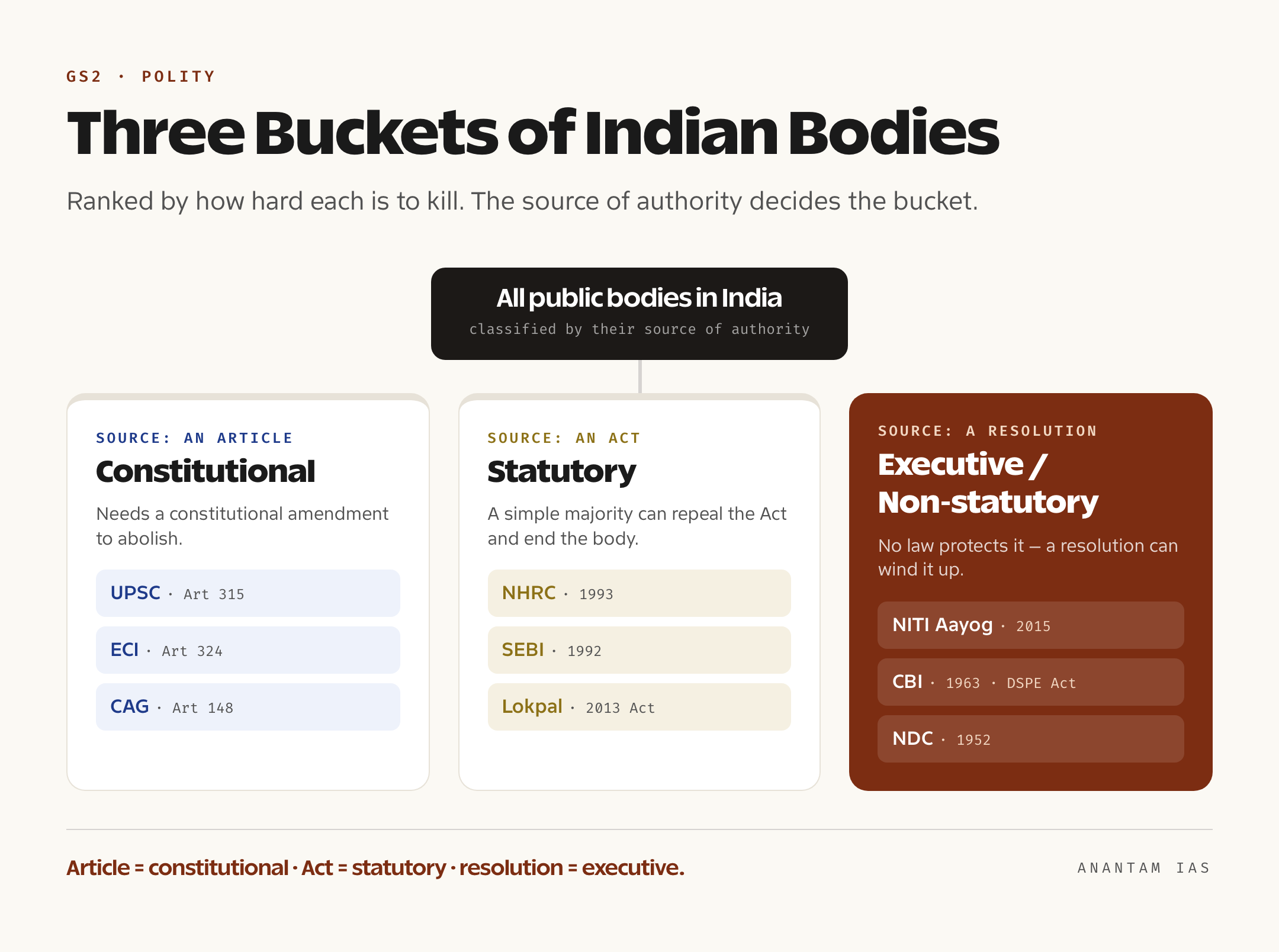
Here’s the cleanest way to hold it. There are really three buckets, ranked by how hard they are to kill:
- Constitutional body: written into the Constitution. You need a constitutional amendment to abolish it. Example: the Election Commission (Article 324).
- Statutory body: created by an ordinary Act of Parliament. A simple majority can repeal that Act and the body vanishes. Example: the National Green Tribunal (NGT Act, 2010).
- Executive / non-statutory body: created by a Cabinet resolution, executive order, or notification. No law protects it, so the government of the day can wind it up with another resolution. Example: NITI Aayog.
If you want the contrast spelled out body by body, our explainer on statutory and constitutional bodies in India lays out the first two buckets in detail, and the full list of constitutional bodies covers everything the Constitution itself sets up. This article deliberately lives in the third bucket and the grey zones around it.
Constitutional Bodies: The Baseline You’re Contrasting Against
Constitutional bodies are the ones the Constitution names directly, with their composition and powers fixed in specific Articles. You can’t touch them without amending the Constitution, which is why they sit at the top of the hierarchy.
You only need these briefly here, because the contrast is what matters. The core list: the Union Public Service Commission (Article 315), the Election Commission of India (Article 324), the Comptroller and Auditor General (Article 148), the Finance Commission (Article 280), the Attorney General of India (Article 76), the National Commission for Scheduled Castes (Article 338) and the National Commission for Scheduled Tribes (Article 338A), and the newest entrant, the GST Council (Article 279A, added by the 101st Constitutional Amendment, 2016). The National Commission for Backward Classes is a useful one to remember because it climbed the ladder: it was statutory until the 102nd Amendment, 2018 made it constitutional under Article 338B. That migration is a favourite Prelims trap.
The defining test for this bucket is single and clean. If the body’s authority flows from an Article, it’s constitutional. Nothing in the lower buckets passes that test.
Non-Constitutional and Extra-Constitutional Bodies: The Core of This Article
This is the bucket aspirants get wrong, so slow down here. An extra-constitutional or non-statutory body is one created purely by executive action, a Cabinet resolution or a government notification, with no Constitution and no Act behind it. It can be created overnight and dissolved overnight, which is precisely what makes it both flexible and fragile.
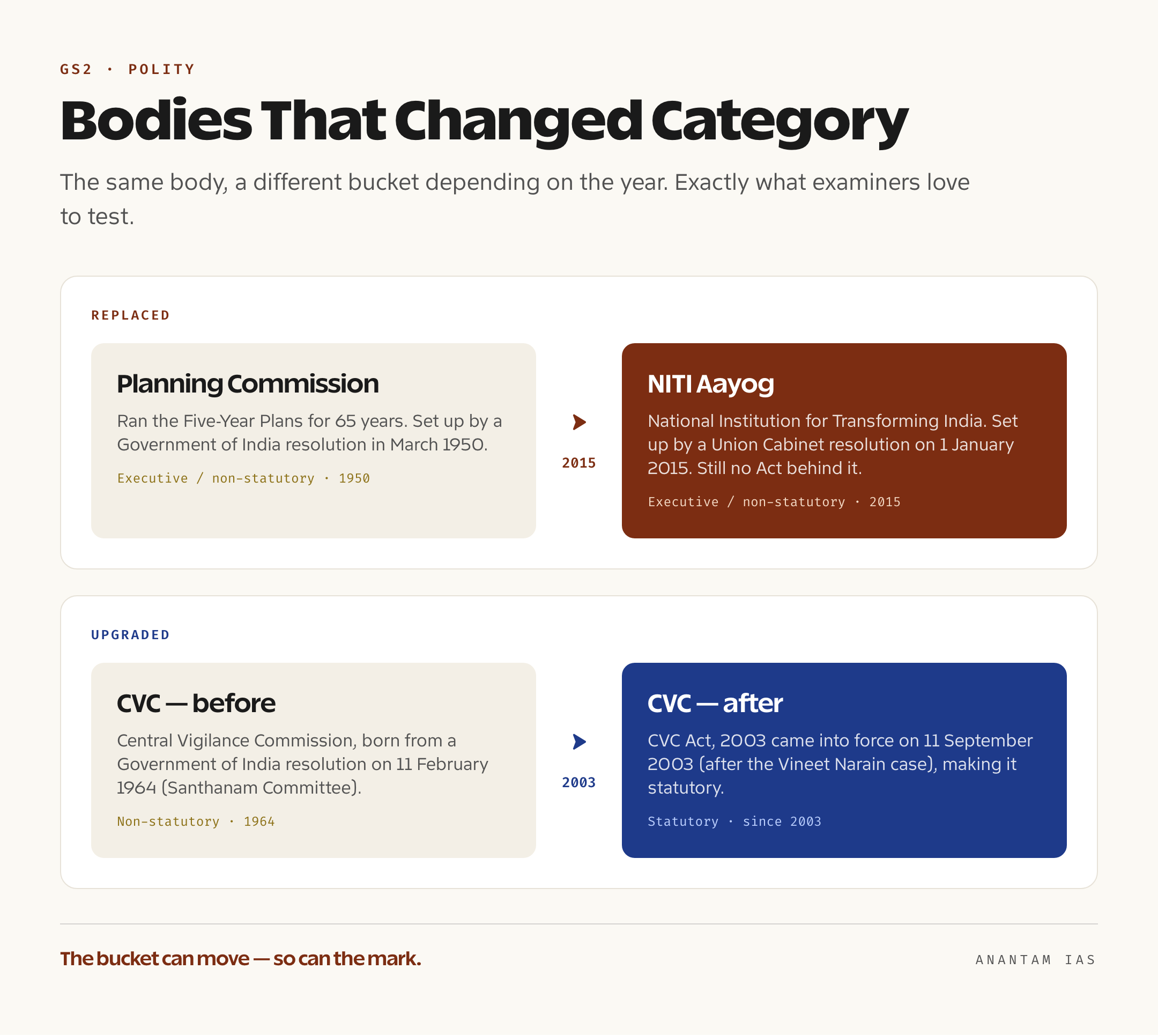
NITI Aayog is the textbook case. The National Institution for Transforming India was set up by a Union Cabinet resolution on 1 January 2015, replacing the Planning Commission. There’s no NITI Aayog Act. It’s a policy think tank for the Government of India that promotes cooperative federalism, and because it rests only on a resolution, a future government could replace it the same way it was born. When a question asks for a body that is “neither constitutional nor statutory,” NITI Aayog is the answer they’re fishing for.
The Planning Commission, NITI Aayog’s predecessor, was the same kind of creature. It was set up by a Government of India resolution in March 1950 and ran the Five-Year Plans for 65 years. It was never created by law, which is exactly why the government could scrap it in 2014 without going to Parliament. The closely linked National Development Council (NDC), set up by an executive resolution in 1952 to bring the Centre and states together over the Plans, is also a non-statutory body for the same reason.
Now the body everyone argues about: the Central Bureau of Investigation (CBI). The CBI is commonly grouped under non-constitutional investigative bodies, and you’ll see it listed that way in many sources, but you have to state the nuance correctly or you’ll lose the mark. The CBI itself was set up by a Government of India resolution dated 1 April 1963, not by a statute. But it does its work, every search, every arrest, every chargesheet, under the Delhi Special Police Establishment Act, 1946. So the precise position is this: the CBI is not a creation of the Constitution, and as an organisation it was constituted by an executive resolution, yet it derives its police powers and legal teeth from a statute, the DSPE Act. That’s why careful answers call the CBI a non-constitutional body that draws its authority from the DSPE Act, rather than flatly calling it “statutory” or “non-statutory.” If you want the deeper structure and the autonomy debate, our CBI explainer goes into the consent provisions and the “caged parrot” controversy.
The Central Vigilance Commission (CVC) is the cleanest example of a body that changed category, so memorise the before-and-after. The CVC began life as a non-statutory body, born from a Government of India resolution on 11 February 1964, on the recommendation of the Santhanam Committee. It stayed non-statutory for nearly four decades. Then, following the Supreme Court’s directions in the Vineet Narain case (1997) on the Hawala scandal, Parliament enacted the Central Vigilance Commission Act, 2003, which came into force on 11 September 2003 and made the CVC a statutory body. So the CVC is the rare institution you can correctly slot into two different buckets depending on the year: non-statutory before 2003, statutory after.
Two more bodies people wrongly lump in with the “extra-constitutional” crowd, when they’re actually statutory. The Lokpal is a statutory anti-corruption ombudsman created by the Lokpal and Lokayuktas Act, 2013, which came into force on 16 January 2014, so it has a clear founding law and is not extra-constitutional. The National Human Rights Commission (NHRC) is statutory too, set up under the Protection of Human Rights Act, 1993. Both are non-constitutional in the wide sense (not in the Constitution) but firmly statutory, not non-statutory. Getting this distinction right is the entire skill the topic is testing. Our NHRC guide and the National Green Tribunal explainer sit squarely in the statutory bucket if you want clean examples to anchor that side.
The Master Table: Body, Type, Created By, Year
This table is the spine of the topic. The trick examiners use is mixing bodies from all three buckets in a single “match the following” or “how many are non-constitutional” question, so train your eye on the Type column. Read it across, not down.
| Body | Type | Created by | Year |
|---|---|---|---|
| Election Commission of India | Constitutional | Article 324 | 1950 |
| UPSC | Constitutional | Article 315 | 1926 (as PSC) / 1950 |
| Comptroller and Auditor General | Constitutional | Article 148 | 1950 |
| Finance Commission | Constitutional | Article 280 | 1951 (first) |
| GST Council | Constitutional | Article 279A (101st Amendment) | 2016 |
| National Human Rights Commission | Statutory | Protection of Human Rights Act | 1993 |
| Central Information Commission | Statutory | Right to Information Act | 2005 |
| National Green Tribunal | Statutory | NGT Act | 2010 |
| Lokpal | Statutory | Lokpal and Lokayuktas Act, 2013 | 2014 (in force) |
| SEBI | Statutory | SEBI Act | 1992 |
| Reserve Bank of India | Statutory | RBI Act | 1934 |
| Central Vigilance Commission | Statutory (since 2003); non-statutory before | Resolution 1964, then CVC Act 2003 | 1964 / 2003 |
| Central Bureau of Investigation | Non-constitutional; powers from DSPE Act, 1946 | Govt resolution; operates under DSPE Act | 1963 |
| NITI Aayog | Executive / non-statutory | Union Cabinet resolution | 2015 |
| Planning Commission (former) | Executive / non-statutory | Government of India resolution | 1950 |
| National Development Council | Executive / non-statutory | Executive resolution | 1952 |
One quick clarification on the SEBI and RBI rows, because aspirants ask. These are statutory regulators, not extra-constitutional bodies. People sometimes file them under “non-constitutional” loosely, and that’s fine in the wide sense, but they each have a founding Act, so they belong with the statutory crowd. If regulators are your weak spot, the breakdown in our statutory and constitutional bodies overview handles them alongside the rest.
How to Study This for UPSC
Start with the three-bucket test, not with memorising lists. Before you try to recall a single name, lock in the rule: Article means constitutional, Act means statutory, resolution or order means executive / non-statutory. Once that filter is automatic, the lists fill themselves in.
For Prelims, this topic is pure factual recall and it rewards precision. Drill the master table above until you can place any body in its bucket in two seconds. Pay special attention to the three classic traps: NITI Aayog and the Planning Commission being non-statutory, the CVC switching to statutory in 2003, and NCBC switching to constitutional in 2018. Examiners love “how many of the following are non-constitutional bodies” questions, and those are designed to punish the half-learnt. Read your standard polity source (Laxmikanth’s chapters on non-constitutional bodies) once for context, then live in the table.
For Mains, the same facts become an argument. The non-statutory nature of NITI Aayog and the CBI is the launchpad for GS2 questions on institutional autonomy, accountability, and the demand to give the CBI statutory backing. So learn the legal basis not as trivia but as the reason these bodies are seen as vulnerable to executive control. What you can safely skip: the year-by-year administrative history of each body. Nobody is testing the exact date of the Santhanam Committee report; they’re testing whether you know the CVC went statutory in 2003 and why that mattered.
Frequently Asked Questions
Is NITI Aayog a constitutional, statutory or non-constitutional body? NITI Aayog is a non-constitutional and non-statutory body. It was created by a Union Cabinet resolution on 1 January 2015, with no Article of the Constitution and no Act of Parliament behind it, which is why it can be reconstituted or replaced by another executive decision.
Is the CBI a statutory or non-statutory body? The CBI is best described as a non-constitutional body that was set up by a Government of India resolution in 1963 and derives its police powers from the Delhi Special Police Establishment Act, 1946. So it isn’t a creation of the Constitution, but it does function under a statute, which is why a flat “statutory” or “non-statutory” label misses the nuance.
What is the difference between non-constitutional and extra-constitutional bodies? “Non-constitutional” is the umbrella term for any body not created by the Constitution, and it includes both statutory bodies and executive ones. “Extra-constitutional,” used interchangeably with “non-statutory,” refers only to bodies created by executive resolution or order with no founding Act, such as NITI Aayog and the National Development Council.
When did the Central Vigilance Commission become a statutory body? The CVC started as a non-statutory body created by a resolution in 1964 and became a statutory body when the Central Vigilance Commission Act, 2003 came into force on 11 September 2003, following the Supreme Court’s directions in the Vineet Narain case.
Are the Lokpal and NHRC non-constitutional bodies? Yes, in the wide sense, because neither is named in the Constitution. But both are statutory: the Lokpal under the Lokpal and Lokayuktas Act, 2013 and the NHRC under the Protection of Human Rights Act, 1993. They are non-constitutional but not extra-constitutional.
Practice Questions
Prelims MCQs
- Which of the following bodies is neither a constitutional nor a statutory body? (a) National Human Rights Commission (b) NITI Aayog (c) Central Information Commission (d) National Green Tribunal Answer: (b) NITI Aayog was created by a Union Cabinet resolution in 2015, with no Article or Act behind it.
- The Central Vigilance Commission was given statutory status by which legislation? (a) Prevention of Corruption Act, 1988 (b) Lokpal and Lokayuktas Act, 2013 (c) Central Vigilance Commission Act, 2003 (d) Delhi Special Police Establishment Act, 1946 Answer: (c) The CVC Act, 2003 came into force on 11 September 2003 and converted the 1964 non-statutory body into a statutory one.
- The Central Bureau of Investigation derives its powers to investigate primarily from which of the following? (a) The Constitution of India (b) The Delhi Special Police Establishment Act, 1946 (c) The CVC Act, 2003 (d) A Supreme Court judgment Answer: (b) The CBI was constituted by a 1963 resolution but exercises its police powers under the DSPE Act, 1946.
- Consider the following bodies: 1. Planning Commission 2. National Development Council 3. Finance Commission 4. GST Council. How many of the above were created by executive action rather than the Constitution or a statute? (a) One (b) Two (c) Three (d) Four Answer: (b) Only the Planning Commission (1950) and the National Development Council (1952) were executive creations; the Finance Commission and GST Council are constitutional.
- Which body was elevated from statutory to constitutional status by a constitutional amendment? (a) National Human Rights Commission (b) National Commission for Backward Classes (c) Central Vigilance Commission (d) Lokpal Answer: (b) The 102nd Constitutional Amendment, 2018 gave the NCBC constitutional status under Article 338B.
Mains Practice Questions
- Distinguish between constitutional, statutory and non-statutory bodies in India, with one example of each, and explain why the distinction matters for institutional autonomy. (15 marks, 250 words)
- “NITI Aayog’s lack of statutory or constitutional backing is both its greatest strength and its greatest weakness.” Critically examine. (15 marks, 250 words)
- Examine the legal basis of the Central Bureau of Investigation and discuss whether it should be given a separate statutory charter. (15 marks, 250 words)
- Trace the evolution of the Central Vigilance Commission from a non-statutory body to a statutory one, and assess how this changed its effectiveness. (10 marks, 150 words)
- Bodies created by executive resolution can be created and dissolved without parliamentary scrutiny. Discuss the accountability concerns this raises, using two contemporary examples. (15 marks, 250 words)
The real payoff here isn’t memorising which body sits in which bucket, though you do need that for Prelims. It’s understanding that the bucket determines how protected a body is from political pressure. A body the Cabinet can dissolve with one resolution behaves very differently from one that needs a constitutional amendment to touch. Once you read the autonomy debates around the CBI and NITI Aayog through that lens, the classification stops being rote learning and starts doing real work in your Mains answers, which is exactly where most aspirants finally make it click.
Tell Google you want more of this.
Add Anantam IAS as a preferred sourceOne tap, and this site shows up more often in your own Top Stories, AI Overviews and AI Mode. Remove it any time.