

The parliamentary form of government, also called the Westminster model or cabinet government, is a system in which the executive is drawn from and is continuously accountable to the legislature. India adopted this model in its Constitution of 1950, consciously following the British experience rather than the American presidential template. The choice was deliberate – the framers believed parliamentary government suited India's diversity, federal structure and long colonial exposure to Westminster conventions. Articles 74, 75, 77, 78 (Union), and 163, 164, 167, 166 (states) form the constitutional scaffolding.
Meaning and Origin
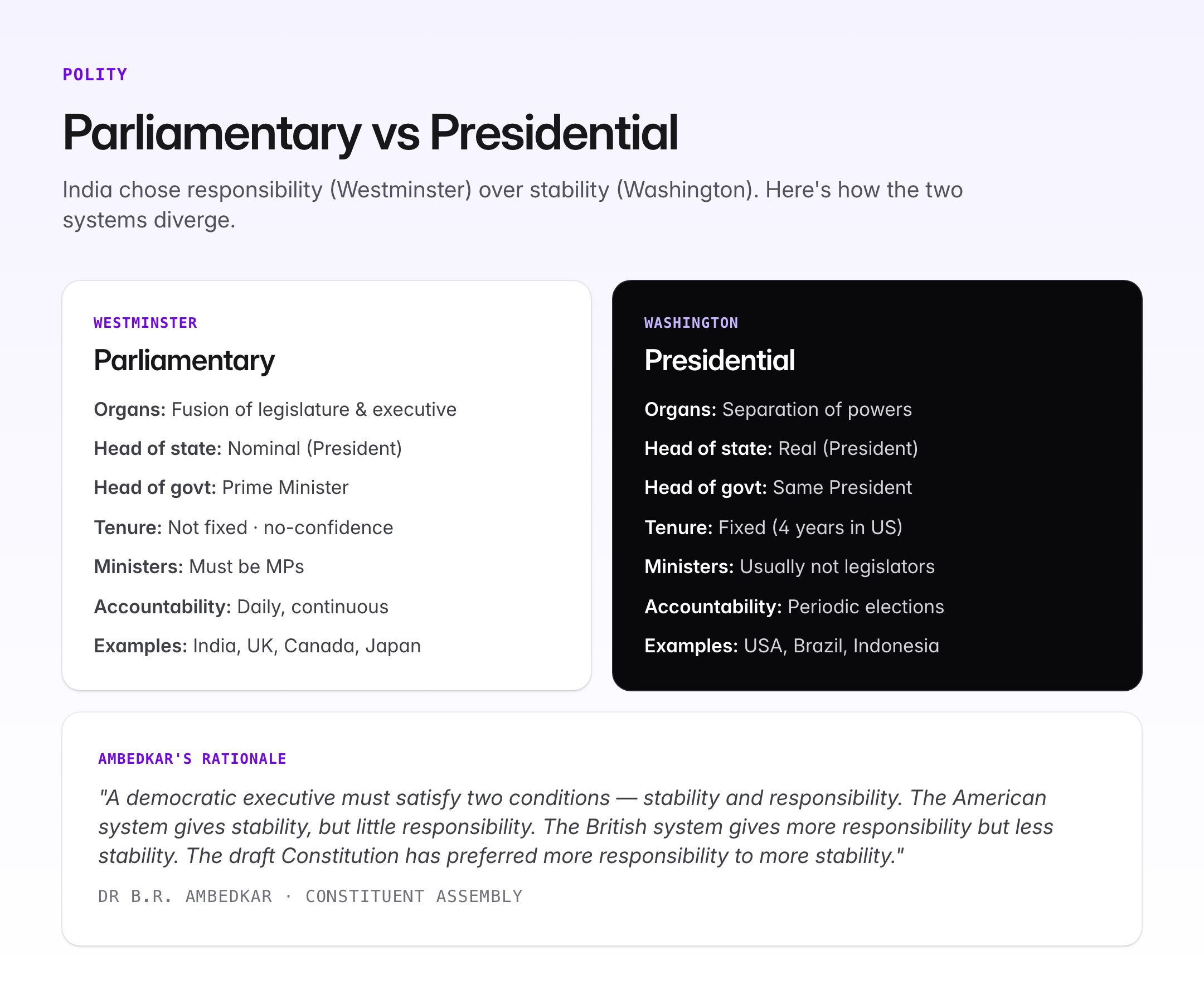
In a parliamentary system, the head of state (President in India, Monarch in the UK) is nominal, while the head of government (Prime Minister) is real and draws legitimacy from majority support in the legislature. The system evolved in Britain over several centuries – from the Magna Carta (1215) to the Glorious Revolution (1688) to the Reform Acts of the nineteenth century – and is called the Westminster model after the seat of the British Parliament.
Features of the Parliamentary System in India
| Feature | Explanation |
|---|---|
| Nominal and real executives | The President (Article 52) is the nominal head; the Prime Minister (Article 75) is the real executive head |
| Majority party rule | Government is formed by the party or coalition commanding a majority in the Lok Sabha |
| Collective responsibility (Article 75(3)) | The Council of Ministers is collectively responsible to the Lok Sabha – all ministers stand or fall together |
| Individual responsibility (Article 75(2)) | Ministers hold office during the pleasure of the President (i.e., Prime Minister) |
| Political homogeneity | Ministers usually belong to the same party and share a common ideology |
| Double membership | Ministers must be members of Parliament; if not, they must be elected within six months (Article 75(5)) |
| Leadership of the Prime Minister | PM is the keystone of the cabinet arch; chooses ministers, allocates portfolios, sets the agenda |
| Dissolution of the Lower House | The PM can advise the President to dissolve the Lok Sabha before its term (Article 85) |
| Secrecy of procedure | Cabinet discussions are confidential; oaths of secrecy taken by ministers |
| Fusion of legislature and executive | Executive (Council of Ministers) is drawn from the legislature |
Key Constitutional Articles
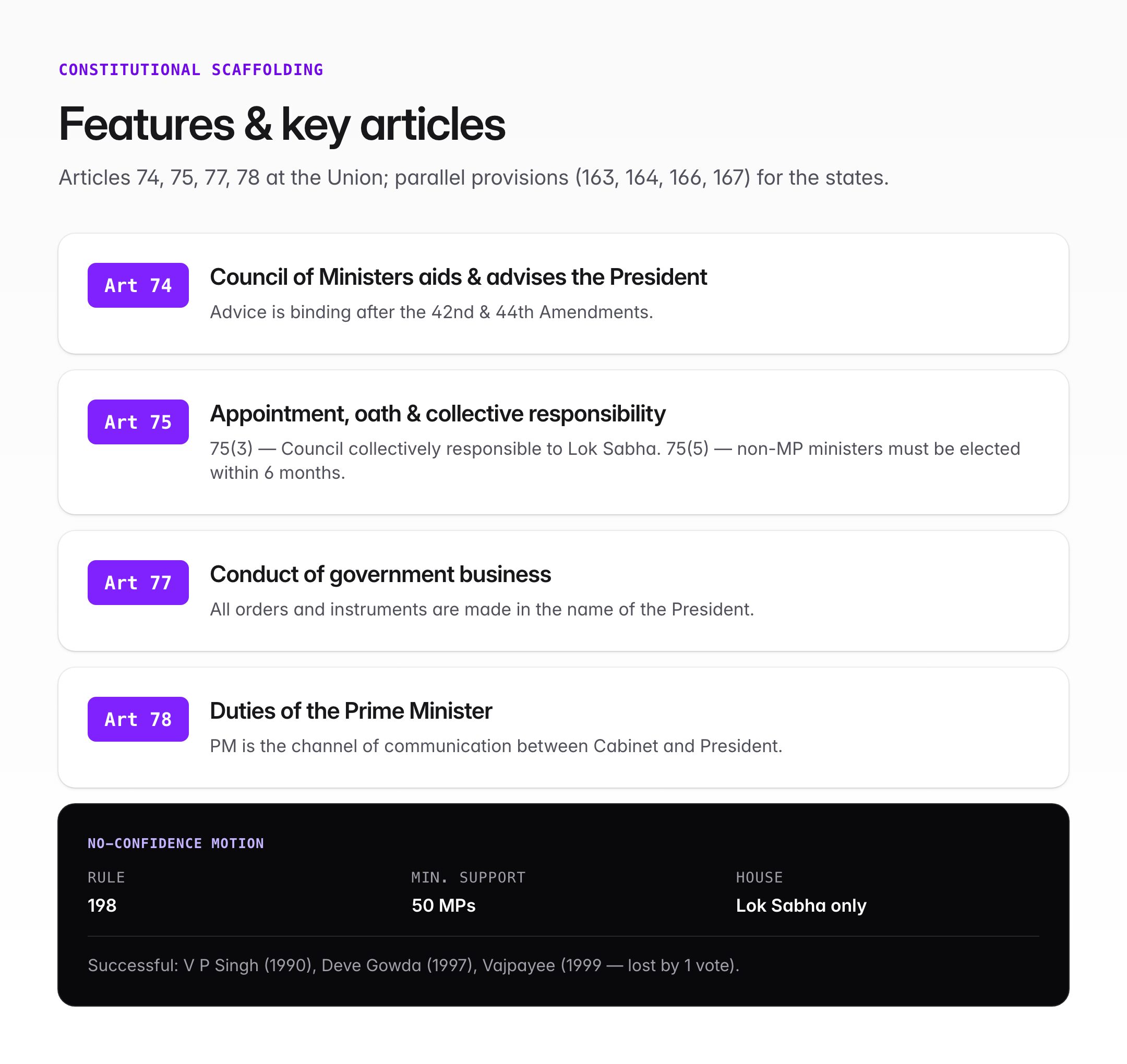
| Article | Provision |
|---|---|
| Article 74 | Council of Ministers with the PM at the head to aid and advise the President; advice is binding (after 42nd and 44th amendments) |
| Article 75 | Appointment, terms, salaries, and oath of ministers; collective responsibility |
| Article 77 | Conduct of business of the Government of India (orders in the name of the President) |
| Article 78 | Duties of PM to inform the President |
| Article 88 | Ministers have the right to speak in either House |
| Article 163-164 | Parallel provisions for States |
Parliamentary vs Presidential System
| Feature | Parliamentary (India, UK) | Presidential (USA, Brazil) |
|---|---|---|
| Relationship between organs | Fusion of legislature and executive | Separation of powers |
| Head of state | Nominal (President/Monarch) | Real (President) |
| Head of government | Prime Minister | President (same person as head of state) |
| Tenure of executive | Not fixed; can be removed by no-confidence | Fixed (e.g., 4 years in USA) |
| Dissolution of legislature | Possible on PM's advice | Not possible |
| Ministers from legislature | Compulsory | Usually not; may be barred |
| Accountability | Continuous, daily question hour, motions | Periodic (elections, impeachment) |
| Leadership concentration | In Prime Minister | In President |
| Example of use | UK, India, Canada, Australia, Japan | USA, Indonesia, Brazil, Mexico, South Korea |
| Risk | Instability if coalition fragile | Gridlock if Congress hostile |
Why India Chose the Parliamentary Form
The Constituent Assembly debated both models extensively. Dr B. R. Ambedkar articulated the rationale:
"A democratic executive must satisfy two conditions – stability and responsibility. The American system gives stability, but little responsibility. The British system gives more responsibility but less stability. The draft Constitution has preferred more responsibility to more stability."
| Reason | Explanation |
|---|---|
| Familiarity | Indians had operated the 1935 Act's parliamentary features for over a decade |
| Accountability | Daily legislative scrutiny suited a diverse country |
| Flexibility | Governments can be changed between elections without constitutional crises |
| Representation | Cabinet can reflect regions, castes, religions, genders |
| Federalism | Parliamentary system could accommodate federal diversity at Union and state levels |
| Avoidance of personality cult | Dispersing power across a Council of Ministers was safer than a single elected President |
Collective Responsibility
Article 75(3) states: "The Council of Ministers shall be collectively responsible to the House of the People." This means:
- A decision taken by the Cabinet binds every minister, even if he or she disagreed in discussion.
- If a minister cannot defend a cabinet decision in public, he or she must resign.
- A defeat of the government on a major policy issue or a no-confidence motion forces the entire Council of Ministers to resign, not just the PM.
- Only the Lok Sabha (not Rajya Sabha) can vote the Government out.
No-Confidence Motion
A no-confidence motion is the ultimate parliamentary check on the executive.
| Aspect | Detail |
|---|---|
| Rule | Rule 198 of the Rules of Procedure of the Lok Sabha |
| Minimum support | Must be supported by at least 50 members |
| Decision | Speaker allows discussion; if motion passes, the Government must resign |
| Voting | Simple majority of those present and voting in the Lok Sabha |
| Successful no-confidence motions in India | V P Singh (1990), Deve Gowda (1997), A B Vajpayee (1999 – lost by 1 vote) |
Related devices include the censure motion, cut motions, confidence motion, adjournment motion and half-an-hour discussions.
Merits of the Parliamentary System
- Harmony between legislature and executive – because ministers are MPs, legislation moves smoothly.
- Responsible government – daily accountability through question hour, zero hour, calling attention motions, debates.
- Prevents despotism – power distributed across PM, cabinet, coalition partners, party, legislature.
- Wide representation – cabinet can include regional, linguistic, religious and gender diversity.
- Ready alternative – if the PM falls, a new PM can emerge from the same House without fresh elections.
- Flexibility – elections can be called early if the ruling party loses support, avoiding stalemate.
Demerits of the Parliamentary System
- Instability – coalition politics can lead to frequent government changes (India 1989-99).
- No continuity of policies – each new government may reverse its predecessor's programme.
- Cabinet dictatorship – if the ruling party has a brute majority, collective responsibility can shade into rubber-stamping.
- Against separation of powers – legislators double up as executives, weakening the watchdog role.
- Amateur governance – ministers may lack subject expertise; portfolios shuffle frequently.
- Defection and horse-trading – especially before the Anti-Defection Law (52nd Amendment, 1985) and still problematic in hung legislatures.
India's Westminster Model vs the British Original
| Feature | UK | India |
|---|---|---|
| Head of state | Hereditary monarch | Elected President |
| Written Constitution | No (conventions) | Yes (lengthy written document) |
| Parliamentary sovereignty | Absolute | Qualified by judicial review and the basic structure doctrine |
| Upper House | Hereditary / life peers | Elected indirectly, with nominations |
| Judicial review | Limited | Strong (Articles 13, 32, 226) |
| Federalism | Unitary | Federal with unitary features |
Role of the President in a Parliamentary System
The President is not a figurehead without function. Responsibilities include:
- Inviting a leader who commands a majority to form the government (Article 75(1))
- Assenting to Bills (Article 111) and using pocket veto or suspensive veto
- Promulgating ordinances (Article 123)
- Returning advice to the Council of Ministers once for reconsideration
- Emergency powers (Articles 352, 356, 360)
- Appointments of Governors, CAG, CEC, judges of the Supreme Court and High Courts
The Shamsher Singh vs State of Punjab (1974) and R K Jain vs Union of India (1993) cases settled that the President acts only on ministerial advice, except in narrow situations (like a hung House).
Special Features – Hung Parliaments and Coalitions
India has seen coalition governments regularly since 1989. Conventions have emerged: the President calls the single largest party or pre-poll alliance first; if none, the largest post-poll alliance; failing that, fresh elections. The 2018 Karnataka case, 2017 Goa and 2019 Maharashtra governor crises remain litmus tests.
UPSC Relevance
Prelims: Expect questions on specific articles (74, 75, 77, 78), the number of no-confidence motions that have succeeded, who determines the pleasure of the President, and the difference between parliamentary and presidential systems. Short comparison questions between Westminster and Washington models are common.
Mains GS-2 (Polity and Governance): Use the parliamentary model to answer questions on separation of powers, accountability of the executive, coalition governance, role of the Speaker, Council of Ministers and its relationship with the Prime Minister, and debates over presidential alternatives. Always cite Ambedkar's "stability vs responsibility" reasoning.
GS-4 (Ethics): Collective responsibility is an example of institutional ethics – individuals subordinating personal views to collective decisions. The cabinet oath of secrecy models confidentiality in public service.
Essay: Write on "Parliamentary democracy in the age of coalitions", "Has India's parliamentary system become cabinet-centric?", and "The case for and against presidentialism in India" – all common themes.
Candidates should remember the key constitutional triad – Article 74 (advice), Article 75 (appointment and responsibility), and Article 78 (PM-President communication) – together with Ambedkar's rationale to answer any parliamentary-form question with confidence.
Tell Google you want more of this.
Add Anantam IAS as a preferred sourceOne tap, and this site shows up more often in your own Top Stories, AI Overviews and AI Mode. Remove it any time.