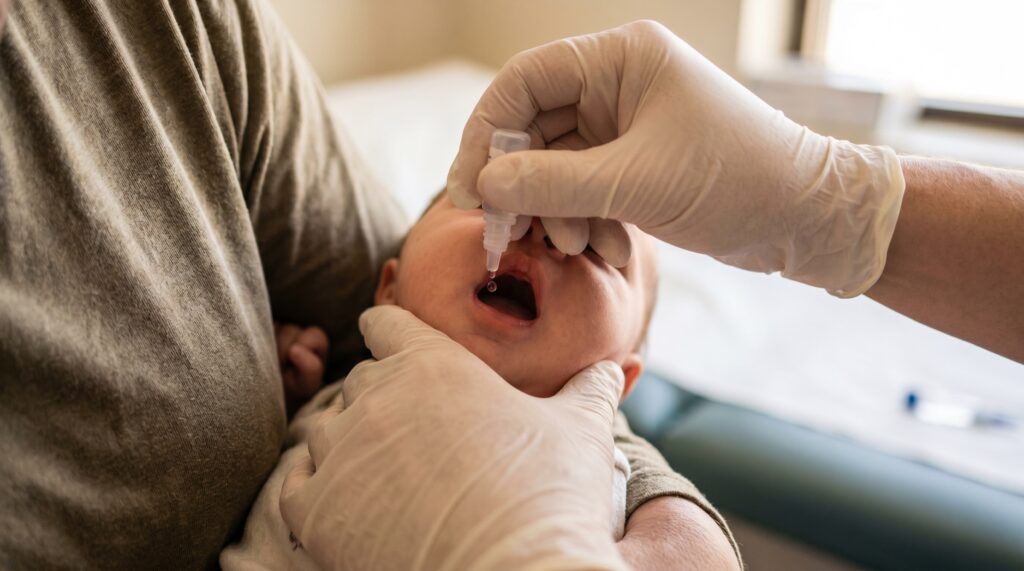
Ask an aspirant how the polio vaccine works and you’ll get “two drops of life.” Ask which two drops, and why India also gives an injection, and the answer usually stops. That gap is worth closing, because nearly everything worth knowing about polio sits inside it: why India used oral drops for twenty years, why it added an injection in 2015, why it swapped one kind of drops for another in 2016, and why a country that hasn’t seen a case since 2011 still runs vaccination rounds every year.
Poliomyelitis is a viral disease with no cure, only prevention. India reported its last case of wild poliovirus in January 2011, and the World Health Organization certified the South-East Asia Region polio-free in March 2014. Getting there took the largest repeated vaccination effort any country has ever attempted, and it still isn’t finished.
What polio actually does to a child
Polio is caused by the poliovirus, which comes in three types, imaginatively named 1, 2 and 3. It spreads by the faecal-oral route, the polite way of saying that virus shed in one child’s stool reaches another child’s mouth through contaminated water, hands or food. That’s why polio was a disease of crowded settlements with weak sanitation rather than of any particular climate.
Once swallowed, it multiplies in the throat and then the intestine, and for most children that’s where it ends. Roughly seven in ten infections cause no symptoms at all, which is what made polio so hard to fight: for every visible case, hundreds of children were spreading the virus invisibly. You were never chasing cases. You were chasing an iceberg.
In about 1 in 200 infections, the virus leaves the gut and invades the nervous system, destroying the motor neurons that tell muscles to move. Sensory nerves stay intact, so the child feels everything and simply cannot move the limb. That’s acute flaccid paralysis, and it’s irreversible, because dead motor neurons don’t grow back. Where it reaches the breathing muscles, 5 to 10 percent of those paralysed die. It strikes children under five overwhelmingly, and there’s no cure. When a disease can only be prevented and never treated, the vaccine isn’t one tool among several. It’s the only tool.
OPV and IPV: the two vaccines, and the real difference
The honest difference between the two polio vaccines isn’t “one is drops and one is a needle.” It’s where in the body each builds immunity, and that single distinction drives every decision India ever made about polio.
The Oral Polio Vaccine (OPV), developed by Albert Sabin, contains live poliovirus that’s been weakened, so it still replicates but can’t paralyse. Because it goes in through the mouth, it takes the same road the real virus takes and builds immunity in the gut lining itself. A child with gut immunity doesn’t just avoid paralysis; the virus can’t multiply in the intestine at all, so the child stops shedding it and stops infecting the neighbours. OPV doesn’t only protect the child, it breaks the chain of transmission. The vaccine virus is also excreted for a few weeks and quietly immunises other children it reaches, so every dose buys more protection than it pays for.
Then the price of that bargain. Because OPV is live, the virus can rarely revert to a paralysing form while replicating. In roughly 1 case per 2.7 million first doses it paralyses the child who received it, called vaccine-associated paralytic poliomyelitis (VAPP). Worse, where too few children are immunised, the excreted vaccine virus keeps passing from child to child for months, mutating until it regains the ability to paralyse: circulating vaccine-derived poliovirus (cVDPV). Get this right, because it’s constantly stated backwards. cVDPV isn’t caused by vaccination. It’s caused by under-vaccination, by live vaccine virus left circulating among unprotected children.
The Inactivated Polio Vaccine (IPV), developed by Jonas Salk and licensed in 1955, does the opposite. The virus is killed and injected, so it can’t replicate and carries no vaccine-derived risk at all. It produces strong blood antibodies that reliably stop the virus reaching the nervous system, so an IPV-vaccinated child won’t be paralysed. But it never passes through the gut, so it leaves only weak intestinal immunity, and that child can still carry the virus and pass it on. IPV protects the individual beautifully and the community only partly.
| Feature | OPV (oral drops) | IPV (injection) |
|---|---|---|
| Developed by | Albert Sabin | Jonas Salk (licensed 1955) |
| Virus | Live, attenuated (weakened) | Inactivated (killed) |
| Gut immunity | Strong | Weak |
| Blood immunity | Good | Strong and reliable |
| Stops person-to-person spread | Yes | Only partly |
| Protects unvaccinated contacts | Yes, via excreted vaccine virus | No |
| Vaccine-derived polio or VAPP | Very small but real risk | None |
| Cost and delivery | Cheap; no needle, any volunteer can give it | Costlier; needs syringes and trained staff |
| Suits | Mass campaigns to stop transmission | Routine immunisation and the endgame |
The choice now explains itself. If you must reach 170 million children in a weekend using volunteers who can’t give injections, against a virus spreading through contaminated water, you need the cheap oral vaccine that shuts down gut transmission. India didn’t pick OPV because it was the better vaccine. It picked OPV because it was the only vaccine that could win the fight India was actually in. For where polio sits among live, inactivated and modern platforms, the comparison of vaccine types gives the full taxonomy.
Pulse Polio: how India ran the biggest vaccination drive on earth
The Pulse Polio Immunization programme launched in 1995, and its design is why it worked. Routine immunisation under the Universal Immunization Programme reaches children gradually, over months, as parents bring them in. A virus with a two-week generation time is perfectly content with gradual. So India stopped being gradual.
The tactic was the National Immunization Day (NID), and most notes garble its logic. On one announced day, every child under five gets OPV drops regardless of whether they’ve been vaccinated before. Not just the unvaccinated ones. Every one. The aim isn’t to top up individual children, it’s to flood the whole population with immunity at the same moment, so the virus runs out of susceptible hosts everywhere at once. That’s the “pulse.” A single round reached about 172 million children, delivered by roughly 2.3 million vaccinators, most of that work resting on ASHAs, Anganwadi workers and ANMs, with transit teams at railway stations, brick kilns and construction sites, because the children most likely to be missed were the children of families in motion.
Underneath the drops sat the part nobody photographs. Under the National Polio Surveillance Project, set up in 1997 with WHO, every case of sudden floppy paralysis in any child under 15 anywhere in India had to be reported and investigated. Notice what that means: India didn’t look for polio, it looked at every paralysis of any cause and ruled polio out. That’s how you earn the right to say a negative result is real. Environmental surveillance later added sewage sampling, catching the virus in a city’s drains before it paralysed a child.
Why India was the hardest place on earth, and how it still won
By the late 2000s, with polio gone from most of the world, India was the single largest reservoir. In 2009 India reported 741 wild cases, close to half the global total, and serious people argued openly that eradication here might be impossible. Three reasons stacked up.
The birth cohort. India adds roughly 27 million babies a year, more new susceptible children annually than the population of Australia. Every year the campaign had to re-immunise a fresh cohort the size of a large country. There was no finish line you could cross once.
Sanitation, and the ugly arithmetic it created. This is the fact that decides the whole question and the one most notes miss. OPV works less well where a child’s gut is already crowded with other infections from contaminated water, because they interfere with the vaccine virus taking hold. In parts of western Uttar Pradesh and Bihar a child might need ten or more doses to become immune where three suffice in Europe. India wasn’t just fighting polio. It was fighting polio with a weakened weapon, and the thing weakening it was open defecation, the same battlefield the Swachh Bharat Mission later fought from another angle. Density and migration compounded it: the last reservoirs, in western UP and the Kosi belt of Bihar, were exactly where crowding, poor sanitation and seasonal movement overlapped.
Refusal. In some underserved pockets, repeated rounds of a free vaccine offered by a state that had delivered very little else met suspicion and outright refusal. India’s answer wasn’t more drops, it was more listening: an Underserved Strategy from 2001 and a Social Mobilisation Network of local mobilisers run with UNICEF, working through community leaders and mothers rather than around them. Refusal fell because the messenger changed, not because the message got louder.
It worked anyway. India’s last case of wild poliovirus was recorded on 13 January 2011, in Rukhsar Khatoon, an unvaccinated 18-month-old in Howrah district, West Bengal. The collapse was astonishing: 741 cases in 2009, 42 in 2010, one in 2011. Three clean years of surveillance had to follow, since certification demands proof of absence rather than absence of proof, and on 27 March 2014 the WHO certified the entire South-East Asia Region, all eleven member countries, as polio-free. India’s inclusion is what made that possible, and it’s one of the cleaner illustrations of what the WHO actually does beyond issuing advisories.
The switch from trivalent to bivalent, and why the injection arrived
Go slowly here, because this is where notes get muddled. Once wild poliovirus type 2 was declared eradicated in September 2015, having last been detected in Aligarh, Uttar Pradesh, in 1999, the type 2 component of the oral vaccine became a strange liability. It was protecting children against a virus that no longer existed in the wild, while causing the large majority of vaccine-derived cases worldwide. All of the risk, none of the benefit.
So the world removed it. In a synchronised operation across more than 150 countries in April 2016, trivalent OPV (types 1, 2 and 3) was replaced by bivalent OPV (types 1 and 3), and India switched on 25 April 2016. Every vial of the old vaccine had to be withdrawn and destroyed inside a tight window, because a single leftover trivalent vial used afterwards could reseed type 2 into a population no longer immunised against it. That opened a hole: children would now have no type 2 protection at all. Which is exactly why India introduced IPV into routine immunisation in 2015, starting in six states and expanding nationally, given as fractional intradermal doses alongside OPV at 6 and 14 weeks, the fractional dose adopted to stretch a globally constrained supply.
Read the two moves together and the design is elegant. bOPV keeps doing the job only a live oral vaccine can do, shutting down transmission of the types still circulating. IPV quietly restores type 2 protection against paralysis with zero risk of seeding a new outbreak. Neither vaccine could have done both. India ended up using each one for precisely the thing it’s good at, and that’s the entire answer to “why both?” The schedule carrying both sits inside Mission Indradhanush.
Why India still vaccinates against a disease it doesn’t have
Polio-free is a status, not a wall. It means no virus is circulating here now. It says nothing about tomorrow, and two threats keep the programme running.
The first is importation. Wild poliovirus type 1 remains endemic in Pakistan and Afghanistan, both sharing long borders and heavy traffic with India. A virus needs one unvaccinated child and one bus. India’s response is layered: annual rounds to keep population immunity saturated, mandatory OPV vaccination for travellers moving between India and polio-affected countries, and continuous surveillance. The second is vaccine-derived poliovirus, which is why the sewage sampling never stopped. When VDPV type 2 was detected in sewage in Hyderabad in 2016 with no paralysed child in sight, India ran a targeted mop-up round for hundreds of thousands of children in the area. That’s the system working as designed, catching the virus in a drain rather than in a spinal cord.
The endgame is the uncomfortable part. Once wild polio is gone everywhere, OPV itself becomes the last remaining source of polio on earth, and all oral vaccine will have to be withdrawn globally, leaving IPV alone. That transition is the hardest part of eradication, not the easiest, which is why novel OPV type 2 (nOPV2), engineered to be far less likely to revert, was granted WHO Emergency Use Listing in 2020. India isn’t running Pulse Polio out of ritual. It’s holding a line until the world can put the weapon down safely.
How to study polio without drowning in acronyms
Build the topic on one distinction and one timeline, and the rest becomes derivable rather than memorisable.
The distinction is gut immunity versus blood immunity. OPV gives gut immunity, so it stops transmission and protects the neighbourhood, at the cost of a tiny live-virus risk. IPV gives blood immunity, so it stops paralysis in that child with no risk, but doesn’t stop the child spreading the virus. Hold only that and you can reconstruct why India ran mass OPV campaigns, why IPV arrived when type 2 was withdrawn, why VDPV exists at all, and why OPV must eventually be retired. This trips up nearly everyone on the first pass, so if it hasn’t clicked, that’s normal. Read those two sentences again before moving on. That really is the whole secret.
The timeline is six beats: 1988, the Global Polio Eradication Initiative launches, when polio was paralysing around 350,000 children a year across 125 countries; 1995, India launches Pulse Polio; 2009, India reports 741 cases, the world’s highest; 13 January 2011, India’s last wild case, in Howrah; 27 March 2014, WHO certifies the South-East Asia Region polio-free; 25 April 2016, India switches from trivalent to bivalent OPV, IPV having arrived in 2015.
Drill only the load-bearing figures and skip the rest: 1 in 200 infections paralyse, types 1, 2 and 3 with only type 1 still wild, Pakistan and Afghanistan the only endemic countries, 172 million children per round, 1955 for Salk. And resist the triumphal register when you write about it. The strongest answer pairs the achievement with the fragility, the certificate of 2014 with the sewage sample of 2016. Set against other national programmes, the comparison of important diseases puts polio next to tuberculosis and malaria, where India has emphatically not finished the job.
Frequently Asked Questions
When was India declared polio free?
India’s last wild poliovirus case was on 13 January 2011 in Howrah district, West Bengal. It left WHO’s list of polio-endemic countries in February 2012, and on 27 March 2014 the WHO certified the whole South-East Asia Region, including India, as polio-free.
What is the difference between OPV and IPV?
OPV is oral and contains live weakened virus. It builds gut immunity, so it stops person-to-person spread and even protects unvaccinated contacts, but carries a very small vaccine-derived risk. IPV is injected and contains killed virus. It reliably prevents paralysis with no vaccine-derived risk, but gives weak gut immunity, so a vaccinated child can still carry and spread the virus.
Why did India use oral drops instead of injections?
Because OPV was the only vaccine that could win India’s specific fight. It’s cheap, needs no needle or trained injector, and it shuts down transmission in the gut, which is where a faecal-oral virus lives. No injectable campaign could have reached 172 million children in a weekend.
What is vaccine-derived poliovirus?
It is the live vaccine virus in OPV regaining the ability to paralyse after circulating for months among under-immunised children. It is caused by under-vaccination, not vaccination. Where enough children are immunised, the vaccine virus dies out before it can revert.
Why did India switch from trivalent to bivalent OPV?
Wild poliovirus type 2 was declared eradicated in September 2015, last detected in Aligarh in 1999. Its vaccine component was then protecting against a virus that no longer existed while causing most vaccine-derived cases. India replaced trivalent with bivalent OPV, covering types 1 and 3 only, on 25 April 2016.
Why does India still run Pulse Polio if there is no polio?
Wild poliovirus type 1 is still endemic in Pakistan and Afghanistan, so importation into an under-immunised pocket remains possible. And vaccine-derived poliovirus can emerge wherever immunity drops, as a sewage detection in Hyderabad in 2016 showed. Polio-free is a status, not a wall.
Can polio be cured?
No. There is no antiviral drug and no cure. The paralysis comes from motor neurons destroyed in the spinal cord, and those don’t regenerate. Physiotherapy, callipers and surgery help survivors, but only vaccination prevents the disease.
Who was India’s last polio patient?
Rukhsar Khatoon, an unvaccinated child of about 18 months in Howrah district, West Bengal, paralysed by wild poliovirus type 1 with onset on 13 January 2011.
Practice Questions
1. India’s last case of wild poliovirus was reported in which year and state?
a) 2009, Uttar Pradesh
b) 2011, West Bengal
c) 2014, Bihar
d) 2016, Telangana
Answer: b) 2011, West Bengal (the Howrah district case had onset on 13 January 2011.)
2. Which of the following is true of the Oral Polio Vaccine (OPV)?
a) It contains killed virus and carries no risk of vaccine-derived polio
b) It contains live attenuated virus and produces strong intestinal immunity
c) It must be given by a trained health worker using a syringe
d) It protects the individual but cannot interrupt transmission
Answer: b) It contains live attenuated virus and produces strong intestinal immunity (which is why it interrupts spread, unlike IPV.)
3. The WHO certified the South-East Asia Region as polio-free in:
a) March 2012
b) March 2014
c) April 2016
d) September 2015
Answer: b) March 2014 (on 27 March 2014, three years after India’s last case.)
4. India replaced trivalent OPV with bivalent OPV in April 2016 primarily because:
a) Bivalent OPV is cheaper to manufacture
b) Wild poliovirus type 2 had been eradicated, while the type 2 vaccine component caused most vaccine-derived cases
c) Trivalent OPV could not be stored in India’s cold chain
d) Bivalent OPV eliminates the risk of vaccine-derived poliovirus entirely
Answer: b) Wild poliovirus type 2 had been eradicated, while the type 2 vaccine component caused most vaccine-derived cases (bivalent OPV covers types 1 and 3.)
5. Wild poliovirus remains endemic in which countries?
a) India and Bangladesh
b) Nigeria and Somalia
c) Pakistan and Afghanistan
d) Indonesia and Myanmar
Answer: c) Pakistan and Afghanistan (only wild poliovirus type 1 still circulates, and only there.)
Mains-style questions
1. “India’s polio eradication succeeded less because of a vaccine and more because of a delivery system.” Critically examine this claim with reference to Pulse Polio, AFP surveillance and social mobilisation. 2. Distinguish between OPV and IPV in terms of the immunity each produces, and explain why India’s immunisation schedule now uses both. 3. Explain what circulating vaccine-derived poliovirus is and why it makes the final phase of global polio eradication harder than the earlier phases. 4. Discuss how inadequate sanitation reduced the effectiveness of oral polio vaccination in India, and what this implies for the design of public health programmes generally. 5. India is polio-free but continues nationwide immunisation rounds. Evaluate the justification for this continued expenditure.
The temptation is to file polio as a solved problem and a proud date, and that reading misses what happened. India didn’t beat polio by having a better vaccine than anyone else. It had the same drops the rest of the world had, and they worked worse here than almost anywhere. What India built was the machinery around the drops: a surveillance system that investigated every paralysed child in a country of a billion, a workforce that could put two drops in 172 million mouths in a weekend, and the patience to keep returning to the households that had said no. That’s the transferable lesson, and it’s why the programme still runs in a country with no polio. The virus is two countries away and one lapse from coming back, and India’s answer to that isn’t confidence. It’s the next round.
Tell Google you want more of this.
Add Anantam IAS as a preferred sourceOne tap, and this site shows up more often in your own Top Stories, AI Overviews and AI Mode. Remove it any time.