You almost certainly ate off them at breakfast, wore them in the last rain, and are carrying a trace of them in your blood right now. PFAS — per- and poly-fluoroalkyl substances, the “forever chemicals” — are a family of thousands of synthetic compounds invented in the 1940s to do one magical thing: repel water, grease and heat all at once. That single property is why they coat the non-stick pan, the waterproof jacket, the grease-proof food wrapper, the stain-resistant sofa and the foam that firefighters spray on burning fuel. And it is also why they have become one of the most stubborn pollution problems on the planet, because the same bond that makes them so useful makes them almost impossible to destroy.
For a UPSC aspirant, PFAS are the perfect modern environment case study — a clean illustration of how a useful technology becomes a slow-moving contamination crisis, how the world’s regulators are scrambling to catch up, and how India sits worryingly behind on a threat that has already been detected in its own rivers and groundwater. They sit at the crossroads of pollution, public health, chemicals regulation and global environmental treaties, and they reward a candidate who can explain the chemistry in one sentence and the policy response in three jurisdictions.
What PFAS Are and Why They’re Called “Forever”
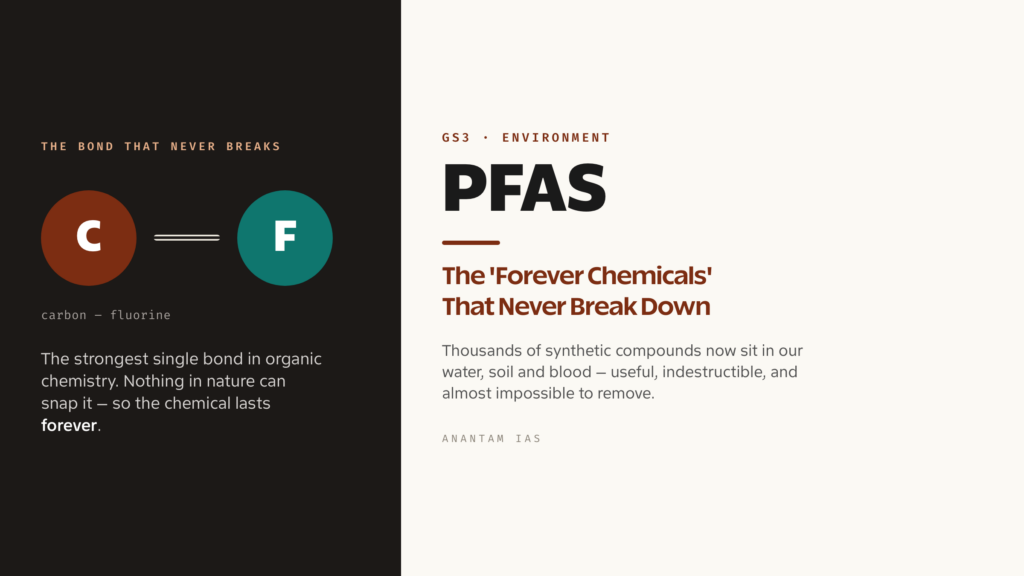
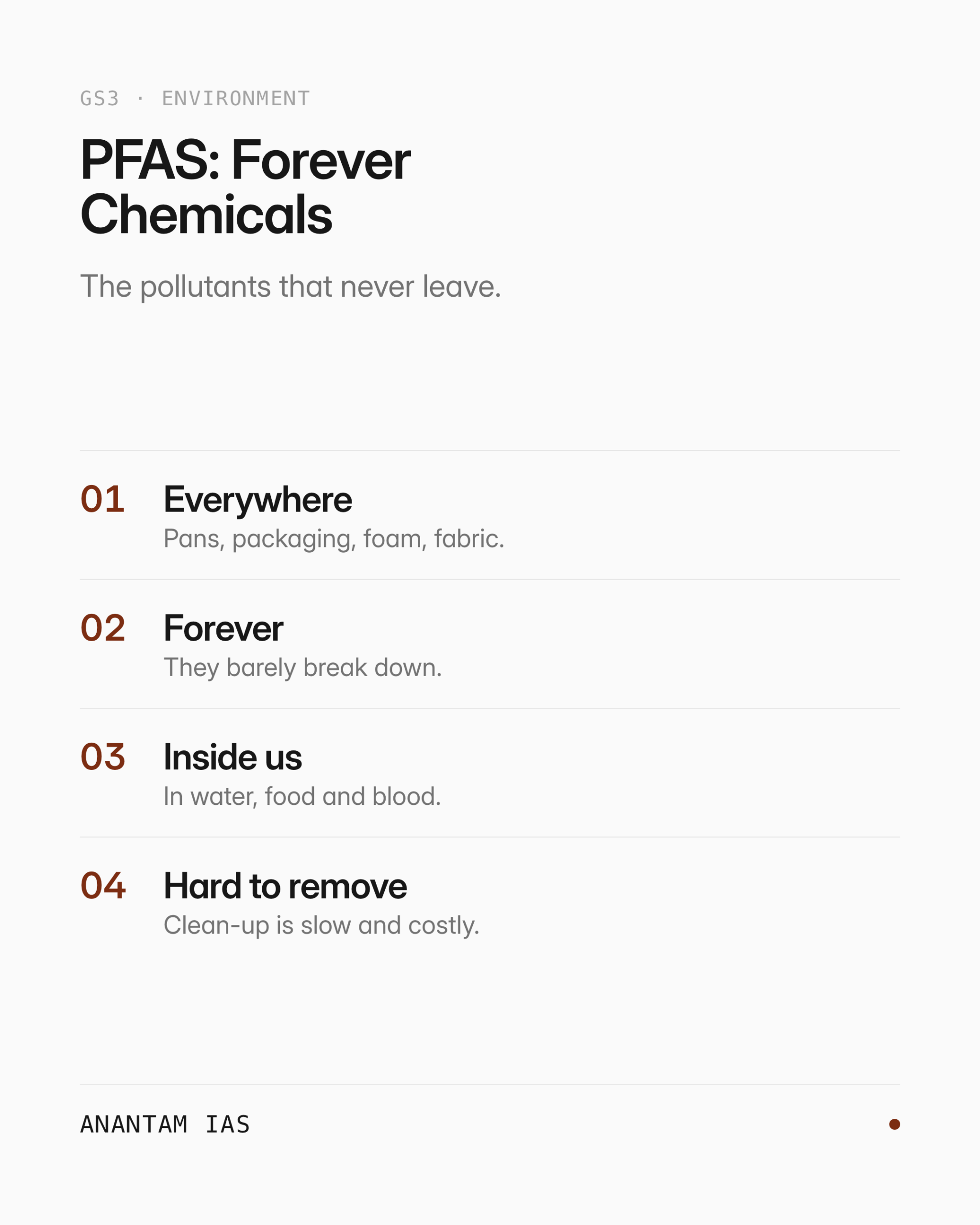
Start with the chemistry, because everything else follows from it. PFAS are a class of human-made chemicals built around chains of carbon atoms bonded to fluorine. The carbon-fluorine bond is the strongest single bond in organic chemistry — one of the strongest bonds in all of nature — and that is the whole secret. Nothing in the ordinary environment is energetic enough to snap it: not sunlight, not water, not bacteria, not the enzymes in your liver. A chemical that cannot be broken apart cannot break down. So once a PFAS molecule is made, it essentially lasts forever, which is exactly how the nickname was born.
This is not a handful of chemicals but an enormous and growing family. Depending on the definition you use, estimates run from several thousand distinct substances into the tens of thousands; the US Environmental Protection Agency’s own toxicity database lists more than 14,000 unique PFAS compounds, and under the broadest definitions chemical databases catalogue millions. The two most studied and most notorious are PFOA (perfluorooctanoic acid, once used to make Teflon) and PFOS (perfluorooctane sulfonate, the active ingredient in old firefighting foams). When you read about “forever chemicals” in the news, these two are usually the villains, but they are only the tip of a very large iceberg.
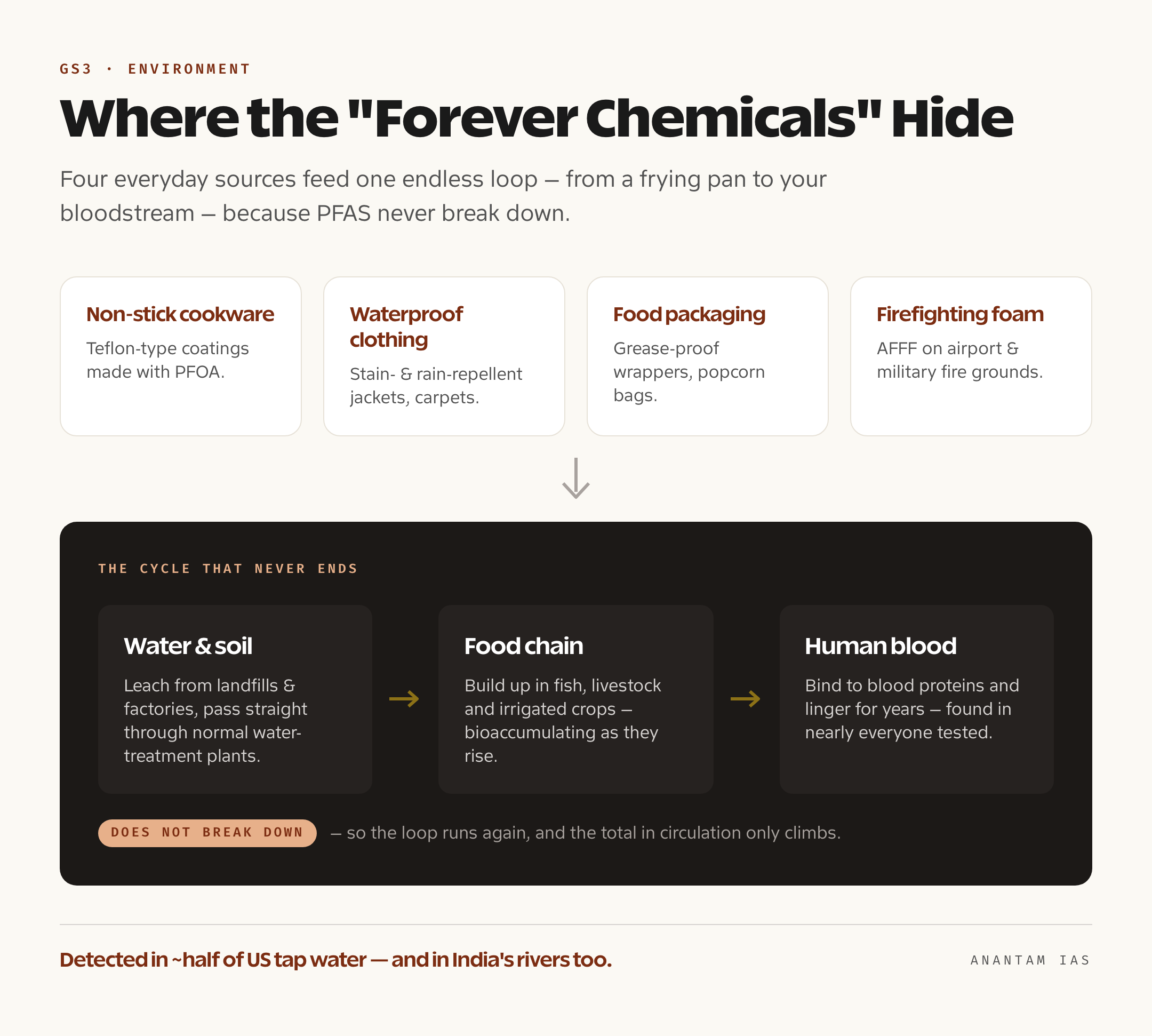
What makes them so commercially irresistible is that they make things slippery, dry and fireproof at the same time. That is why they turn up almost everywhere in modern life: non-stick cookware, water-repellent and stain-resistant clothing and carpets, grease-proof fast-food packaging and microwave-popcorn bags, cosmetics and dental floss, semiconductor manufacturing, chrome plating, and — crucially for the contamination story — aqueous film-forming foam, the AFFF that airports and the military have used for decades to smother jet-fuel fires. Each of those uses puts more indestructible molecules into the world, and because they never degrade, the total amount in circulation only climbs.
How PFAS Spread Through Water, Soil and Blood
Here is where “forever” turns from a quirky chemistry fact into a public-health problem. Because PFAS don’t break down, they don’t stay put — they leach, travel and accumulate. The journey usually starts at a point source: a factory that makes or uses them, a landfill where treated products rot, a sewage works that can’t filter them out, or a fire-training ground soaked in foam. From there they seep into groundwater and run off into rivers, and because most are water-soluble and mobile, they spread far from where they began. They have been found in rainwater over remote mountains, in Arctic snow, in the deep ocean and in the blood of polar bears — a contamination so total that scientists now describe PFAS as effectively planetary.
The most direct route into people is drinking water. PFAS dissolved in a river or aquifer pass straight through conventional water-treatment plants, which were never designed to catch them, and come out of the tap. From there they enter the body and, instead of being flushed out quickly like most toxins, they bind to proteins in the blood and linger for years — some PFAS have a half-life in the human body of several years, meaning it takes that long for the body to clear even half a single dose. They also bioaccumulate up the food chain, concentrating in fish, in livestock that drink contaminated water, and in the crops irrigated with it. A US Geological Survey study estimated that PFAS are present in the tap water of nearly half of American households, and biomonitoring surveys routinely find detectable PFAS in the blood of almost everyone tested. This is the defining feature of the crisis: a pollutant that is simultaneously everywhere in the environment and inside nearly every human body.
The Health Concerns: What the Science Says
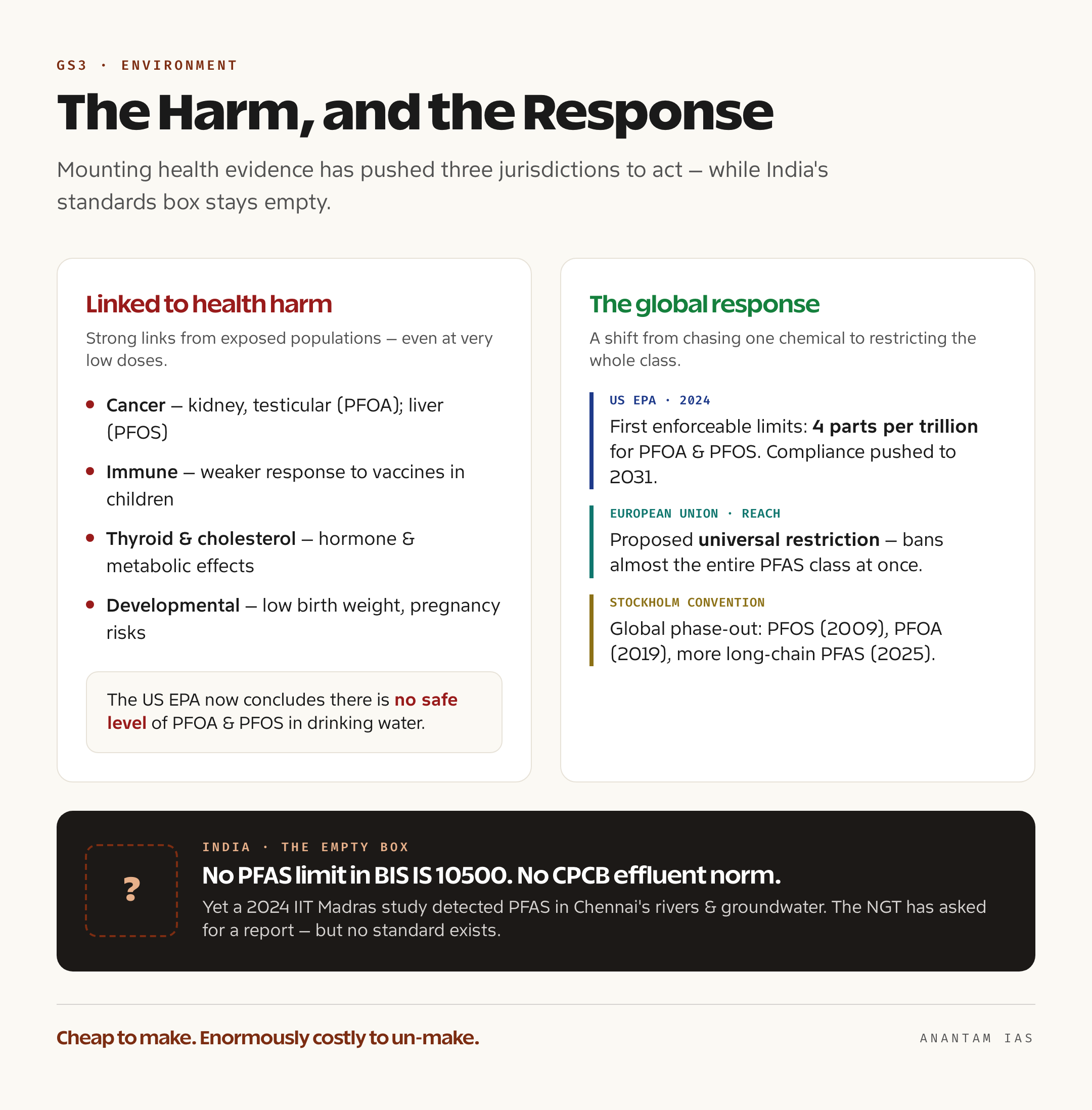
The reason regulators are alarmed is a growing body of evidence linking PFAS exposure to real harm, even at very low doses. The clearest signals are around cancer — PFOA is associated with an increased risk of kidney and testicular cancer, and PFOS with liver cancer — which is why the World Health Organization’s cancer research arm now classifies PFOA as carcinogenic to humans. Beyond cancer, the suspected effects read like a tour of the body’s regulatory systems. PFAS have been linked to raised cholesterol, thyroid disease, liver damage, and disruption of the immune system, including a worrying finding that exposed children may respond less strongly to routine vaccines. They are also tied to developmental and reproductive harm: lower birth weight, pregnancy complications such as high blood pressure, and effects on fertility. Many PFAS behave as endocrine disruptors, meaning they interfere with the hormones that quietly run growth, metabolism and reproduction.
Two honest caveats keep this from being scaremongering, and a good answer carries both. First, most evidence is associational — drawn from populations exposed through contaminated water — so it shows strong links rather than proof that a given exposure caused a given illness in a given person. Second, “PFAS” covers thousands of compounds with very different toxicities, and the science is far ahead on a few like PFOA and PFOS and thin on the rest. But the weight of evidence on the well-studied ones has been enough to shift the official view dramatically. The US EPA has now concluded that for PFOA and PFOS there is effectively no safe level of exposure in drinking water — a striking statement that means the goal is not to manage these chemicals down to a tolerable dose but to get them as close to zero as technology allows.
How the World Is Trying to Regulate the Unbreakable
Faced with a pollutant that won’t break down and won’t stay still, governments have moved on three fronts, and a sharp answer can name all three. The first is drinking-water limits. In April 2024 the US EPA issued the first legally enforceable national standards for PFAS in drinking water, setting a maximum of just 4 parts per trillion each for PFOA and PFOS — an extraordinarily tight limit, the rough equivalent of a few drops in an Olympic swimming pool — plus limits on several other PFAS. The politics have since wobbled: in 2025 the EPA said it would keep the PFOA and PFOS limits but push the compliance deadline for water utilities from 2029 to 2031, while reconsidering the rules for some of the other PFAS. The headline still stands — the world’s most influential regulator has declared these chemicals unsafe at vanishingly small concentrations.
The second and most ambitious front is the European Union, where five countries — Germany, Denmark, the Netherlands, Norway and Sweden — have proposed a “universal” PFAS restriction under the bloc’s REACH chemicals law. Rather than banning PFAS one molecule at a time, which lets industry swap a regulated chemical for an unregulated cousin, the proposal would restrict the entire class of thousands of substances at once, with carve-outs for essential uses where no alternative exists. The European Chemicals Agency is still assessing it and is due to send its scientific opinions to the European Commission, but if adopted it would be the broadest chemical restriction in the EU’s history. The third front is global: under the Stockholm Convention on Persistent Organic Pollutants, the international treaty that phases out the world’s worst long-lived chemicals, PFOS was listed back in 2009, PFOA was added in 2019, and a further group of long-chain PFAS was listed in 2025 — steadily bringing these “forever chemicals” under a worldwide phase-out. The common thread is a shift from chasing individual chemicals to treating PFAS as a class, because the science of the carbon-fluorine bond applies to all of them.
The Clean-Up Problem and Why India Is Behind
Even perfect regulation leaves the molecules already loose in the world, and removing them is brutally hard. Because PFAS don’t break down, you can’t simply let nature digest them or burn them cheaply — incineration must reach very high temperatures or it just scatters them. The main water-treatment options, granular activated carbon and ion-exchange resins, work by trapping PFAS rather than destroying them, which means the captured chemicals still have to be disposed of somewhere, and the filters are expensive to install and replace at the scale of a city’s water supply. Estimates for cleaning up PFAS contamination across the United States alone run into tens of billions of dollars, and genuine destruction technologies that break the carbon-fluorine bond are only now emerging from the laboratory. This is the cruel arithmetic of a forever chemical: the cost of making it was trivial, and the cost of un-making it is enormous.
And this is exactly where India should worry, because the problem has already arrived while the defences have not. A 2024 study by IIT Madras detected PFAS in the surface water and groundwater around Chennai, including the Adyar river, the Buckingham Canal and Chembarambakkam lake, and other research has found PFAS in the Ganga basin. Yet India has no specific limit for PFAS in drinking water: the Bureau of Indian Standards’ drinking-water specification, IS 10500, does not list them, and the Central Pollution Control Board sets no PFAS effluent standard, so factories are under no obligation to measure or curb what they release. The National Green Tribunal has taken note, directing the environment ministry and the CPCB to report on forever chemicals, which is a start but not a standard. The gaps stack up: little routine monitoring, no mandatory testing of tap or source water, no class-wide restriction, and continued import and use of PFAS-laden products and foams even as the EU moves to ban them. For a country whose groundwater is already its most stressed resource, a persistent, bioaccumulative contaminant with no removal infrastructure is a slow emergency, and the way forward is not mysterious — set BIS limits and CPCB standards, build a national monitoring programme, phase out non-essential uses such as PFAS firefighting foams, and align with the Stockholm Convention listings the country has already accepted. (You can see how PFAS fit alongside the other emerging water threats in our explainer on microplastics, and where they sit in the wider map of contamination in our guide to the types of pollution.)
For Your Mains Answer
This is a high-value topic for GS Paper 3, which covers environment, conservation, pollution, and the impact of science and technology — and it doubles as a sharp example for ethics and essay papers on the theme of technology outrunning regulation. Questions on emerging contaminants, persistent organic pollutants, drinking-water safety, chemicals regulation, or India’s environmental governance gaps can all draw on this material. The skill examiners reward is the one this article uses: explain the chemistry in a single clear line, then connect it to health, regulation and the specific India deficit.
How to Build the Answer
Open with the chemistry, not the alarm — define PFAS as a large class of synthetic chemicals whose strong carbon-fluorine bond makes them resist breakdown, so they last “forever.” Move in a logical chain: what they are and why they don’t degrade, where they come from (everyday products plus firefighting foam), how they spread (water, soil, food, blood, bioaccumulation), why they harm health (cancer, immune, thyroid, developmental — and “no safe level” for PFOA/PFOS), how the world is responding (US limits, EU universal restriction, Stockholm Convention), and finally the India gap (detected in rivers, but no BIS/CPCB standard). Close with a balanced way forward. That arc — define, spread, harm, regulate, localise, evaluate — fits almost any PFAS or emerging-contaminant question.
Common Mistakes to Avoid
Don’t treat PFAS as a single chemical; it is a class of thousands, and the class-wide approach is the whole point of the EU proposal. Don’t say they “decompose slowly” — the sharper point is that the carbon-fluorine bond makes them effectively non-degradable. Don’t claim filtration destroys them; activated carbon and ion exchange only trap and concentrate them. And don’t forget the India-specific deficit — naming the absence of a BIS limit and a CPCB standard is what turns a generic environment answer into a current, India-grounded one.
A Compact Answer Spine
PFAS = thousands of synthetic chemicals with a near-unbreakable carbon-fluorine bond → “forever” because they don’t degrade → sources: non-stick, waterproofing, food packaging, AFFF firefighting foam → spread via water/soil into food and human blood, bioaccumulate, found in ~half of US tap water → health: kidney/liver cancer, immune, thyroid, cholesterol, developmental; EPA says no safe level for PFOA/PFOS → regulation: US EPA 4 ppt limits (2024), EU universal REACH restriction, Stockholm Convention listings (PFOS 2009, PFOA 2019, more in 2025) → clean-up costly, only traps not destroys → India: detected in Chennai/Ganga but no BIS/CPCB standard → way forward: set limits, monitor, phase out non-essential uses.
Diagram or Flowchart Idea
Draw a simple flow: a row of source icons (pan, jacket, food wrapper, foam) feeding arrows into a central “water and soil” band, which then loops up into “food” and “human blood,” with a small “does not break down” label on the loop. Beside it, a three-box strip — US / EU / Stockholm — with an empty fourth box marked “India: gap.” The cycle plus the regulatory strip communicates the whole story at a glance.
A Balanced-Conclusion Line
A line that lands the marks: “PFAS are a textbook case of a useful technology becoming a permanent liability — the very bond that made them valuable makes them impossible to retire, and India’s challenge is to build standards and monitoring before the contamination, already in its rivers, becomes the next irreversible chapter of its water crisis.”
How to Use Data Without Cramming
You need only four anchors, not a spreadsheet: the carbon-fluorine bond (strongest in organic chemistry, which is why they’re “forever”), the EPA limit of 4 parts per trillion for PFOA and PFOS, the IIT Madras detection of PFAS in Chennai’s waters (2024), and the absence of any PFAS standard in BIS IS 10500. Drop those four into the right sentences — attributed plainly, “as a 2024 IIT Madras study found” — and the answer reads as authoritative without a single crammed figure too many.
Frequently Asked Questions
What exactly are PFAS, and why are they called “forever chemicals”?
PFAS — per- and poly-fluoroalkyl substances — are a family of several thousand human-made chemicals built around carbon atoms bonded to fluorine. That carbon-fluorine bond is the strongest in organic chemistry, so nothing in the ordinary environment can break it: not sunlight, water, microbes or the body’s enzymes. Because they essentially never degrade, they are nicknamed “forever chemicals.” They are prized for repelling water, grease and heat, which is why they coat non-stick pans, waterproof clothing, food packaging and firefighting foam.
How do PFAS get into our bodies, and are they dangerous?
Mainly through drinking water and food. PFAS leach from factories, landfills and fire-training sites into rivers and groundwater, pass through ordinary water-treatment plants, and reach the tap; they also build up in fish, livestock and crops. Once inside, they bind to blood proteins and linger for years. They have been linked to kidney and liver cancer, immune and thyroid effects, raised cholesterol, and developmental harm, and the US EPA now concludes there is no safe level of PFOA and PFOS in drinking water. Most evidence is associational, but it is strong enough to have triggered tough new limits.
How are countries regulating PFAS?
On three fronts. The US EPA set the first enforceable national drinking-water limits in 2024 — just 4 parts per trillion each for PFOA and PFOS — though it has since extended the compliance deadline to 2031. The European Union is considering a “universal” restriction that would ban almost the entire PFAS class at once under its REACH law. And globally, the Stockholm Convention on Persistent Organic Pollutants has listed PFOS (2009), PFOA (2019) and more long-chain PFAS (2025) for phase-out. The trend is to regulate PFAS as a whole class rather than one chemical at a time.
What is India doing about PFAS?
Very little so far. PFAS have been detected in Indian waters — a 2024 IIT Madras study found them in rivers and groundwater around Chennai, and they have turned up in the Ganga basin — but India has no specific limit for PFAS in drinking water under the BIS standard IS 10500, and the Central Pollution Control Board sets no PFAS effluent norm. The National Green Tribunal has asked the environment ministry and the CPCB to report on the issue. The gap is wide: little monitoring, no mandatory testing, no class-wide restriction, and continued use of PFAS products and foams.
Practice Questions
Prelims MCQs
- With reference to PFAS, often called “forever chemicals,” consider the following statements: 1) They are a single naturally occurring compound. 2) Their persistence is due to the strong carbon-fluorine bond. 3) They are used in non-stick cookware and firefighting foam. Which are correct?
(a) 1 and 2 only
(b) 2 and 3 only
(c) 1 and 3 only
(d) 1, 2 and 3
Answer: (b) PFAS are a large class of thousands of synthetic chemicals, not one natural compound; their persistence comes from the carbon-fluorine bond, and they are used in non-stick coatings and firefighting foam. - Why are PFAS described as “forever chemicals”?
(a) They are radioactive with very long half-lives
(b) Their carbon-fluorine bonds resist breakdown so they barely degrade in the environment
(c) They are recycled indefinitely by industry
(d) They were patented in perpetuity
Answer: (b) The carbon-fluorine bond is the strongest in organic chemistry, so PFAS resist degradation by sunlight, water and microbes and persist almost indefinitely. - Which body issued the first legally enforceable national drinking-water limits for PFAS in 2024, setting a maximum of 4 parts per trillion for PFOA and PFOS?
(a) The European Chemicals Agency
(b) The World Health Organization
(c) The US Environmental Protection Agency
(d) The Stockholm Convention Secretariat
Answer: (c) The US EPA set the first enforceable national limits in April 2024, at 4 parts per trillion each for PFOA and PFOS. - The Stockholm Convention, which has listed several PFAS for global phase-out, deals primarily with which category of substances?
(a) Greenhouse gases
(b) Ozone-depleting substances
(c) Persistent Organic Pollutants
(d) Hazardous radioactive waste
Answer: (c) The Stockholm Convention targets Persistent Organic Pollutants; it listed PFOS in 2009, PFOA in 2019 and additional long-chain PFAS in 2025. Ozone-depleting substances fall under the Montreal Protocol. - Regarding PFAS regulation in India, which statement is correct?
(a) BIS standard IS 10500 sets a strict limit for PFAS in drinking water
(b) The CPCB enforces a PFAS effluent standard on all industries
(c) There is currently no specific PFAS standard, though PFAS have been detected in Indian waters
(d) India has banned the entire PFAS class under REACH
Answer: (c) India has no specific PFAS limit in IS 10500 or CPCB norms, even though a 2024 IIT Madras study detected PFAS in waters around Chennai; REACH is an EU law, not Indian.
Mains Practice Questions
- PFAS are often described as a textbook case of a useful technology becoming a permanent environmental liability. Examine this statement with reference to the chemistry, sources and persistence of “forever chemicals.” (15 marks, 250 words)
- Discuss the health and environmental concerns associated with PFAS and evaluate why regulators are moving towards restricting them as an entire class rather than one chemical at a time. (15 marks, 250 words)
- Compare the regulatory responses to PFAS in the United States, the European Union and under the Stockholm Convention. What lessons do they hold for India? (15 marks, 250 words)
- “PFAS have already been detected in India’s rivers and groundwater, yet no national standard governs them.” Critically analyse the gaps in India’s framework for emerging contaminants and suggest a way forward. (15 marks, 250 words)
- Why is the clean-up of PFAS contamination technically difficult and financially expensive? Discuss in the context of building resilient drinking-water infrastructure in India. (10 marks, 150 words)
Tell Google you want more of this.
Add Anantam IAS as a preferred sourceOne tap, and this site shows up more often in your own Top Stories, AI Overviews and AI Mode. Remove it any time.