There’s a quiet revolution happening inside steel tanks, and it could end up reshaping how the world eats. Picture a brewery — except instead of beer, the vat is brewing the exact same whey protein that comes out of a cow, the same egg white a hen lays, the same red heme molecule that makes meat taste of meat. No animal is involved at any step. The trick is to take a microbe — a yeast, a fungus or a bacterium — and program it with a single gene so that it manufactures one specific, useful molecule and then nothing else. This is precision fermentation, and over 2024 and 2025 it stopped being a laboratory curiosity. Real products built on it reached supermarket shelves in Singapore and the United States, and in India a clutch of startups and a national policy began betting that microbes, not herds, might be the cheapest way to close the country’s protein gap.
For a UPSC aspirant, this sits at one of the richest crossroads in the syllabus. It is a Science and Technology topic — synthetic biology and metabolic engineering put to work. It is a food-security and agriculture topic, because it promises protein with a fraction of the land, water and emissions of a dairy or poultry farm. And it is a live policy topic, because India’s BioE3 strategy names “smart proteins” as a priority and the food regulator is still writing the rulebook for it. So the smart move is to understand the technology cleanly, separate it from the things it gets confused with, and learn the India story well enough to write a balanced answer.
What Precision Fermentation Actually Is
Start with the word “fermentation,” because almost everyone already knows half the story. Humans have fermented food for thousands of years — bread rises, beer brews, cheese sets and curd thickens because microbes feed on sugars and, as they live, throw off a messy mix of useful products: alcohol, carbon dioxide, acids, flavours. That’s traditional fermentation, and its defining feature is that you get a whole soup of compounds and the microbe’s own biomass, not one clean ingredient. Brewing beer gives you alcohol and a hundred minor by-products, all at once.
Precision fermentation keeps the tank and the microbe but adds a layer of genetic programming so the output is a single, pure target molecule. The idea isn’t new — it is how the world has made medicines for decades. Human insulin for diabetics has been brewed in engineered bacteria since the early 1980s rather than harvested from animal pancreases. And chymosin, the enzyme that curdles milk into cheese, became in 1990 the first genetically engineered food ingredient cleared as safe in the United States; today microbe-made chymosin sets the overwhelming majority of the world’s cheese, quietly replacing rennet scraped from calf stomachs. What’s changed recently is ambition. Where the technology once made enzymes and drugs, it is now being aimed at the proteins and fats that make up our everyday food.
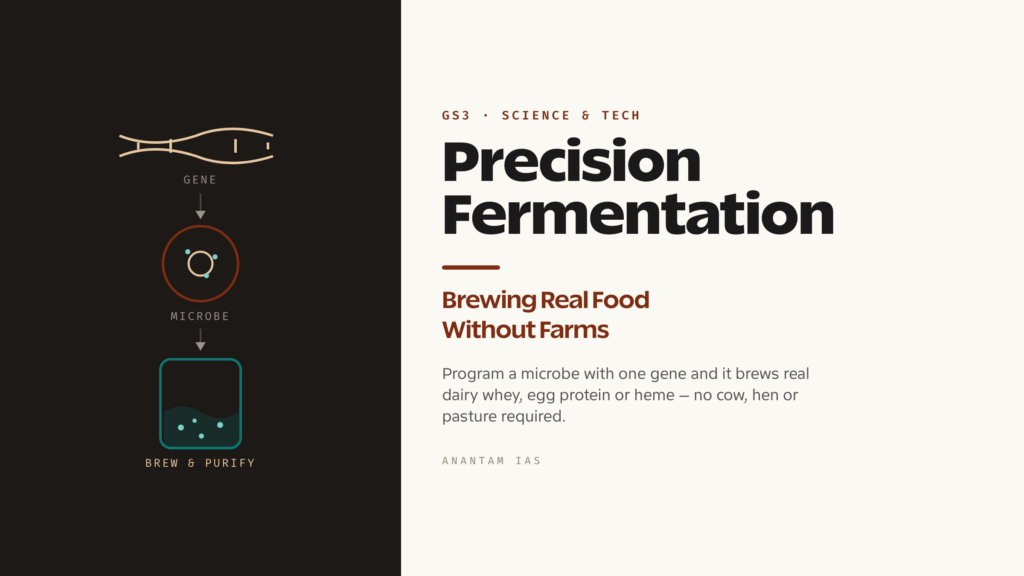
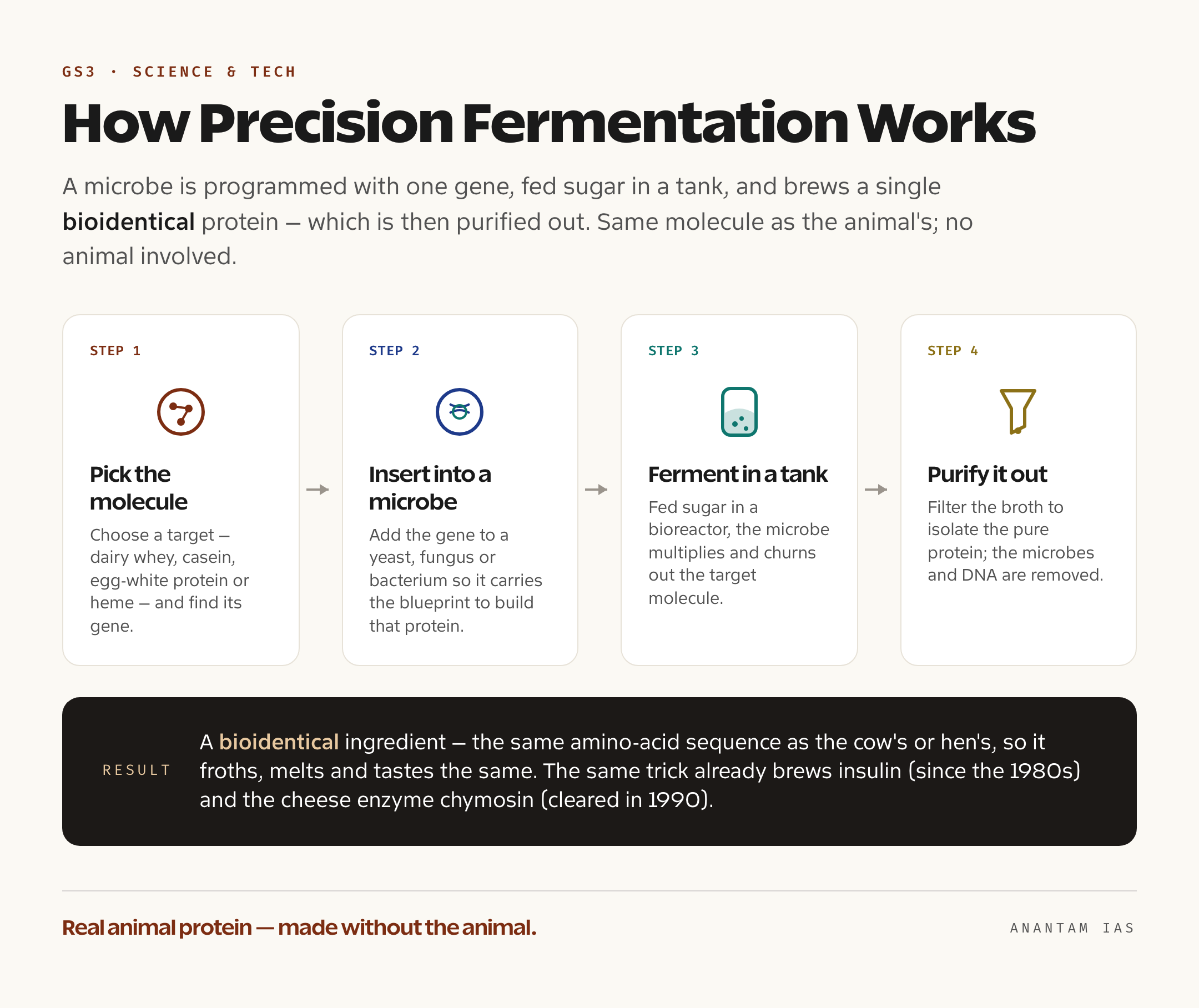
The mechanism is best held as a four-beat chain. First, scientists identify the exact molecule they want — say, the bovine whey protein beta-lactoglobulin — and find the gene that codes for it. Second, they insert that gene into a host microbe, usually a workhorse yeast, fungus or bacterium, so the microbe is now carrying the instructions to build that protein. Third, the microbe goes into a bioreactor, is fed sugar and nutrients, and as it grows it churns out the target molecule the way a tiny factory follows a blueprint. Fourth — and this is the step people forget — the broth is filtered and purified so the final ingredient is just the protein, with the microbes and the genetic material removed. The protein that comes out is what the industry calls “bioidentical”: its amino-acid sequence is the same as the cow’s or the hen’s, so it behaves in food exactly as the animal version does. It froths, melts, browns and tastes the same, because at the molecular level it is the same. That is the whole promise in one line — real animal protein, made without the animal.
How It Differs From Plant-Based and Cultured Meat
This is where most answers go wrong, so it’s worth getting the three categories straight. They are often lumped together as “alternative” or “smart” protein, but they work in completely different ways and sit at different stages of maturity.
Plant-based protein is the oldest and simplest. You take proteins from soy, pea, wheat or other crops and process them to mimic the taste and texture of meat or milk. A plant-based burger is an imitation — clever, increasingly tasty, but made of plant molecules pretending to be animal ones. Nothing in it is biologically the same as beef. Precision fermentation is fundamentally different: it doesn’t imitate the animal protein, it manufactures the identical molecule. A precision-fermented whey is not “milk-like”; it is the real whey protein, just grown in a tank instead of a mammary gland. That’s why it can make true cheese that stretches and melts, or whey for sports nutrition, where plant proteins struggle to convince.
Cultured meat — also called cultivated or lab-grown meat, a branch of what scientists call cellular agriculture — is the third route, and the one furthest from your plate. Here you take actual animal cells, usually muscle and fat cells, and grow them directly in a bioreactor into tissue that is, genuinely, meat. The crucial distinction is that precision fermentation grows microbes that secrete a molecule, while cultured meat grows animal cells into flesh. Precision fermentation can never produce a steak — it makes proteins, fats, pigments and enzymes, not muscle. But it often props up the other two: the heme that makes a plant-based burger “bleed” and taste meaty is itself a precision-fermented ingredient, and cultured-meat makers use fermentation-made growth factors and proteins to cut their costs. So the categories compete and cooperate at the same time.
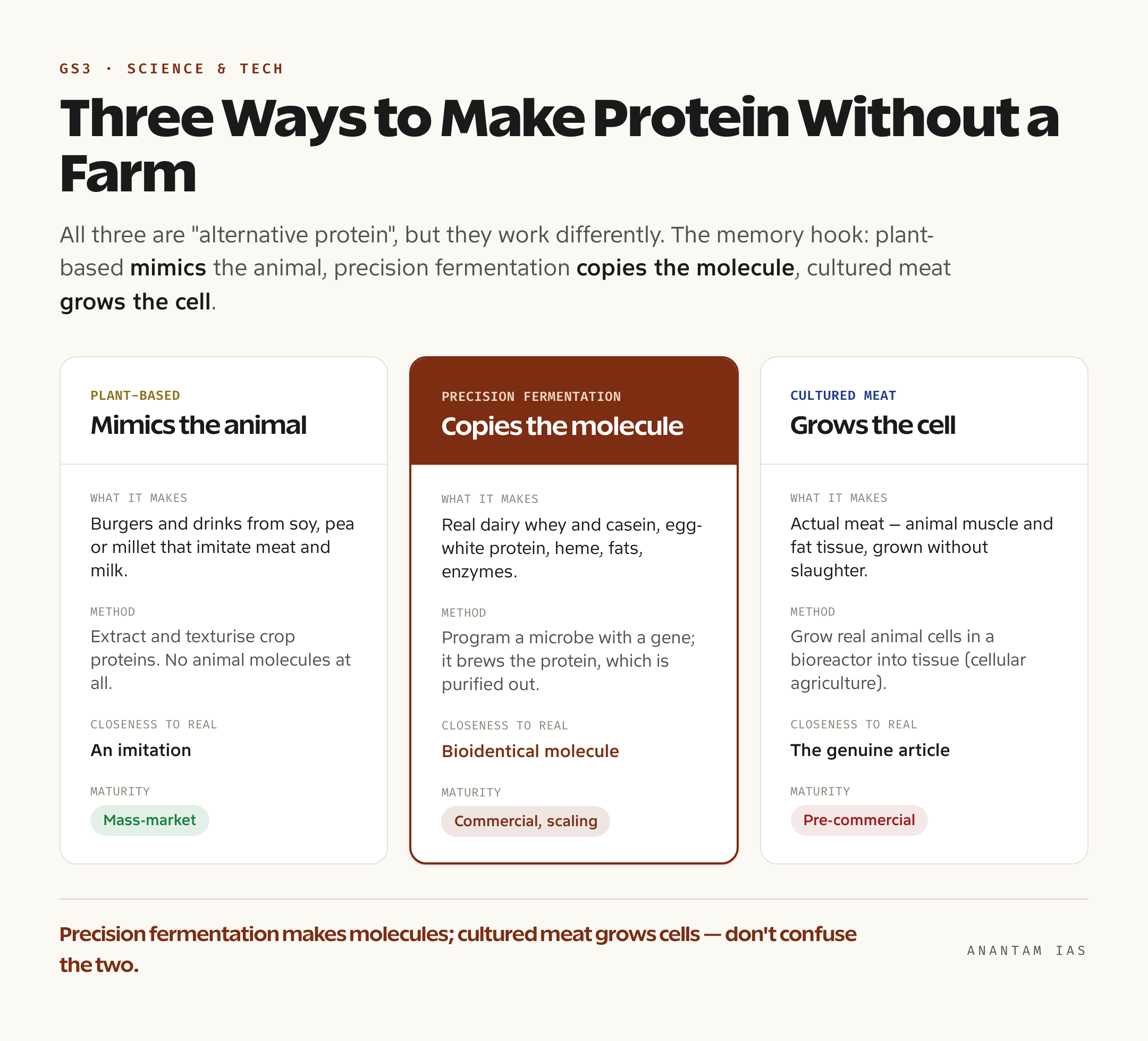
A clean way to remember it: plant-based mimics the animal, precision fermentation copies the molecule, and cultured meat grows the cell. On maturity, plant-based is already a mass-market industry, precision fermentation is commercial but still scaling, and cultured meat remains expensive and largely pre-commercial. In a 2025 estimate that aspirants can quote, making a kilogram of conventional protein cost only a few euros, while the same kilogram by these novel routes often cost roughly ten times more — a gap that tells you where the real battle lies.
Why It Matters: Food Security and a Lighter Footprint
The case for precision fermentation rests on a hard arithmetic of land, water and carbon. Animal agriculture is one of the heaviest loads on the planet — it uses a vast share of the world’s farmland and freshwater and is a major source of greenhouse gases, much of it methane from cattle. Brewing protein in a tank sidesteps most of that. The microbes need feedstock and energy, but they don’t need pasture, they don’t belch methane, and they aren’t vulnerable to drought or disease the way a herd is. One industrial milestone reported in 2025 — making dairy casein through precision fermentation — was credited with cutting carbon emissions by around three-quarters and land use by as much as 99 per cent against the conventional dairy route. Even allowing for optimism in such figures, the direction is unmistakable: far less land and water for the same protein.
There’s a food-security argument layered on top, and it lands hard in India. The country is broadly self-sufficient in food calories yet carries a stubborn protein and nutrition deficit — over a third of Indian children are stunted, a sign of chronic undernutrition, and surveys suggest a healthy diet is unaffordable for the large majority of the population. Precision fermentation offers a way to make high-quality, complete protein — the bioidentical dairy and egg proteins the body uses most efficiently — without the cost, climate exposure and land hunger of expanding livestock. Because the process runs in sealed tanks, it also dodges some risks built into animal farming: no antibiotics fed to keep crowded animals healthy, no zoonotic-disease spillover from herds and flocks, and consistent, contamination-controlled output batch after batch. This is the bundle India’s policymakers mean when they talk of “smart proteins” — protein that is high-quality, low-footprint and not hostage to land or weather.
And the promise stretches beyond protein. The same trick that brews whey can brew specific fats, vitamins and enzymes — riboflavin (vitamin B2) is already made this way at industrial scale, and companies are working on precision-fermented fats to give plant-based foods the mouthfeel they lack. So the technology is really a general-purpose platform for making functional food ingredients on demand, which is why it keeps showing up in discussions of the future bioeconomy rather than just the dairy aisle.
The Hurdles: Cost, Scale, Regulation and Trust
For all the promise, precision fermentation is not yet winning at the till, and an honest answer has to say why. The first and biggest wall is cost and scale. Programming a microbe is the easy part; doing it cheaply, in tanks big enough to feed a market, is not. The world simply doesn’t have enough large food-grade bioreactor capacity, and building it is slow and capital-heavy. Indian startups illustrate the climb in plain numbers — Bengaluru’s Phyx44 has spoken of scaling from hundred-litre tanks toward a thousand litres, while a fat-focused player like FermBox operates a facility on the order of 40,000 litres. Those are real volumes, but a single dairy cooperative dwarfs them. Until the technology reaches the titres, yields and tank sizes that drive cost down toward conventional protein, it stays a premium product rather than a staple.
The second wall is regulation, and here the rules are still being written almost everywhere. As of the mid-2020s there is no settled, dedicated legal definition of precision-fermented food in most countries; products are squeezed into existing frameworks — “Generally Recognized as Safe” in the United States, “novel food” approval in Europe. In India, the Food Safety and Standards Authority of India, the FSSAI, has cleared a handful of such products case by case under its Non-Specified Food rules: a precision-fermented whey protein and a mycoprotein were approved in 2022, an algal protein in 2023, and a biomass-fermentation protein in 2024. But the regulator has not yet issued a clear, unified rulebook for precision fermentation or cultured meat, which leaves companies facing a slow, uncertain, product-by-product path. Labelling is its own fight — a 2021 FSSAI advisory barred plant drinks from using words like “milk,” and the dairy lobby will resist anything brewed in a tank being called milk or cheese.
The third wall is in the mind. These foods are made using genetic engineering, and “GM” carries a heavy stigma with many consumers, even though the engineered microbe is removed before the food is sold and the final protein is identical to the natural one. Surveys in 2025 found that people routinely confuse precision fermentation with cultured meat and struggle to grasp either, and acceptance often falls once the genetic-engineering element is explained. There is also a powerful incumbent interest: India has the world’s largest dairy sector and tens of millions of livelihoods riding on it, so a technology that could one day undercut farm milk is politically and economically sensitive, not just scientifically immature. Winning will take cheaper production, a clear and trusted regulatory label, and patient public communication — not just better microbes.
The India Angle: BioE3, Smart Protein and the Bioeconomy
India has chosen to lean in, and the framing matters. In 2024 the Union Cabinet approved the BioE3 Policy — Biotechnology for Economy, Environment and Employment — a national strategy to make India a high-performance biomanufacturing hub. BioE3 names a short list of priority sectors, and “smart proteins and functional foods” is explicitly one of them, sitting alongside bio-based chemicals, precision biotherapeutics and climate-resilient agriculture. The policy’s tools are biomanufacturing hubs, bio-AI hubs and a national network of biofoundries — shared, high-end facilities where startups and labs can engineer microbes and run pilot-scale fermentation without each building a plant from scratch. It plugs into the larger ambition of a roughly $300 billion bioeconomy by 2030, which you can read more about in our explainer on the bioeconomy in India and the underlying science in synthetic biology explained.
On the ground, an ecosystem is taking shape. The Department of Biotechnology and its funding arm BIRAC have backed incubation and scale-up centres — a Centre for Smart Protein and Sustainable Material Innovation and an Alternative Proteins Innovation Center launched in Bengaluru in 2024, and a biofoundry incubation centre on the CFTRI campus in Mysore — and held a first-of-its-kind Regulatory Conclave on Smart Protein in April 2024 to start hammering out the path to market. The non-profit Good Food Institute India has become the connective tissue, publishing State of the Industry reports, running a Smart Protein Forum, and pushing the regulator toward a clearer framework. Industry is moving too: the US firm Perfect Day, which makes precision-fermented whey, acquired a Gujarat plant and is reported to be readying production there from the second half of 2026, and home-grown players like Phyx44 and fat-maker FermBox are scaling animal-free dairy ingredients. Big pharma has noticed — Zydus Lifesciences took a stake in the relevant Gujarat biotech assets in 2024.
So the India story is genuinely poised. The pull factors are strong — a serious protein gap, a climate-and-water squeeze on farming, a young biotech industry, and a government policy that names the sector. The friction is just as real — the need for cheap scale-up, an unfinished regulatory framework, and the political weight of a dairy economy that is also a vast source of rural livelihoods. For an aspirant, that tension is the answer: precision fermentation is one of the clearest places where India’s bioeconomy ambition, its food-security challenge and its rural reality all collide, and the policy choices over the next few years will decide whether it becomes a pillar of the food system or stays a high-tech niche.
For Your Mains Answer
This is a versatile topic for GS Paper 3, which covers science and technology developments and their applications, biotechnology, and food security and the economics of animal husbandry. It can answer questions on emerging biotechnology, alternative and smart proteins, the BioE3 policy and the bioeconomy, and sustainable food systems. It also offers a sharp example for the Essay paper on themes of technology and society, food security, or sustainability. The skill examiners reward is the same one this article uses: define the technology precisely, distinguish it cleanly from its cousins, and balance the promise against the hurdles with a few hard figures and an India anchor.
How to Build the Answer
Move in a logical chain. Define precision fermentation as programming microbes to make one bioidentical molecule, and separate it from traditional fermentation. Distinguish the three routes — plant-based mimics, precision fermentation copies the molecule, cultured meat grows the cell. Lay out the four process steps (choose molecule, insert gene, ferment, purify). Give the promise (land, water, emissions, no antibiotics, food security). Give the hurdles (cost and scale, regulation, GM perception). Then anchor it in India — BioE3 naming smart proteins, FSSAI’s case-by-case approvals, GFI India, the dairy-economy tension. Close with a balanced judgement. That arc — define, distinguish, mechanism, promise, hurdle, India, verdict — fits almost any version of the question.
Common Mistakes to Avoid
Don’t conflate the three technologies — losing marks for calling precision fermentation “lab-grown meat” is the classic error; precision fermentation makes molecules, cultured meat grows cells. Don’t say the microbe ends up in the food — it is purified out, leaving only the bioidentical protein. Don’t oversell it as already cheap and mainstream — flag the cost, scale and bioreactor-capacity problem honestly. And don’t ignore the dairy-livelihood dimension when discussing India; the social and political stakes are part of a complete answer.
A Compact Answer Spine
Precision fermentation = program a microbe (yeast/fungus/bacterium) with a gene to brew one bioidentical molecule (whey, casein, egg protein, heme), then purify it out → built on old tech (insulin since the 1980s, microbial chymosin for cheese since 1990) → distinct from plant-based (mimics) and cultured meat (grows animal cells) → promise: far less land/water/emissions (casein route cited at ~74% lower CO₂, up to 99% less land), no antibiotics, complete protein for food security → hurdles: high cost (~10× conventional protein), scarce bioreactor capacity, unfinished regulation, GM perception → India: BioE3 (2024) names smart proteins, FSSAI clears products case-by-case (whey + mycoprotein 2022, algal 2023, biomass 2024), GFI India + DBT/BIRAC hubs, Perfect Day’s Gujarat plant from 2026, dairy-economy tension → verdict: promising platform, decided by cost and regulation.
Diagram or Flowchart Idea
Draw the four-step pipeline as a left-to-right flow — gene → microbe → fermentation tank → purified protein — and beside it a small three-column table contrasting plant-based, precision fermentation and cultured meat on “what it makes” and “method.” That single visual carries the two ideas examiners most want to see: the mechanism and the clean distinction between the categories.
A Balanced-Conclusion Line
A line that lands the marks: “Precision fermentation lets us brew real animal protein without the animal — a genuine route to low-footprint food security — but for India its future will be settled less in the laboratory than in the cost curve, the regulatory rulebook, and a fair reckoning with the millions whose livelihoods rest on the dairy economy it might one day disrupt.”
How to Use Data Without Cramming
You need only a handful of anchors: the gene-to-microbe-to-tank-to-purified-protein chain; insulin since the 1980s and chymosin since 1990 as proof the tech is mature; roughly 74 per cent lower emissions and up to 99 per cent less land for the casein route; about ten times the cost of conventional protein; BioE3 in 2024 naming smart proteins; and FSSAI’s case-by-case approvals from 2022. Attribute them plainly — “as the Good Food Institute India notes,” “under FSSAI’s Non-Specified Food route” — rather than scattering numbers.
Frequently Asked Questions
What is precision fermentation in simple terms?
It is a way of making specific food ingredients by programming microbes instead of using animals. Scientists insert a gene into a yeast, fungus or bacterium so it produces one exact molecule — such as the whey or casein protein found in milk, an egg-white protein, or the heme that makes meat taste meaty. The microbe ferments in a tank, and the target protein is then purified out. The result is “bioidentical” — molecularly the same as the animal version — so it behaves the same in food, just made without a cow, hen or farm.
How is it different from plant-based food and lab-grown meat?
All three are “alternative proteins” but they work differently. Plant-based foods use crop proteins like soy or pea to mimic meat or milk — nothing in them is biologically animal protein. Precision fermentation copies the actual animal molecule using microbes, so it can make real dairy whey or egg protein. Cultured (lab-grown) meat grows real animal cells into tissue in a bioreactor. The simplest memory hook: plant-based mimics the animal, precision fermentation copies the molecule, cultured meat grows the cell.
Why does precision fermentation matter for India?
India has a large protein and nutrition gap despite being food-secure in calories, and animal farming is land-, water- and emissions-heavy. Precision fermentation can make high-quality protein with far less land, water and greenhouse gas, and no antibiotics. India’s 2024 BioE3 Policy explicitly names “smart proteins” as a priority sector, the FSSAI has begun approving such products case by case, and the Good Food Institute India is building the ecosystem — making this central to India’s food-security and bioeconomy goals.
What is stopping it from going mainstream?
Three things. Cost and scale — making a kilogram this way can cost around ten times more than conventional protein, and the world lacks enough large food-grade fermentation tanks. Regulation — most countries, including India, have no dedicated, unified rulebook yet, so approvals are slow and product-by-product. And public trust — the foods rely on genetic engineering, which carries a stigma, and in India a vast dairy economy and its livelihoods add a strong incumbent interest.
Practice Questions
Prelims MCQs
- With reference to precision fermentation, which of the following statements is/are correct? 1. It uses genetically programmed microbes to produce a single, specific target molecule.
2. The microorganism remains in the final food product as a source of protein.
3. Human insulin and the cheese-making enzyme chymosin are early applications of the underlying technology. Select the correct answer:
(a) 1 and 2 only
(b) 1 and 3 only
(c) 2 and 3 only
(d) 1, 2 and 3
Answer: (b) The microbe is purified out of the final product, so statement 2 is wrong; insulin (since the 1980s) and microbial chymosin are classic early uses. - Precision fermentation differs from cultured (lab-grown) meat in that precision fermentation:
(a) grows real animal muscle cells in a bioreactor
(b) programs microbes to secrete specific molecules such as proteins and fats
(c) blends plant proteins to imitate meat texture
(d) requires no genetic engineering at any stage
Answer: (b) Precision fermentation makes molecules using engineered microbes; cultured meat grows actual animal cells into tissue. - The BioE3 Policy, approved by the Union Cabinet in 2024, is associated with which of the following?
(a) Promotion of high-performance biomanufacturing, including smart proteins
(b) A new framework for inter-state river water sharing
(c) Regulation of cross-border data flows
(d) Expansion of solar manufacturing capacity
Answer: (a) BioE3 (Biotechnology for Economy, Environment and Employment) targets biomanufacturing and names smart proteins among its priority sectors. - Which body in India has been approving precision-fermented and other smart-protein products on a case-by-case basis under its Non-Specified Food route?
(a) BIRAC
(b) The Department of Biotechnology
(c) FSSAI
(d) The Good Food Institute India
Answer: (c) The Food Safety and Standards Authority of India clears such products under its Non-Specified Food regulations pending a dedicated framework. - Which of the following are commonly cited as hurdles to scaling up precision fermentation? 1. High production cost relative to conventional protein 2. Limited large-scale food-grade bioreactor capacity 3. Absence of a settled, dedicated regulatory framework in most countries Select the correct answer:
(a) 1 and 2 only
(b) 2 and 3 only
(c) 1 and 3 only
(d) 1, 2 and 3
Answer: (d) Cost, bioreactor capacity and an unfinished regulatory rulebook are all recognised constraints, alongside consumer acceptance.
Mains Practice Questions
- Explain what precision fermentation is and distinguish it clearly from plant-based foods and cultured meat. How does it build on established biotechnology? (15 marks, 250 words)
- “Precision fermentation can deliver high-quality protein with a fraction of the land, water and emissions of animal agriculture.” Critically examine its potential to strengthen food and nutritional security in India. (15 marks, 250 words)
- Discuss the main hurdles — technological, regulatory and social — that stand between precision fermentation and mainstream adoption. (15 marks, 250 words)
- Evaluate the role of the BioE3 Policy and institutions such as the FSSAI, DBT and BIRAC in shaping India’s smart-protein ecosystem. (10 marks, 150 words)
- India has the world’s largest dairy sector and a large protein deficit at the same time. Examine the opportunities and tensions that precision fermentation creates for India’s food economy. (15 marks, 250 words)
Tell Google you want more of this.
Add Anantam IAS as a preferred sourceOne tap, and this site shows up more often in your own Top Stories, AI Overviews and AI Mode. Remove it any time.