Indian agriculture has long been a story of production success but marketing failure. India is the world's largest producer of milk, pulses, jute, and second-largest producer of rice, wheat, sugarcane, fruits and vegetables. Yet the post-production value chain — the network through which crops travel from farm gate to consumer plate — remains stuck in a regulatory architecture designed in the 1960s. The Agricultural Produce Market Regulation Acts (APMC Acts) enacted by states, combined with Essential Commodities Act (ECA), 1955, multiple intermediaries, fragmented mandis, and weak infrastructure result in 20-25% post-harvest losses worth nearly Rs 92,000 crore per year — money that should have gone to farmers.
For UPSC, agricultural marketing reform is a perennial GS-III focus area, intersecting with doubling farmers' income, food security, food processing, MSP, e-NAM, and the now-repealed Farm Laws of 2020. Prelims has tested APMC structure, the role of CACP, Shanta Kumar Committee findings, and recent Model APLM Act provisions. Mains questions probe why APMCs are dysfunctional and what reforms can unlock farm-gate price realisation.
What is the Agricultural Marketing Architecture?
Agricultural marketing in India is regulated almost entirely by states under the State List (Entry 28 of List II) of the Constitution. The architecture has several layers:
- APMC Regulated Markets (~2,500) — principal mandis where notified produce must be sold via licensed intermediaries (commission agents/aarthiyas, traders).
- APMC Sub-market Yards (~5,000) — feeder yards under each APMC.
- Rural Markets/Grameen Haats (~22,000) — small periodic markets controlled by panchayats and local bodies.
- Direct Marketing Channels — farmer-to-consumer sales (Apni Mandis in Punjab, Rythu Bazaar in AP/Telangana, Uzhavar Sandhai in Tamil Nadu).
- Contract Farming, FPOs, e-NAM — newer channels that bypass APMC intermediaries.
The intent of APMCs in the 1960s was noble — protect farmers from exploitative private traders by mandating sale in regulated markets. Six decades later, the regulator has become the bottleneck.
Background: How APMCs Became the Problem
The Restrictive Regime
Under most state APMC Acts, farm produce notified for an APMC must be sold only inside the regulated mandi through licensed commission agents/traders. This rule:
- Prohibits direct sale to processors, exporters, or consumers.
- Forces farmers to travel long distances to mandis.
- Locks farmers into relationships with aarthiyas who often double as moneylenders.
The Essential Commodities Act, 1955 (ECA) complicates matters by allowing the Centre and states to impose stock limits on essential commodities — onion, pulses, edible oils — discouraging private investment in storage and processing.
Findings of Key Committees
| Committee | Year | Key Recommendation |
|---|---|---|
| Acharya Committee on Agricultural Marketing | 2002 | Reform APMC Acts; allow private mandis, contract farming |
| Vajpayee Committee on Agricultural Marketing | 2003 | Model APMC Act, 2003 framework for states |
| Swaminathan Commission | 2006 | One APMC per 80 sq km area; expand storage |
| Shanta Kumar Committee on FCI | 2015 | MSP procurement benefits only ~6% of farmers |
| Dalwai Committee on DFI | 2018 | Marketing reforms, e-NAM expansion, contract farming |
| Ramesh Chand Committee on MSP | 2024 | Legalisation issues, broader market reforms |
Average APMC Coverage
The Swaminathan Commission recommended one APMC per 80 sq km. The reality: an average APMC in India serves ~450 sq km, far above the recommendation. In Eastern India and the North-East, the gap is even worse, forcing farmers to sell at distress prices to roadside traders.
Components: The Specific Problems with APMC Marketing
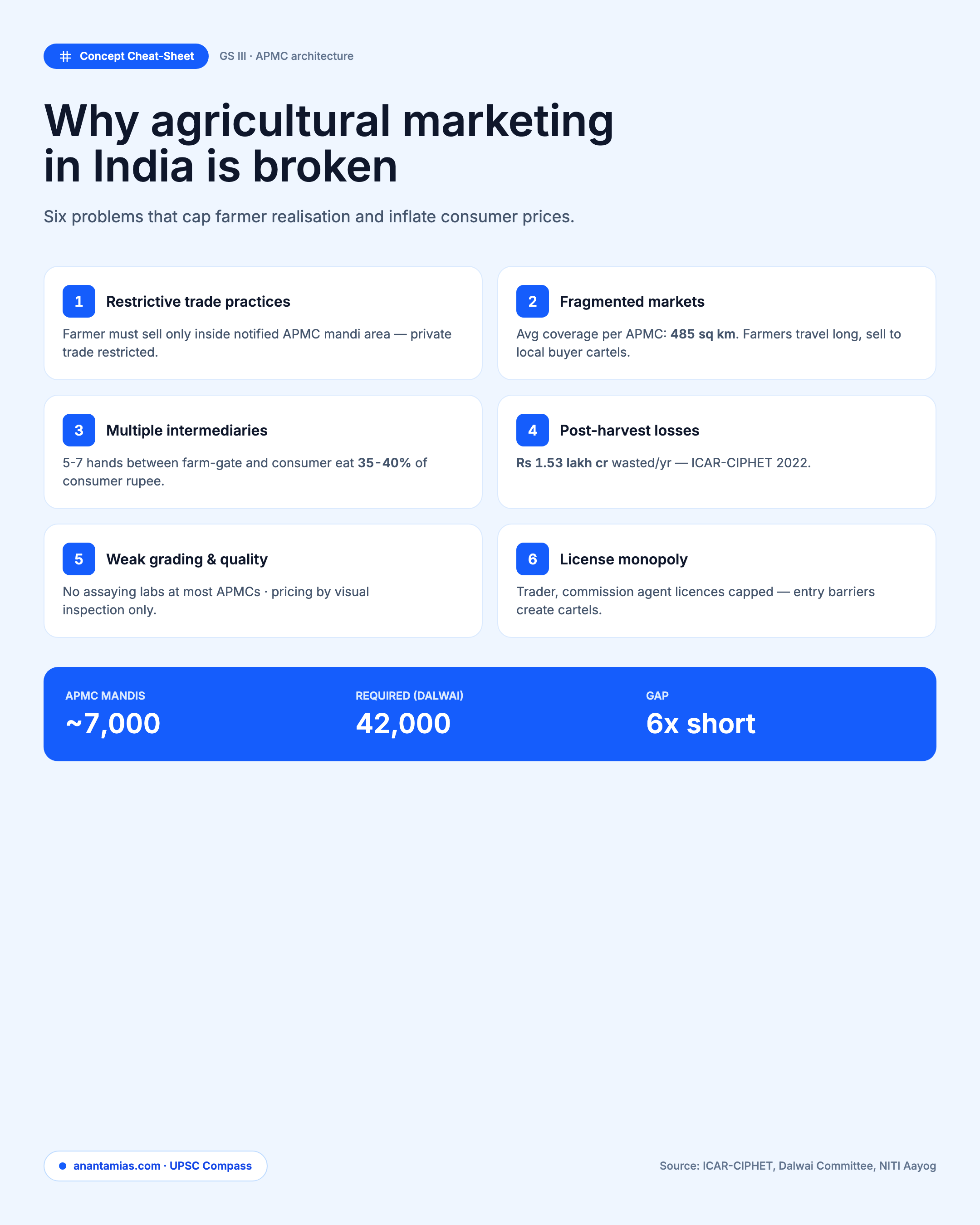
1. Restrictive Trade Practices
Farmers cannot sell outside notified mandis for crops covered under APMC. This kills the price discovery function — when only one buyer (the licensed aarthiya cartel) exists in the mandi, prices are set by the buyer, not the market.
2. Fragmented Markets
With ~2,500 principal APMCs and 5,000 sub-yards, India has tens of thousands of disconnected markets. A wheat farmer in Bihar has no access to Madhya Pradesh's higher prices — physical and regulatory walls block inter-mandi trade. Multiple intermediaries — commission agent, trader, wholesaler, semi-wholesaler, retailer — strip away 40-60% of the consumer rupee from the farmer's share.
3. Lack of Freedom to Farmers
A farmer cannot:
- Sell directly to a food processor (e.g., Britannia, ITC, Adani Wilmar).
- Bypass the local aarthiya for a higher offer in another district.
- Engage in long-term contracts with bulk buyers without state-mediated permission in many states.
4. Geographic Inadequacy
Average APMC coverage of 450 sq km vs Swaminathan's 80 sq km recommendation. The result: distress sales in villages outside mandi reach.
5. Anti-Small-Farmer Bias
86% of Indian farmers are small or marginal (less than 2 ha). Their marketable surplus is small — often a few quintals — making it uneconomical to transport to a distant mandi. The aarthiya buys from them at the village gate at 15-20% below mandi price.
6. Poor Infrastructure
APMCs typically lack:
- Cold storage and warehouses.
- Electronic auction platforms (despite e-NAM rollout).
- Grading and assaying labs.
- Drying yards and tarpaulins.
Resulting 20-25% post-harvest losses — perishables hit hardest.
7. Multiple Fees and Cesses
APMC fees, mandi cess, rural development cess, market development fee, commission, hamali (loading) charges — collectively 10-15% of produce value. These are paid by traders but passed on by squeezing farmer realisation. Punjab and Haryana levy 6.5-8.5% in fees alone — among the highest.
8. Post-Harvest Losses
Estimates from CIPHET-Ludhiana (ICAR) put post-harvest losses at:
- 20-25% for fruits and vegetables (most perishable).
- 5-10% for grains and pulses.
- Total losses worth ~Rs 92,000 crore per year.
Recent Reforms: The Mixed Story
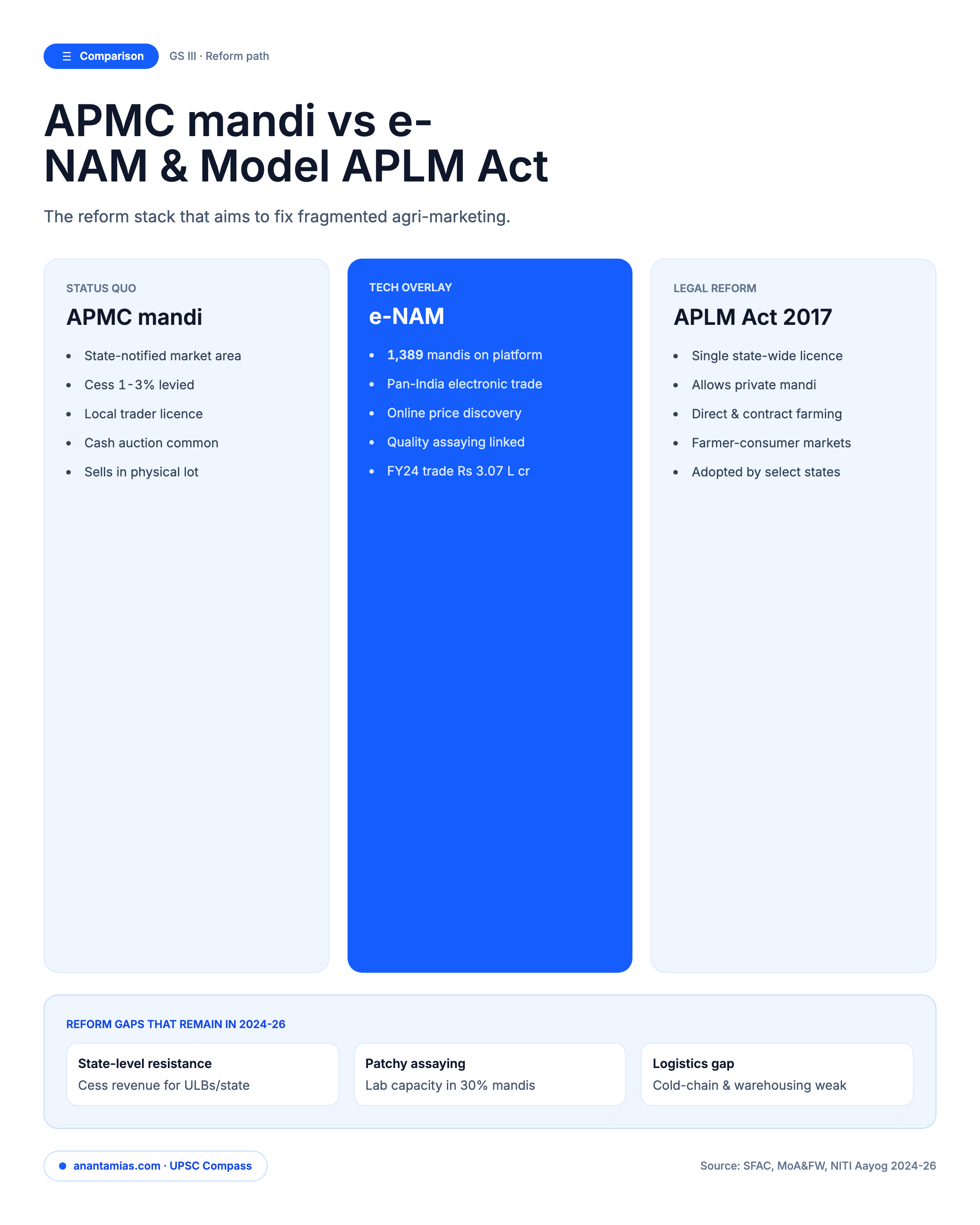
Model APMC Act, 2003
Introduced private mandis, direct marketing, contract farming. Adoption has been patchy — only ~12 states implemented full provisions.
Model Agricultural Produce and Livestock Marketing (APLM) Act, 2017
Allowed:
- Single licence valid across the state.
- e-trading and warehouse-based trading.
- National-level markets (precursor to e-NAM).
e-NAM (National Agriculture Market), 2016
Online trading platform connecting 1,389+ APMC mandis across 23 states/UTs as of 2025. Platform of Platforms (PoP) module added in 2022 to integrate logistics, fintech, FPOs.
Farm Laws 2020 and Their Repeal
The three Farm Acts of September 2020 — Farmers' Produce Trade and Commerce (Promotion and Facilitation) Act, Farmers (Empowerment and Protection) Agreement on Price Assurance and Farm Services Act, Essential Commodities (Amendment) Act — would have allowed inter-state trade, contract farming, and removed stock limits. Repealed in November 2021 after farmer protests centred in Punjab and Haryana.
Model Contract Farming Act, 2018
Provided framework for sponsor-producer agreements with dispute resolution. Several states notified their versions.
eNAM Platform of Platforms (2022)
Integrated logistics aggregators, fintech, warehousing, FPO modules — described in detail in the e-NAM article.
Recent Developments (2024-2026)
| Year | Update |
|---|---|
| 2024 | Ramesh Chand Committee report on MSP and marketing reforms |
| Budget 2024-25 | Rs 1,000 crore for Agriculture Infrastructure Fund (AIF) market linkages |
| 2024 | Digital Agriculture Mission integrates AgriStack with e-NAM for plot-level price discovery |
| 2025 | National Cooperative Policy rolls out 2 lakh PACS as multipurpose cooperatives; market linkage role |
| Budget 2025-26 | AIF corpus expanded to Rs 1.25 lakh crore; private mandis and modern storage co-funded |
| 2025-26 | Bharat Krishi Setu — new digital procurement portal piloted in 6 states |
| 2026 | Model APLMC Act 2026 under consultation — incorporates Ramesh Chand Committee inputs |
Reforms and Way Forward
- One nation, one mandi license — a single trader licence valid across India.
- De-list more crops from APMC schedule — fruits, vegetables, eggs, fish, milk should be fully outside APMC.
- Strengthen e-NAM — auction modules, FPO onboarding, warehouse-based trading, drone-image-based assaying.
- Modernise APMCs — pack-houses, dryers, cold storage, electronic weighing, transparent auction halls.
- Promote private mandis — competition with APMCs through Model APLM Act adoption.
- Empower FPOs and PACS — collective bargaining and aggregation reduce intermediary count.
- Contract farming framework — predictable, dispute-resolution-backed agreements with food processors.
- Decriminalise stock-holding — reform the Essential Commodities Act to remove penal stock limits except in genuine emergencies.
- Strengthen MSP procurement architecture beyond rice and wheat — include pulses, oilseeds, millets via PM-AASHA.
- Cold chain and reefer transport — under PMKSY-Sampada and AIF.
- Digital land + AgriStack + e-NAM linkage — plot-level pricing, procurement, advisory.
- Reduce mandi fees — bring total levies under 2% in line with international benchmarks.
Government Schemes and Budget Allocations (2025-26)
- e-NAM: Department of Agriculture; SFAC implementing agency.
- Agriculture Infrastructure Fund (AIF): corpus expanded to Rs 1.25 lakh crore.
- PM Kisan Sampada Yojana: cold storage and processing infrastructure; Rs 4,000 crore.
- PMFME (Micro Food Processing): One District One Product; Rs 700 crore.
- PM-AASHA (Pradhan Mantri Annadata Aay Sanrakshan Abhiyan): MSP support beyond rice/wheat.
- National Cooperative Policy: 2 lakh PACS as marketing nodes.
- Operation Greens: 22 perishable crops, price-stabilisation.
- Digital Agriculture Mission: e-NAM-AgriStack integration.
Mains Answer Hook
A balanced GS-III Mains answer should: (a) cite APMC's design failure vs intent — protector turned bottleneck; (b) quantify the cost — Rs 92,000 crore in post-harvest losses, 6% Shanta Kumar finding, 450 sq km vs 80 sq km recommendation; (c) trace the reform journey from Model APMC Act 2003 → Model APLM 2017 → e-NAM 2016 → Farm Laws 2020 → repeal 2021 → AIF and Digital Agriculture Mission; (d) propose a roadmap — single licence, de-listing, e-NAM PoP, FPO empowerment, AIF, contract farming.
Use the line: "India's marketing reform is not anti-mandi but pro-farmer-choice — competition between APMC and alternative channels is what drives price discovery."
Prelims Pointers
- APMC: Agricultural Produce Market Committee; ~2,500 principal mandis + 5,000 sub-yards.
- Grameen Haats: ~22,000 rural markets.
- Average APMC area: ~450 sq km vs Swaminathan recommendation of 80 sq km.
- Post-harvest losses: 20-25% in perishables; ~Rs 92,000 crore/year.
- Shanta Kumar Committee: only 6% of farmers benefit from MSP procurement.
- Model APLM Act: 2017.
- e-NAM: launched April 2016; 1,389+ mandis as of 2025.
- Farm Laws: passed September 2020; repealed November 2021.
- AIF corpus 2025-26: Rs 1.25 lakh crore.
- Essential Commodities Act: 1955.
FAQ on Indian Agricultural Marketing
Why are APMCs criticised?
For restrictive trade rules, fragmented markets, multiple fees, low geographic coverage, and a cartelised aarthiya system that suppresses farmer prices.
What is the Model APLM Act?
A 2017 model law allowing single state-wide licences, e-trading, warehouse-based trading, and national markets — adopted by some states.
What was the Shanta Kumar Committee finding?
That MSP procurement reaches only ~6% of farmers, mostly large landholders in Punjab, Haryana, MP.
Why were the Farm Laws of 2020 repealed?
Year-long farmer protests, mainly in Punjab and Haryana, demanding MSP guarantees and rejecting private trade liberalisation.
What are post-harvest losses in India?
20-25% of perishable horticulture; 5-10% of grains; total ~Rs 92,000 crore/year per CIPHET-ICAR.
How does e-NAM solve APMC problems?
By creating a unified online auction across mandis, e-NAM enables wider price discovery, electronic payment, and reduced intermediary costs.
Indian agricultural marketing is a textbook case of regulation-induced inefficiency. For UPSC, anchor your answers in the APMC architecture, the Shanta Kumar 6% finding, the Rs 92,000 crore loss, the e-NAM-AIF-Digital Agriculture stack, and the Farm Laws 2020-21 episode. That gives you both the structural critique and the reform roadmap.
Tell Google you want more of this.
Add Anantam IAS as a preferred sourceOne tap, and this site shows up more often in your own Top Stories, AI Overviews and AI Mode. Remove it any time.