
The terms "race" and "ethnicity" are often used interchangeably in everyday speech — and even in some policy documents — but they refer to fundamentally different things. Race is grounded in biology and phenotype; ethnicity is grounded in culture, language, religion, and shared history. UNESCO has held since 1950 that biological races among humans, in any pure form, do not exist, while ethnic identity is everywhere alive and politically consequential. For UPSC GS-I (Indian Society) and GS-II (vulnerable sections, communalism, regionalism), the distinction is not academic — it shapes policy on anti-racial discrimination, ethnic minority protection, the Durban debate on caste, Northeast ethnic conflict, and identity-based politics.
This guide unpacks the conceptual difference, the sociological theory, the Indian context (Aryan-Dravidian, Northeast, Adivasi, Pasmanda), the constitutional-legal framework, and the 2024-26 hot-button issues.
Definitions
| Aspect | Race | Ethnicity |
|---|---|---|
| Basis | Biological — skin colour, hair texture, facial structure, head shape | Cultural — shared language, religion, customs, history, ancestry |
| Inheritance | Phenotype inherited genetically | Culture taught and learned, transmitted via socialisation |
| Group boundaries | Closed — one cannot move between races | Fluid — individuals can shift via migration, conversion, marriage |
| Examples | Caucasian, Negroid, Mongoloid (classical typology) | Punjabi, Tamilian, Bengali, Gond, Pashtun, American |
| Scientific status | Biological "race" rejected by modern genetics | Robust, observable, self-defined |
| Indian usage | Andamanese (Negrito), NE (Mongoloid features) | Bengali, Tamilian, Bhil, Pasmanda, Sikh-Punjabi |
A Working Definition
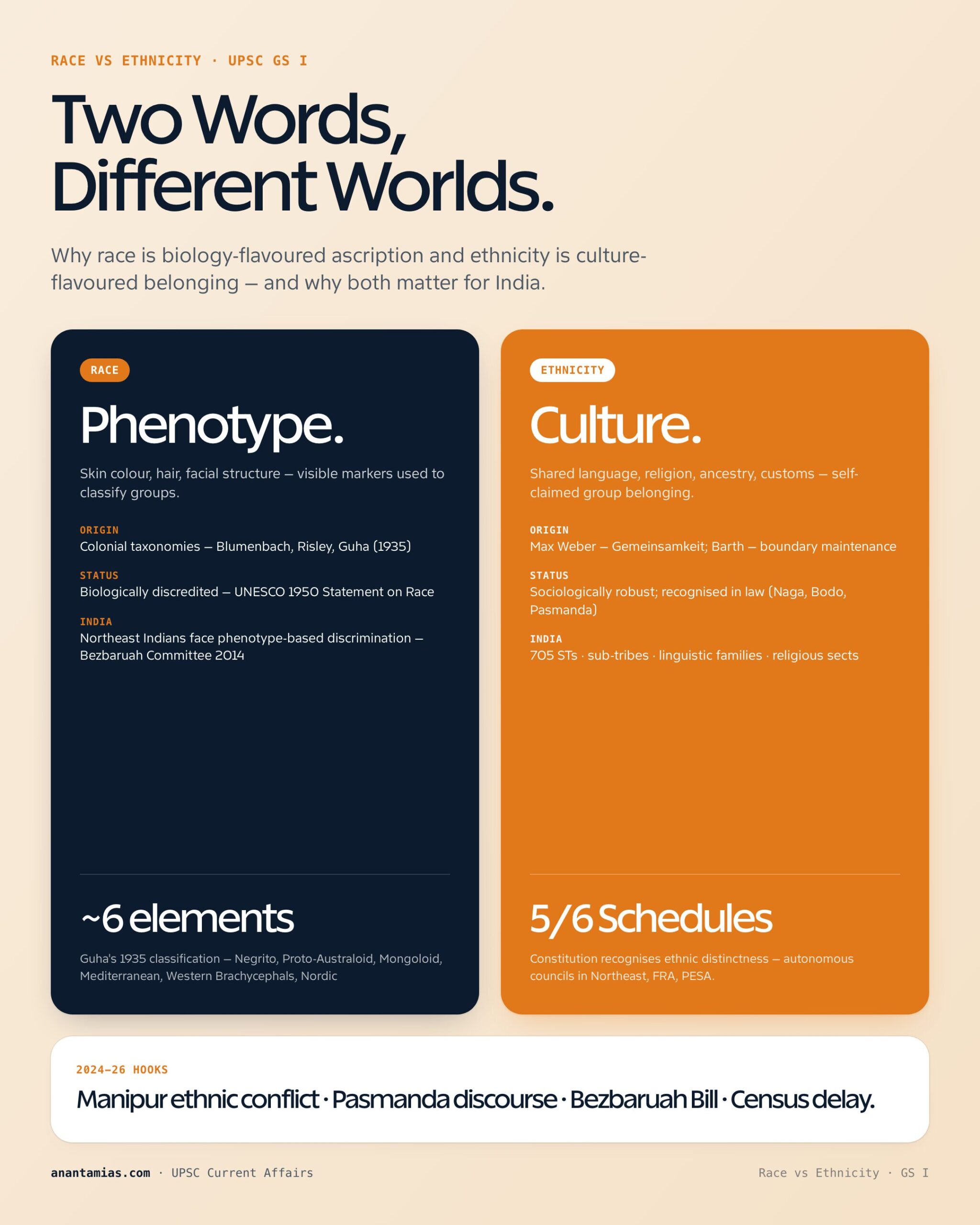
- Race (classical anthropology): A population sharing distinct heritable physical traits. Modern genetics shows clinal variation, not discrete races (UNESCO 1950, 1967, 1978).
- Ethnicity (Max Weber, Economy and Society, 1922): "Those human groups that entertain a subjective belief in their common descent because of similarities of physical type or of customs or both, or because of memories of colonisation and migration."
- Ancestry (genetics): Genetic-genealogical lineage — distinct from both race and ethnicity, used carefully in medical and population studies.
Sociological Theory: How Each Concept Was Built
Race
- Johann Friedrich Blumenbach (1795): Five-race classification — Caucasian, Mongolian, Ethiopian, American, Malayan.
- Joseph Arthur de Gobineau (1853): Essay on the Inequality of Human Races — pseudo-scientific racial hierarchy, foundation of European racism.
- Franz Boas (1911): Demolished biological-racism with cranial measurement studies of immigrants — environment shapes phenotype.
- UNESCO Statements on Race (1950, 1967, 1978): Biological race is not a valid scientific concept for human population.
- Population genetics (Lewontin 1972; Reich 2018): Within-group genetic variation greater than between-group variation; ancestry is a continuous gradient.
Ethnicity
- Max Weber: Ethnicity is a subjective belief in common descent — not necessarily biological.
- Fredrik Barth (1969): Ethnic Groups and Boundaries — ethnicity is about boundary maintenance, not internal cultural content.
- Clifford Geertz: "Primordial attachments" — ethnic ties as deep, given.
- Benedict Anderson: "Imagined community" — ethnic/national identity is socially constructed.
- Stuart Hall: Ethnicity is a discursive resource for politics.
Race vs Ethnicity: The Core Differences
| Dimension | Race | Ethnicity |
|---|---|---|
| Foundation | Biology | Culture |
| Acquisition | Inherited | Acquired & taught |
| Mobility | Closed group | Fluid, can shift |
| Examples | Negrito, Mongoloid (classical) | Bengali, Tamil, Naga |
| Discrimination form | Racism | Ethnic prejudice, communalism |
| International law | ICERD 1965 | Minority rights (e.g., UN Declaration 1992) |
| Indian context | Northeast, Africans | Linguistic-religious-tribal groups |
| Sociology | UNESCO rejects biological race | Weber, Barth, Geertz, Anderson |
Indian Context: Where the Distinction Matters
1. The Aryan-Dravidian Debate
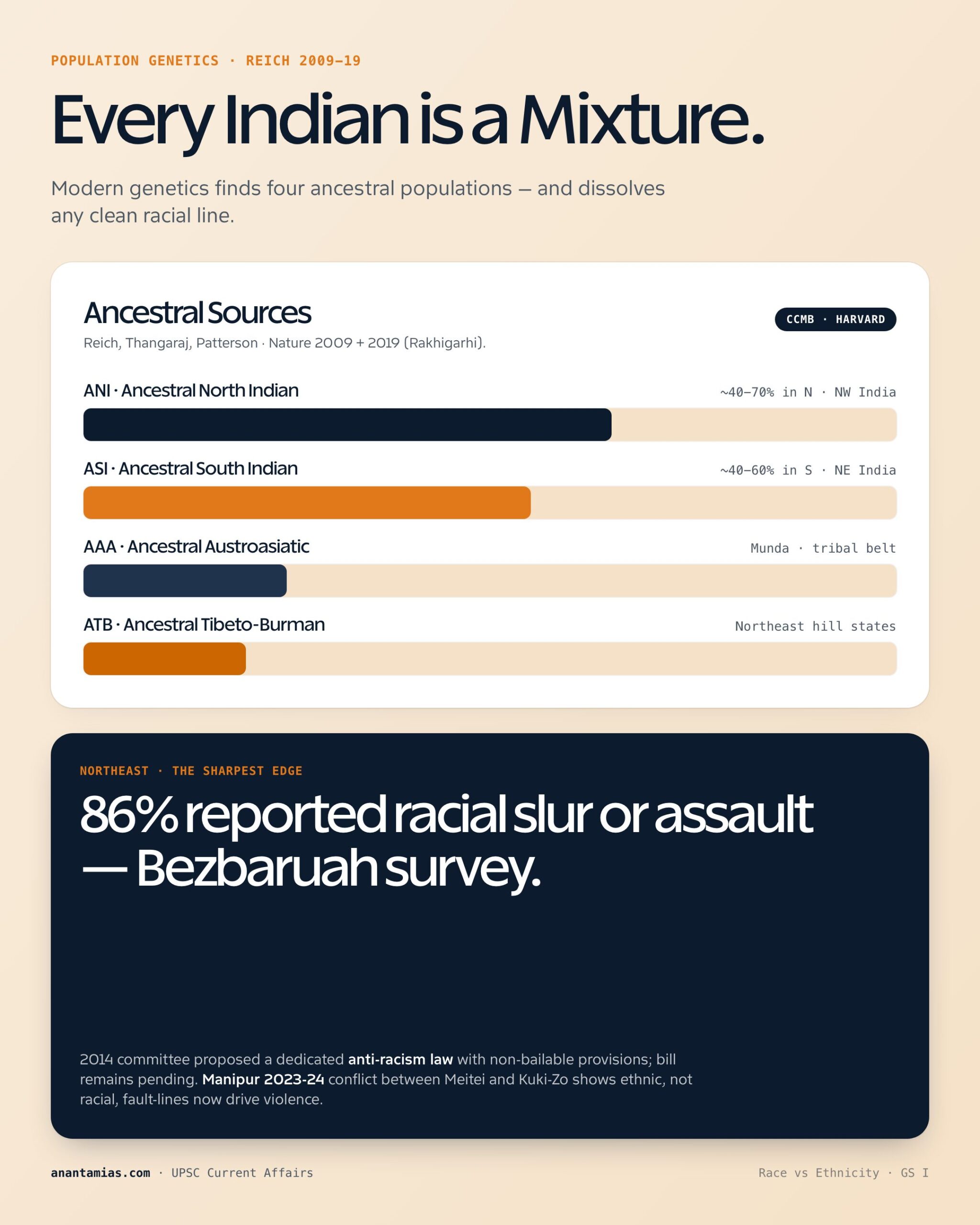
Once framed as a racial divide between fair-skinned northern "Aryans" and dark-skinned southern "Dravidians", modern population genetics (Reich et al., 2009; Narasimhan et al., 2019) shows that all Indians are admixed populations of Ancestral North Indians (ANI) and Ancestral South Indians (ASI) with differing proportions. The Aryan-Dravidian distinction is best understood as linguistic-cultural (ethnic), not racial.
2. Northeast: Phenotype Mistaken for Ethnicity
Northeast Indians have Tibeto-Burman ancestry and Mongoloid phenotypic features. In metro India, they face racial profiling ("Chinese," "corona") even though their ethnicity is Indian — Naga, Mizo, Manipuri, Khasi, Garo, Adi. The Bezbaruah Committee (2014) treated this as racial discrimination requiring a dedicated law.
3. Tribes (Adivasi) as Ethnicity
India's 8.6% Scheduled Tribe population (10.43 crore, Census 2011) is best classified ethnically — by language, religion, customs — even though some classifications mention "Proto-Australoid" or "Mongoloid" types. The Constitution speaks of "tribe", not "race".
4. Caste: Not Race (the Durban Debate)
At the 2001 Durban World Conference Against Racism, India argued that caste is not race because:
- Castes share the same gene pool as the surrounding population.
- Caste is a social-religious institution, not biological.
- Inclusion under ICERD would imply external interference in internal affairs.
Activist groups (NGOs like National Campaign on Dalit Human Rights) argued for inclusion. The UN Committee on Elimination of Racial Discrimination (CERD) in 2002 stated that descent-based discrimination falls within ICERD scope.
For UPSC: caste is best treated as a distinct, sui generis institution — protected under Articles 15, 17 — not equated with race.
5. Pasmanda Muslims: Ethnic + Caste Identity
The Pasmanda movement organises Dalit and OBC Muslims based on shared occupational and ethnic identities (Ajlaf, Arzal). It is an ethnic-class formation within Indian Islam, not a racial one.
6. Manipur 2023-24: An Ethnic Conflict
The Meitei vs. Kuki-Zo conflict in Manipur is ethnic, not racial — both groups have similar Mongoloid ancestry; the dispute is over land, ST status, religion (Hindu Meitei vs. Christian Kuki), and political access. The Supreme Court has monitored relief; over 220 dead and 60,000+ displaced.
Constitutional and Legal Framework
| Provision | Coverage |
|---|---|
| Article 14 | Equality before law |
| Article 15(1) | Prohibits discrimination on race and religion, caste, sex, place of birth |
| Article 15(2) | Equal access to public places |
| Article 16 | Equal opportunity in public employment |
| Article 17 | Abolition of untouchability |
| Article 21 | Right to life and dignity |
| Article 25-30 | Religious & minority cultural rights |
| Article 29-30 | Cultural and educational rights |
| Article 244 + Fifth/Sixth Schedule | Tribal autonomy |
| BNS 2023, Sec. 196-197 | Promoting enmity between groups (formerly IPC 153A, 153B) |
| SC/ST POA Act 1989, amended 2015 | Atrocity protection |
| Transgender Persons Act 2019 | Gender identity protection |
| ICERD 1965 | Race convention; India signatory |
| UN Declaration on Rights of Persons Belonging to National or Ethnic, Religious and Linguistic Minorities, 1992 | Ethnic rights |
Discrimination: Racism vs. Ethnocentrism / Communalism
- Racism: Hierarchical valuation based on perceived biological difference.
- Ethnic prejudice / communalism: Based on cultural difference — language chauvinism, religious nationalism, regional bias.
- Xenophobia: Hostility toward foreigners as ethnic outsiders.
- Caste-ism: Endogamy + hierarchy + occupational closure.
2024-26 Hot-Button Issues
- Manipur ethnic conflict (2023-24): Meitei-Kuki violence, SC monitoring, 220+ deaths.
- CAA implementation 2024: Religious-ethnic citizenship debates in Assam, Bengal, Northeast.
- Northeast racial discrimination: 86% NE students in Delhi reported racial slurs (NESCH 2024 survey).
- Pasmanda mobilisation: Reservation politics for backward Muslims, OBC sub-categorisation.
- Sub-classification within SCs: State of Punjab v. Davinder Singh (2024) — 7-judge SC verdict.
- Caste census 2027: Will sharpen the data base for caste vs. ethnic policy debates.
- Anti-Racial Discrimination Bill: Bezbaruah recommendation still pending.
- Africans in India: ~25,000 students; multiple race incidents prompt MEA advisories.
Government Initiatives
- Bezbaruah Committee implementation (partial): NE Special Police Unit, NESCH helpline.
- PM-DevINE (2022, ₹6,600 crore) for Northeast.
- Tribal Sub Plan / DAPST + PM-JANMAN (2023, ₹24,104 crore for PVTGs).
- Sahitya Akademi, Sangeet Natak Akademi, ICCR — ethnic-cultural promotion.
- National Commission for Minorities, NCST, NCSC, NCBC — institutional bodies.
- Eklavya Model Residential Schools (728 sanctioned).
- Mission Vatsalya, Mission Shakti — ethnic-gender intersection.
- NEP 2020 — multilingual, multicultural curriculum.
Sociological Perspectives Applied to India
| Theorist | Concept | Indian Application |
|---|---|---|
| Max Weber | Subjective belief in common descent | Bengali, Tamilian, Pasmanda |
| Fredrik Barth | Boundary maintenance | Naga vs. Kuki, Meitei vs. Kuki |
| Clifford Geertz | Primordial attachments | Linguistic-religious passions |
| Benedict Anderson | Imagined community | Pan-Indian nation, regional ethnos |
| Stuart Hall | Race as floating signifier | NE racialised in metros |
| Frantz Fanon | Internalised colonial racism | Skin-tone bias, matrimonial colourism |
| Andre Beteille | Race vs. caste | Caste is not race; Durban debate |
Data Snapshot (2024-26)
| Indicator | Value | Source |
|---|---|---|
| ST share | 8.6% | Census 2011 |
| Documented communities | 4,635 | People of India (ASI) |
| Manipur deaths | 220+ | MHA |
| NE students facing slurs (Delhi) | 86% | NESCH 2024 |
| African students in India | ~25,000 | MEA |
| Communal riot cases | 272 (2022) | NCRB |
| SC/ST atrocity cases | 57,582 (2022) | NCRB |
| Languages in 8th Schedule | 22 | Constitution |
Challenges
- Conceptual conflation of race and ethnicity in public discourse.
- No dedicated anti-racial discrimination law.
- Ethnic-religious overlap producing communalism and regionalism.
- Internal Northeast tensions (Manipur, Naga-Kuki, Bodo-Adivasi).
- Caste politics mistakenly racialised by international actors.
- Skin-colour bias in matrimony, advertising, films.
- Genetic disease load from prolonged endogamy.
Way Forward
- Enact a standalone Anti-Racial Discrimination Act (per Bezbaruah).
- Operationalise the distinction between race and ethnicity in textbooks, police training, journalism.
- Strengthen Article 15-17 enforcement with SC/ST POA Act and BNS 2023.
- Strengthen ethnic minority protections — language rights, religious freedom, autonomous councils.
- Promote inter-cultural dialogue through Ek Bharat Shreshtha Bharat, NEP 2020, and digital media.
- Inclusive AI and biometric systems that handle Mongoloid features and dark skin tones equitably.
- Continue principled engagement with ICERD reporting while defending caste as a distinct category.
Mains Hook
"Race is biology; ethnicity is biography." In light of this distinction, examine the legal and policy framework for combating discrimination based on race, ethnicity, and caste in India. (GS-I, 250 words, 15 marks)
Prelims Pointers
- Race vs Ethnicity (basics): Race = biological, closed; Ethnicity = cultural, fluid.
- UNESCO statement: 1950, 1967, 1978 — biological race rejected.
- ICERD: 1965, India is signatory.
- Durban Declaration 2001: India argued caste ≠ race.
- Bezbaruah Committee: 2014, anti-racial discrimination law recommendation.
- ANI-ASI: Reich et al., Nature 2009.
- Sixth Schedule: NE tribal autonomous councils.
- Manipur conflict: Meitei vs. Kuki-Zo, 2023-24.
- PM-JANMAN: Nov 2023, PVTGs, ₹24,104 crore.
- Davinder Singh case: 2024 SC, sub-classification within SCs.
The race-ethnicity distinction is one of those deceptively simple but heavily-loaded UPSC concepts. Mastering it lets you talk about Northeast violence, Manipur, Pasmanda politics, the Durban debate, and the Bezbaruah Committee with conceptual precision — rather than collapsing them into one undifferentiated "identity" term.
Tell Google you want more of this.
Add Anantam IAS as a preferred sourceOne tap, and this site shows up more often in your own Top Stories, AI Overviews and AI Mode. Remove it any time.





