Radioactive pollution is the release of radioactive substances into the air, water, soil, or living tissues in quantities that threaten human health and the environment. Unlike most pollutants, its harmful effects persist for decades to millennia because radioactive atoms decay slowly, emitting ionising radiation that damages DNA and living cells long after the original contamination event. For UPSC aspirants, radioactive pollution spans Environment (GS III), Disaster Management (GS III), and Science and Technology, and it ties directly to India's nuclear programme, climate policy, and international agreements.
What Is Radioactive Pollution
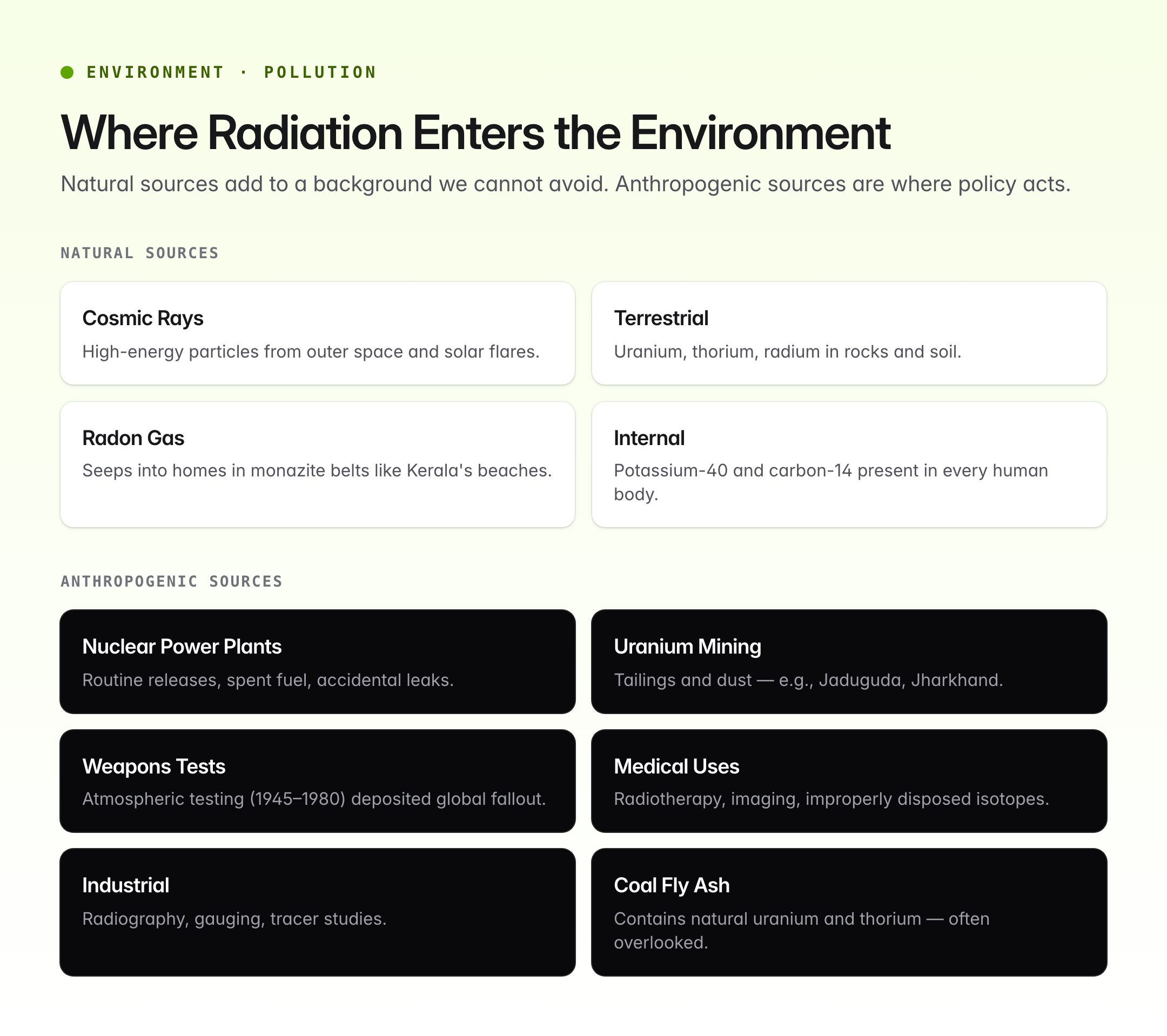
Radioactive pollution occurs when unstable radionuclides such as uranium-235, plutonium-239, caesium-137, iodine-131, and strontium-90 escape containment and contaminate the environment. These atoms emit alpha particles, beta particles, gamma rays, or neutrons as they decay. The measure of decay rate is the half-life, the time taken for half of a given amount of the isotope to decay.
| Isotope | Half-life | Main hazard |
|---|---|---|
| Iodine-131 | 8 days | Thyroid cancer |
| Caesium-137 | 30 years | Soft tissue, long-term soil contamination |
| Strontium-90 | 29 years | Bone, bone marrow (mimics calcium) |
| Plutonium-239 | 24,100 years | Lung cancer if inhaled |
| Uranium-238 | 4.5 billion years | Kidney toxicity, low-level radiation |
Sources of Radioactive Pollution
Sources fall into natural and anthropogenic (human-made) categories.
Natural Sources
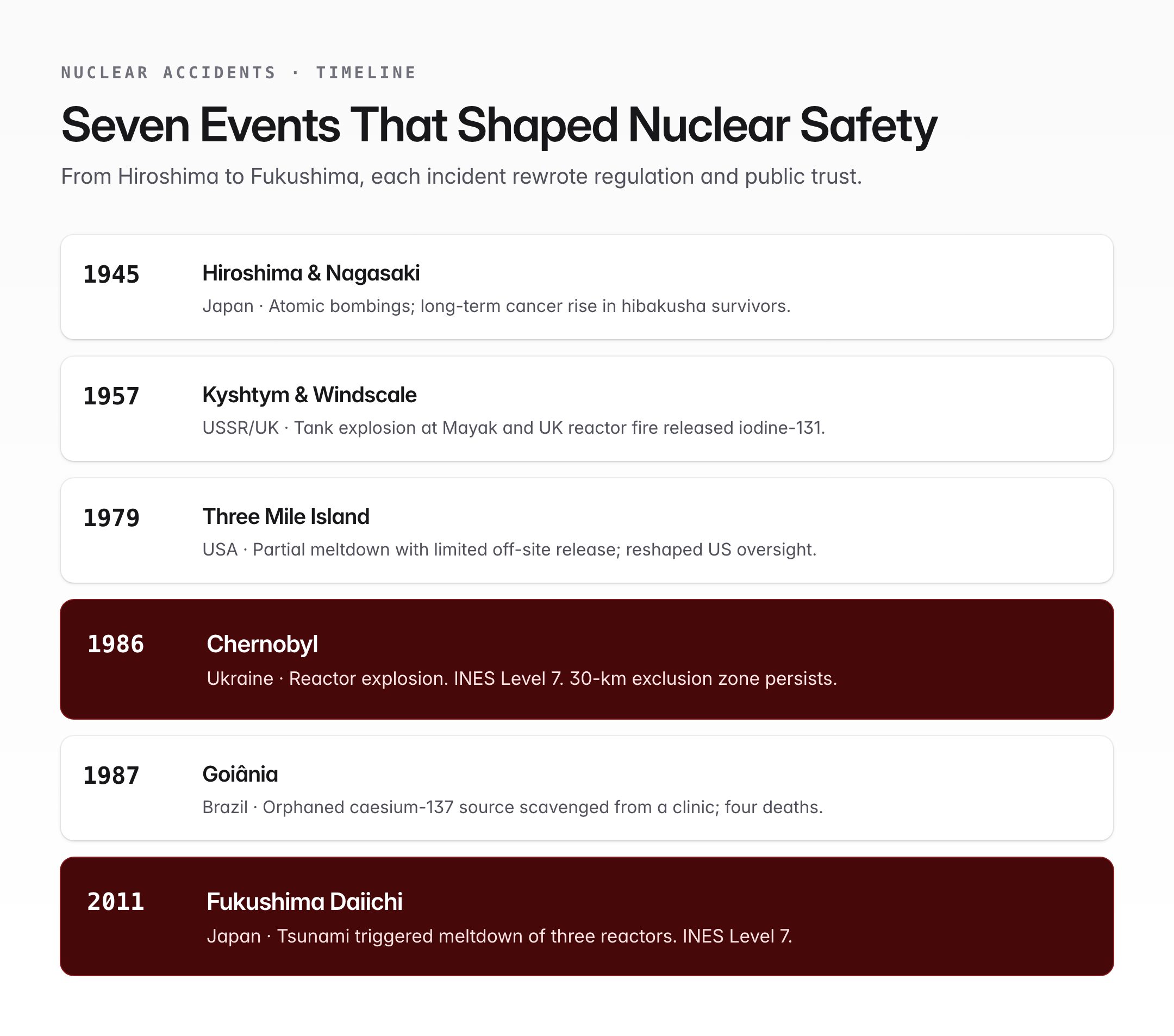
- Cosmic rays from outer space.
- Terrestrial radiation from uranium, thorium, and radium in rocks and soil.
- Radon gas, a decay product of uranium, which seeps into homes in granite-rich regions such as Kerala's monazite-bearing beaches and parts of Karnataka.
- Internal radiation from potassium-40 and carbon-14 naturally present in the human body.
Anthropogenic Sources
| Source | Description |
|---|---|
| Nuclear power plants | Routine low-level releases and accidental leaks; spent fuel storage. |
| Uranium mining and milling | Tailings, dust, and contaminated water (e.g., Jaduguda, Jharkhand). |
| Nuclear weapons testing | Atmospheric tests between 1945–1980 deposited global fallout. |
| Medical uses | Radiotherapy, diagnostic imaging, improperly disposed medical isotopes. |
| Industrial applications | Radiography in non-destructive testing, gauging, and tracer studies. |
| Research reactors and laboratories | Small but concentrated contamination risks. |
| Nuclear accidents | Catastrophic releases from reactor failures or transport accidents. |
| Coal-fired power plants | Fly ash contains natural uranium and thorium. |
Effects of Radioactive Pollution
Radiation damages living tissue by ionising atoms in cells. Effects are classified as deterministic (severity increases with dose above a threshold) or stochastic (probability increases with dose, no threshold).
Health Effects on Humans
- Acute Radiation Syndrome (radiation sickness) — nausea, vomiting, hair loss, bone marrow failure, and death at high doses (above 1 Sievert).
- Cancers — leukaemia, thyroid, breast, lung, and bone cancers from long-term exposure.
- Genetic damage — mutations in germ cells that can be inherited.
- Congenital defects — foetal malformations from in-utero exposure.
- Reduced immunity and cardiovascular disease.
Ecological Effects
- Bioaccumulation of radionuclides in food chains (e.g., strontium in milk, caesium in fish).
- Sterility and mutations in plants and animals.
- Soil contamination that can persist for centuries.
- Water pollution affecting aquatic ecosystems, especially cold-water coolant discharges from reactors.
Major Radioactive Pollution Incidents
| Incident | Year | Country | Key facts |
|---|---|---|---|
| Hiroshima and Nagasaki | 1945 | Japan | Atomic bombings; long-term cancer increase in survivors (hibakusha). |
| Kyshtym disaster | 1957 | USSR | Tank explosion at Mayak plutonium plant; Level 6 on INES. |
| Windscale fire | 1957 | UK | Reactor fire released iodine-131. |
| Three Mile Island | 1979 | USA | Partial meltdown; limited off-site release. |
| Chernobyl | 1986 | Ukraine (USSR) | Reactor explosion; Level 7 on INES; 30-km exclusion zone remains; tens of thousands of long-term cancer cases attributed. |
| Goiânia accident | 1987 | Brazil | Orphaned caesium-137 source scavenged from a clinic; four deaths. |
| Fukushima Daiichi | 2011 | Japan | Tsunami-triggered meltdown of three reactors; Level 7 on INES; ongoing tritiated water discharge debate. |
Chernobyl remains the worst civil nuclear disaster. A flawed reactor design and a botched safety test caused a steam explosion and graphite fire, spreading fallout across Belarus, Ukraine, Russia, and much of Europe. Fukushima showed that even well-regulated modern reactors are vulnerable to cascading natural disasters; the 9.0 magnitude earthquake and 14-metre tsunami disabled cooling systems and caused three core meltdowns.
Radioactive Pollution in India
India has a civilian nuclear programme with 22 operating reactors (as of the mid-2020s) and several under construction. Known concerns include:
- Jaduguda, Jharkhand — allegations of elevated birth defects and cancers near uranium mining and tailings dams.
- Kudankulam, Tamil Nadu — public protests over safety and coolant discharge.
- Tarapur, Maharashtra — ageing reactor and spent fuel storage concerns.
- Kalpakkam, Tamil Nadu — cooling-water discharge into the Bay of Bengal.
- Monazite-rich beaches of Kerala — among the highest natural background radiation levels in the world.
Regulatory Framework in India
| Body / law | Role |
|---|---|
| Atomic Energy Act, 1962 | Primary legislation; places atomic energy under central control. |
| Atomic Energy Regulatory Board (AERB, 1983) | Safety regulator for nuclear and radiation facilities. |
| Department of Atomic Energy (DAE) | Policy, R&D, and operation of nuclear facilities. |
| Nuclear Power Corporation of India Ltd (NPCIL) | Operates commercial nuclear power plants. |
| Bhabha Atomic Research Centre (BARC) | Research, fuel cycle, waste management. |
| Environment (Protection) Act, 1986 | Broader environmental safeguards. |
| Civil Liability for Nuclear Damage Act, 2010 | Liability framework for nuclear accidents. |
India is a party to the Convention on Nuclear Safety, the Joint Convention on the Safety of Spent Fuel Management, and the Comprehensive Nuclear-Test-Ban Treaty (signed but not ratified). It is a member of the International Atomic Energy Agency (IAEA) and adheres to IAEA safeguards on civilian facilities under the 2008 India–IAEA agreement.
Prevention and Management
- Containment through multi-layered reactor design and shielding.
- Safe waste disposal via vitrification and deep geological repositories.
- Emergency preparedness including evacuation plans, potassium iodide prophylaxis, and exclusion zones.
- Monitoring networks of dosimeters and environmental sensors.
- Decommissioning protocols for end-of-life reactors.
- International cooperation through IAEA safeguards and peer reviews.
UPSC Relevance
Radioactive pollution is a recurring theme in the Prelims through questions on half-lives, isotopes (iodine-131, caesium-137), nuclear accidents, and Indian regulatory bodies such as the AERB, DAE, BARC, and NPCIL. In Mains GS Paper III, it links to questions on nuclear energy as a clean-energy option, India’s three-stage nuclear programme, the Civil Liability for Nuclear Damage Act, and disaster management frameworks after Fukushima. In GS Paper II, expect questions on India’s international nuclear diplomacy — the Indo–US nuclear deal, NSG membership bid, and IAEA safeguards. Essay aspirants can use radioactive pollution to explore the trade-off between decarbonisation and safety in the climate debate. Connect it with bioaccumulation, biomagnification, persistent pollutants, and Stockholm Convention themes. Also study thorium-based reactors and small modular reactors (SMRs) as emerging answers to the pollution–energy dilemma.
Tell Google you want more of this.
Add Anantam IAS as a preferred sourceOne tap, and this site shows up more often in your own Top Stories, AI Overviews and AI Mode. Remove it any time.