A radioisotope is an unstable form of an element whose nucleus has the wrong balance of protons and neutrons and decays over time, releasing energy as radiation. Most of the elements you can name have at least one radioactive form. Some occur in nature, like uranium-238 in rocks or carbon-14 in the upper atmosphere. Many more are produced artificially by bombarding stable isotopes with neutrons in a reactor or with charged particles in a cyclotron.
The decay rate of any radioisotope is fixed by its physics. The half-life, the time after which half the original atoms have decayed, ranges from microseconds for some artificial isotopes to billions of years for naturally occurring uranium and thorium. That predictability is what makes radioisotopes useful. A doctor can dose a patient with iodine-131 knowing exactly how the radiation will fall off. An engineer can label a pipeline tracer and find a leak hours later. A geologist can date a fossil to within a few thousand years using carbon-14.
For UPSC, the topic is in nuclear technology under GS-III, intersects health system and agriculture, and connects to the institutional landscape of the Department of Atomic Energy. This article explains the physics of radioactive decay, the major medical, industrial, and agricultural applications of key isotopes, the production infrastructure in India under BARC and BRIT, and the policy questions around access and waste management.
What a Radioisotope Is
An atomic nucleus contains protons and neutrons, held together by the strong nuclear force. The number of protons defines the element. The number of neutrons defines the isotope. Carbon, for example, has six protons by definition. The most common form, carbon-12, has six neutrons; carbon-13, also stable, has seven; carbon-14, radioactive, has eight.
A radioisotope decays because its combination of protons and neutrons is energetically unfavourable. The nucleus rearranges itself, often by emitting a particle, to reach a more stable configuration. The energy released in the rearrangement appears as the kinetic energy of the emitted particle and as electromagnetic radiation.
The three main modes of decay are alpha, beta, and gamma. Alpha decay emits a helium-4 nucleus, two protons and two neutrons bound together. Beta decay emits an electron or positron and a neutrino, with one neutron converting to a proton or vice versa. Gamma decay emits a high-energy photon as the nucleus drops from an excited state to the ground state.
The penetrating power and damage profile of these three forms of radiation differ sharply. Alpha particles are heavy and slow, stopping within a few centimetres of air or a sheet of paper, but extremely damaging if emitted inside the body. Beta particles are lighter and faster, passing through paper but stopped by aluminium foil. Gamma rays are pure electromagnetic radiation and require dense shielding like lead or thick concrete to attenuate.
The Concept of Half-Life
Half-life is the most important parameter of any radioisotope. It is the time after which half the atoms in a sample have decayed. After two half-lives, a quarter remain. After three, an eighth. The decay is exponential, not linear.
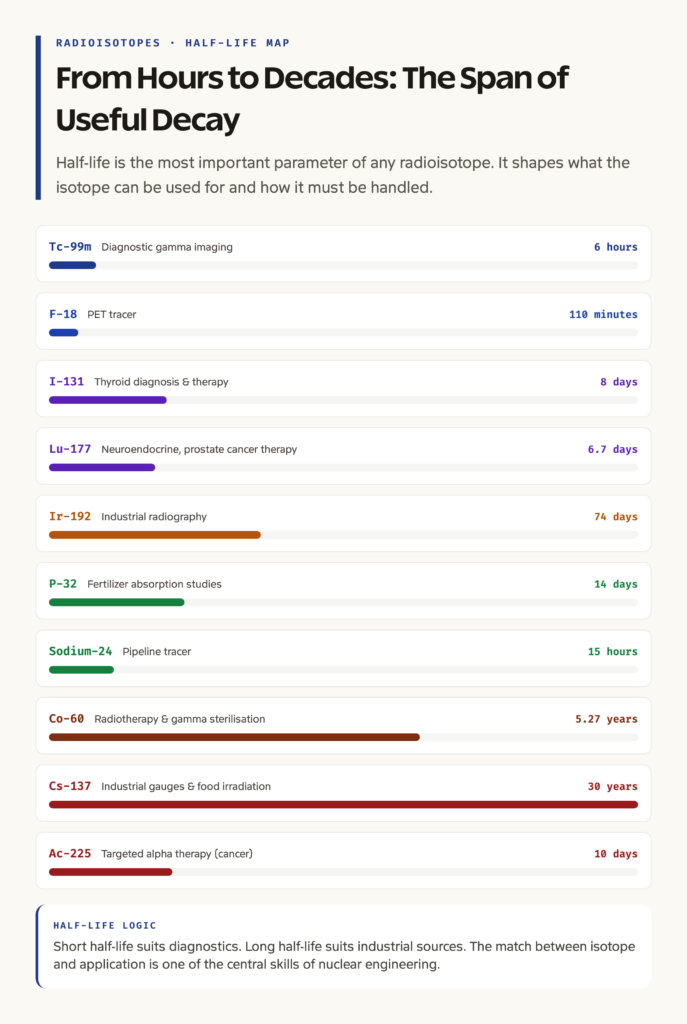
Half-lives range across an extraordinary span. Polonium-214 has a half-life of 164 microseconds. Technetium-99m, the workhorse of nuclear medicine imaging, has a half-life of just over 6 hours. Iodine-131 has a half-life of about 8 days. Cobalt-60 has a half-life of 5.27 years. Caesium-137 has a half-life of 30 years. Carbon-14 has a half-life of 5,730 years. Uranium-238 has a half-life of 4.5 billion years.
The half-life shapes what the isotope can be used for. A short half-life is desirable in medical diagnostics because the radiation dose to the patient drops quickly after the test. A long half-life is necessary for industrial sources that need to last years between replacements. The matching of isotope to application is one of the central skills of nuclear engineering.
Medical Diagnostics
The single most important medical radioisotope is technetium-99m, used in over 30 million diagnostic procedures globally each year. Tc-99m has a 6-hour half-life and emits a gamma photon at 140 kiloelectronvolts that is well-suited to imaging by gamma cameras. It can be chemically attached to a wide range of biological molecules, allowing imaging of bone, heart, kidney, brain, lung, and tumours.
Tc-99m is produced from molybdenum-99, which has a 66-hour half-life. Mo-99 is delivered to hospital nuclear medicine departments in generator units, where the daughter Tc-99m can be eluted on demand. The global Mo-99 supply has been a chronic vulnerability because most production has historically come from a small number of ageing research reactors.
Iodine-131 is used in low doses for thyroid function tests, exploiting the natural concentration of iodine in the thyroid. The patient takes a small amount of radioactive iodine, and a gamma camera images the gland’s uptake. Other diagnostic isotopes include thallium-201 for cardiac imaging, gallium-67 for inflammation imaging, and fluorine-18 fluorodeoxyglucose for positron emission tomography of cancer and neurology.
PET imaging is a separate diagnostic branch using positron-emitting isotopes. F-18, the most common, has a 110-minute half-life and is produced by hospital cyclotrons. The combination of PET with computed tomography in PET-CT scanners has become the workhorse of cancer staging.
Medical Therapy
Therapeutic radioisotopes deliver radiation to destroy diseased cells, particularly cancer cells. The choice of radiation type depends on the disease.
Iodine-131, in higher doses than the diagnostic version, is used to treat thyroid cancer and hyperthyroidism. Because iodine concentrates naturally in thyroid tissue, the radiation is delivered specifically to the target. The treatment has been used since the 1940s and remains a textbook example of targeted radionuclide therapy.
Lutetium-177 is the rising star of nuclear medicine. It is a beta emitter with a 6.7-day half-life and is used in two major therapies. Lu-177 DOTATATE treats neuroendocrine tumours by attaching the isotope to a peptide that binds somatostatin receptors expressed by these tumours. Lu-177 PSMA-617 treats metastatic prostate cancer by attaching the isotope to a molecule that binds prostate-specific membrane antigen. Both therapies received FDA approval in recent years and are being scaled in India through BARC and clinical partnerships.
Actinium-225 is the next frontier. It is an alpha emitter, and alpha particles deposit much more energy per unit length than beta particles, so they kill targeted cells more efficiently with less collateral damage. Targeted alpha therapy with Ac-225 is in advanced clinical trials for prostate cancer, leukemia, and other malignancies. The supply of Ac-225 is currently very limited globally, and BARC has been working on production routes.
Cobalt-60 has been used for external beam radiotherapy since the 1950s. The Bhabhatron, an indigenous teletherapy machine developed by BARC and AERB, uses Co-60 to treat tumours and has been deployed in cancer hospitals across India and to several African and Asian countries. Linear accelerator technology has largely replaced Co-60 in modern radiotherapy in advanced countries, but Co-60 machines remain valuable where reliability and lower cost matter.
Yttrium-90 microspheres are used in selective internal radiation therapy for liver cancer, with the spheres delivered through the hepatic artery to lodge in tumour vasculature. Phosphorus-32 has been used historically for polycythemia vera and bone metastases.
Industrial Applications
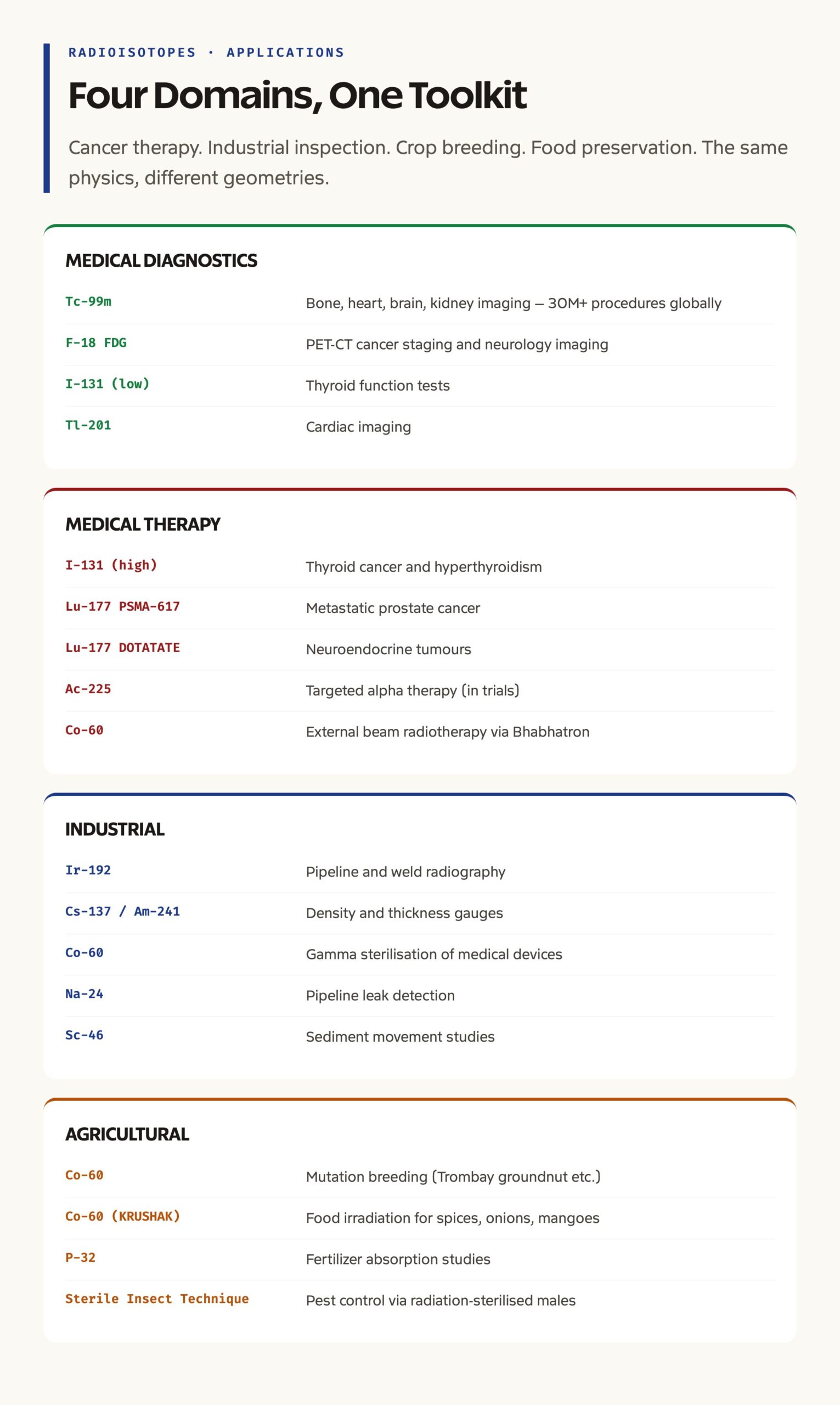
Industrial radioisotope use is large and largely invisible to the public. Cobalt-60 and caesium-137 are used in industrial radiography, where their gamma rays pass through metal welds and are recorded on film or digital detectors to look for cracks and porosity. Iridium-192, with a 74-day half-life, is used widely for portable radiography of pipelines, pressure vessels, and structural welds.
Radioisotope tracers identify leaks, blockages, and flow patterns in pipelines and industrial systems. A small amount of a short-lived gamma emitter, often sodium-24 with a 15-hour half-life or bromine-82, is injected into the flow. Detectors outside the pipeline track the tracer’s progress, and any anomaly identifies the problem.
Density and thickness measurement gauges using sealed sources of caesium-137, americium-241, or krypton-85 are standard in paper mills, steel rolling lines, and chemical plants. The radiation passes through the material; the absorption tells you the thickness or density. The same technology is used in oil-well logging, where the gauges descend into bore holes and characterise the surrounding rock.
Gamma irradiation, using Co-60 sources, is used to sterilise medical devices, syringes, surgical sutures, and implants. India has commercial gamma irradiation plants at several locations. Food irradiation uses Co-60 to extend shelf life and eliminate insects and pathogens; the BRIT-supported KRUSHAK facility at Lasalgaon, near Nashik, irradiates onions, mangoes, and spices for export.
Agricultural Applications
In agriculture, radioisotopes serve research, breeding, and pest control roles. Phosphorus-32, a beta emitter with a 14-day half-life, is used to study how plants absorb fertiliser. The isotope is added to the fertiliser, and the uptake into the plant is measured at different stages, helping to optimise application rates and timing.
Mutation breeding uses gamma radiation, usually from Co-60 sources, to induce random mutations in seeds. Most mutations are deleterious, but some produce useful traits, including disease resistance, drought tolerance, and improved yield. Several Indian rice, wheat, groundnut, and pulse varieties have been developed through mutation breeding at BARC, with the cultivar Trombay Groundnut and several mutant rices in commercial use.
Sterile insect technique uses radiation to sterilise male insects, which are then released to mate with wild females, producing no offspring and reducing the pest population. The technique has been used against fruit flies and screwworms internationally. India has explored the technique against fruit flies in mango and citrus belts.
Soil hydrology studies use sodium-24 and tritium to track water movement through soil and rock formations, helping to design irrigation systems and groundwater recharge schemes.
India’s Production Infrastructure
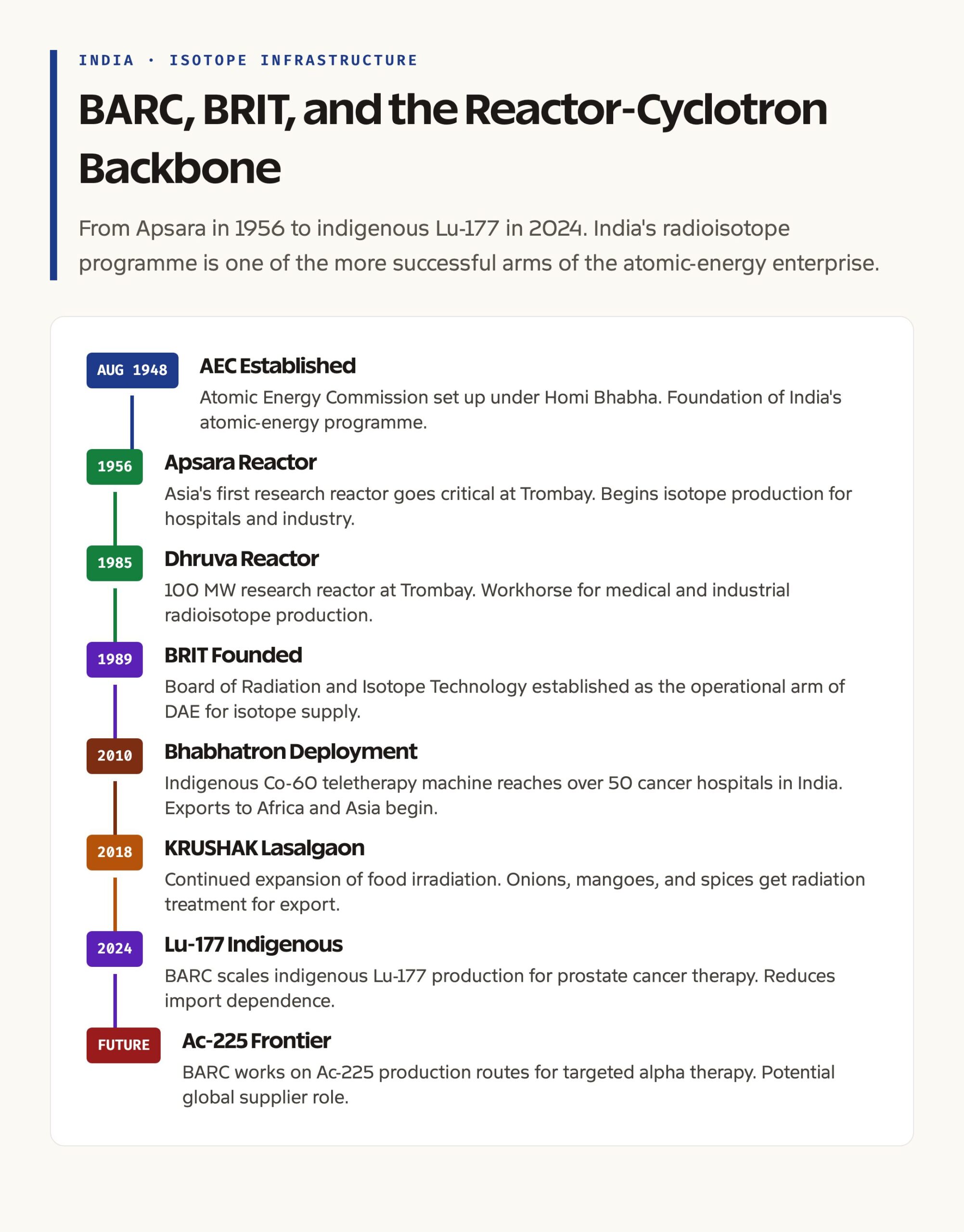
India’s radioisotope programme is run primarily by the Bhabha Atomic Research Centre, BARC, with the Board of Radiation and Isotope Technology, BRIT, as the operational arm. BRIT is the public-sector unit under the Department of Atomic Energy that produces and supplies radioisotopes, sealed sources, and labelled compounds to hospitals, industry, and research institutions across India.
The major reactor sources are Apsara-U, the upgraded version of India’s first research reactor at Trombay, and the Dhruva research reactor, also at Trombay, which is the workhorse for medical and industrial isotope production. The Kalpakkam Mini Reactor, KAMINI, is a small uranium-233 fuelled reactor that produces specialised isotopes. The Cyclotron Project at the Variable Energy Cyclotron Centre, Kolkata, produces shorter-lived cyclotron isotopes including F-18 and other PET tracers.
BARC has expanded medical isotope production substantially in recent years, including indigenous Lu-177 supply for the growing demand from prostate cancer therapy, Ac-225 development for targeted alpha therapy, and the establishment of a regional medical cyclotron network in major Indian cities. The Bhabhatron Co-60 teletherapy machine, designed by BARC and built in partnership with industry, has been deployed in over 50 cancer hospitals in India and in countries including Mongolia, Vietnam, and several African nations.
The institutional architecture also includes the Atomic Energy Regulatory Board, AERB, which regulates the use of radioisotopes for safety, the Tata Memorial Centre, which is the lead clinical institution for nuclear oncology, and the Indira Gandhi Centre for Atomic Research, IGCAR, at Kalpakkam.
Safety, Waste, and Regulation
Working with radioisotopes requires strict safety procedures. Radiation workers in India are monitored by the Personnel Monitoring Service of BARC through thermoluminescent dosimeter badges and quarterly dose reporting. Radiation protection follows the ALARA principle, As Low As Reasonably Achievable, with internal limits well below international thresholds.
Radioactive waste is segregated by activity level. Short-lived medical waste, such as used Tc-99m vials, can be held in shielded storage until decay reduces activity to background levels and then disposed of as ordinary medical waste. Higher-activity industrial sealed sources require return to suppliers or controlled disposal at the dedicated radioactive waste management sites operated by BARC at Trombay, Tarapur, and Kalpakkam.
The orphan source problem has been a recurring concern globally. Industrial radiography sources or medical teletherapy heads that are lost, stolen, or improperly disposed of can cause serious accidents. The 2010 Mayapuri incident in Delhi, where a discarded Co-60 source from a research institution caused multiple radiation injuries among scrap workers, prompted strengthening of source-control regulations under AERB.
The Atomic Energy Act 1962 is the basic legal instrument, supplemented by the Atomic Energy (Radiation Protection) Rules 2004 and several specific regulations on industrial radiography, medical isotope use, and consumer products containing radioisotopes.
Prelims Pointers
A radioisotope is an unstable isotope that decays by emitting alpha, beta, or gamma radiation. Half-life is the time for half the atoms to decay. Technetium-99m has a 6-hour half-life and is the most-used medical diagnostic isotope. Iodine-131 has an 8-day half-life and is used for thyroid function tests in low doses and thyroid cancer therapy in high doses. Lutetium-177 is used for neuroendocrine tumour therapy, Lu-177 DOTATATE, and metastatic prostate cancer therapy, Lu-177 PSMA-617. Actinium-225 is used in targeted alpha therapy. Cobalt-60 has a 5.27-year half-life and is used for external beam radiotherapy via the Bhabhatron, food irradiation, and industrial radiography. Iridium-192 is the standard portable radiography isotope. The Board of Radiation and Isotope Technology, BRIT, is the operational arm of DAE for radioisotope supply. BARC produces medical isotopes from the Dhruva reactor at Trombay. AERB regulates radiation safety. The KRUSHAK facility at Lasalgaon irradiates spices and onions.
Mains Practice Questions
- Radioisotopes are central to modern medicine, industry, and agriculture, but production capacity remains uneven globally. Examine India’s role and the policy framework supporting it. (250 words)
- Compare the medical applications of beta-emitting and alpha-emitting therapeutic radioisotopes, with reference to Lu-177 and Ac-225, and discuss the implications for cancer treatment in India. (250 words)
- Discuss the regulatory and safety architecture for radioisotope use in India, with reference to the Atomic Energy Act, AERB, and recent incidents. (250 words)
Way Forward
India’s radioisotope programme has performed well historically, but the demand from cancer hospitals, industrial users, and research institutions is growing faster than the production base. The first priority is reactor and cyclotron capacity. A new high-flux research reactor, dedicated to isotope production rather than fundamental research, has been proposed in DAE planning documents and would significantly expand domestic supply.
A second priority is medical access. The growth of nuclear oncology in India is concentrated in a few major cities. Rolling out Lu-177 PSMA therapy and Lu-177 DOTATATE therapy to tier-2 cities requires both production scale and trained nuclear medicine specialists, an area where India has fewer than a thousand certified physicians for a population of 1.4 billion. The DAE-supported regional cancer centre network needs continued expansion.
A third priority is the alpha therapy frontier. Ac-225 is in extreme global short supply, and any country with a credible production route gains a strategic advantage. BARC’s work on Th-229/Ac-225 generators and on alternative production from Th-232 should be sustained, with potential to make India a major global supplier as the therapy becomes standard care.
A fourth is industrial source security. The recurring problem of orphan sources requires both stronger tracking through digital registers and stricter disposal protocols. The recent strengthening of AERB’s regulations is welcome but enforcement and inspection capacity needs to keep pace with the growth in source numbers.
For the broader nuclear energy ecosystem, the radioisotope programme is a high-impact, low-controversy success story that demonstrates the practical value of India’s atomic-energy investment. Sustained funding and institutional support will keep it that way.
Frequently Asked Questions
What is a radioisotope?
A radioisotope is an unstable form of a chemical element whose nucleus has the wrong balance of protons and neutrons and decays over time by emitting radiation. Some radioisotopes occur naturally; many are produced artificially in reactors or cyclotrons.
What are alpha, beta, and gamma radiation?
Alpha radiation consists of helium-4 nuclei, slow but heavy. Beta radiation consists of electrons or positrons, faster and lighter. Gamma radiation is electromagnetic, like very high-energy X-rays, and the most penetrating. Alpha is stopped by paper; beta by aluminium foil; gamma requires lead or concrete shielding.
What is half-life?
Half-life is the time after which half the atoms in a sample of a radioisotope have decayed. Half-lives range from microseconds to billions of years and are a fixed property of each isotope. They determine the suitability of an isotope for medical, industrial, or research applications.
What is technetium-99m used for?
Technetium-99m is the most widely used medical diagnostic radioisotope. With a 6-hour half-life and a 140 keV gamma photon, it can be attached to many biological molecules and used to image bone, heart, kidney, brain, lung, and tumours through gamma cameras. Over 30 million Tc-99m procedures are performed globally each year.
What is lutetium-177?
Lutetium-177 is a beta-emitting therapeutic radioisotope with a 6.7-day half-life. Lu-177 DOTATATE treats neuroendocrine tumours by binding somatostatin receptors. Lu-177 PSMA-617 treats metastatic prostate cancer by binding prostate-specific membrane antigen. Both therapies are increasingly used in India.
What is the Bhabhatron?
The Bhabhatron is an indigenous Co-60-based teletherapy machine designed by BARC and AERB for cancer radiotherapy. It has been deployed in over 50 cancer hospitals across India and exported to several Asian and African countries. It provides reliable, lower-cost radiotherapy compared to linear accelerator alternatives.
What does BRIT do?
The Board of Radiation and Isotope Technology, BRIT, is the public-sector operational arm of the Department of Atomic Energy that produces and supplies radioisotopes, sealed sources, labelled compounds, and equipment to medical, industrial, and research users in India and abroad.
What is food irradiation?
Food irradiation uses gamma rays, typically from Co-60 sources, to extend shelf life, eliminate insects, and reduce pathogens in foods such as spices, onions, mangoes, and grains. The KRUSHAK facility at Lasalgaon near Nashik is one of the major Indian food irradiation plants and supports export of irradiated produce.
What is targeted alpha therapy?
Targeted alpha therapy uses alpha-emitting radioisotopes attached to molecules that bind cancer cells. Alpha particles deposit a large amount of energy over a very short distance, killing cancer cells with minimal damage to surrounding tissue. Actinium-225 is the leading isotope for this approach, with global supply currently very limited.
Who regulates radioisotope use in India?
The Atomic Energy Regulatory Board, AERB, under the Department of Atomic Energy, regulates the safe use of radioisotopes in India. The Atomic Energy Act 1962 and the Atomic Energy (Radiation Protection) Rules 2004 are the primary legal instruments, supplemented by specific regulations for medical, industrial, and research applications.
Tell Google you want more of this.
Add Anantam IAS as a preferred sourceOne tap, and this site shows up more often in your own Top Stories, AI Overviews and AI Mode. Remove it any time.