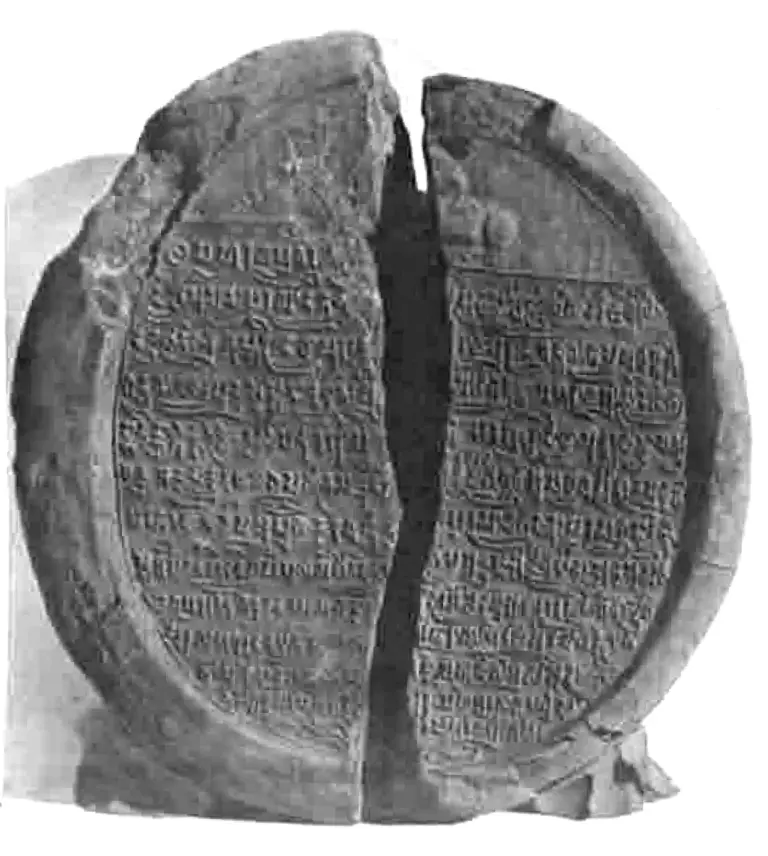
Rigveda key facts for UPSC are easy to memorize badly. That is the problem. Most aspirants remember “oldest Veda, 10 mandalas, 1,028 hymns” and then stop. UPSC does not stop there.
The exam usually tests the Rigveda through small traps: which mandalas are older, why the tenth mandala is treated as later, where the Gayatri Mantra appears, what the Purusha Sukta implies, which deity dominates the hymns, and what the text tells us about early Vedic society.
So read the Rigveda like an evidence file. It is not just a religious text. For Ancient History, it is the main source for reconstructing the Early Vedic Period, roughly c. 1500-1000 BCE, especially the society of the Sapta-Sindhu region.
Rigveda Key Facts for UPSC: Quick Revision
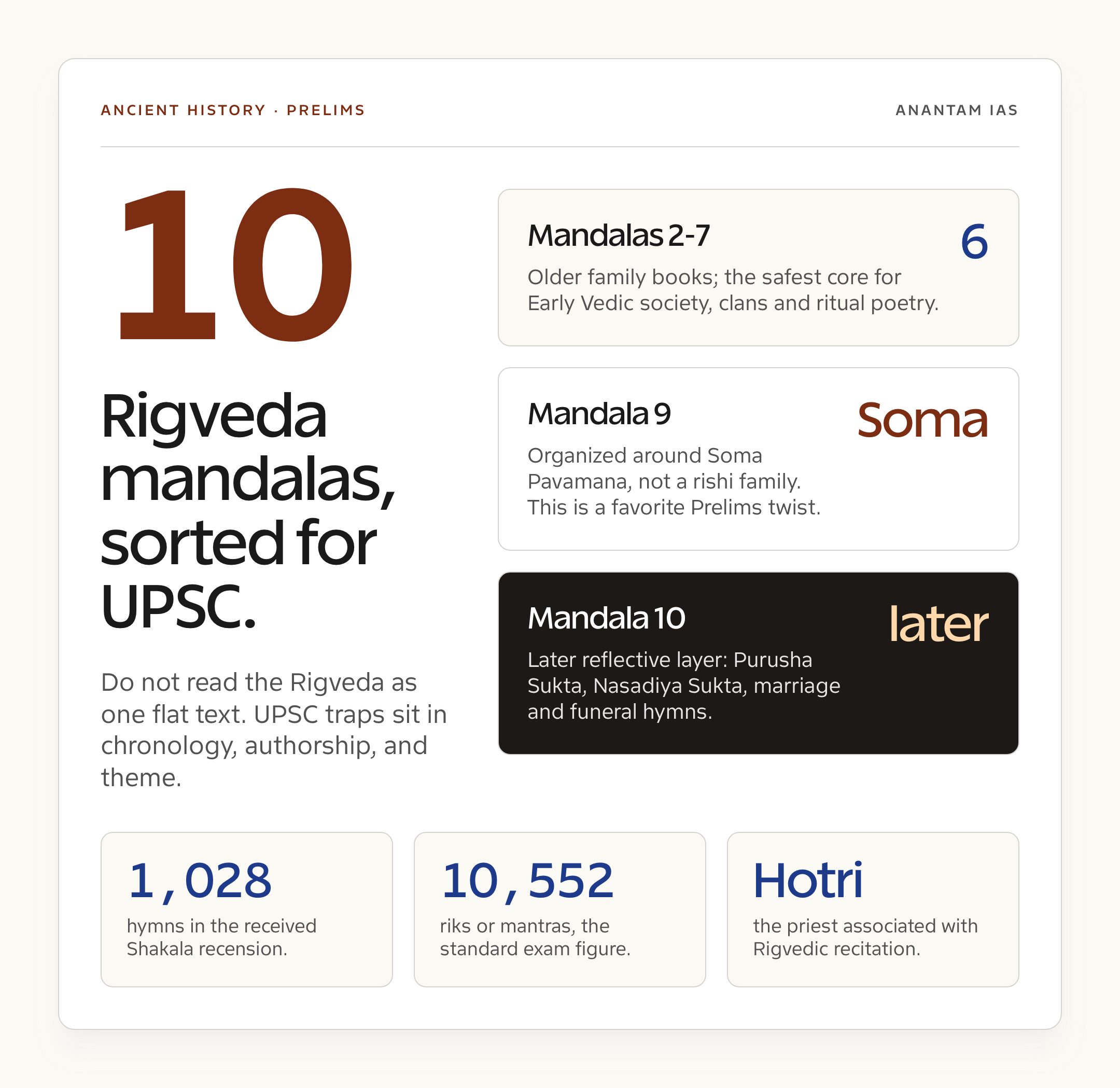
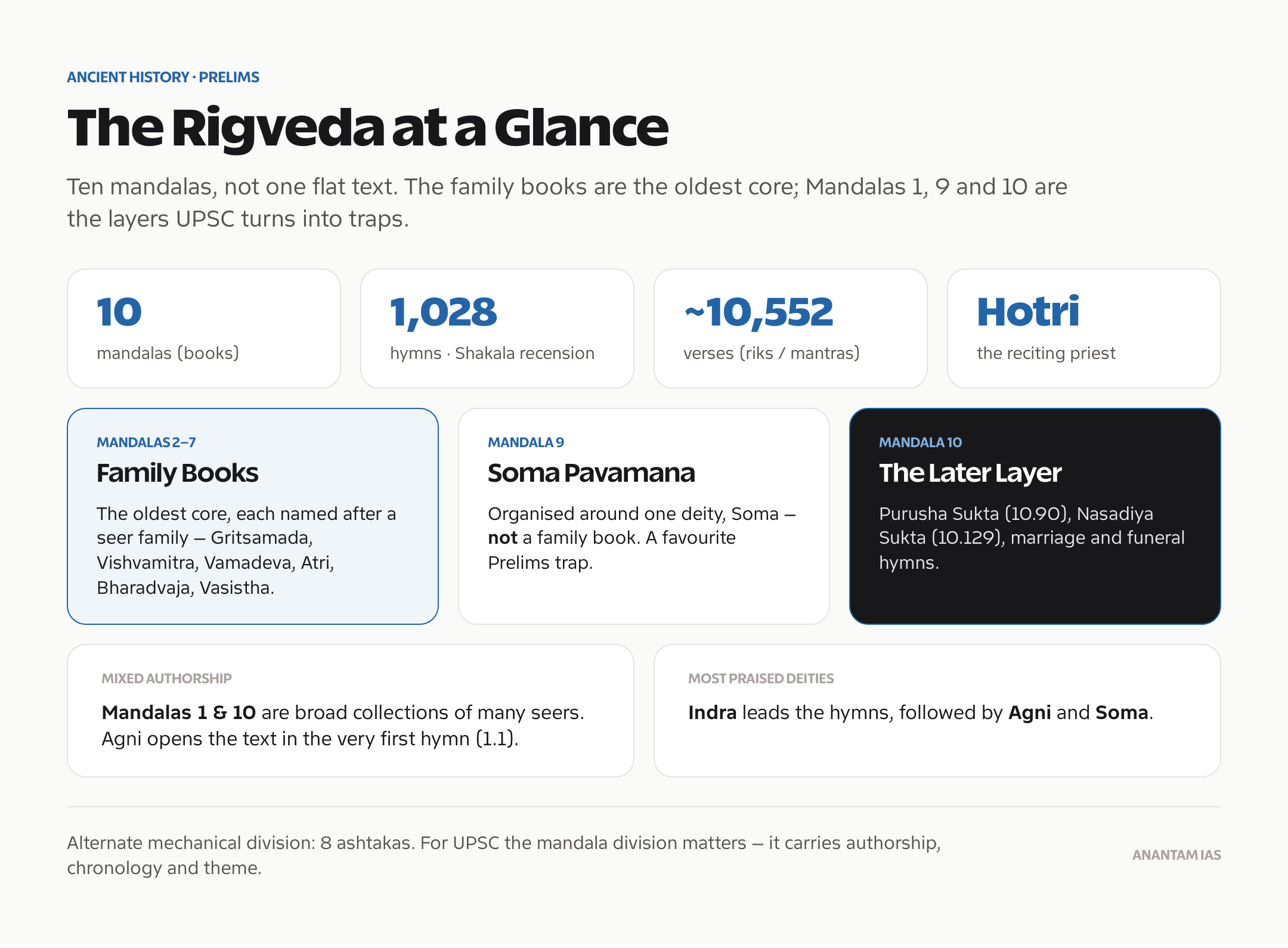
The Rigveda is the oldest Veda and the main literary source for the Early Vedic period. It contains 1,028 hymns arranged in 10 mandalas, preserved through a powerful oral tradition before manuscript transmission.
Keep these facts tight. They are Prelims material:
- Meaning of Rigveda: “Knowledge of verses” or “knowledge of hymns”; from ric or rik, meaning a praise verse.
- Language: Vedic Sanskrit, older than Classical Sanskrit.
- Date: Commonly placed around c. 1500-1000 BCE for the core Rigvedic phase, though exact dating is debated.
- Region: Sapta-Sindhu, the north-western region around the Indus and its tributaries.
- Number of mandalas: 10.
- Number of hymns: 1,028 suktas in the received Shakala recension.
- Number of verses: Usually given as 10,552 riks or mantras.
- Oldest portion: Mandalas 2 to 7, called the family books.
- Later portions: Mandalas 1, 8, 9 and 10 are generally treated as later than the core family books.
- Most praised deity: Indra, followed by Agni and Soma.
- Priest associated with Rigveda: Hotri, the reciting priest.
- Associated Upanishads: Aitareya Upanishad and Kaushitaki Upanishad.
- Associated Brahmanas: Aitareya Brahmana and Kaushitaki or Shankhayana Brahmana.
- Important shakhas: Shakala and Bashkala, with Shakala being the main surviving recension.
- UNESCO status: Rigveda manuscripts from India were included in UNESCO’s Memory of the World Register in 2007.
For the wider timeline, read this with the Vedic Period: Early and Later Vedic Society article. That page gives the big shift from pastoral, tribal Rigvedic society to the more settled Later Vedic world.
UPSC Note: Do not treat the Rigveda as a single-date text. The family books, Mandalas 2-7, are older. Mandala 10 contains later and more speculative hymns, including Purusha Sukta and Nasadiya Sukta.
Why the Rigveda Matters for UPSC
The Rigveda matters because it is the earliest literary window into Vedic society, polity, economy and religion. UPSC uses it to test both factual recall and historical interpretation.
For Prelims, it appears through names, pairs and statements. For Mains, it helps answer questions on early Vedic society, women, pastoral economy, political assemblies, religious ideas and the evolution of the varna system.
The smart way to study it is to divide the content into three layers:
- Textual facts: mandalas, hymns, recensions, suktas, associated texts.
- Historical facts: geography, society, economy, polity, religion.
- Exam interpretation: what changed between Early Vedic and Later Vedic periods.
That last layer is where marks sit. A candidate who only memorizes numbers may clear a basic factual question. A candidate who understands why the Purusha Sukta matters can handle Prelims and Mains both.
For example, the Purusha Sukta in Mandala 10 mentions the four varnas. But since Mandala 10 is treated as later, historians use it carefully. It suggests that rigid social hierarchy was emerging, not that a fully developed birth-based caste system existed from the beginning of the Rigvedic age.
That is exactly the kind of nuance UPSC likes.
Structure of the Rigveda
The Rigveda is arranged mainly into 10 mandalas, but it also has an alternate mechanical division into 8 ashtakas. For UPSC, the mandala division is more important because it tells us something about authorship, chronology and content.
The basic hierarchy is:
- Mandala: Book or section.
- Sukta: Hymn.
- Rik or Richa: Individual verse.
- Pada: Metrical foot within a verse.
The received Shakala recension contains 1,017 regular hymns plus 11 Valakhilya hymns, usually counted together as 1,028 hymns. This matters because some sources give slightly different explanations while still arriving at the familiar exam number.
Mandala-Wise Table for UPSC
Use this table as your central revision sheet. If you remember only one table from this article, make it this one.
| Mandala | Hymns | Traditional Association | UPSC Importance |
|---|---|---|---|
| 1 | 191 | Mixed authorship | Opening hymns, Agni begins the text, later than core family books |
| 2 | 43 | Gritsamada family | Family book, among the oldest layers |
| 3 | 62 | Vishvamitra family | Gayatri Mantra, river hymn, family book |
| 4 | 58 | Vamadeva family | Family book, old core layer |
| 5 | 87 | Atri family | Family book, hymns to Agni, Indra, Maruts and others |
| 6 | 75 | Bharadvaja family | Family book, old core layer |
| 7 | 104 | Vasistha family | Battle of Ten Kings, Sudas, Parushni river |
| 8 | 103 | Kanva and others | Mixed material, includes Valakhilya hymns |
| 9 | 114 | Soma hymns | Dedicated to Soma Pavamana, arranged by deity |
| 10 | 191 | Mixed later material | Purusha Sukta, Nasadiya Sukta, marriage and funeral hymns, social ideas |
The family books, Mandalas 2-7, form the older core. They are called family books because each is associated with a priestly family of seers. This does not mean every verse was written by one person. It means the hymns were preserved and organized through family lineages.
Mandalas 1 and 10 are broad collections with many seers. Mandala 9 is unusual because it is organized around one deity, Soma, rather than one family. That is a favorite Prelims trap.
Rigveda Recensions and Oral Tradition
The Rigveda survived because of disciplined oral transmission, not because ancient India had printing presses or mass manuscript culture. The text was memorized with sound, accent and sequence treated as sacred.
The two important Rigvedic shakhas are:
- Shakala Shakha: The main surviving recension. The standard 1,028-hymn Rigveda comes through this line.
- Bashkala Shakha: Known in tradition and scholarship, but not preserved in the same complete way as Shakala.
The oral tradition used different recitation methods to protect the text:
- Samhita Patha: Continuous recitation with sandhi.
- Pada Patha: Word-by-word recitation, separating compounds and sandhi.
- Krama Patha: Sequential paired recitation.
- Jata and Ghana Patha: More complex recitation styles used later to preserve order and sound.
For UPSC, you do not need to master Vedic phonetics. But you should know why the Rigveda is considered one of the best-preserved ancient oral texts. The sound structure mattered. Accent mattered. Sequence mattered.
This is also why calling the Rigveda “just mythology” is lazy history. It is a layered oral archive. It preserves ritual, poetry, clan memory, river geography, political conflict, social vocabulary and religious imagination.
Important Rigvedic Hymns and Suktas
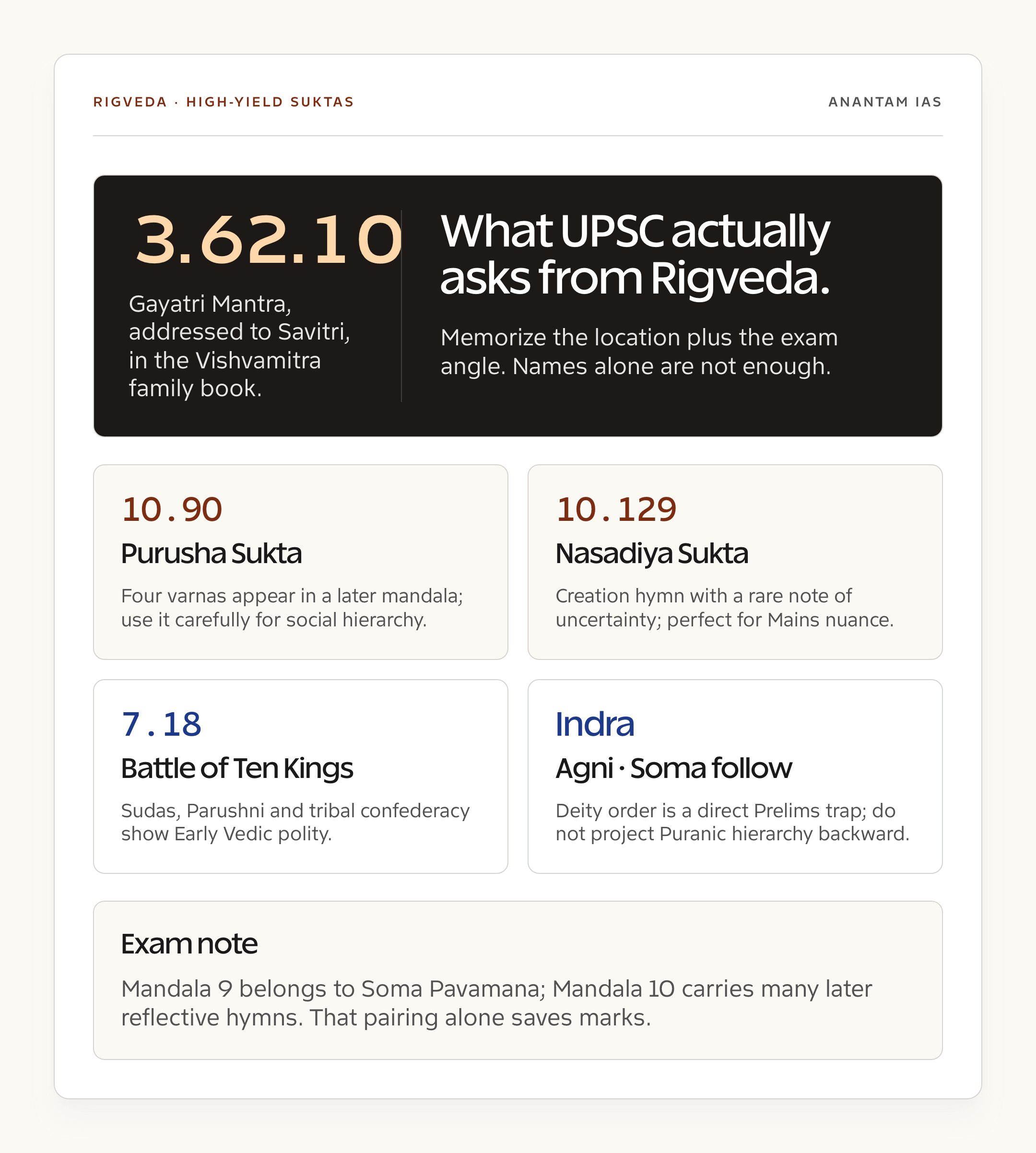
Certain Rigvedic hymns are disproportionately important for UPSC. Learn them by mandala number, theme and historical value, not as isolated Sanskrit trivia.
Here is the exam-first list:
| Hymn / Sukta | Location | Main Idea | UPSC Angle |
|---|---|---|---|
| Agni Sukta | Rigveda 1.1 | Opening hymn to Agni | Agni as priest, messenger and sacrificial fire |
| Gayatri Mantra | Rigveda 3.62.10 | Prayer to Savitri | Most famous Vedic mantra, Vishvamitra family |
| River Hymn of Vishvamitra | Rigveda 3.33 | Vipash and Sutudri rivers | Geography, movement, river crossing tradition |
| Battle of Ten Kings | Rigveda 7.18 | Sudas and tribal confederacy | Early Vedic polity and inter-tribal conflict |
| Frog Hymn | Rigveda 7.103 | Frogs after rain compared to chanting priests | Nature poetry, satire, monsoon imagery |
| Soma Hymns | Mandala 9 | Soma Pavamana | Entire mandala dedicated mainly to Soma |
| Yama-Yami Dialogue | Rigveda 10.10 | Dialogue hymn | Samvada Sukta, early dramatic form |
| Dice Hymn | Rigveda 10.34 | Lament of a gambler | Social life, moral warning, secular hymn |
| Purusha Sukta | Rigveda 10.90 | Cosmic being and four varnas | Social hierarchy, later layer, varna debate |
| Marriage Hymn | Rigveda 10.85 | Wedding ritual | Family, marriage, ritual continuity |
| Funeral Hymns | Rigveda 10.16, 10.18 | Cremation and afterlife | Early mortuary practices |
| Pururavas-Urvashi Dialogue | Rigveda 10.95 | Dialogue between mortal and celestial woman | Early dramatic and narrative element |
| Hiranyagarbha Sukta | Rigveda 10.121 | Golden embryo, cosmic origin | Speculative theology |
| Vak Sukta / Devi Sukta | Rigveda 10.125 | Speech as cosmic power | Feminine sacred speech, later Shakta importance |
| Nasadiya Sukta | Rigveda 10.129 | Creation, doubt, existence | Philosophical speculation, agnostic tone |
The Two Hymns You Must Not Confuse
The Purusha Sukta and Nasadiya Sukta both appear in Mandala 10, but they do very different work.
- Purusha Sukta: Explains the universe through the sacrifice of the cosmic being Purusha. It mentions the four varnas: Brahmana, Rajanya or Kshatriya, Vaishya and Shudra.
- Nasadiya Sukta: Questions creation itself. It begins from non-being and being, and ends with a rare uncertainty about whether even the highest overseer knows how creation happened.
One is social-cosmic ordering. The other is philosophical questioning.
That contrast is important. The Rigveda is not one flat text. It contains praise poetry, ritual hymns, clan memory, social imagination and speculation. That is why it can support both Prelims facts and Mains analysis.
Rigvedic Deities: What to Remember
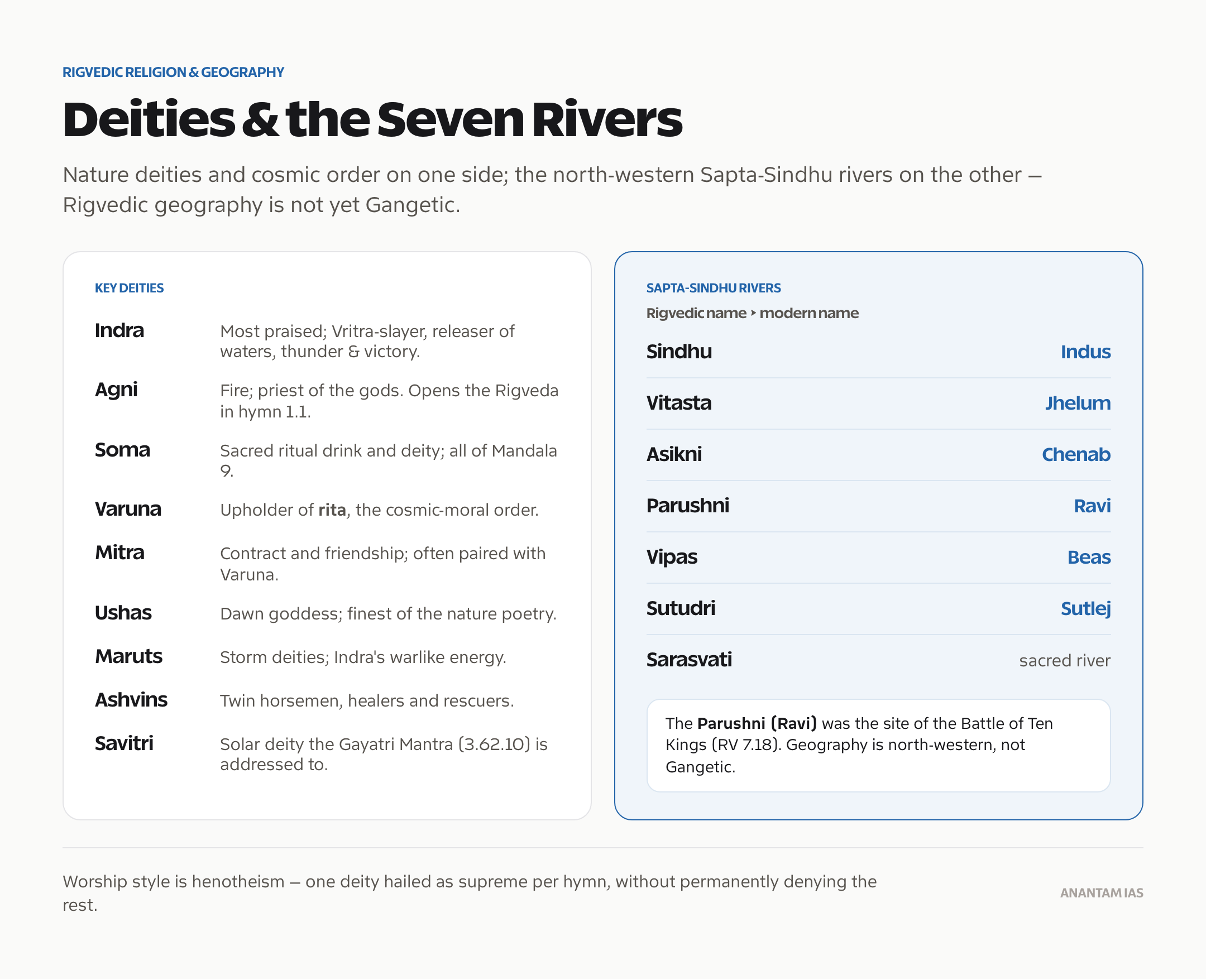
Rigvedic religion is centered on deities connected with nature, ritual, cosmic order, strength, dawn, storm, fire and sacred drink. The most important names for UPSC are Indra, Agni, Soma, Varuna, Mitra, Ushas, Maruts, Ashvins, Savitri, Vishnu, Rudra and Sarasvati.
Do not read these deities through later Puranic Hinduism. That is a common mistake. Rigvedic Vishnu and Rudra are present, but they are not yet the dominant figures they become in later traditions.
| Deity | Rigvedic Role | UPSC Note |
|---|---|---|
| Indra | Warrior deity, destroyer of Vritra, releaser of waters, associated with thunder and victory | Most praised deity in the Rigveda |
| Agni | Fire deity, priest of the gods, messenger between humans and gods | First word and first hymn of Rigveda invoke Agni |
| Soma | Sacred drink, deity, ritual power | Mandala 9 is dedicated to Soma Pavamana |
| Varuna | Upholder of rita, moral and cosmic order | More ethical and sovereign than a simple water god |
| Mitra | Contract, friendship, social order | Often paired with Varuna |
| Ushas | Dawn goddess | Important example of nature poetry |
| Maruts | Storm deities | Associated with Rudra and Indra’s warlike energy |
| Ashvins | Twin horsemen, healers, rescuers | Linked with speed, medicine and rescue |
| Savitri | Solar deity who impels movement | Gayatri Mantra is addressed to Savitri |
| Surya | Sun deity | Visible solar form, often distinguished from Savitri |
| Vayu | Wind deity | Linked with movement and life-force |
| Pusan | Protector of paths, cattle and travelers | Useful for pastoral economy questions |
| Vishnu | Takes three strides, cosmic pervasion | Important but not yet Puranic supreme Vishnu |
| Rudra | Fierce deity, healer, father of Maruts | Early form later associated with Shiva |
| Sarasvati | River and goddess | Both river geography and sacred speech associations matter |
| Aditi | Mother of Adityas, boundlessness | Linked with cosmic and moral order |
The Rigvedic religious style is often described as henotheism or kathenotheism, meaning one deity is praised as supreme in a particular hymn without permanently denying the greatness of others. In simpler terms, the worshipper’s focus shifts by hymn.
That is different from later sectarian supremacy. Do not project later Vaishnavism, Shaivism or Shaktism backward without evidence.
Geography of the Rigveda
The Rigveda belongs primarily to the Sapta-Sindhu region, the land of seven rivers in the north-west. Its geographical memory is strongest around the Indus system, Punjab and adjoining areas.
Important rivers include:
- Sindhu: Indus, the great river.
- Vitasta: Jhelum.
- Asikni: Chenab.
- Parushni: Ravi, associated with the Battle of Ten Kings.
- Vipas: Beas.
- Sutudri: Sutlej.
- Sarasvati: A major sacred river in Rigvedic memory.
- Drishadvati: Often connected with the Vedic region along with Sarasvati.
- Ganga: Mentioned rarely, not central to the early Rigvedic geography.
- Yamuna: More visible than Ganga but still not as central as the north-western rivers.
This distribution matters. The Rigveda is not primarily a Ganga plain text. The Ganga-Yamuna doab becomes more important in the Later Vedic period, when Vedic culture moves eastward.
That is why the Rigveda is the source for Early Vedic society, while the Samaveda, Yajurveda, Atharvaveda, Brahmanas and early Upanishads become more useful for the Later Vedic period.
For a focused agrarian angle, read Rigvedic Irrigation, Wells and Agriculture. It explains wells, channels, barley, ploughing and why the “pure pastoral nomad” reading is too simplistic.
Rigvedic Society
Rigvedic society was tribal, kinship-based and relatively flexible compared with the Later Vedic period. The text shows social ranking, but not yet the fully rigid birth-based caste order of later centuries.
Important social units:
- Kula: Family.
- Grama: Village or moving group of families.
- Vis: Clan or people.
- Jana: Tribe.
- Janapada: Territory of a tribe, clearer in later usage.
- Gotra: Literally connected with cattle enclosure, later lineage marker.
The family was patriarchal, but women had a more visible position than in Later Vedic texts. The Rigveda mentions women seers such as Lopamudra, Ghosa, Apala and Vishvavara. Women participated in rituals and could compose hymns.
Be careful, though. “Better position of women” does not mean modern equality. It means relative freedom compared with later restrictions: no clear evidence of child marriage as a normal institution, no rigid exclusion from religious learning in the same later form, and visible women in intellectual and ritual life.
Varna in the Rigveda
The Purusha Sukta mentions four varnas, but it is in Mandala 10, a later layer. So the correct UPSC line is:
- Social differentiation existed in the Rigvedic period.
- The term varna appears, but the system was not yet as rigid as in the Later Vedic period.
- Occupational mobility seems greater in the early period.
- The birth-based, ritualized, hierarchical varna order becomes clearer later.
This point is gold for Mains. It helps you show historical change instead of writing a flat paragraph.
Rigvedic Polity
Rigvedic polity was tribal rather than territorial-monarchical. The king, or rajan, was more of a tribal chief than an absolute monarch.
Important political terms:
- Rajan: Chief or king of the tribe.
- Purohita: Priest and adviser, often politically powerful.
- Senani: Military commander.
- Gramani: Leader of grama, sometimes understood as village or troop leader.
- Sabha: Smaller assembly, often elite or council-like.
- Samiti: Larger popular assembly.
- Vidatha: Assembly connected with distribution, ritual and military functions.
- Bali: Voluntary offering or tribute, not a regular tax in the modern sense.
The rajan protected cattle, led war, distributed booty and performed rituals. But his power was checked by assemblies and kinship structures. There was no developed bureaucracy, no standing army, no fixed capital and no regular taxation system of the later state type.
Battle of Ten Kings
The Battle of Ten Kings, described in Rigveda 7.18, is one of the most important political references. It was fought on the Parushni river, generally identified with the Ravi.
The main figure is Sudas, associated with the Bharata tribe and the priest Vasistha. The conflict involved a confederacy of tribes against Sudas. For UPSC, remember it as evidence of:
- Inter-tribal warfare.
- River geography.
- The role of priestly lineages in politics.
- The importance of cattle, territory and prestige.
- The early memory of the Bharatas, a name that later becomes central to Indian tradition.
Do not overstate it as a modern state war. It was a tribal conflict, but historically valuable because it gives us names, geography and political structure.
Rigvedic Economy
The Rigvedic economy was pastoral-agrarian. Cattle were the main form of wealth, but agriculture was known and practiced.
Important economic terms:
- Gau: Cow, central to wealth and ritual.
- Gavishti: Literally “search for cows”; often used for cattle raid or war.
- Duhitri: Daughter, often explained as “one who milks the cow” in traditional etymology.
- Yava: Barley, the main cereal associated with the Rigvedic period.
- Krishi: Agriculture.
- Langala / Sira: Plough-related terms.
- Kupa / Avata: Wells.
- Kulya: Water channel or irrigation channel.
- Pani: Traders or wealthy groups, often portrayed negatively in the hymns.
- Nishka: Gold ornament or value object, not coinage in the later numismatic sense.
The older textbook line says the Rigvedic people were mainly pastoral. That is true as far as cattle wealth dominates the hymns. But it becomes misleading if it erases agriculture.
The better UPSC answer is this: early Rigvedic society was pastoral with growing agrarian practices. Cattle were wealth, traction, ritual value and food economy. Agriculture added cereal production, especially barley.
No punch-marked coins existed in the Rigvedic period. Trade was limited and barter-based. Metal use existed, but ayas in the Rigveda should not automatically be read as iron. In early contexts, it is usually taken as copper or bronze. Iron becomes clearer in the Later Vedic period.
Rigvedic Religion and Philosophy
Rigvedic religion was sacrificial, poetic and naturalistic, but it was not simple. It moved from praise of deities to questions about cosmic order, creation and existence.
Core religious ideas:
- Yajna: Sacrifice, the central ritual act.
- Rita: Cosmic and moral order, especially associated with Varuna.
- Soma: Sacred ritual drink and deity.
- Agni: Fire as mediator between humans and gods.
- Dana: Gift-giving and generosity, important in ritual and social prestige.
- Mantra: Sacred utterance or hymn.
There were no temples in the later built-temple sense. There is also no strong evidence of image worship in the later Puranic style. Worship centered on fire ritual, offering, chant and priestly performance.
But the later mandalas show more abstract thought. The Nasadiya Sukta does not give a simple creation story. It questions whether creation began with being or non-being, and whether anyone truly knows. That philosophical uncertainty is one reason the Rigveda remains intellectually powerful.
Rita vs Dharma
For UPSC, distinguish rita and dharma carefully.
- Rita: Cosmic order in the Rigvedic world. It governs truth, nature, sacrifice and moral rhythm.
- Dharma: Later, wider concept of duty, law, ethics and social order.
Dharma does not disappear from Vedic thought, but if the question is specifically Rigvedic, rita is the sharper answer.
Language, Metre and Literature
The Rigveda is composed in Vedic Sanskrit and uses strict poetic metres. This is not decoration. The metre helped oral preservation.
Important metres:
- Gayatri: 24 syllables, 3 lines of 8 syllables each. The Gayatri Mantra uses this metre.
- Anushtubh: 32 syllables, later dominant in classical shloka poetry.
- Trishtubh: 44 syllables, very common in the Rigveda.
- Jagati: 48 syllables.
Important literary forms:
- Stuti hymns: Praise of deities.
- Samvada Suktas: Dialogue hymns, such as Yama-Yami and Pururavas-Urvashi.
- Dana Stutis: Praise of generosity, often preserving names of patrons.
- Philosophical hymns: Nasadiya Sukta, Hiranyagarbha Sukta, Purusha Sukta.
- Secular or social hymns: Dice Hymn, Frog Hymn.
This variety is useful for Mains. It lets you write that the Rigveda is not only a ritual text but also a source for early poetry, social anxiety, ecological observation and philosophical speculation.
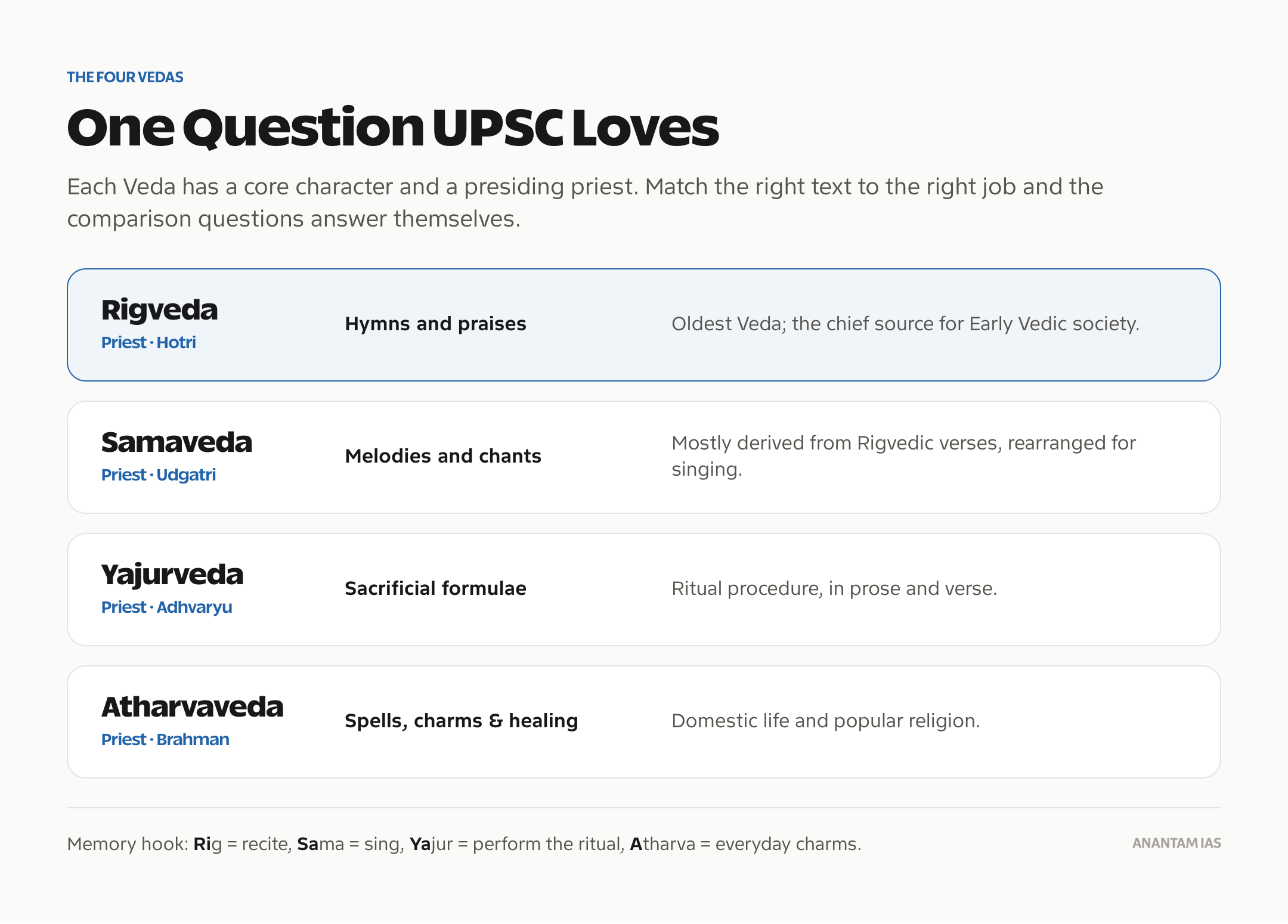
Rigveda and the Other Vedas
The Rigveda is the oldest Veda, but it should be studied in relation to the other three Vedas. UPSC loves comparison questions.
| Veda | Core Character | Priest | UPSC Memory Hook |
|---|---|---|---|
| Rigveda | Hymns and praises | Hotri | Oldest Veda, Early Vedic society |
| Samaveda | Melodies and chants | Udgatri | Mostly derived from Rigvedic verses |
| Yajurveda | Sacrificial formulas | Adhvaryu | Ritual procedure, prose and verse |
| Atharvaveda | Spells, charms, healing, domestic concerns | Brahman priest in later ritual system | Popular religion and everyday life |
The Samaveda borrows heavily from the Rigveda but rearranges verses for singing. The Yajurveda is more directly tied to ritual performance. The Atharvaveda gives a different social texture, including healing, charms and domestic concerns.
So, if a question asks about the source for Early Vedic society, choose Rigveda. If it asks about sacrificial formulae, look toward Yajurveda. If it asks about melodies, Samaveda. If it asks about spells and charms, Atharvaveda.
Simple. But in the exam hall, simple things fail when they are not revised cleanly.
Rigveda vs Later Vedic Texts
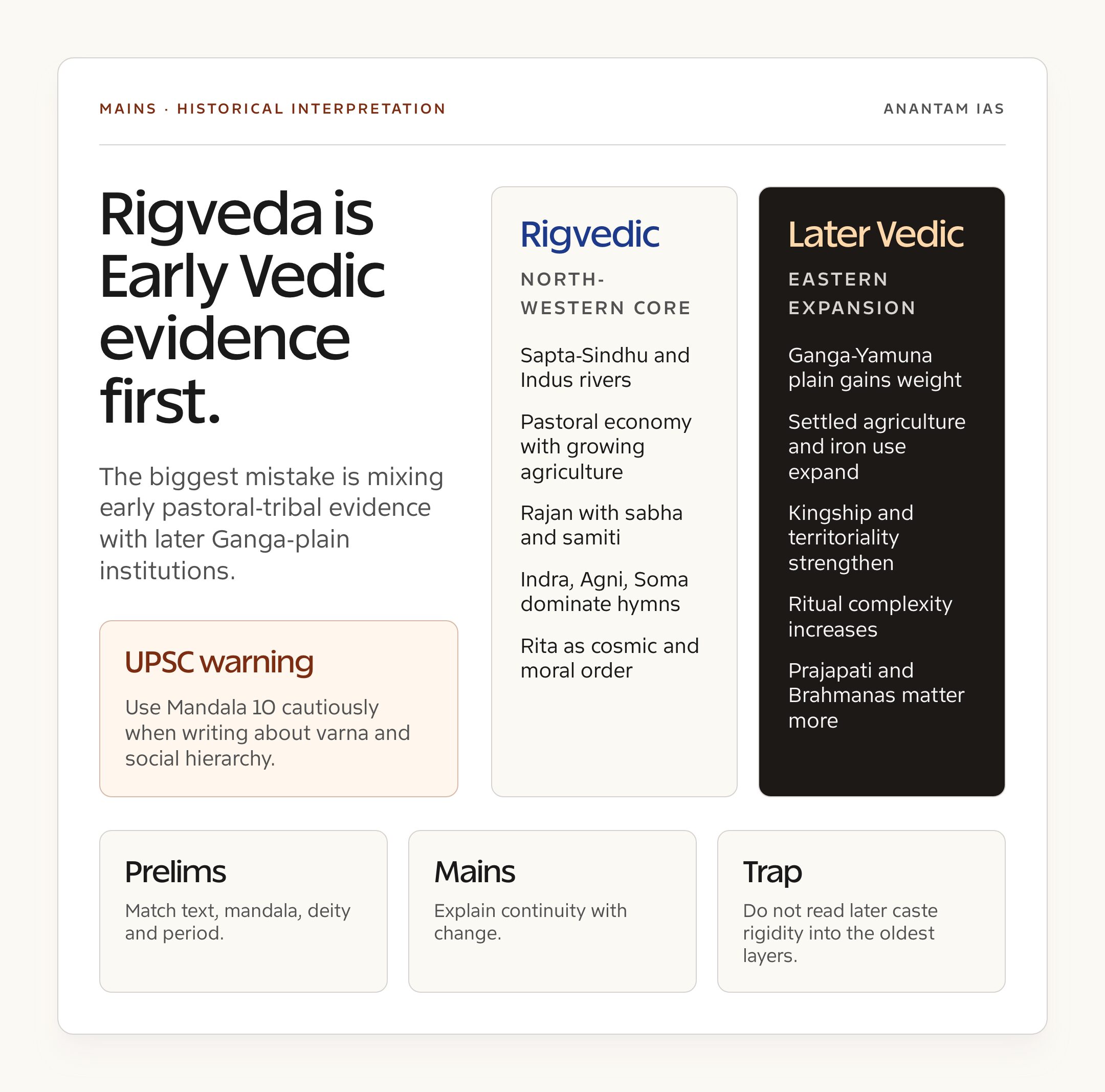
The biggest historical use of the Rigveda is comparison. It tells us what the early phase looked like before the Later Vedic changes became stronger.
| Theme | Rigvedic / Early Vedic | Later Vedic |
|---|---|---|
| Geography | Sapta-Sindhu, north-west | Ganga-Yamuna doab and eastward expansion |
| Economy | Pastoral-agrarian, cattle-centered | More settled agriculture, rice, iron tools |
| Polity | Tribal chiefship, assemblies | Larger kingdoms, stronger monarchy |
| Taxation | Bali as voluntary offering | More regular tribute and revenue |
| Society | Flexible social ranking | Varna becomes more rigid and hereditary |
| Women | More visible in ritual and intellectual life | Status declines in many later texts |
| Religion | Nature deities, yajna, rita | Elaborate ritualism, Brahmana dominance |
| Texts | Rigveda | Samaveda, Yajurveda, Atharvaveda, Brahmanas, Aranyakas |
| Main deities | Indra, Agni, Soma, Varuna | Prajapati rises, ritual theology expands |
| Philosophy | Early speculation in later mandalas | Upanishadic thought develops further |
This table is Mains-ready. A good GS-I answer on Vedic society should show transition, not just list features.
Prelims Notes: High-Yield Rigveda Facts
Use this section for last-week revision. These are the facts most likely to become statement-based questions.
- The Rigveda is the oldest of the four Vedas.
- It is composed in Vedic Sanskrit.
- It contains 10 mandalas and 1,028 hymns in the received Shakala recension.
- Mandalas 2-7 are the family books and are considered the oldest core.
- Mandala 9 is mainly dedicated to Soma.
- Mandala 10 contains Purusha Sukta, Nasadiya Sukta, marriage hymns, funeral hymns and dialogue hymns.
- The Gayatri Mantra appears in Rigveda 3.62.10 and is addressed to Savitri.
- The Battle of Ten Kings appears in Mandala 7 and is associated with Sudas and the Parushni river.
- Indra is the most praised deity.
- Agni opens the Rigveda.
- Varuna is closely associated with rita, the cosmic order.
- The Rigvedic priest is Hotri.
- The chief was called Rajan.
- Sabha and Samiti were political assemblies.
- Bali was a voluntary offering, not a modern tax.
- Cattle were the main wealth.
- Yava, usually barley, was the main cereal.
- Nishka was a gold ornament or value object, not a coin in the later sense.
- Ayas in early Rigvedic context should not automatically be taken as iron.
- No clear evidence exists for later-style temples or idol worship in the Rigvedic period.
- The four-varna idea appears in Purusha Sukta, a later hymn in Mandala 10.
- The Rigveda’s geography is north-western, not primarily Gangetic.
Common Prelims Traps
- Trap: Samaveda is the oldest Veda.
Correction: Rigveda is the oldest Veda.
- Trap: Mandala 9 is a family book.
Correction: Mandalas 2-7 are family books. Mandala 9 is centered on Soma.
- Trap: Gayatri Mantra is addressed to Surya.
Correction: It is addressed to Savitri, a solar deity.
- Trap: Purusha Sukta proves caste was fully rigid from the earliest Rigvedic phase.
Correction: Purusha Sukta is in Mandala 10, a later layer. It shows emerging hierarchy, not the entire early phase.
- Trap: Rigvedic economy was purely pastoral.
Correction: It was cattle-centered but agriculture was known. Barley, ploughing, wells and water channels appear.
- Trap: Ayas means iron everywhere.
Correction: In the Rigvedic context, ayas is usually taken as copper or bronze. Iron becomes clearer later.
- Trap: Rigvedic religion was identical to later Puranic Hinduism.
Correction: Many later deities appear in seed form, but the dominant Rigvedic deities are Indra, Agni, Soma and Varuna.
Mains Notes: How to Use the Rigveda in GS-I
For Mains, the Rigveda should be used as evidence, not as a memorized paragraph. Quote themes, terms and examples.
1. Source for Early Vedic Society
The Rigveda gives us the earliest literary evidence for Vedic society. It shows a tribal order based on jana, vis, grama and kula. The rajan was not yet an absolute monarch, and assemblies like sabha and samiti limited political power.
Use this in answers on state formation, tribal polity and early Indian political institutions.
2. Evidence of Social Change
The text shows social differentiation, but the fully rigid varna system belongs more clearly to the Later Vedic phase. The Purusha Sukta is important because it gives a cosmic origin to varna, but its placement in Mandala 10 matters.
Use this to show that caste hierarchy evolved historically instead of appearing fully formed.
3. Women’s Position
Women such as Lopamudra, Ghosa, Apala and Vishvavara appear in the Rigvedic tradition. The evidence points to a more visible intellectual and ritual role for women than in many later texts.
Use this carefully. Do not exaggerate it into full equality. Write “relatively better position compared with Later Vedic society.”
4. Economy: Pastoral But Not Only Pastoral
Cattle wealth dominates the Rigveda. Terms like gau and gavishti show the importance of cattle. But agriculture also appears through yava, ploughing and water use.
Use the phrase “pastoral-agrarian economy” instead of “purely pastoral economy.”
5. Religion and Philosophy
Rigvedic religion begins with praise of natural and cosmic deities, but later hymns show speculative thinking. Nasadiya Sukta and Hiranyagarbha Sukta are useful examples of early philosophical inquiry.
Use this in answers on the development of Indian philosophical thought.
6. Geography and Migration of Vedic Culture
The Rigveda’s river geography is north-western. The Later Vedic shift toward the Ganga plain marks a major transition in Indian history, linked with settled agriculture, iron technology and larger kingdoms.
Use this when writing about the shift from Early Vedic to Later Vedic society.
Model Mains Answer Points
If UPSC asks, “Discuss the Rigveda as a source for reconstructing Early Vedic society,” your answer should not become a list of deities. Structure it like this:
- Opening: Rigveda is the oldest Veda and the chief source for Early Vedic society in the Sapta-Sindhu region.
- Society: Tribal units like jana, vis, grama and kula; kinship-based order; women seers; flexible social ranking.
- Polity: Rajan, sabha, samiti, vidatha, purohita, senani; tribal chiefship rather than territorial monarchy.
- Economy: Cattle wealth, gavishti, yava, barter, limited trade, pastoral-agrarian character.
- Religion: Indra, Agni, Soma, Varuna, yajna, rita, no later-style temple culture.
- Limitations: It is a priestly poetic text, not a neutral census. It reflects elite ritual memory more than everyday life of every group.
- Conclusion: It remains the key source, but should be read with archaeology and later Vedic literature for a fuller picture.
That last limitation line is important. It makes the answer sound mature. UPSC rewards balance when it is specific.
Rigveda: One-Page Revision Notes
Use this as your final quick revision block:
- Oldest Veda: Rigveda.
- Core region: Sapta-Sindhu.
- Core period: Early Vedic, c. 1500-1000 BCE.
- Text size: 10 mandalas, 1,028 hymns, about 10,552 verses.
- Old core: Mandalas 2-7.
- Soma mandala: Mandala 9.
- Later philosophical/social mandala: Mandala 10.
- Opening deity: Agni.
- Most praised deity: Indra.
- Cosmic order: Rita, linked strongly with Varuna.
- Gayatri Mantra: Rigveda 3.62.10, addressed to Savitri.
- Battle of Ten Kings: Mandala 7, Sudas, Parushni.
- Purusha Sukta: Rigveda 10.90, four varnas.
- Nasadiya Sukta: Rigveda 10.129, creation speculation.
- Main wealth: Cattle.
- Main cereal: Yava, barley.
- Political assemblies: Sabha, Samiti, Vidatha.
- Chief: Rajan.
- Priest: Hotri.
- Associated Brahmanas: Aitareya and Kaushitaki.
- Associated Upanishads: Aitareya and Kaushitaki.
- Surviving recension: Shakala.
Frequently Asked Questions
Which is the oldest Veda?
The Rigveda is the oldest Veda. It is older than the Samaveda, Yajurveda and Atharvaveda and is the main source for studying the Early Vedic period.
How many mandalas and hymns are in the Rigveda?
The Rigveda has 10 mandalas and 1,028 hymns in the received Shakala recension. These hymns contain about 10,552 verses.
Which mandalas of the Rigveda are called family books?
Mandalas 2 to 7 are called the family books. They are associated with priestly families such as Gritsamada, Vishvamitra, Vamadeva, Atri, Bharadvaja and Vasistha, and are considered the older core of the Rigveda.
Which mandala of the Rigveda is dedicated to Soma?
Mandala 9 is mainly dedicated to Soma Pavamana. It is organized by deity rather than by a priestly family, which makes it different from the family books.
Where is the Gayatri Mantra found in the Rigveda?
The Gayatri Mantra is found in Rigveda 3.62.10. It is addressed to Savitri, a solar deity, and is associated with the Vishvamitra family.
What is the significance of Purusha Sukta?
Purusha Sukta, Rigveda 10.90, describes the cosmic being Purusha and mentions the four varnas. Since it appears in Mandala 10, a later layer, historians use it as evidence for the emergence of social hierarchy rather than proof of a fully rigid caste system in the earliest Rigvedic phase.
What is the significance of Nasadiya Sukta?
Nasadiya Sukta, Rigveda 10.129, is a philosophical hymn on creation. It asks whether existence came from non-existence and ends with doubt about whether anyone truly knows the origin of the universe.
Who was the most important deity in the Rigveda?
Indra was the most praised deity in the Rigveda. Agni and Soma were also central. Varuna was important as the upholder of rita, the cosmic and moral order.
What was the economy of Rigvedic society?
Rigvedic society had a pastoral-agrarian economy. Cattle were the main form of wealth, but agriculture was known. Yava, usually barley, was the main cereal, and the text also refers to ploughing, wells and water channels.
Was the caste system fully developed in the Rigvedic period?
No. Social differentiation existed, and the Purusha Sukta mentions the four varnas, but the rigid birth-based caste order became clearer in the Later Vedic period. The Rigvedic phase was comparatively more flexible. ## Final Note for UPSC Aspirants Do this before moving on: memorize the mandala table, the important suktas, and the Prelims traps. Then connect the Rigveda with the broader UPSC Syllabus 2026 under GS-I Ancient History and Indian Culture. Bottom line: the Rigveda is not a topic to "read once." It is a framework text. If you understand it well, the Early Vedic period, Later Vedic transition, varna debate, early polity, pastoral economy and beginnings of Indian philosophical thought all become easier to revise.
Tell Google you want more of this.
Add Anantam IAS as a preferred sourceOne tap, and this site shows up more often in your own Top Stories, AI Overviews and AI Mode. Remove it any time.