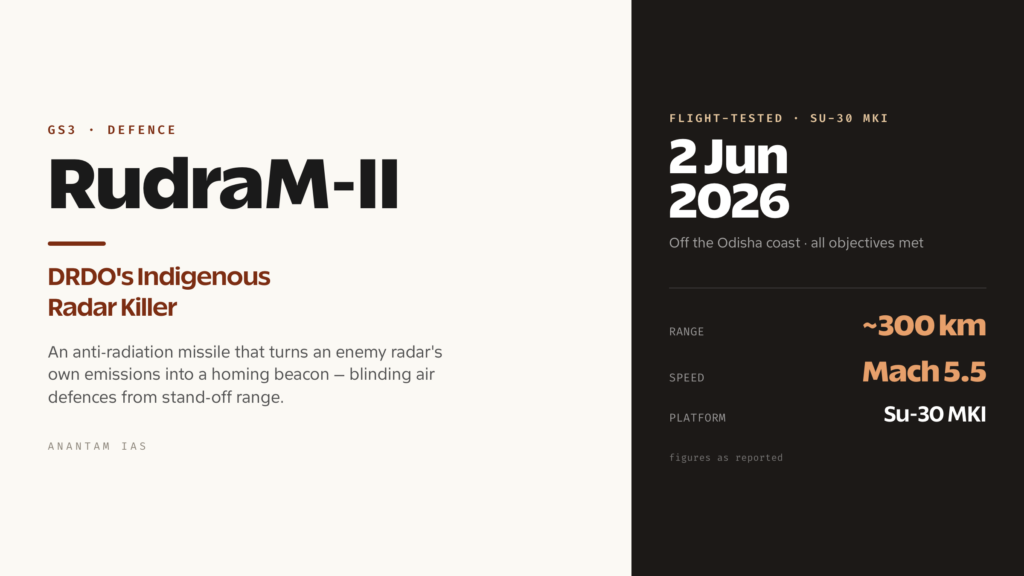
On 2 June 2026, a Sukhoi Su-30 MKI peeled off over the Bay of Bengal, released a missile under what the defence ministry called extreme conditions, and watched it fly a hard, deliberate trajectory before striking a target off the Odisha coast with pin-point accuracy. The weapon was the RudraM-II — DRDO’s home-grown anti-radiation missile — and the test was meant to wring out every subsystem at once. Range instruments at the Integrated Test Range, Chandipur, captured the data, confirmed all objectives were met, and Defence Minister Rajnath Singh congratulated DRDO, the IAF, the public-sector undertakings and private industry for what he called the growing maturity of indigenous defence technology.
That last line is the one to sit with. RudraM-II is not just another missile test; it is India learning to do something most air forces still buy from abroad — blind the enemy’s radars from a safe distance before the rest of the air campaign begins. For a country whose air-defence-suppression weapons were until recently imported, a Mach-class, indigenous “radar killer” launched from a frontline fighter is a genuine capability shift. And because it sits at the intersection of defence technology, self-reliance and strategic deterrence, it’s exactly the kind of development the GS3 paper loves.
What an Anti-Radiation Missile Actually Does
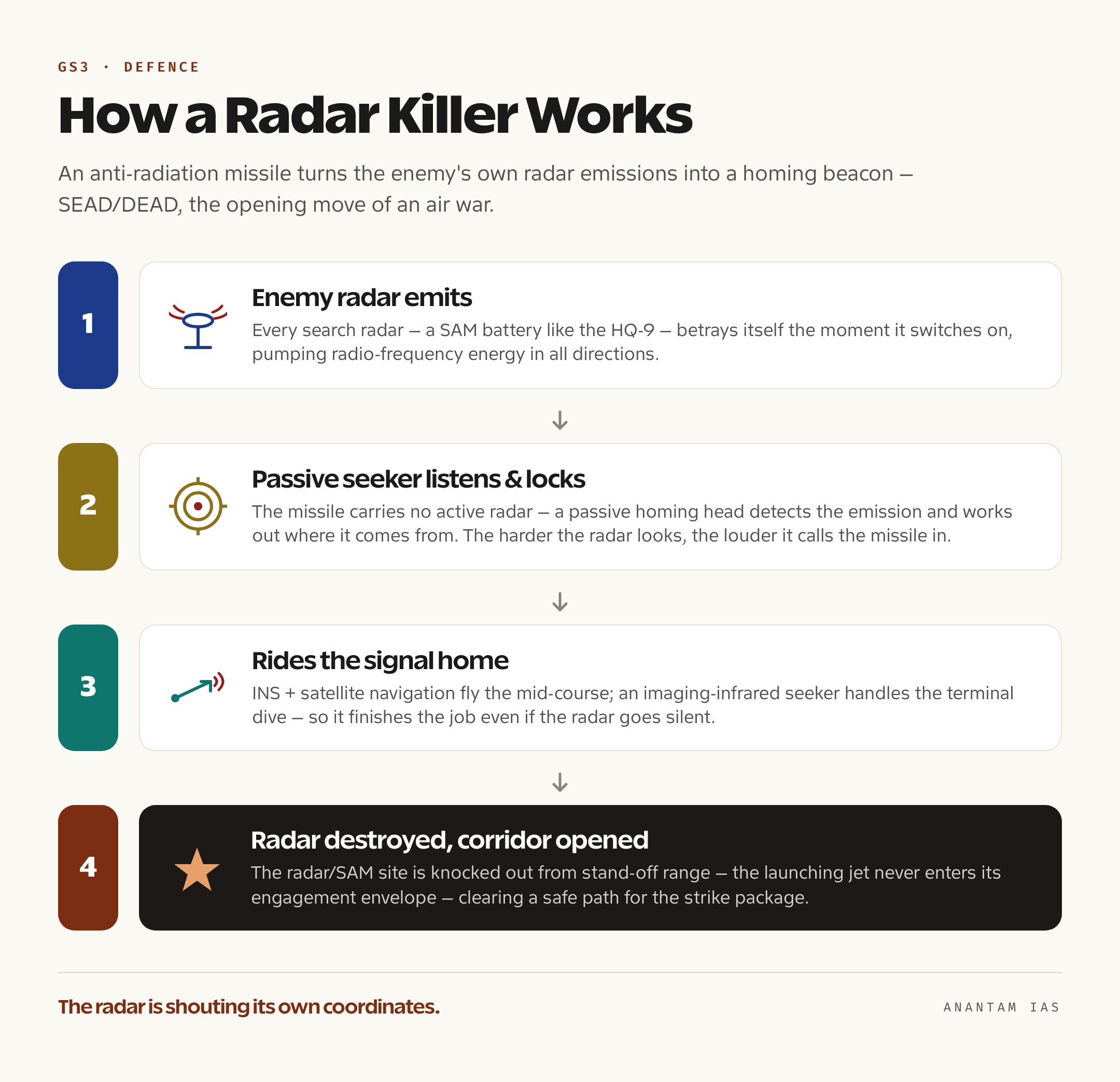
Start with the problem it solves, because the rest only makes sense once you see the battlefield it’s built for. A modern air-defence system — a surface-to-air missile battery like China’s HQ-9 or the layered networks Pakistan fields — is only as good as its radar. The radar is the eyes. It sweeps the sky, finds incoming aircraft, and feeds firing solutions to the missiles. So if you want to push your own jets through hostile airspace without losing them, the smartest first move isn’t to dodge the missiles. It’s to kill the radar that aims them.
That mission has a name in air-warfare doctrine: SEAD and DEAD — Suppression and Destruction of Enemy Air Defences. The idea is to go in early in a conflict, knock out or blind the enemy’s radar and missile sites, and open a corridor through which the rest of the strike package can fly safely. It’s the unglamorous, decisive work that happens in the first hours of an air war, and it’s precisely what RudraM-II is designed for. DRDO describes it as a weapon built to neutralise enemy radars, communication systems and other radio-frequency emitters from stand-off range — far enough that the launching aircraft never has to enter the radar’s own engagement envelope.
Here’s the clever part, and it’s worth slowing down on because it’s the whole trick. An anti-radiation missile doesn’t carry its own active radar to hunt the target. It carries a passive one — a passive homing head that simply listens. Every search radar betrays itself the moment it switches on, because it pumps out radio-frequency energy in all directions. The missile’s seeker detects that emission, works out where it’s coming from, and rides the signal straight back to its source. The radar is, in effect, shouting its own coordinates. The harder it looks for your aircraft, the louder it calls the missile in. This is why crews sometimes try to switch the radar off when an anti-radiation missile is inbound — but a good seeker, backed by inertial navigation and satellite positioning, remembers where the emission last came from and finishes the job anyway.
RudraM-II layers a few seekers to make that kill reliable. Reports describe a passive homing head for the anti-radiation role, inertial navigation (INS) coupled with satellite positioning for the mid-course flight, and an imaging infrared (IIR) seeker that lets it lock onto the heat-and-shape signature of a target in the terminal dive — useful when a radar has gone silent or the missile is being used against other high-value ground targets. It’s also built to support both “lock-on before launch” and “lock-on after launch,” meaning the pilot can either designate the target before firing or release the missile and let it acquire the emitter in flight — a big tactical advantage when threats pop up mid-mission.
The RudraM Family: One Idea, Climbing in Range
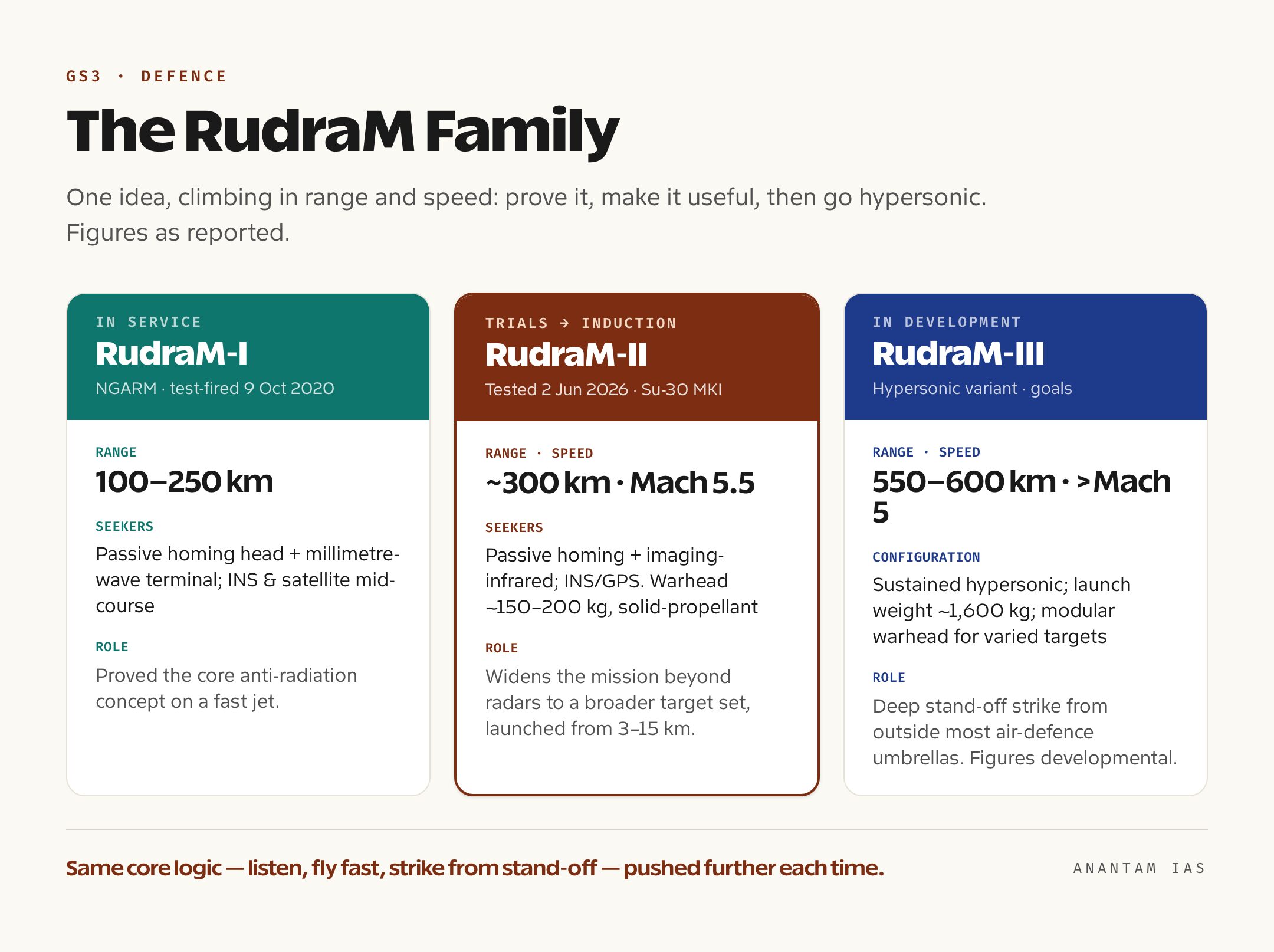
RudraM-II makes far more sense as the middle child of a family than as a one-off, so it’s worth laying the line-up out. The series — the name comes from a fierce Vedic form of Shiva — is India’s first home-grown family of air-launched anti-radiation and stand-off weapons, developed under DRDO with Research Centre Imarat in Hyderabad as the nodal laboratory and a string of sister labs handling propulsion, warhead and test work. Read the family top to bottom and you can watch a single idea grow up.
RudraM-I, also called the New Generation Anti-Radiation Missile (NGARM), is the one already in service. It was successfully test-fired from a Su-30 MKI on 9 October 2020 from the test range off Balasore, and has been inducted since the early 2020s. It carries a passive homing head that can pick up radar emissions from a long way out, plus a millimetre-wave seeker for the terminal phase, with INS-and-satellite guidance in between. Its reach is reported in the region of 100 to 250 km depending on launch altitude and speed. RudraM-I proved the core concept — that India could build a working anti-radiation seeker and put it on a fast jet.
RudraM-II is the expansion. It pushes the engagement range out to a reported 300 km or so, is credited with terminal speeds as high as Mach 5.5, and carries a warhead in the 150-to-200 kg class. Crucially, it widens the mission beyond pure radar-hunting: by adding the imaging infrared seeker alongside the anti-radiation passive head, RudraM-II can go after a broader set of ground targets, not just emitting radars. It’s solid-propellant powered, launches from a Su-30 MKI flying anywhere between roughly 3 km and 15 km altitude, and the 2 June 2026 trial was one of several validating it in its full operational form — the May 2024 flight having been, as reported, its first full-configuration test.
RudraM-III is the planned next leap, and it’s a big one. DRDO is working toward a hypersonic variant — speeds beyond Mach 5 sustained, not just in a terminal dash — with a reported range in the 550-to-600 km band, a launch weight around 1,600 kg, and a modular warhead so the same airframe can be tasked against different target types. If it matures, RudraM-III would turn the Su-30 MKI into a genuine long-range stand-off strike platform, able to hit deep targets from outside most air-defence umbrellas. Figures for it remain developmental and should be read as goals rather than confirmed performance.
The pattern is the thing to remember for an exam. Each generation keeps the same core logic — listen for the radar, fly fast, strike from stand-off — while pushing range up, speed up, and the target set wider. RudraM-I proved it could be done; RudraM-II makes it useful at operationally meaningful distances; RudraM-III aims to make it hypersonic and deep-strike. That’s a textbook indigenous development curve, and it’s far more quotable than any single specification.
Inside RudraM-II: Specs, Platform and the Honest Caveats
Now the numbers — with a warning attached, because defence specifications reported in the press are rarely fully declassified, and several figures float in narrow ranges. Treat the precise values as “as reported” and you’ll sound more credible than a candidate who states them as gospel.
As reported, RudraM-II engages targets at ranges of around 300 km, reaches speeds up to Mach 5.5, and carries a warhead of roughly 200 kg (some sources put it nearer 155 kg). It uses a solid-propellant rocket motor, which keeps it simple, storable and ready to fire without the fuelling fuss of liquid systems. Guidance is the layered package already described: INS plus satellite navigation for the cruise, a passive homing head for the anti-radiation kill, and an imaging infrared seeker for terminal precision. The launch platform is the IAF’s Su-30 MKI — the workhorse heavy fighter — released from altitudes between about 3 km and 15 km, which lets the pilot choose a launch profile that maximises range or minimises exposure.
The platform side matters as much as the missile. A weapon is only as good as the number of aircraft cleared to carry it. As of mid-2024, around 40 Su-30 MKI jets had reportedly been modified to take RudraM-II, with plans to equip many more — figures of another 84 have been cited — under the ongoing “Super Sukhoi” upgrade programme that is modernising the Sukhoi fleet’s avionics, radar and weapons. The longer-term ambition is to integrate RudraM-class weapons onto other platforms too, including the indigenous Tejas line, which would spread the SEAD capability across more of the air force.
The honest caveats are worth stating, because UPSC rewards balance. RudraM-II is still in the trials-to-induction phase, not yet a fully fielded operational weapon across the fleet. Its published specifications are journalistic and approximate, not an official datasheet. And “Mach 5.5” describes a terminal speed regime rather than a sustained hypersonic cruise — the genuinely hypersonic ambition belongs to RudraM-III. None of this diminishes the achievement. It just keeps the claim accurate, which is the difference between an answer that reads as informed and one that reads as a press release.
Why It Matters: Self-Reliance, Deterrence and the DRDO Ecosystem
So why should any of this earn space in your notes, beyond the novelty of a fast missile? Because RudraM-II sits on top of three of the most heavily examined themes in Indian defence policy at once, and you can hang all three off this one weapon.
The first is self-reliance — Atmanirbhar Bharat in defence. India has long been among the world’s largest arms importers, and anti-radiation missiles were historically something you bought abroad. Building an indigenous SEAD weapon, with its seekers, propulsion and warhead developed at home through the DRDO-plus-industry ecosystem, directly cuts that import dependence. Rajnath Singh framed the June 2026 test in exactly these terms — as evidence that India’s home-grown defence technology is maturing — and the project deliberately pulls in public-sector undertakings and private firms, building a domestic supply chain rather than a single lab’s prototype. That ecosystem story, where a research lab, the public defence companies and private players all contribute, is the modern face of self-reliance and a clean example to cite.
The second is deterrence and operational edge against credible adversaries. India’s planners have to reckon with two well-defended neighbours: China, which fields dense, long-range systems like the HQ-9, and Pakistan, with its own layered air defences. A reliable, indigenous, stand-off radar-killer changes the arithmetic of any future air campaign. It lets the IAF blind hostile air defences early, protect its strike aircraft, and operate inside contested airspace at far lower risk. That improved survivability of friendly aircraft — the official rationale for the weapon — is the whole point of SEAD, and it strengthens conventional deterrence without anyone firing a shot.
The third is the strength of the underlying technology base. A working anti-radiation missile is not one breakthrough; it’s a stack of them — passive radio-frequency seekers, imaging infrared homing, solid-rocket propulsion, precision guidance, and the systems integration to make a fighter release it cleanly at high speed. Each of those capabilities, once proven, feeds into other programmes. The RudraM line is also a confidence-builder: success here is what makes the leap to a hypersonic RudraM-III credible rather than fanciful. In other words, RudraM-II is both a weapon and a demonstration that India’s missile ecosystem can keep climbing the ladder.
Put together, that’s the case for why a single missile test belongs in a serious civil-services answer. It is technology, economics and strategy braided into one example you can deploy across several questions.
For Your Mains Answer
This topic lives squarely in GS Paper 3, under “achievements of Indians in science and technology; indigenisation of technology and developing new technology” and “various security forces and agencies and their mandate.” It also touches the defence and internal-security strand and can flavour an economy answer on cutting the defence import bill. The smart move is to treat RudraM-II as a concrete case study for the larger theme of indigenisation and self-reliance, rather than as a missile to be described for its own sake — examiners reward the candidate who uses the example to make an argument.
How to Build the Answer
Open with the function, not the hardware: explain what SEAD/DEAD is and why suppressing enemy air defences is the decisive opening move of an air campaign. Then introduce RudraM-II as India’s indigenous answer to that mission, name the 2 June 2026 Su-30 MKI test as your current anchor, and place it within the RudraM family to show the development curve. Pivot to significance — self-reliance, deterrence, the DRDO-and-industry ecosystem — and close on a balanced note about what remains to be done (full induction, scaling up integrated platforms). That arc — function, weapon, family, significance, caveat — fits almost any “indigenous defence technology” question.
Common Mistakes to Avoid
Don’t turn the answer into a spec sheet; one or two figures (range ~300 km, Mach ~5.5) are plenty, and you should flag them as “as reported.” Don’t confuse RudraM-II with the hypersonic RudraM-III — keep the family members distinct. Don’t overstate induction; it is in the trials-to-induction phase, not fielded across the fleet. And don’t reduce “self-reliance” to a slogan — show the mechanism, the home-built seekers and the domestic supply chain, which is what actually proves the point.
A Compact Answer Spine
SEAD/DEAD as the opening move of air war → RudraM-II as India’s indigenous anti-radiation missile (passive homing onto enemy radar emissions, IIR + INS/GPS, solid-propellant, Su-30 MKI, ~300 km, validated again on 2 June 2026) → the RudraM family climbing from RudraM-I/NGARM through RudraM-II to the hypersonic RudraM-III → significance: Atmanirbhar Bharat in defence, lower import dependence, deterrence against well-defended neighbours, a maturing DRDO-plus-industry ecosystem → caveat: trials-to-induction, figures approximate, hypersonic ambition still ahead.
Diagram or Flowchart Idea
Draw the SEAD kill chain as a simple four-box flow: (1) enemy radar emits radio-frequency energy → (2) RudraM-II passive seeker detects and locks the emission → (3) INS/GPS mid-course flight, IIR for terminal precision → (4) radar/SAM site destroyed, corridor opened for strike aircraft. A clean kill-chain diagram like this communicates the whole concept in seconds and earns marks fast.
A Balanced-Conclusion Line
Close with something like: “RudraM-II shows that self-reliance in defence is no longer about copying imports but about building the hard technologies — seekers, propulsion, guidance — that let India set its own pace; the task now is to convert successful trials into fielded squadrons and to carry the same curve up to the hypersonic generation.” That line credits the achievement and points to the unfinished work.
How to Use Data Without Cramming
Anchor with two or three quotable facts, not ten. The 2 June 2026 Su-30 MKI test off Odisha; a reported range of around 300 km and speed up to Mach 5.5; RudraM-I’s induction after its 2020 test; the Super Sukhoi programme integrating the weapon across the fleet. Attach “as reported” to the contested numbers, name the source in passing — “DRDO’s June 2026 trial,” “the Super Sukhoi upgrade” — and you’ll sound like someone who has read the news, not memorised a coaching handout.
FAQ
What is the RudraM-II missile and what does it do? RudraM-II is DRDO’s indigenous air-to-surface anti-radiation missile, designed mainly for Suppression and Destruction of Enemy Air Defences (SEAD/DEAD). It homes onto the radio-frequency emissions of enemy radars and destroys them from stand-off range, blinding hostile air defences so friendly aircraft can operate more safely. It was flight-tested again from a Su-30 MKI on 2 June 2026 off the Odisha coast.
How is RudraM-II different from RudraM-I? RudraM-I (the New Generation Anti-Radiation Missile, NGARM) is the inducted first generation, with a reported range in the 100-250 km band and a passive-radar plus millimetre-wave seeker. RudraM-II extends the reach to a reported ~300 km, adds an imaging infrared seeker so it can engage a wider set of targets, and is credited with terminal speeds up to Mach 5.5. RudraM-III, still in development, aims to go hypersonic with a 550 km-plus range.
Which aircraft carries RudraM-II, and who developed it? It is launched from the IAF’s Su-30 MKI heavy fighter, released from altitudes of roughly 3 to 15 km, and is being integrated more widely under the “Super Sukhoi” upgrade programme. It was developed indigenously by DRDO, with Research Centre Imarat in Hyderabad as the nodal laboratory and several sister labs handling propulsion, warhead and testing.
Why is RudraM-II significant for India? It gives India an indigenous stand-off “radar-killer,” cutting dependence on imported SEAD weapons and advancing Atmanirbhar Bharat in defence. Strategically, it lets the IAF suppress the dense air defences of well-armed neighbours early in a conflict, improving aircraft survivability and strengthening conventional deterrence. It also proves a stack of hard technologies — passive RF seekers, IIR homing, solid propulsion — that feed future programmes like the hypersonic RudraM-III.
Practice Questions
Prelims MCQs
- With reference to the RudraM-II missile, consider the following statements:
1. It is an indigenously developed air-to-surface anti-radiation missile.
2. It is primarily designed for the suppression and destruction of enemy air defences.
3. It is a surface-to-air missile launched from naval warships.
Which of the statements given above are correct?
(a) 1 and 2 only
(b) 2 and 3 only
(c) 1 and 3 only
(d) 1, 2 and 3.
Answer: (a) RudraM-II is an air-to-surface anti-radiation missile for SEAD/DEAD, launched from the Su-30 MKI — not a ship-launched surface-to-air weapon. - An “anti-radiation missile” such as RudraM-II destroys its target by:
(a) emitting intense radiation that disables electronics
(b) homing onto the radio-frequency emissions of an enemy radar
(c) using a nuclear warhead against radiation sources
(d) jamming satellite navigation signals.
Answer: (b) It carries a passive homing head that detects and rides an enemy radar’s own emissions back to the source. - The RudraM-II missile is launched from which of the following platforms?
(a) INS Vikrant aircraft carrier
(b) Agni mobile launcher
(c) Su-30 MKI fighter aircraft
(d) Rafale naval variant only.
Answer: (c) It is released from the IAF’s Su-30 MKI, with wider integration planned under the Super Sukhoi programme. - Which DRDO laboratory is the nodal agency for the RudraM series of missiles?
(a) Aeronautical Development Agency
(b) Research Centre Imarat, Hyderabad
(c) Defence Bioengineering and Electromedical Laboratory
(d) Combat Vehicles Research and Development Establishment.
Answer: (b) Research Centre Imarat (RCI), Hyderabad, leads the RudraM programme with several sister DRDO labs contributing. - “SEAD,” frequently mentioned in the context of modern air warfare and missiles like RudraM-II, stands for:
(a) Strategic Electronic Attack Doctrine
(b) Suppression of Enemy Air Defences
(c) Surface-to-Earth Air Deployment
(d) Satellite-Enabled Air Defence.
Answer: (b) SEAD — Suppression of Enemy Air Defences — is the mission of blinding or destroying hostile radars and missile sites to open a safe corridor for friendly aircraft.
Mains Practice Questions
- “Indigenisation of defence technology is no longer about replacing imports but about mastering critical sub-systems.” Examine this statement in the light of India’s development of the RudraM family of anti-radiation missiles. (15 marks, 250 words)
- What is meant by Suppression and Destruction of Enemy Air Defences (SEAD/DEAD)? Discuss how indigenous stand-off weapons strengthen the Indian Air Force’s ability to operate in contested airspace. (15 marks, 250 words)
- Analyse the role of the DRDO-led research-and-industry ecosystem in advancing India’s self-reliance in advanced weapon systems, with reference to recent missile programmes. (10 marks, 150 words)
- Discuss how the development of indigenous precision stand-off weapons contributes to India’s conventional deterrence against well-defended adversaries. (10 marks, 150 words)
- India remains among the world’s largest arms importers even as its indigenous missile programmes advance. Critically evaluate the challenges that lie between successful flight-testing and full operational induction of new weapon systems. (15 marks, 250 words)
Tell Google you want more of this.
Add Anantam IAS as a preferred sourceOne tap, and this site shows up more often in your own Top Stories, AI Overviews and AI Mode. Remove it any time.