The Silent Valley Movement was a twelve-year campaign (1973–1985) that prevented a hydroelectric dam from drowning one of the last undisturbed tropical evergreen rainforests in peninsular India. It stands as independent India's first mass environmental movement, the political birth of the Kerala Sastra Sahitya Parishad (KSSP) as a national environmental voice, and a landmark for biodiversity conservation in the Western Ghats. The movement's success — declaration of Silent Valley National Park in 1984 — still defines the template for science-driven environmental activism in India.
Location and Ecological Context
Silent Valley lies in the Nilgiri sub-cluster of the Western Ghats, in Palakkad district of Kerala. It is drained by the Kuntipuzha river, a tributary of the Bharathapuzha, and covers approximately 89.52 sq km of core park area, buffered by the larger Nilgiri Biosphere Reserve (the first Biosphere Reserve notified in India, 1986).
The name "Silent Valley" — in local lore — comes from the absence of cicadas, whose incessant chirp characterises most Indian forests. Whether scientifically accurate or not, the poetry endures.
| Feature | Detail |
|---|---|
| Location | Palakkad district, Kerala |
| Area | 89.52 sq km (National Park core); ~237 sq km including buffer |
| Altitude | 658 m to 2,383 m |
| Rainfall | 3,000–5,000 mm annually |
| Forest type | Tropical evergreen rainforest, grasslands, shola |
| Principal river | Kuntipuzha |
| Biosphere Reserve | Nilgiri (notified 1986) |
| UNESCO recognition | Part of Western Ghats World Heritage cluster (2012) |
The Proposed Hydroelectric Project
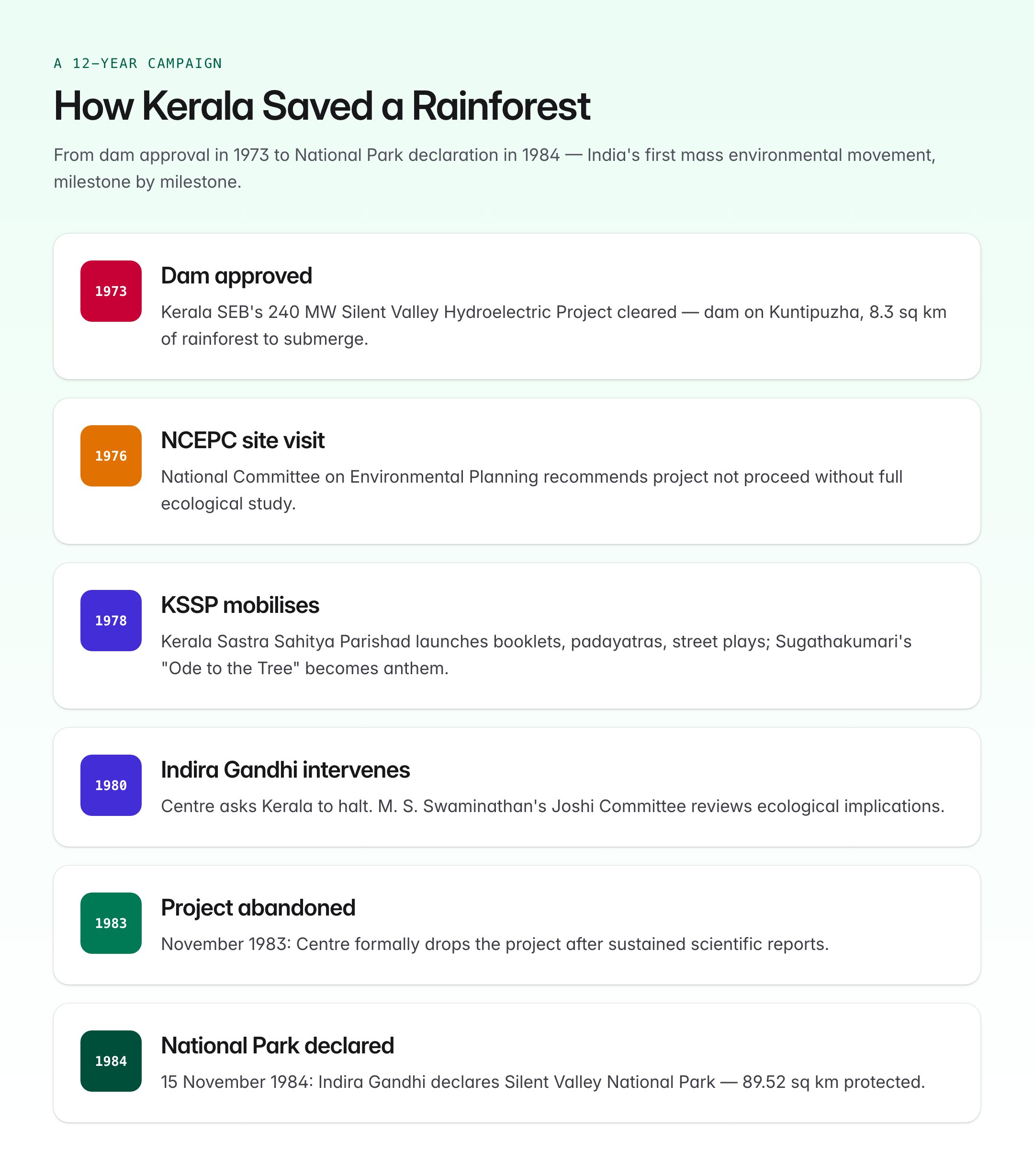
In 1973, the Kerala State Electricity Board's Silent Valley Hydroelectric Project received planning approval. The specifications:
- Dam of 130.5 m height across the Kuntipuzha river.
- Installed capacity 240 MW (2 × 120 MW).
- Submergence area approximately 8.3 sq km of pristine rainforest.
- Estimated cost at the time: Rs 25 crore (1973 prices).
Kerala was power-hungry, and the project was defended on grounds of irrigation, flood moderation and rural electrification. Construction was slated to begin in 1977.
Opposition Begins (1973–1977)
The earliest opposition came from botanists and ecologists — notably M. K. Prasad, Satish Chandran Nair, and the Bombay Natural History Society. In 1976, the National Committee on Environmental Planning and Coordination (NCEPC) visited the site and recommended that the project not proceed without comprehensive ecological study.
Two streams of opposition converged:
- Scientific community led by botanists, zoologists and the Zoological Survey of India warning of irreplaceable biodiversity loss.
- Kerala Sastra Sahitya Parishad (KSSP) — a mass science movement founded in 1962 with the motto "Science for Social Revolution" — which transformed the issue from a technical dispute into a public debate.
The KSSP and Mass Mobilisation (1978–1980)
KSSP produced accessible booklets, padayatra (foot marches), street plays and village-level discussions in Malayalam. Poet Sugathakumari's anthem "Marathinu Sthuthi" (Ode to the Tree) became the movement's cultural voice. Writer O. N. V. Kurup, ornithologist Salim Ali, environmentalist Zafar Futehally and ecologist Madhav Gadgil lent scientific and public credibility.
Opposition arguments rested on four pillars:
| Argument | Content |
|---|---|
| Biodiversity | One of the last undisturbed tropical evergreen rainforests in peninsular India |
| Endemism | High share of plant and animal species found only in Western Ghats |
| Economics | Power generation alternatives available; benefits overstated |
| Hydrology | Long-term catchment damage from deforestation |
Biodiversity Arguments — The Scientific Core
The valley hosts extraordinary biodiversity, documented by the Zoological Survey of India, Botanical Survey of India, and the later Silent Valley Study (1977–79) by the Kerala Forest Research Institute.
Key taxa:
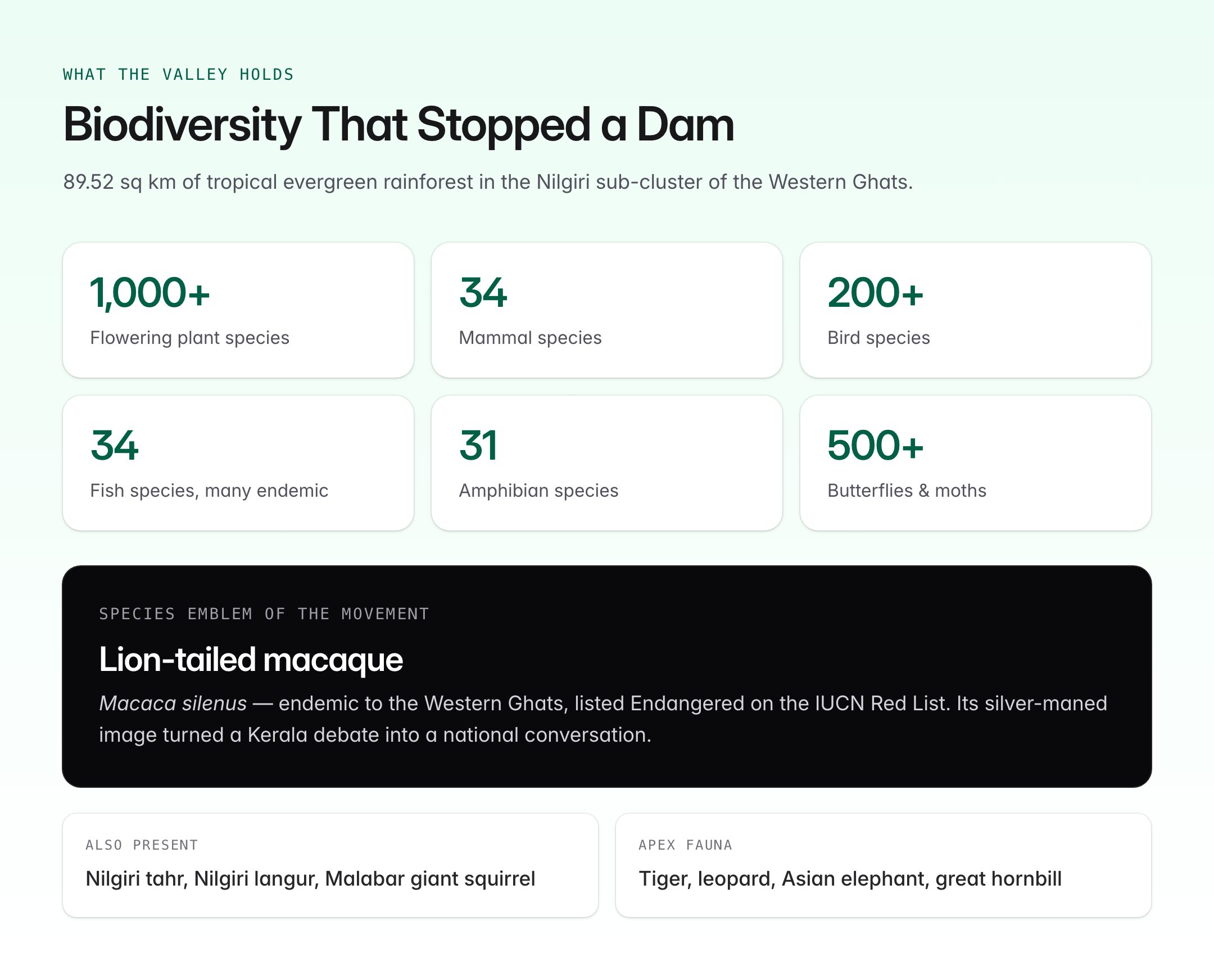
- Over 1,000 species of flowering plants, including many endemics.
- 34 species of mammals, including lion-tailed macaque (Macaca silenus), Nilgiri tahr, Nilgiri langur, Nilgiri marten, Malabar giant squirrel, tiger, leopard, Asian elephant.
- Over 200 species of birds, including great hornbill, Ceylon frogmouth, and numerous Western Ghats endemics.
- 34 species of fish, many endemic.
- 31 species of amphibians and 19 reptiles.
- 500+ species of butterflies and moths.
The lion-tailed macaque — endemic to the Western Ghats, listed Endangered on the IUCN Red List — became the species-emblem of the movement. Images of the silver-maned macaque circulated nationally, turning a Kerala debate into a Delhi conversation.
The Joshi Committee and the Turning Point
Prime Minister Morarji Desai initially favoured the project; Chief Minister E. K. Nayanar (CPI-M-led LDF) also supported it. In 1979, the Centre constituted the M. G. K. Menon Committee; then the Joshi Committee (M. S. Swaminathan, 1980) reviewed ecological implications after the Jairam Ramesh — then Indira Gandhi's environment advisers — raised alarm.
Indira Gandhi, returning to power in January 1980, is widely credited with the decisive shift. She engaged personally, read the Parliament Estimates Committee inputs, and met Sugathakumari, Salim Ali and Madhav Gadgil. In October 1980, the central government requested Kerala to halt the project. In November 1983, after sustained scientific reports (including by the M. S. Swaminathan committee and M. G. K. Menon), the project was officially abandoned.
Silent Valley National Park — The Outcome
- 15 November 1984 — Indira Gandhi formally declared Silent Valley National Park.
- 7 September 1985 — Rajiv Gandhi inaugurated the park in a public ceremony at Mukkali.
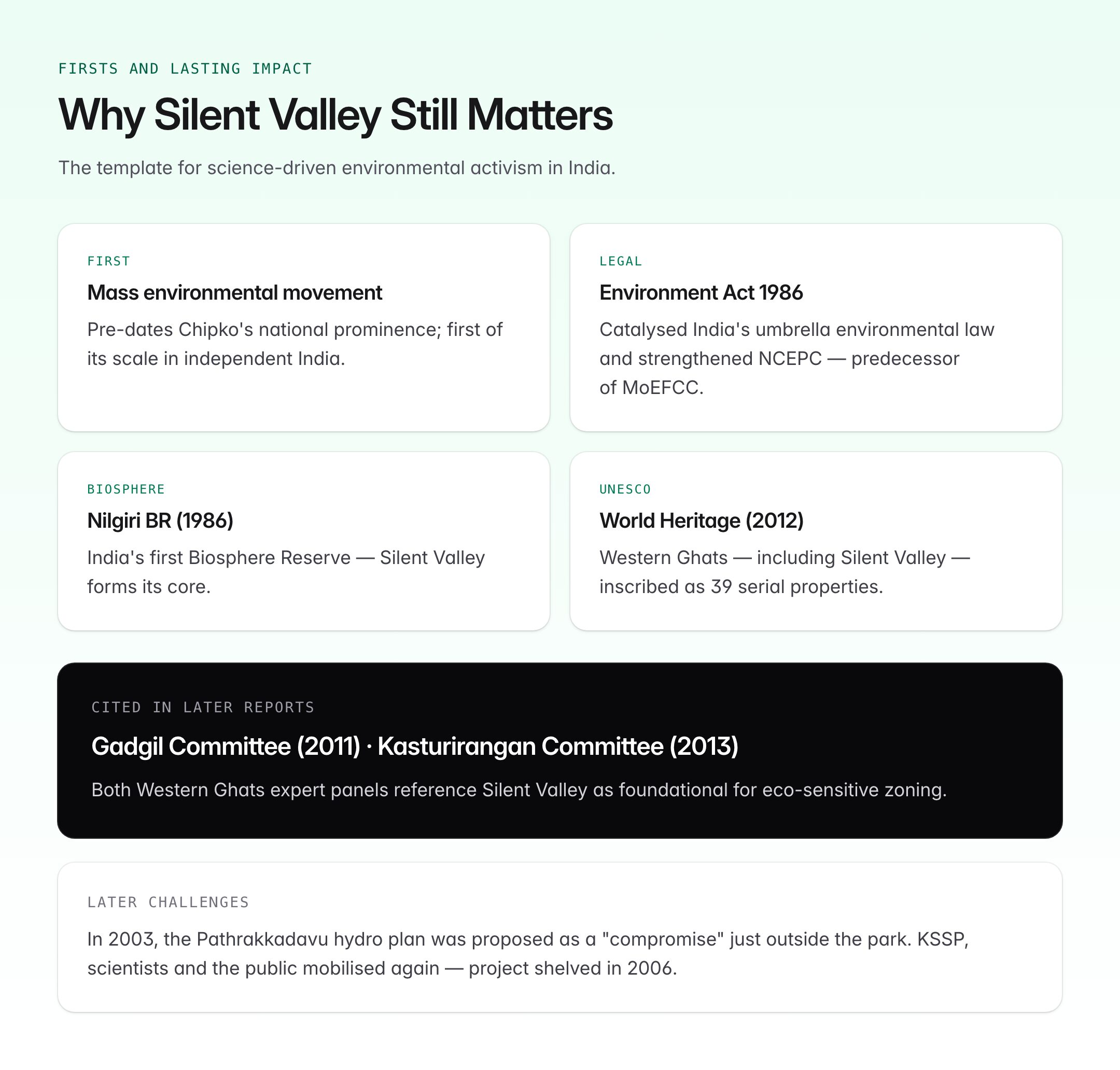
- 1986 — the area was incorporated into the Nilgiri Biosphere Reserve, India's first.
- 2007 — 89.52 sq km Sairandhri buffer added, strengthening the ecological integrity.
- 2012 — broader Western Ghats, including Silent Valley, inscribed as UNESCO World Heritage Site (39 serial properties).
In 2003, plans for a Pathrakkadavu hydroelectric project just outside the core park were proposed as a "compromise." KSSP, scientists and the public mobilised again; the project was shelved in 2006, showing the movement's continuing relevance.
Legacy and Significance
The Silent Valley Movement established several firsts:
| First / Lesson | Detail |
|---|---|
| First major environmental movement in independent India | Pre-dates Chipko's national prominence in the same decade |
| Institutional outcome | Strengthened role of NCEPC (forerunner of MoEFCC) |
| Legal outcome | Influenced the Environment (Protection) Act, 1986 |
| Scientific activism | Template for later debates: Narmada, Niyamgiri, Athirappilly |
| Public science | KSSP model replicated across India |
| Biodiversity governance | Case study cited in the Gadgil Committee (2011) and Kasturirangan Committee (2013) reports on Western Ghats |
Contemporary Challenges
Silent Valley today faces new pressures: climate-induced changes in rainfall, invasive species (especially Lantana camara), plantation encroachment on buffer, limited corridor connectivity to Mukurthi and Attappadi, and renewed "small hydro" proposals in neighbouring catchments. The Western Ghats Ecology Expert Panel (Gadgil Committee) and the High-Level Working Group (Kasturirangan) reports — though contested politically — keep the question of ecologically sensitive zoning alive.
UPSC Relevance
Prelims: Location (Palakkad, Kerala), river (Kuntipuzha), KSSP founding year (1962), park declaration (1984), biosphere reserve (Nilgiri, 1986), key species (lion-tailed macaque, Nilgiri tahr, great hornbill), committees (Joshi, Menon, Swaminathan), UNESCO inscription (2012).
GS-I (Geography): Western Ghats physiography, Nilgiri sub-cluster, endemism, rainfall regimes.
GS-III (Environment): Classic case study for "environmental movements in India," "biodiversity hotspots," "development vs environment" debate, role of civil society and science communication in policy.
A typical GS-III question: "The Silent Valley movement marked a paradigm shift in India's approach to development and environment. Discuss."
Essay: Excellent illustration for essays on "development vs conservation," "science in public policy," "voice of the citizen in a democracy."
Interview: Expect questions on comparing Silent Valley with Chipko or Narmada Bachao Andolan, on whether ecological concerns should veto development projects, and on the Gadgil vs Kasturirangan debate.
Study Silent Valley as the moment when evidence, poetry and politics aligned — producing a rare, durable win for the forests of the Western Ghats.
Tell Google you want more of this.
Add Anantam IAS as a preferred sourceOne tap, and this site shows up more often in your own Top Stories, AI Overviews and AI Mode. Remove it any time.