Sohrai painting is a traditional mural art form practised by tribal and rural women of Jharkhand, especially in the Hazaribagh region, during the post-harvest Sohrai festival that celebrates cattle and the harvest. Characterised by earthy pigments, nature motifs, and geometric forms painted on mud-plastered walls, Sohrai is closely linked with the related Khovar marriage-season art. Both traditions received the Geographical Indication (GI) tag in 2020 as "Sohrai Khovar Painting", cementing their status as a protected cultural heritage of Jharkhand. This guide explores Sohrai's origins, technique, themes, and significance for UPSC Art & Culture.
What Is Sohrai Painting
Sohrai is a post-harvest mural art tradition of central-eastern India, painted on the outer and inner walls of village homes to mark the arrival of the cattle festival of the same name.
- Practised predominantly by women of tribal and agrarian communities including Kurmi, Santhal, Oraon, Munda, Agaria, Ghatwal, and Prajapati communities.
- Painted after the Diwali–Kartik Purnima period in October–November.
- Associated with the Sohrai festival, which honours cattle (pashu pooja) and celebrates the harvest.
The name "Sohrai" is believed to derive from the word soro meaning "to drive with a stick", referencing the ceremonial procession of cattle.
Origins and Antiquity
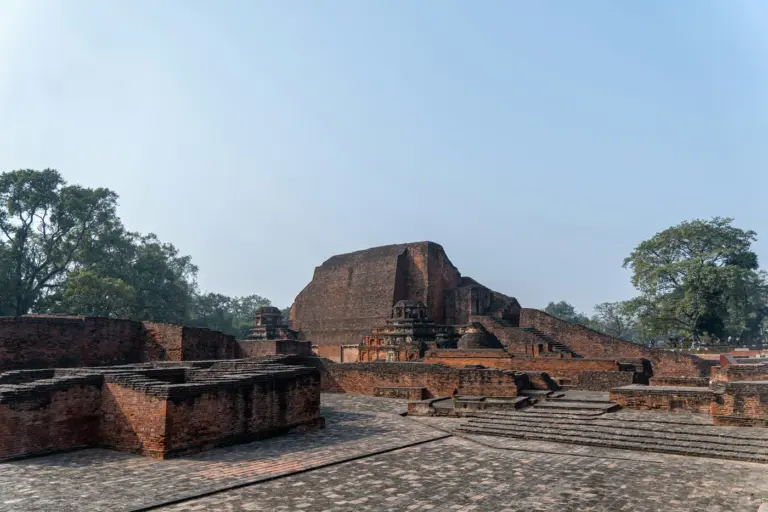
Sohrai art has deep prehistoric roots.
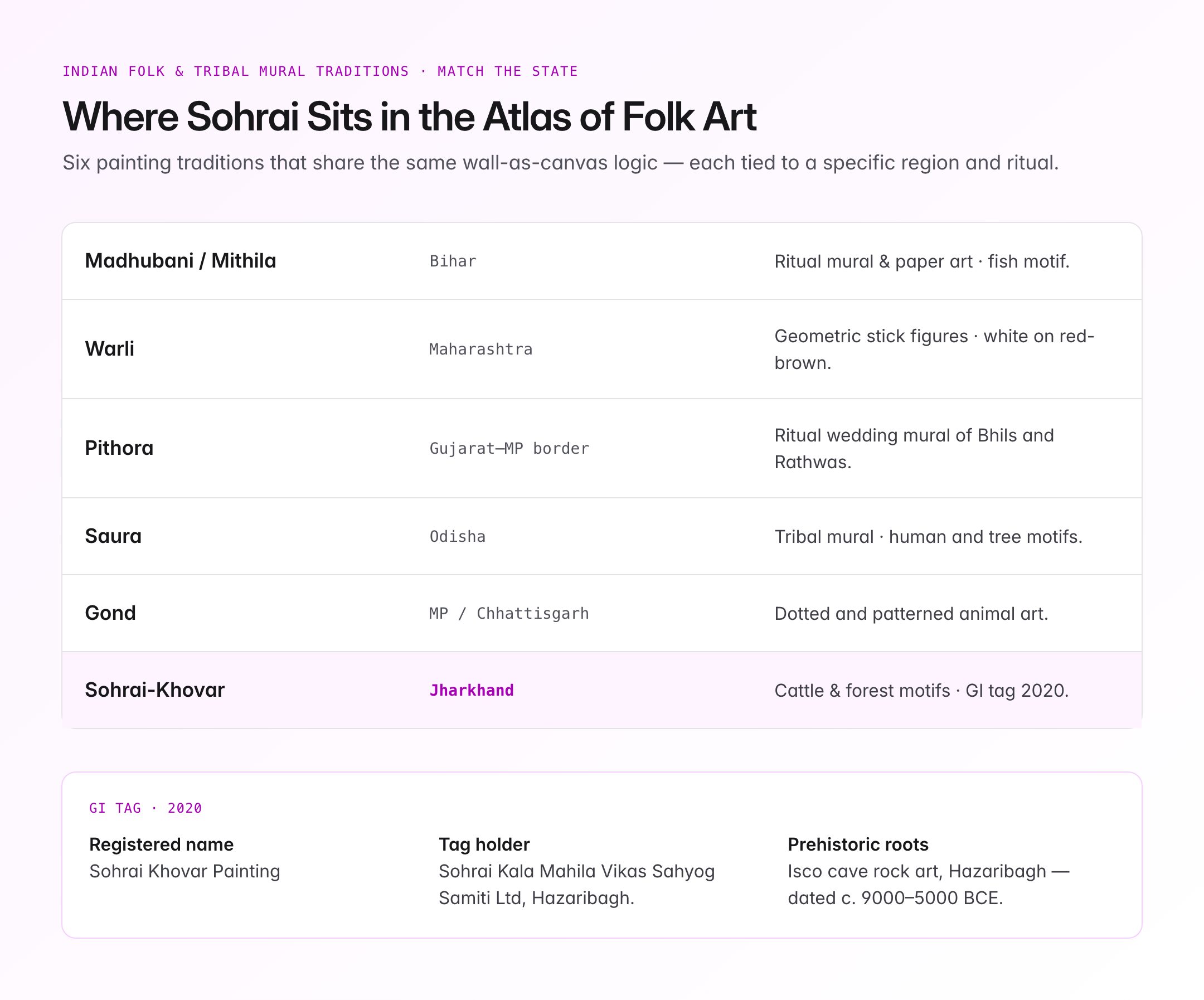
- Rock art in the Isco caves of Hazaribagh, dated to Mesolithic–Neolithic periods (c. 9000–5000 BCE), displays motifs strikingly similar to modern Sohrai — animals, sun, and geometric patterns.
- This has led scholars to describe Sohrai as a living tradition continuous with ancient rock art.
- Hazaribagh-based conservationist and scholar Bulu Imam led efforts to document and revive the tradition.
Sohrai and Khovar: Two Sister Traditions
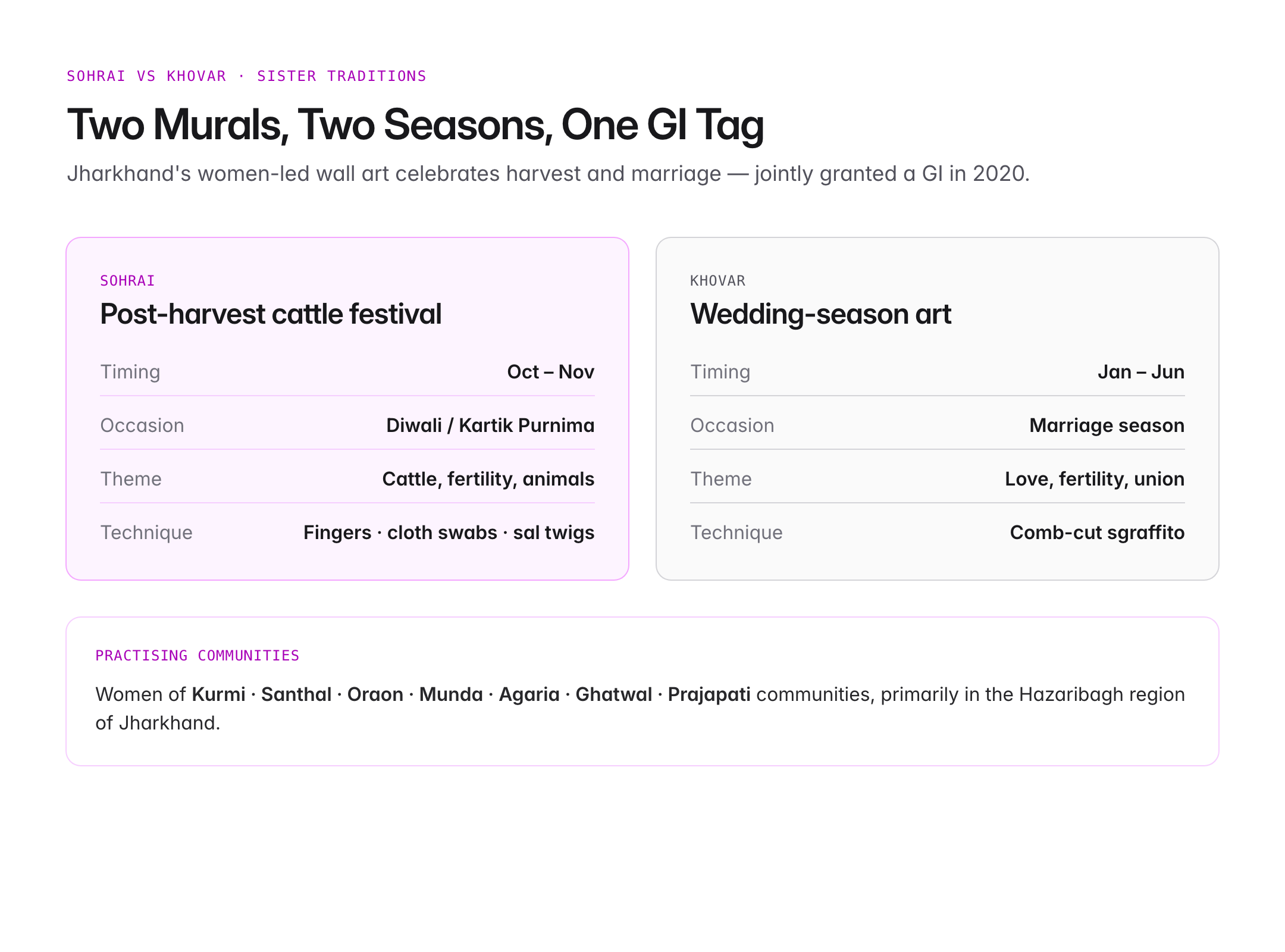
| Feature | Sohrai | Khovar |
|---|---|---|
| Occasion | Post-harvest, cattle festival | Wedding season |
| Timing | October–November | January–June |
| Theme | Cattle, fertility, animals, nature | Fertility, love, marriage |
| Technique | Painted with fingers, cloth swabs, twigs | "Comb-cut" sgraffito on wet clay |
- Sohrai uses pigment application on dry or semi-dry walls.
- Khovar uses a comb-cut technique — two layers of clay (dark underneath, lighter on top) are applied and then the top layer is scraped off to reveal designs.
Together they form a seasonal rhythm of domestic art tied to agriculture and marriage cycles.
Materials and Technique
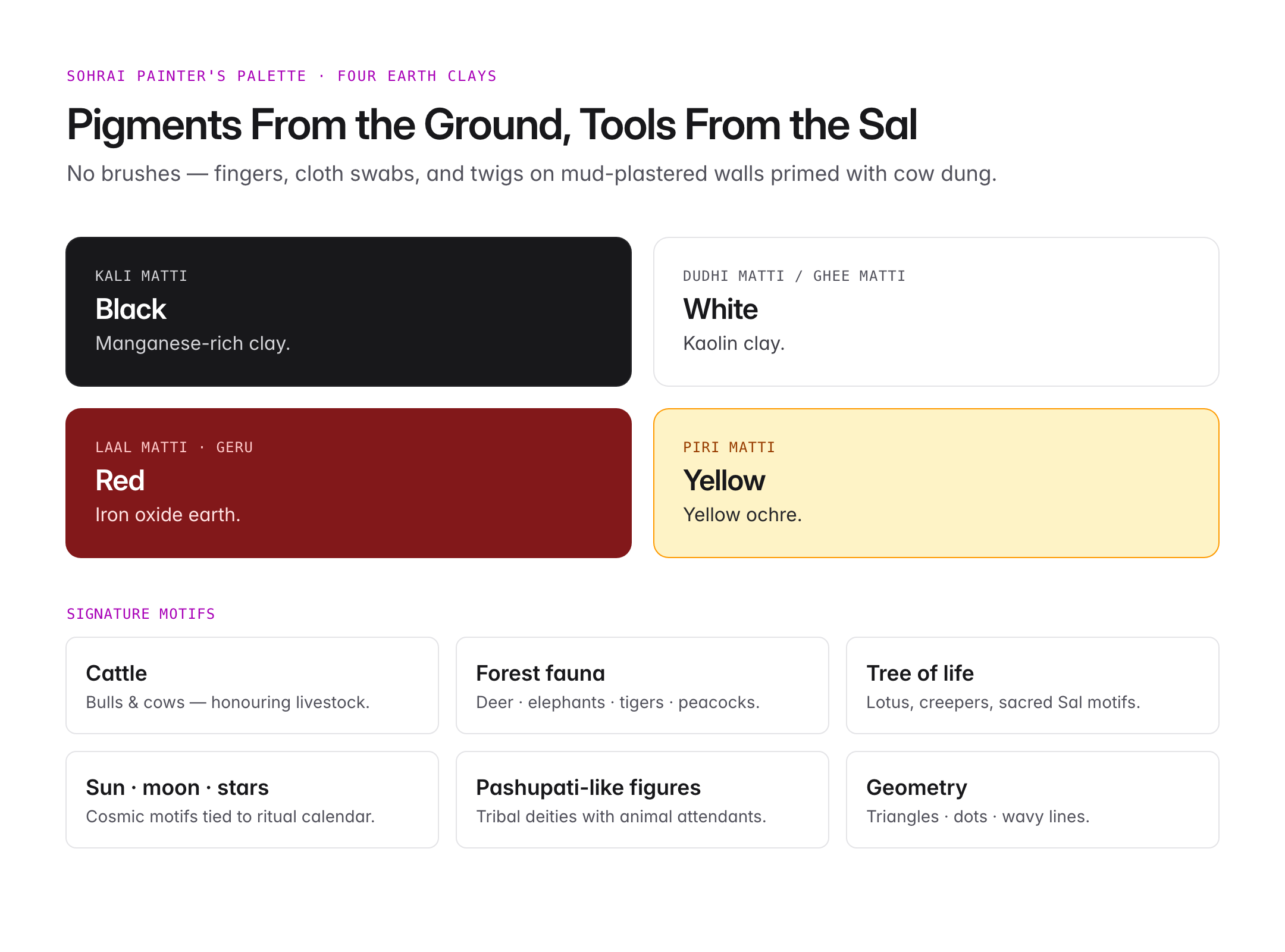
Sohrai is executed with natural earthen pigments:
- Kali matti (black manganese-rich clay)
- Ghee matti / dudhi matti (white kaolin clay)
- Laal matti / geru (red oxide)
- Piri matti (yellow ochre)
Tools:
- Twigs of sal, wads of cloth, and fingers.
- No brushes in the conventional sense.
Surface:
- Mud-plastered walls of village homes.
- The base layer is usually prepared with cow dung and mud.
Preservation:
- Traditionally painted afresh each year as seasonal renewal; contemporary artists now create works on paper and canvas for markets.
Themes and Motifs
Sohrai art draws from the natural and spiritual world of rural Jharkhand.
- Cattle – bulls, cows – central motif honouring livestock.
- Forest animals – deer, elephants, tigers, peacocks.
- Flora – lotus, trees of life, creepers.
- Sun, moon, and stars.
- Pashupati-like figures and tribal deities.
- Geometric patterns – triangles, dots, wavy lines.
The art style emphasises bold outlines, symmetry, and repetition, creating a rhythmic visual tapestry tied to seasonal cycles.
Sohrai Festival
The Sohrai festival itself is an integral context for the painting.
- Celebrated across Jharkhand, Bihar, West Bengal (Jangalmahal), Odisha, and Chhattisgarh.
- Cattle are bathed, decorated with vermillion and flowers, and offered rice cakes.
- Sacred bullfights and community dances mark the festivities.
- Paintings adorn doorways and courtyards to welcome cattle and deities into the home.
Geographical Indication (GI) Tag
In 2020, "Sohrai Khovar Painting" was granted a Geographical Indication (GI) tag under the Geographical Indications of Goods (Registration and Protection) Act, 1999.
- Tag holder: Sohrai Kala Mahila Vikas Sahyog Samiti Limited, Hazaribagh.
- The GI covers paintings originating from Hazaribagh district and surrounding areas of Jharkhand.
- GI status provides legal protection against imitation, supports artisans commercially, and preserves cultural heritage.
Jharkhand's other famous GI-tagged craft is Dokra (bell metal) art.
Notable Sohrai Artists
- Parvati Devi and other Hazaribagh-based women artists have showcased Sohrai at national and international venues.
- Bulu Imam, founder of INTACH Hazaribagh Chapter, documented Sohrai and fought to preserve it during coal mining and developmental pressures.
- In 2019, Sohrai murals were painted at the Rajiv Gandhi International Airport, Hyderabad and the Hazaribagh–Ranchi railway station, bringing the art to public spaces.
- Works have been displayed at the National Museum, the British Museum, and galleries in Europe and Australia.
Threats and Challenges
- Coal mining in Hazaribagh and the broader Damodar Valley threatens both villages and the cultural landscape.
- Urban migration weakens inter-generational transmission.
- Use of synthetic paints and cement walls replaces traditional mud surfaces.
- Commercialisation risks diluting authenticity unless carefully managed.
Revival Efforts
- INTACH Hazaribagh Chapter runs documentation and training workshops.
- Jharkhand state government promotes Sohrai through tourism and handicraft boards.
- Cooperative societies bring artists into formal markets, including the one that holds the GI.
- Paintings on paper and canvas extend the market beyond seasonal mural works.
Comparable Indian Folk Art Traditions
| Art form | State | Feature |
|---|---|---|
| Madhubani / Mithila | Bihar | Ritual mural and paper art, fish motif |
| Warli | Maharashtra | Geometric stick figures, white on red-brown |
| Pithora | Gujarat–MP border | Ritual wedding mural of Bhils and Rathwas |
| Saura | Odisha | Tribal mural with human and tree motifs |
| Gond | MP/Chhattisgarh | Dotted and patterned animal art |
| Sohrai-Khovar | Jharkhand | Mural, cattle and forest motifs |
UPSC Relevance
Prelims focus:
- Sohrai-Khovar received GI tag in 2020.
- Origin: Hazaribagh, Jharkhand.
- Sohrai – post-harvest cattle festival mural; Khovar – wedding season.
- Isco caves in Hazaribagh show prehistoric continuity.
- Materials: natural clay pigments, applied with fingers, twigs, cloth.
Mains GS angle (GS Paper I – Art & Culture, Indian Society):
- Tribal art as living heritage and identity marker.
- Role of GI tags in protecting intangible cultural heritage and supporting livelihoods.
- Balancing development (mining) with preservation of cultural landscapes.
- Contribution of tribal women artists to India's artistic pluralism.
Sample PYQ angle: UPSC has asked about folk and tribal art traditions, GI tags, and state-specific art. Expect questions pairing Sohrai with Jharkhand, Khovar with weddings, and comparative questions on Indian folk art styles.
Tell Google you want more of this.
Add Anantam IAS as a preferred sourceOne tap, and this site shows up more often in your own Top Stories, AI Overviews and AI Mode. Remove it any time.