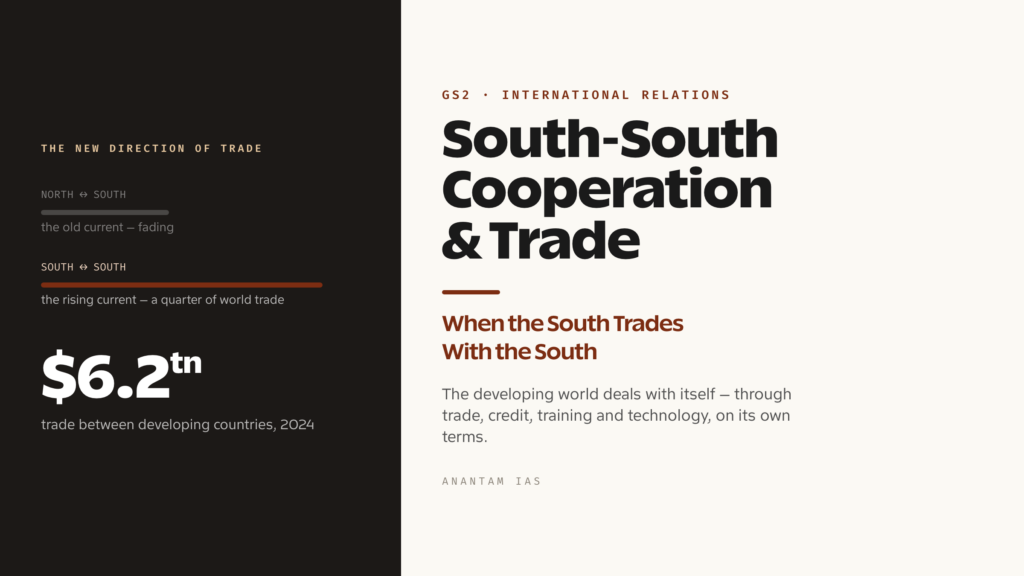
For most of the twentieth century, the map of world trade ran north to south. Developing countries dug raw materials out of the ground and shipped them to rich factories in Europe, North America and Japan, then bought back the finished goods at a markup. The South sold cotton and bought shirts. That old current is now visibly reversing. Trade between developing countries themselves — what economists call South-South trade — has crossed $6.2 trillion a year and has grown from barely a tenth of world merchandise trade in 2000 to roughly a quarter of it by 2024. A Vietnamese phone assembled with Chinese parts and sold in Nigeria, an Indian tractor financed by an Indian loan and ploughing a field in Tanzania — these are the new arteries, and they no longer pass through the old centres of power.
This shift sits at the heart of what diplomats now call the Global South, and it matters for an aspirant because it cuts across almost the whole of GS Paper 2’s international-relations syllabus. South-South cooperation is not only trade. It is loans, training, technology, vaccines and political solidarity — a whole alternative architecture that developing countries have built to deal with each other on their own terms, rather than through the institutions the West designed after 1945. India has become one of its most active builders and its loudest voice. Understand this story well, and you can answer questions on India’s neighbourhood and Africa policy, on multilateral reform, on the BRICS and the IBSA grouping, and on India’s bid to lead the developing world — all from one well-organised body of facts.
What South-South Cooperation Actually Means
Start with the two halves of the phrase, because each carries weight. “South” here is not a compass direction but a shorthand for the developing world — the roughly 130 countries of Asia, Africa and Latin America that were once colonised, are still catching up economically, and share a sense of having been on the losing side of the old global order. “North” is the rich, industrialised bloc — Western Europe, North America, Japan, Australia. So North-South cooperation is the familiar aid relationship, a rich donor giving to a poor recipient. South-South cooperation is the opposite idea: developing countries helping each other, as equals, without that hierarchy of donor and beggar.
The principle that holds it together is solidarity rather than charity. Where Western aid often comes with conditions — adopt these economic reforms, hold these elections, open these markets — South-South cooperation officially rests on horizontality, mutual benefit, respect for sovereignty and “non-interference” in another country’s internal affairs. The pitch is that a country like India, which solved its own problems of food shortage, vaccine supply or digital identity within living memory, can share what actually worked on the ground far better than a distant Western consultant. The help is meant to flow between near-equals who understand each other’s constraints, in fields the recipient chooses, with no political strings attached. That is the promise; the practice, as we’ll see, is more complicated.
This is also an old idea with a long pedigree, and naming its milestones strengthens any answer. Its political roots lie in the 1955 Bandung Conference, where newly independent Asian and African states first gathered to assert a collective voice, and in the Non-Aligned Movement that followed. Its formal development charter is the Buenos Aires Plan of Action, adopted by 138 countries in 1978 to promote technical cooperation among developing nations — which is why the United Nations marks 12 September as the Day for South-South Cooperation. The fortieth-anniversary conference in 2019, known as BAPA+40, recommitted the world to it as a pillar of the 2030 Sustainable Development Goals. And the United Nations runs a dedicated office, the UN Office for South-South Cooperation, to coordinate it. The thread runs unbroken from anti-colonial solidarity to today’s trade and technology partnerships.
Why South-South Trade Is Surging
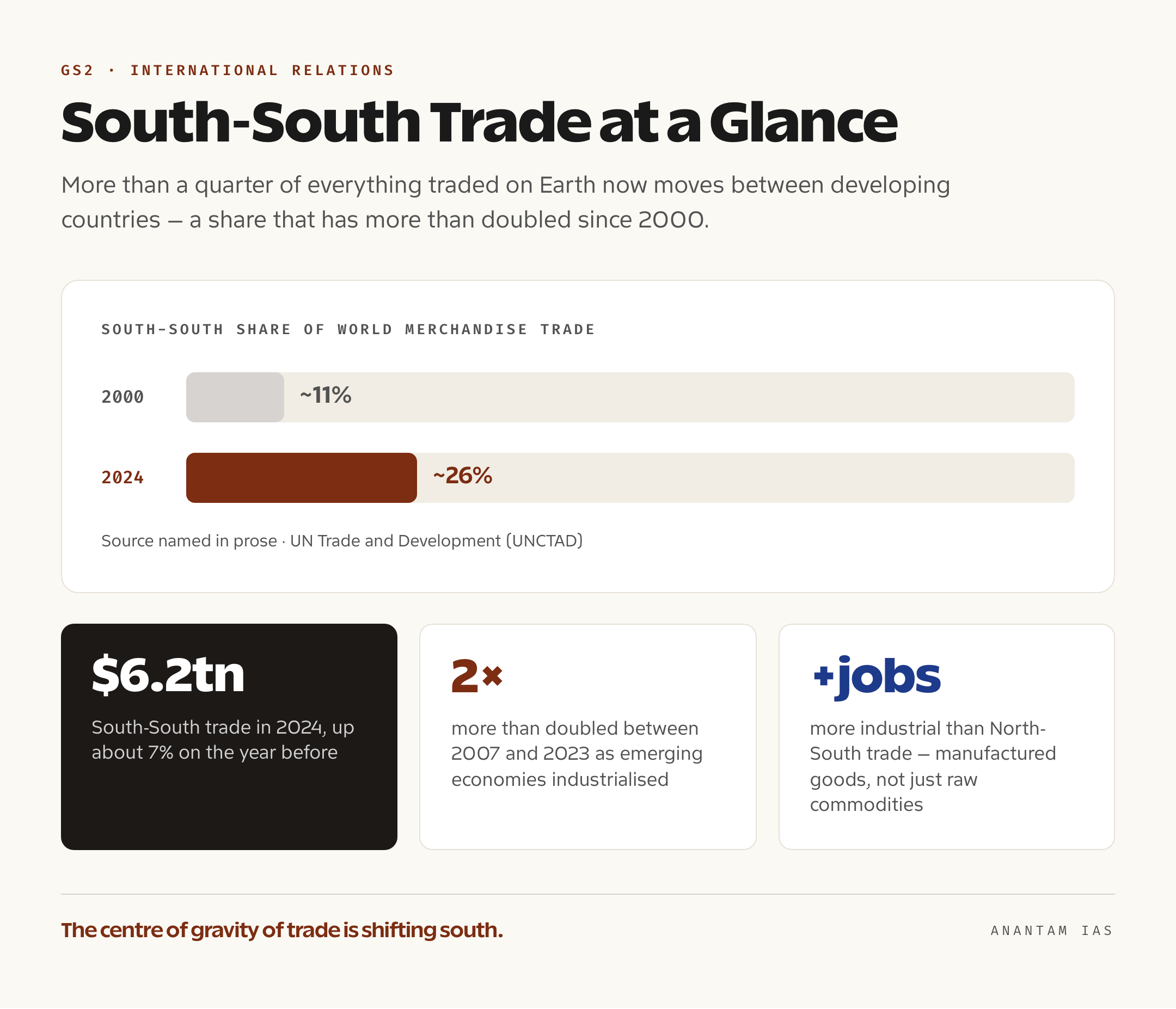
The numbers are the spine of this topic, so anchor them firmly. According to UN Trade and Development, the body still widely known as UNCTAD, South-South trade was worth about $6.2 trillion in 2024, up roughly 7 per cent on the year before, and it more than doubled between 2007 and 2023. Its share of total world merchandise trade climbed from around 11 per cent in 2000 to about 26 per cent in 2024 — more than a quarter of everything traded on Earth now moves between developing countries. East Asia leads this surge, with the strongest export growth and intra-regional trade rising at double-digit rates, but Africa too has been posting solid gains in both exports and imports. The centre of gravity of trade is shifting south and east, and the data make the trend impossible to dismiss.
Several forces drive it, and a good answer lists them as a chain rather than a heap. The first is the sheer rise of the emerging economies themselves — as China, India, Brazil, Indonesia and others industrialised, they began producing the machinery, electronics, chemicals and vehicles that other developing countries want to buy, so the South now makes goods the South can use. The second is a growing middle class across the developing world, a vast new pool of consumers whose demand pulls in imports from neighbours rather than only from the West. The third is the proliferation of regional trading blocs — the African Continental Free Trade Area, ASEAN, Mercosur in South America — that knock down tariffs between developing countries and stitch their markets together. And the fourth is a deliberate hedge: after the trade wars, supply-chain shocks and the weaponisation of economic ties of recent years, developing countries want to diversify their export destinations away from a handful of volatile Western markets. Put together, supply, demand, policy and risk-management all push the same way.
There is a structural point worth carrying into an answer, too. South-South trade is, on average, more diversified and more industrial than the old North-South pattern. When a developing country sells to the rich world, it still tends to ship raw commodities; when it sells to another developing country, it is more likely to ship manufactured and intermediate goods. That matters for development because manufacturing creates jobs, skills and higher-value exports in a way that digging up ore never does. So the rise of South-South trade is not just a change in direction — it can be a ladder out of the low-value commodity trap that colonial trade locked many economies into.
The Machinery: How the Global South Cooperates
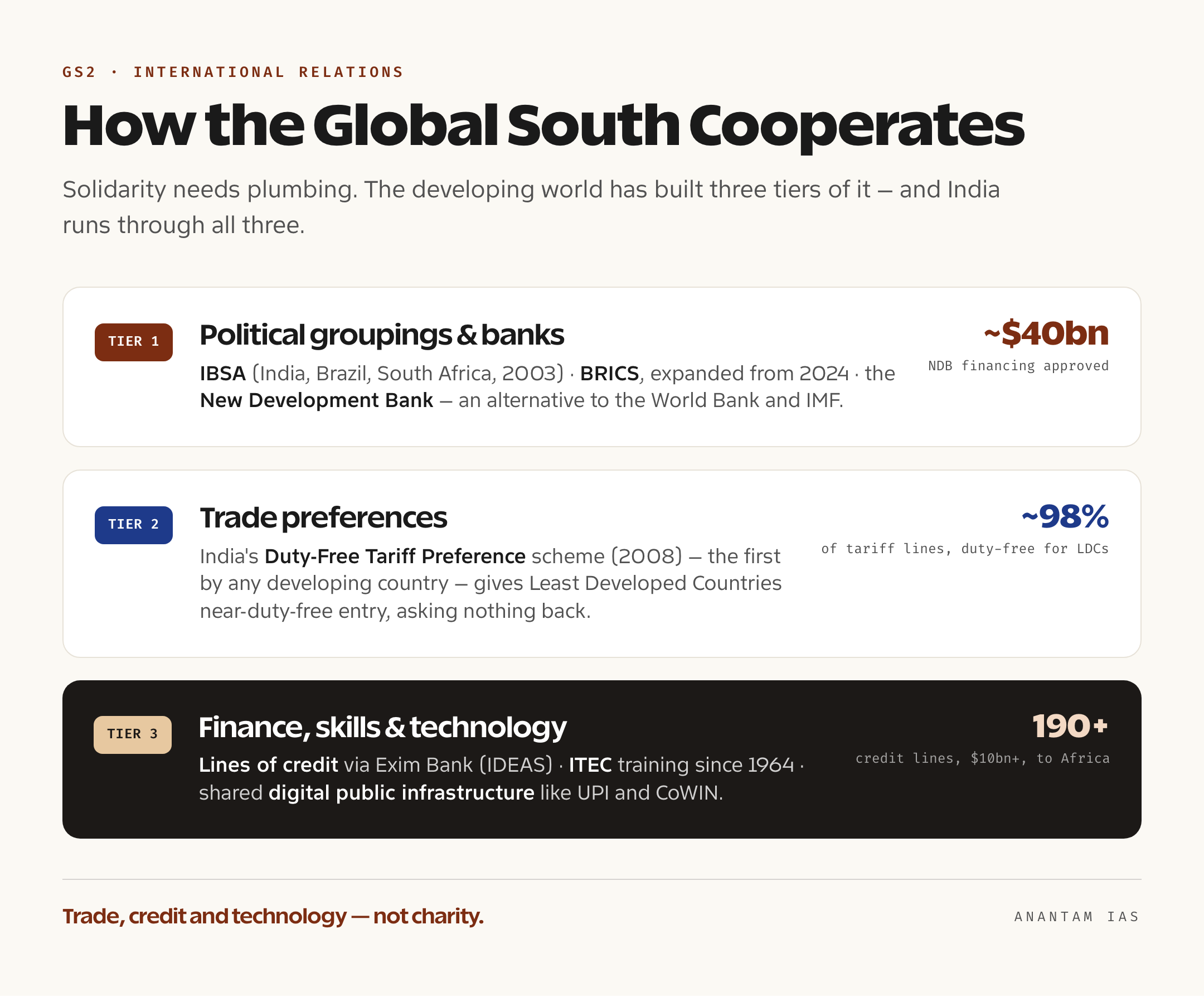
Solidarity needs plumbing, and the developing world has built a surprising amount of it. The most political layer is the groupings. The IBSA Dialogue Forum, launched in 2003, links India, Brazil and South Africa — three large democracies on three different continents — and runs a small but symbolically important IBSA Fund that bankrolls development projects in other poor countries, from agriculture in Guinea-Bissau to health in Palestine. BRICS, which grew out of the same impulse, is the heavyweight: originally Brazil, Russia, India, China and South Africa, it expanded from 2024 to include Egypt, Ethiopia, Iran and the United Arab Emirates, with a long line of further countries invited to join. Its financial arm, the New Development Bank, headquartered in Shanghai, has now approved around $40 billion of financing for infrastructure and sustainable-development projects across the South, and has itself taken in new members like Bangladesh, Egypt and the UAE — a deliberate alternative to the World Bank and the IMF, where the West still holds the votes.
The second layer is trade preferences, and here India has a flagship to name. Its Duty-Free Tariff Preference scheme, launched in 2008, was the first such offer by any developing country to the world’s Least Developed Countries: it lets the poorest nations export to India with zero or reduced duties on about 98 per cent of all tariff lines, with roughly three dozen LDCs notified as beneficiaries. The logic is non-reciprocal generosity — India asks nothing back, on the theory that opening its huge market to the poorest exporters does more for development than any handout. Multiply that by similar schemes elsewhere and you get a web of preferential access that lets small economies sell into big Southern markets they could never crack on Western terms.
The third layer is finance and capacity-building, and this is where India’s own model is clearest. India runs its development partnership through lines of credit — concessional loans, mostly routed through the Export-Import Bank under the IDEAS scheme, that a partner country uses to buy Indian goods and services for a project it has chosen, such as a railway, a power plant or a drinking-water network. India has extended more than 190 such lines of credit worth over $10 billion to 41 African countries alone, and trade with Africa has climbed to around $82 billion a year. Alongside the money runs the training: the Indian Technical and Economic Cooperation programme, ITEC, running since 1964, has trained tens of thousands of officials and professionals from developing countries in Indian institutes, from auditors to IT specialists. And India increasingly shares its digital public infrastructure — the UPI payments rails, the CoWIN vaccination platform, the Aadhaar-style identity stack — as a low-cost development tool. Money, skills and technology, bundled together, are India’s distinctive contribution to the machinery.
India and the Voice of the Global South
India has tried to do more than participate in South-South cooperation; it has tried to lead it, and the most visible vehicle is the Voice of Global South Summit. India launched this virtual platform in January 2023, around its G20 presidency, precisely to position itself as a bridge between the rich world and the developing one — to carry the concerns of countries that have no seat at the high tables into the rooms where decisions are actually made. The third edition, held in August 2024 under the theme “An Empowered Global South for a Sustainable Future,” drew participation from 123 countries, a scale that lets India credibly claim to speak with, if not quite for, much of the developing world. At it, the Prime Minister proposed a “Global Development Compact” built on India’s own development experience, promising partnership that would not bury poorer countries under debt — a pointed contrast with lending elsewhere that has left some nations in distress.
The strategy behind this is worth spelling out, because examiners reward the “why.” India sits in an unusual position: large and fast-growing enough to matter to the West, yet still a developing country that shares the South’s grievances about an unfair global order. It uses that dual identity to push a consistent set of demands — reform of the United Nations Security Council and the Bretton Woods institutions so the South gets real votes, a fairer deal on climate finance and technology, and debt relief for the most stressed economies. By championing these causes India builds diplomatic capital across Africa, Latin America and small-island states, capital it can convert into support at the UN, into export markets for its firms, and into a counterweight to China’s own deep reach into the developing world. South-South leadership, in other words, is both principle and strategy at once.
But the leadership is contested, and a balanced answer must say so. China is by far the largest South-South actor, with its Belt and Road Initiative dwarfing India’s lending in raw scale, which makes “Global South leadership” a quiet competition as much as a shared cause. The grouping itself is loose and diverse — a bloc that contains both Gulf petro-states and famine-prone Sahel nations has no single interest, and consensus is hard. And India’s own record is uneven: some of its overseas projects have run late or over budget, and the gap between the rhetoric of equal partnership and the reality of commercial self-interest is real. None of this cancels the achievement, but it means India’s claim to lead the South is a work in progress, earned summit by summit and project by project rather than declared.
For Your Mains Answer
This is a high-value topic for GS Paper 2, specifically the segment on India and its neighbourhood, bilateral and regional groupings involving India, and the structures and mandate of international institutions. It speaks directly to questions on India’s Africa policy, on the reform of global governance, on India’s role in the BRICS and IBSA, and on the very idea of the Global South. It also feeds the Essay paper on themes of solidarity, a multipolar world and the legacy of decolonisation. What examiners reward is the ability to move from the big idea (solidarity over charity) to hard mechanisms (credit lines, the DFTP scheme, the New Development Bank) and then to a fair-minded verdict — all anchored by two or three exact figures.
How to Build the Answer
Open by defining South-South cooperation against North-South cooperation — equals helping each other versus donor-recipient aid — and root it in Bandung and the Buenos Aires Plan of Action so the reader knows it has history. Then show the scale with the trade numbers ($6.2 trillion, a quarter of world trade). Next, lay out the machinery in three tiers: political groupings (IBSA, BRICS, NDB), trade preferences (the DFTP scheme), and India’s finance-and-capacity model (lines of credit, ITEC, digital public goods). Bring it home through India’s Voice of the Global South leadership and its dual-identity strategy. Close with a balanced verdict that names the limits — China’s larger footprint, the bloc’s diversity, the rhetoric-reality gap. That arc — define, scale, mechanisms, India, evaluate — fits almost any question on the theme.
Common Mistakes to Avoid
Don’t treat South-South cooperation as only trade; the capacity-building and political-solidarity dimensions are half the marks. Don’t describe it as charity — the whole point is mutual benefit between equals, and missing that misses the concept. Don’t present India as the undisputed leader of the Global South when China’s scale is far larger; acknowledge the competition. And don’t recite the principles (sovereignty, non-interference, no conditions) without noting that the practice falls short of them — the gap is exactly what a critical answer should flag.
A Compact Answer Spine
South-South cooperation = developing countries helping each other as equals (vs North-South donor-recipient aid), rooted in Bandung 1955 and the Buenos Aires Plan of Action 1978 → scale: South-South trade ≈ $6.2 trillion, up from ~11% of world trade in 2000 to ~26% in 2024, and more industrial than North-South trade → machinery in three tiers: groupings (IBSA, BRICS + New Development Bank ~$40bn approved), trade preferences (India’s DFTP, zero duty on ~98% of lines for LDCs), finance and skills (190+ lines of credit worth $10bn+ to Africa, ITEC since 1964, digital public infrastructure) → India’s lead: Voice of Global South Summit (123 countries, 2024), Global Development Compact, dual bridge identity → verdict: real alternative architecture, but limited by China’s scale, the bloc’s diversity and a rhetoric-reality gap.
Diagram or Flowchart Idea
Draw a simple three-tier pyramid for the machinery — political groupings at the top (IBSA, BRICS, NDB), trade preferences in the middle (DFTP), finance and capacity-building at the base (lines of credit, ITEC, digital public goods) — with India’s name threaded through all three layers. Beside it, a small line showing South-South trade rising from 11 to 26 per cent of world trade. The pyramid communicates the whole architecture at a glance and is quick to sketch.
A Balanced-Conclusion Line
A line that lands the marks: “South-South cooperation has matured from a slogan of anti-colonial solidarity into a working architecture of trade, credit and technology that gives the developing world real bargaining power — and India, by bundling concessional finance with skills and digital public goods, has made itself one of its principal builders, even as China’s scale and the bloc’s own diversity keep true leadership a contest rather than a coronation.”
How to Use Data Without Cramming
You need only four anchors, not a spreadsheet: $6.2 trillion (South-South trade), about 26 per cent (its share of world trade, up from 11 per cent in 2000), 190-plus lines of credit worth over $10 billion (India to Africa), and 123 countries (the 2024 Voice of Global South Summit). Drop those four into the right sentences and the answer reads as authoritative. Attribute them plainly — “as UN Trade and Development reports” or “according to the Ministry of External Affairs” — rather than scattering numbers without a source.
FAQ
What is the difference between South-South and North-South cooperation? North-South cooperation is the traditional aid relationship in which a rich, industrialised donor in the global North gives assistance to a poorer recipient in the South, often with policy conditions attached. South-South cooperation is developing countries helping each other as near-equals — sharing trade, concessional loans, training and technology on principles of solidarity, mutual benefit, respect for sovereignty and no political strings. The first is hierarchical charity; the second is meant to be horizontal partnership.
How big is South-South trade today? According to UN Trade and Development, trade between developing countries reached about $6.2 trillion in 2024, up roughly 7 per cent on the previous year, and it more than doubled between 2007 and 2023. Its share of total world merchandise trade has risen from around 11 per cent in 2000 to about 26 per cent in 2024 — more than a quarter of all goods traded now move between developing economies, and that share is still climbing.
What does India do for South-South cooperation? India contributes through several channels: concessional lines of credit (over 190 worth more than $10 billion to African countries alone, routed through the Exim Bank), the Duty-Free Tariff Preference scheme that gives the poorest countries near-duty-free access to its market, the ITEC programme that has trained tens of thousands of professionals from developing nations since 1964, and increasingly its digital public infrastructure like UPI and CoWIN. It also leads politically through the BRICS, the IBSA forum and the Voice of Global South Summit.
What is the Voice of Global South Summit? It is a virtual platform India launched in January 2023 to amplify the concerns of developing countries and position itself as a bridge between the rich world and the Global South. The third edition, in August 2024 under the theme “An Empowered Global South for a Sustainable Future,” drew 123 countries, and at it India proposed a “Global Development Compact” offering partnership without saddling poorer nations with unsustainable debt.
Practice Questions
Prelims MCQs
- With reference to South-South cooperation, consider the following: it is best described as
(a) aid given by industrialised countries to developing countries with policy conditions
(b) cooperation among developing countries on principles of solidarity and mutual benefit
(c) trade conducted only through the World Trade Organization
(d) a military alliance of non-aligned states
Answer: (b) South-South cooperation refers to developing countries helping each other as near-equals, in contrast to the donor-recipient model of North-South aid. - The Duty-Free Tariff Preference (DFTP) scheme is associated with which of the following?
(a) A reciprocal free-trade agreement between India and the European Union
(b) India’s non-reciprocal tariff preferences for Least Developed Countries
(c) A World Bank programme for middle-income countries
(d) A BRICS common external tariff
Answer: (b) Launched by India in 2008, the DFTP scheme offers Least Developed Countries duty-free or reduced-duty access on about 98 per cent of tariff lines, with no requirement of reciprocity. - The New Development Bank is most closely associated with which grouping?
(a) The G7
(b) BRICS
(c) The Organisation for Economic Co-operation and Development
(d) The Asian Development Bank’s member states
Answer: (b) The New Development Bank, headquartered in Shanghai, was set up by the BRICS countries as an alternative source of development finance and has since admitted further members. - The United Nations observes the Day for South-South Cooperation on 12 September because that date marks the adoption of which document?
(a) The Bandung Declaration
(b) The Buenos Aires Plan of Action
(c) The Marrakesh Agreement
(d) The Paris Agreement
Answer: (b) The Buenos Aires Plan of Action for promoting technical cooperation among developing countries was adopted on 12 September 1978, and the UN day commemorates it. - The IBSA Dialogue Forum brings together which three countries?
(a) India, Brazil and South Africa
(b) India, Bangladesh and Sri Lanka
(c) Indonesia, Brazil and South Africa
(d) India, Brazil and Saudi Arabia
Answer: (a) IBSA, launched in 2003, links the three large developing democracies India, Brazil and South Africa and runs a fund for development projects in other poor countries.
Mains Practice Questions
- Distinguish between South-South and North-South cooperation, and examine why South-South trade has grown faster than world trade over the past two decades. (15 marks, 250 words)
- “South-South cooperation has evolved from a slogan of solidarity into a working architecture of trade, credit and technology.” Discuss with reference to its key mechanisms. (15 marks, 250 words)
- Evaluate India’s development-partnership model — lines of credit, the Duty-Free Tariff Preference scheme, ITEC and digital public infrastructure — as an instrument of its foreign policy. (15 marks, 250 words)
- To what extent has the Voice of Global South Summit strengthened India’s claim to lead the developing world? Critically analyse, noting the competition it faces. (15 marks, 250 words)
- The Global South is a diverse and loosely organised bloc. Examine the opportunities and limits this diversity creates for effective South-South cooperation. (10 marks, 150 words)
Tell Google you want more of this.
Add Anantam IAS as a preferred sourceOne tap, and this site shows up more often in your own Top Stories, AI Overviews and AI Mode. Remove it any time.