Swarved Mahamandir (also known as Swarved Mandir) is the world’s largest meditation centre, located at Umraha, Varanasi in Uttar Pradesh. The seven-storey structure was inaugurated by Prime Minister Narendra Modi on 18 December 2023, during the birth centenary celebrations of Sadguru Sant Pravar Shri Harihar Baba. The temple stands as a global landmark of the Vihangam Yoga spiritual tradition. For UPSC aspirants, Swarved Mandir is relevant for General Studies (art and culture, contemporary developments) and current affairs.
Overview

| Feature | Detail |
|---|---|
| Location | Umraha, Varanasi (approximately 18 km from Varanasi city) |
| State | Uttar Pradesh |
| Founding tradition | Vihangam Yoga Sansthan |
| Spiritual inspiration | Sadguru Sadafal Deo Ji Maharaj (1888-1954) |
| Built by | Vihangam Yoga Sansthan followers |
| Inauguration date | 18 December 2023 |
| Inaugurated by | Prime Minister Shri Narendra Modi |
| Primary purpose | Meditation centre and temple dedicated to the scripture Swarved |
| Construction period | Approximately 20 years |
Architectural Marvel
Swarved Mandir is an architectural achievement that blends ancient Indian temple design with modern engineering.
| Architectural Feature | Detail |
|---|---|
| Total area | Over 3,00,000 square feet built-up area |
| Height | Approximately 180 feet |
| Storeys | Seven floors |
| Meditation hall capacity | 20,000 meditators simultaneously (making it the world's largest meditation hall) |
| Shape | Pyramidal structure |
| Primary material | Makrana marble (same marble used in the Taj Mahal) |
| Sandstone work | Pink and red sandstone for external carvings |
| Dome | Massive central dome with intricate carvings |
| Petal structure | The temple is designed in the shape of a lotus with ornate petals |
| Walls and pillars | Inscribed with 3,137 doha (couplets) from the Swarved scripture |
| Carvings | Depictions of the lives of Indian saints and episodes from Indian spiritual literature |
Unique Design Elements
- The exterior features 138 lotus-petal-like projections symbolising spiritual blossoming.
- The walls are adorned with engravings of Swarved verses composed by Sadguru Sadafal Deo Ji Maharaj.
- Stone carvings narrate episodes from the lives of saints across India's spiritual heritage.
- A fountain plaza surrounds the structure with a 125-foot-high Om statue and other spiritual installations.
- The building is designed to accommodate large congregations for Yoga Sadhana (meditation practice).
Sadguru Sadafal Deo Ji Maharaj: The Founder's Vision
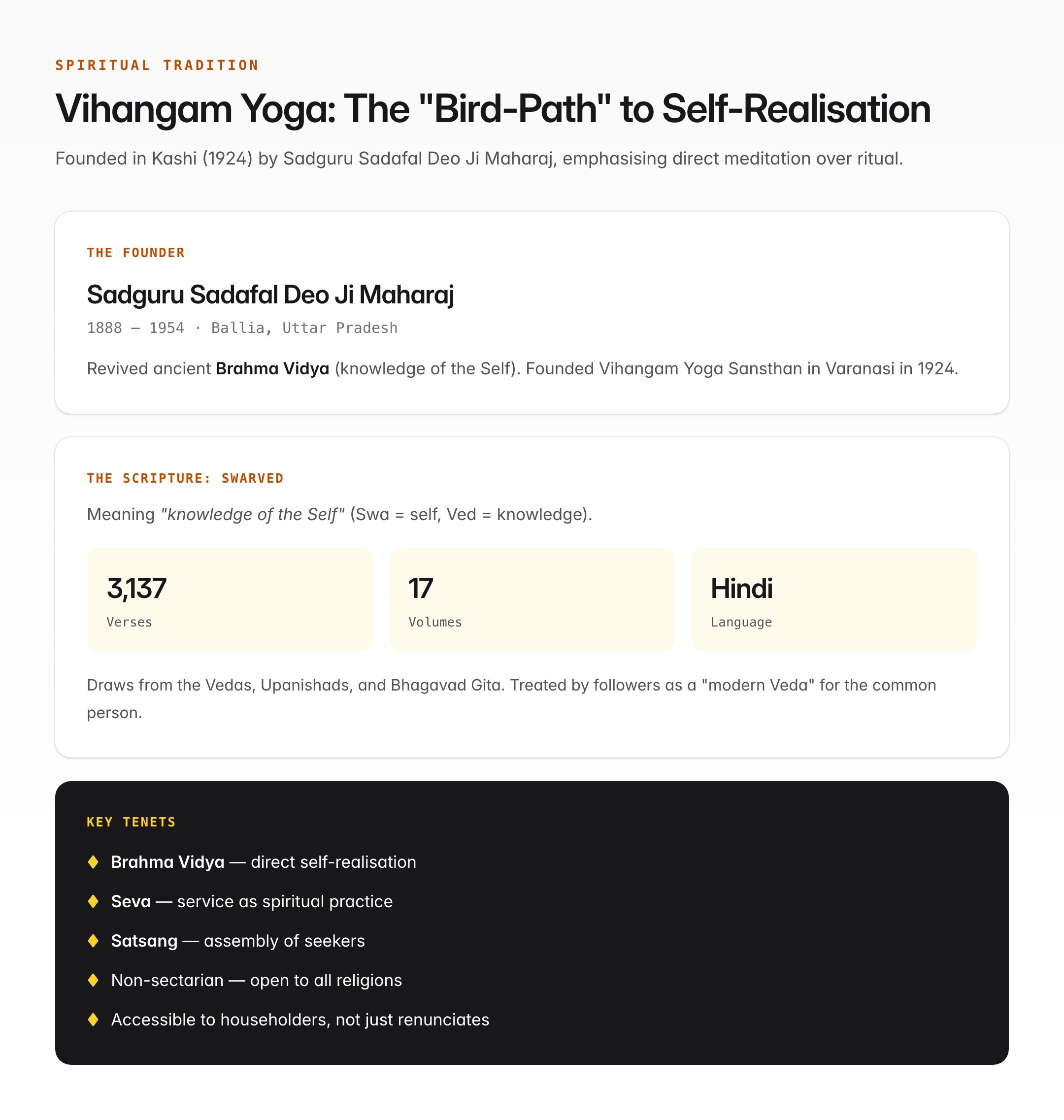
Sadguru Sadafal Deo Ji Maharaj (1888-1954) was a spiritual leader who founded the Vihangam Yoga Sansthan in 1924 at Kashi (Varanasi).
| Aspect | Detail |
|---|---|
| Birth | 15 September 1888, Ballia district, United Provinces (now Uttar Pradesh) |
| Passing | 23 May 1954 |
| Spiritual tradition | Revived the ancient Brahma Vidya (knowledge of the Self) |
| Magnum opus | Swarved — a scripture of 3,137 verses in Hindi describing meditation techniques and spiritual wisdom |
| Teaching method | Direct, experiential yoga emphasising meditation over ritual |
| Successors | Sadguru Acharya Shri Dharma Chandra Dev Ji Maharaj; later Sant Pravar Shri Vigyan Dev Ji Maharaj |
The Swarved Scripture
The Swarved is a major spiritual text composed by Sadguru Sadafal Deo Ji Maharaj. The name literally means "knowledge of the Self/Soul" (Swa = self, Ved = knowledge). Key features:
- Written in simple, accessible Hindi
- Comprises 17 volumes
- Draws upon the Vedas, Upanishads, Bhagavad Gita, and other classical Indian scriptures
- Focus on direct experience of consciousness rather than theoretical philosophy
- Treated by followers as a modern Veda for the common person
Vihangam Yoga Tradition
Vihangam Yoga literally means "bird-path yoga", suggesting a direct, swift path to spiritual realisation, akin to a bird's direct flight compared to a terrestrial journey.
| Feature | Detail |
|---|---|
| Founding year | 1924 |
| Headquarters | Varanasi, Uttar Pradesh |
| Philosophy | Drawn from Advaita Vedanta with emphasis on direct meditation |
| Practice | Silent meditation focusing on the inner Self (Atman) |
| Ashrams and centres | Hundreds of centres across India and abroad |
| Annual events | Large-scale spiritual gatherings called Sant Samagam |
| Followers | Millions across India and globally |
Key Tenets
- Brahma Vidya: The knowledge of ultimate reality through self-realisation.
- Seva: Service to humanity as an integral spiritual practice.
- Satsang: Assembly of seekers for spiritual discourse and meditation.
- Non-sectarianism: Open to followers of all religions and backgrounds.
- Householder path: Spiritual practice is accessible to ordinary people leading family lives.
Spiritual Significance
Swarved Mandir is not merely an architectural wonder — it is a functioning spiritual centre.
| Significance | Detail |
|---|---|
| Largest meditation hall | Provides space for 20,000 meditators at once — unprecedented in the world |
| Scriptural preservation | Walls serve as a permanent record of the Swarved scripture |
| Global pilgrimage centre | Attracts Vihangam Yoga followers and visitors from across the world |
| Teaching centre | Regular discourses, meditation sessions, and spiritual retreats |
| Centenary tribute | Built in memory of Sadguru Sadafal Deo Ji's legacy |
Inauguration Ceremony (2023)
On 18 December 2023, Prime Minister Narendra Modi inaugurated the Swarved Mahamandir during the 125th birth anniversary celebrations of Sant Pravar Shri Harihar Baba, who was a disciple of Sadguru Sadafal Deo Ji.
Highlights of the Inauguration
- The event was attended by tens of thousands of devotees and Vihangam Yoga followers from across the world.
- PM Modi addressed the gathering, calling the temple a "reflection of India's spiritual heritage".
- The event was part of a broader series of spiritual and cultural inaugurations in Varanasi under PM Modi's tenure.
- A cultural programme featuring classical music and spiritual discourses accompanied the inauguration.
Varanasi: The Spiritual Capital
The Swarved Mandir is one of many spiritual landmarks that make Varanasi a global centre of Hindu pilgrimage.
| Major Varanasi Landmarks | Significance |
|---|---|
| Kashi Vishwanath Temple | One of 12 Jyotirlingas dedicated to Lord Shiva |
| Kashi Vishwanath Corridor | Massive redevelopment project inaugurated in December 2021 |
| Sarnath | Site where Buddha delivered his first sermon |
| Ghats | Over 88 ghats along the Ganga, including Dashashwamedh and Manikarnika |
| BHU (Banaras Hindu University) | Founded by Madan Mohan Malaviya in 1916 |
| Swarved Mahamandir | Latest addition to Varanasi's spiritual landmarks |
Tourism and Visitor Information
| Information | Detail |
|---|---|
| Nearest airport | Lal Bahadur Shastri International Airport, Varanasi (approximately 30 km) |
| Nearest railway station | Varanasi Junction (approximately 20 km) |
| Visiting hours | Open to the public with designated timings |
| Dress code | Traditional/modest attire recommended |
| Photography | Permitted in most areas |
| Meditation sessions | Open to visitors interested in Vihangam Yoga |
UPSC Relevance
| Paper | How It Appears |
|---|---|
| Prelims (GS) | Location, inauguration date, founder, architectural features, associated scripture |
| Mains GS-I (Art and Culture) | Modern Indian spiritual traditions, temple architecture |
| Mains GS-II (Governance) | Role of religious tourism in regional economy |
| Current Affairs | Inaugurations, spiritual centre openings, Varanasi as cultural capital |
| Essay | Spirituality and modern India, preservation of heritage |
Key terms to remember: Swarved Mahamandir, Umraha, Varanasi, Sadguru Sadafal Deo Ji Maharaj, Vihangam Yoga Sansthan, Swarved scripture, Brahma Vidya, Sant Pravar Shri Harihar Baba, 3,137 dohas, world's largest meditation centre.
Themes for UPSC
- Spiritual and cultural revival in contemporary India
- Role of religious tourism in Uttar Pradesh's economic development
- Temple architecture as a manifestation of cultural continuity
- Non-sectarian spiritual movements in modern India
Swarved Mahamandir represents a confluence of India's ancient spiritual wisdom, modern architectural ambition, and contemporary cultural assertion. For UPSC aspirants, it serves as a contemporary example of how India's living spiritual traditions continue to evolve and find new expressions.
Tell Google you want more of this.
Add Anantam IAS as a preferred sourceOne tap, and this site shows up more often in your own Top Stories, AI Overviews and AI Mode. Remove it any time.