Introduction
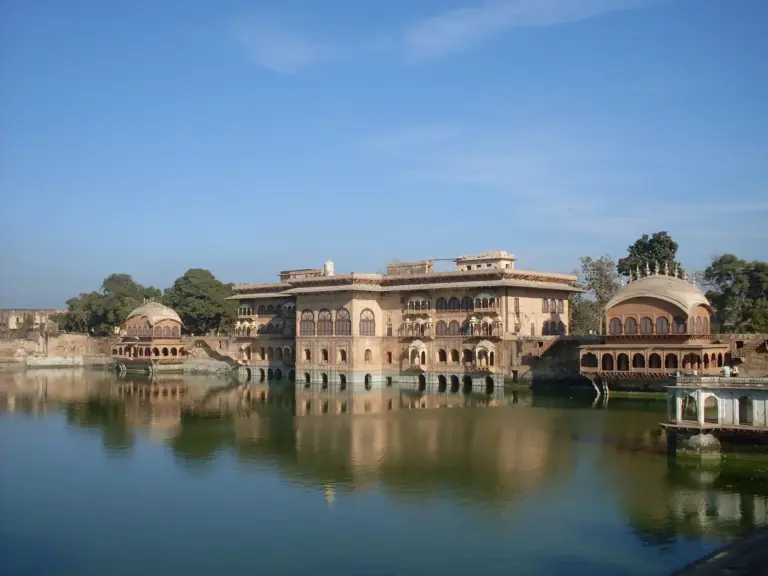
The Treaty of Salbai signed on 17 May 1782 ended the First Anglo-Maratha War between the British East India Company and the Maratha Confederacy. Negotiated at Salbai in present-day Madhya Pradesh, the treaty was the diplomatic product of more than seven years of indecisive fighting that had exhausted both sides. It restored the status quo ante, returned most captured territories, and guaranteed roughly two decades of peace between the Company and the Marathas, during which the British consolidated their control over Bengal, Mysore and the Carnatic. For UPSC aspirants, the treaty is a pivotal moment in modern Indian history — the first formal Maratha recognition of the Company as a major Indian political power.
Background: Causes of the War
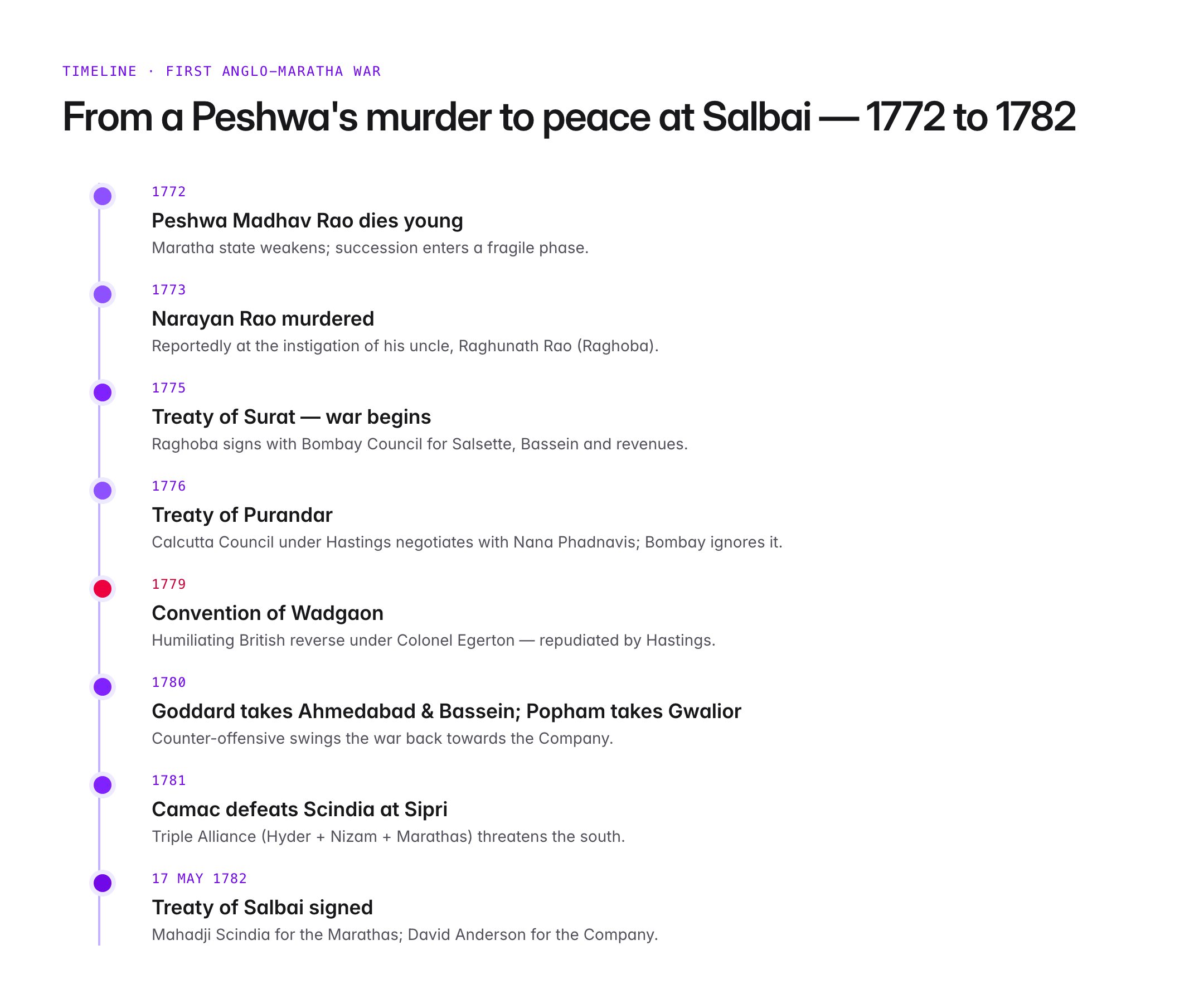
The First Anglo-Maratha War (1775–1782) arose from a combination of internal Maratha succession disputes and Company ambitions:
- The death of the young Peshwa Madhav Rao in 1772 left a weakened Maratha state.
- His brother Narayan Rao became Peshwa but was murdered in 1773, apparently at the instigation of his uncle Raghunath Rao (Raghoba).
- A council of ministers at Poona (the Barbhai Council led by Nana Phadnavis) installed the infant Madhav Rao II (son of the murdered Peshwa) and excluded Raghunath Rao.
- Raghunath Rao approached the Bombay Council of the Company for military assistance, signing the Treaty of Surat (1775) in exchange for Salsette, Bassein and a share of revenues.
- The Calcutta Council, under Warren Hastings, disapproved and negotiated the Treaty of Purandar (1776) with Nana Phadnavis, but Bombay ignored it and continued supporting Raghunath Rao.
- This divergence produced the war, during which Colonel Egerton's forces suffered the humiliating Convention of Wadgaon (1779).
Course of the War and Lead-Up to Salbai
After Wadgaon, Warren Hastings repudiated the convention and launched a counter-offensive. Key events:
- General Goddard captured Ahmedabad and Bassein (1780)
- Captain Popham captured Gwalior from Scindia (1780)
- Mahadji Scindia emerged as the most formidable Maratha commander
- Colonel Camac defeated Scindia at Sipri (1781)
- A new threat emerged in the south from Hyder Ali and his alliance with the Nizam and the Marathas in a Triple Alliance against the British
Facing the Second Anglo-Mysore War simultaneously, Warren Hastings sought to separate the Marathas from Hyder Ali and negotiate peace. Mahadji Scindia was the chief Maratha mediator; David Anderson represented the Company.
Key Terms of the Treaty
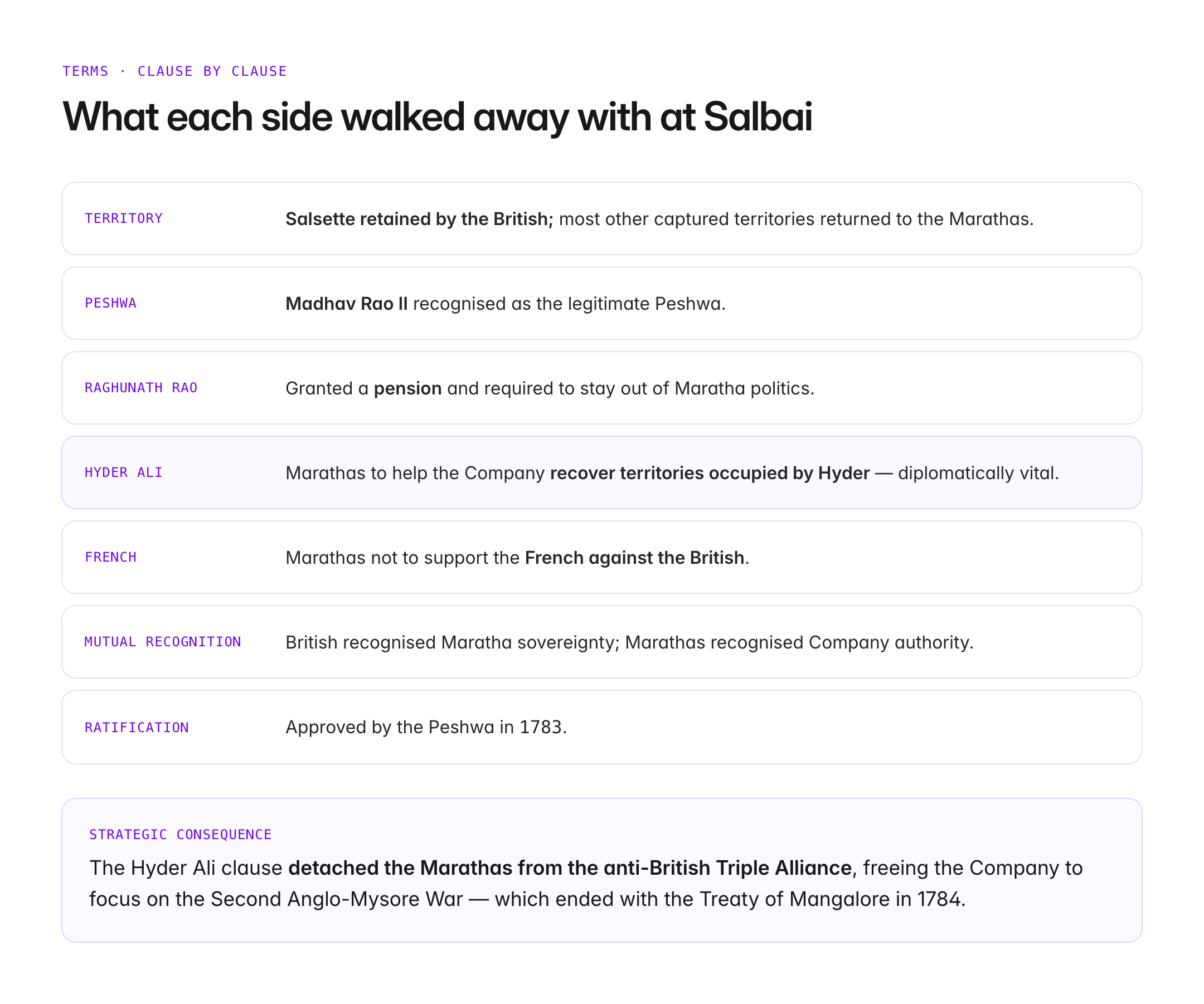
The treaty's provisions restored the status quo ante and produced a balance acceptable to both sides.
| Clause | Outcome |
|---|---|
| Territory | Salsette retained by the British; most other captured territories returned to Marathas |
| Peshwa | Madhav Rao II recognised as the legitimate Peshwa |
| Raghunath Rao | Granted a pension and required to stay away from Maratha politics |
| Hyder Ali | Marathas to help recover British territories occupied by Hyder |
| French | Marathas not to support French against the British |
| Mutual Recognition | British recognised Maratha sovereignty; Marathas recognised Company authority |
| Ratification | Approved by the Peshwa in 1783 |
The article on Hyder Ali proved diplomatically vital — it effectively detached the Marathas from the anti-British Triple Alliance and freed the Company to focus on Mysore.
Significance of the Treaty
The Treaty of Salbai had strategic consequences beyond its immediate clauses:
- It established roughly twenty years of peace between the Company and the Marathas (until the Second Anglo-Maratha War began in 1803).
- It allowed the Company to consolidate its hold over Bengal and Bihar without Maratha interference.
- It freed British resources to fight the Second Anglo-Mysore War, which ended with the Treaty of Mangalore (1784).
- It enhanced the prestige of Mahadji Scindia, who emerged as the most powerful Maratha figure in North India in the following years.
- It marked the Company's emergence as a recognised political power in India, negotiating as an equal with the strongest indigenous confederacy.
- Warren Hastings's reputation as a shrewd administrator and diplomat was reinforced.
Long-Term Impact
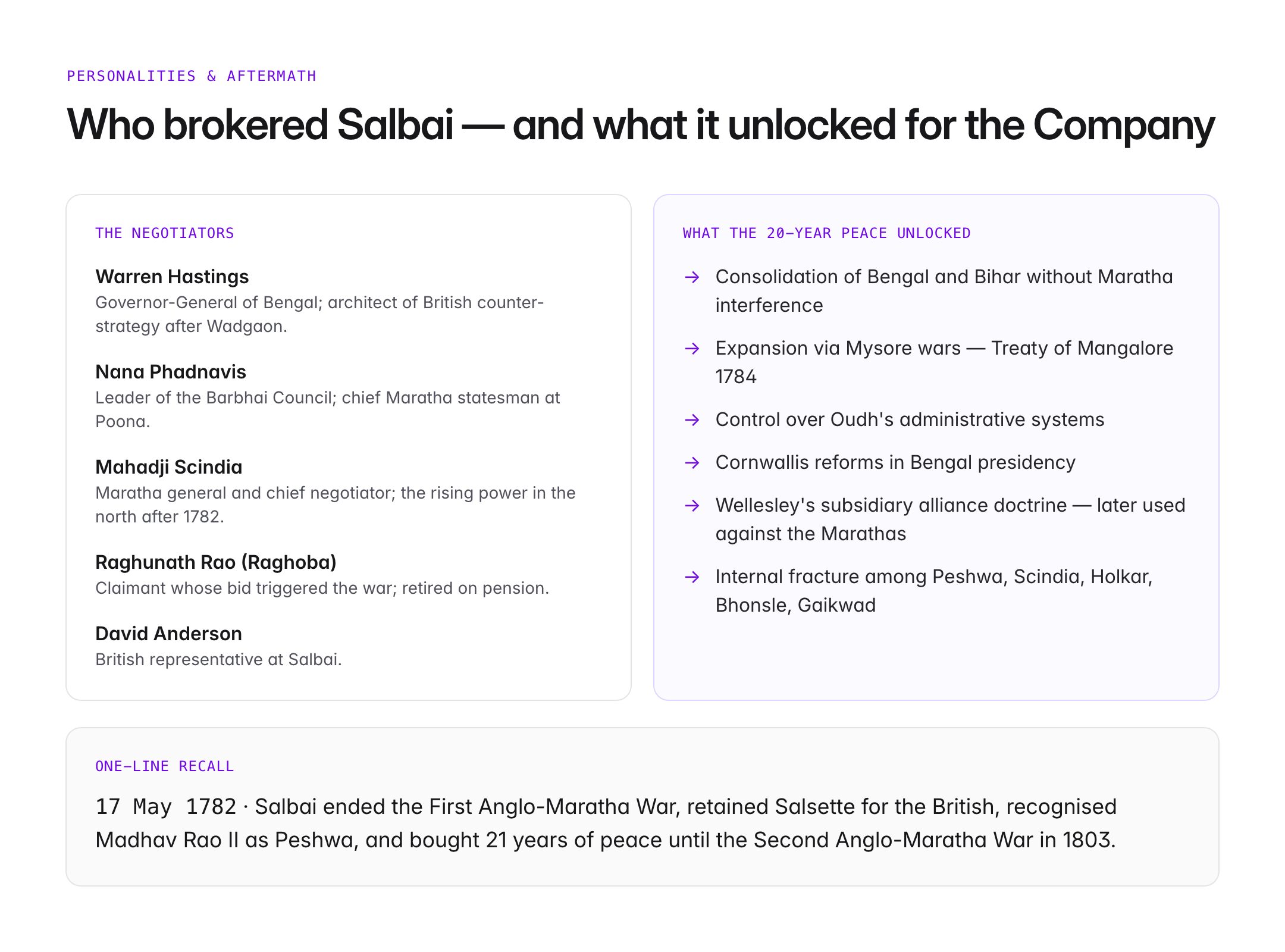
In the two decades that followed, the relative inactivity on the Anglo-Maratha front allowed the Company to:
- Expand influence in the south through the Mysore wars
- Annex Oudh's administrative systems
- Reorganise the Bengal presidency under Cornwallis's reforms
- Develop the subsidiary alliance doctrine under Wellesley, which would eventually be used against the Marathas themselves in 1803
The Marathas, meanwhile, fractured internally. Tensions among the Peshwa, Scindia, Holkar, Bhonsle and Gaikwad eroded their unity, setting the stage for the Second and Third Anglo-Maratha Wars and eventual British paramountcy.
Personalities to Remember
A quick roster:
- Warren Hastings — Governor-General of Bengal, architect of the British strategy
- Nana Phadnavis — leader of the Barbhai Council, chief Maratha statesman
- Mahadji Scindia — Maratha general and chief negotiator of the treaty
- Raghunath Rao (Raghoba) — claimant to the Peshwaship who triggered the war
- David Anderson — British representative at Salbai
UPSC Relevance
Prelims focus: The Treaty of Salbai was signed in 1782, ended the First Anglo-Maratha War, confirmed Madhav Rao II as Peshwa, retained Salsette for the British, and was brokered by Mahadji Scindia with David Anderson. Remember the Convention of Wadgaon (1779) and Treaties of Surat (1775) and Purandar (1776) as its precursors.
Mains GS-I angle: Use this treaty in questions on the Company's rise, the decline of the Maratha Empire, the role of diplomacy in the eighteenth century, and Warren Hastings's administration. It is a classic example of a treaty whose terms seemed balanced but whose strategic consequences favoured one party decisively.
Sample PYQ angle: UPSC has asked about the causes and consequences of the Anglo-Maratha Wars and the role of Warren Hastings. A well-structured answer can anchor the First War's outcome on the Treaty of Salbai while explaining its downstream effect on Mysore and subsequent Maratha conflicts.
Tell Google you want more of this.
Add Anantam IAS as a preferred sourceOne tap, and this site shows up more often in your own Top Stories, AI Overviews and AI Mode. Remove it any time.