India is spending more on tribal citizens than at any point in its history. PM-JANMAN put ₹24,104 crore behind the most vulnerable tribal communities in November 2023, and DAJGUA added another ₹79,156 crore a year later to saturate nearly 64,000 tribal villages with houses, roads, water, and schools. Yet on the one law that hands tribes ownership rather than welfare, the picture turns. When the Ministry of Tribal Affairs reviewed the Forest Rights Act on 1 June 2025, more than a third of all claims, over 18 lakh of them, had been rejected. So the same state that’s pouring record money into tribal welfare is still turning down a third of the people asking only to keep the forest land their families have lived on for generations.
That gap is the whole topic. Welfare delivers houses and pipes. Rights deliver title and agency, the power to say no to a mine and yes to your own forest. Both matter. But a Mains answer that treats record spending as proof of success misses the harder question: is the state recognising tribal communities as owners and decision-makers, or only servicing them as beneficiaries? The marks sit in telling those two things apart.
The Issue, Framed
The fight here isn’t whether the state should help tribal India. Of course it should. The fight is about the difference between welfare and rights, and which one actually changes the balance of power on the ground.
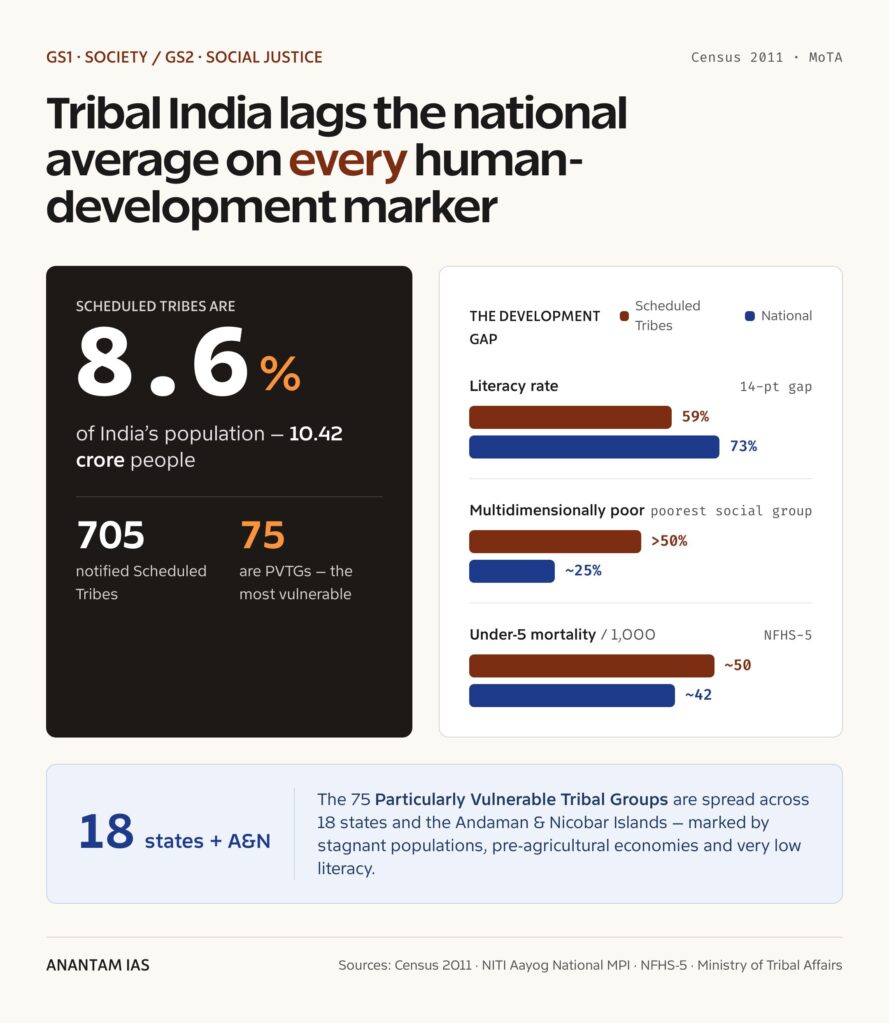
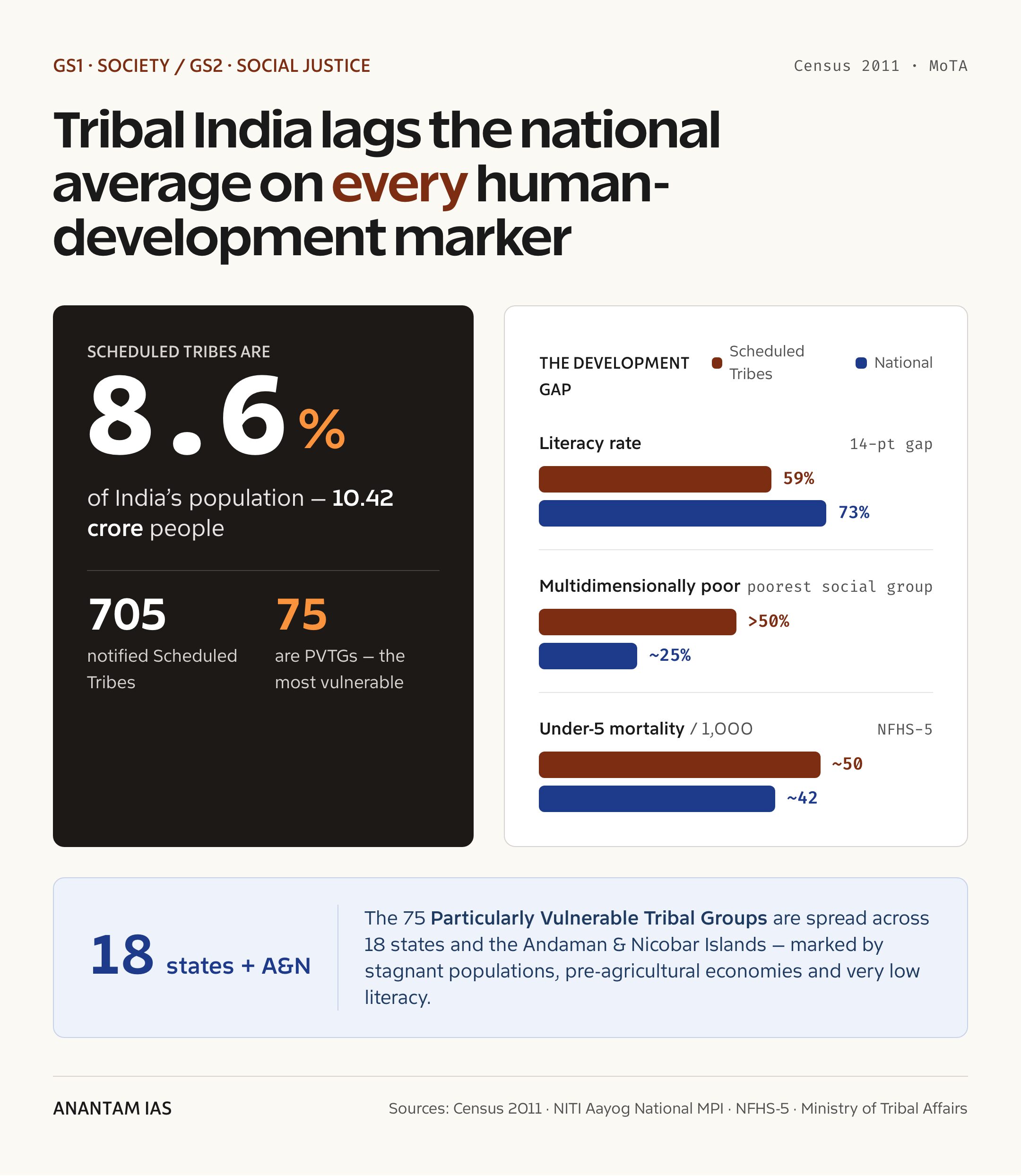
Let’s fix the vocabulary first, because most confusion on this topic comes from people blurring terms that mean very different things. Scheduled Tribes (STs) are the communities listed under Article 342 of the Constitution as historically isolated, distinct in culture, and entitled to special protection. They number 10.42 crore, about 8.6% of India, across 705 notified groups, per Census 2011. Within them sits a smaller, harder-pressed category: Particularly Vulnerable Tribal Groups (PVTGs), 75 communities the government singles out for stagnant or falling populations, pre-agricultural technology, and very low literacy. They live across 18 states and the Andaman & Nicobar Islands. So when you say “tribal welfare,” you’re really talking about two scales of need at once: 10 crore people broadly, and a most-fragile core within them.
Now the laws. The Forest Rights Act, 2006 (FRA) is the keystone, because it does something welfare schemes can’t. It recognises forest-dwelling tribes and other traditional forest dwellers as the legal owners and managers of land they’ve used for generations, instead of treating them as encroachers. It grants two kinds of right. Individual Forest Rights (IFR) title the plot a family farms and lives on. Community Forest Resource rights (CFR) title an entire village’s collective forest, the grazing land, the bamboo, the water bodies, and the right to govern that commons. And the gatekeeper for both is the gram sabha, the full village assembly of all adult voters, which the FRA makes the first authority to verify and approve claims. So the FRA’s radical move isn’t the land. It’s who decides: the village, not the forest officer.
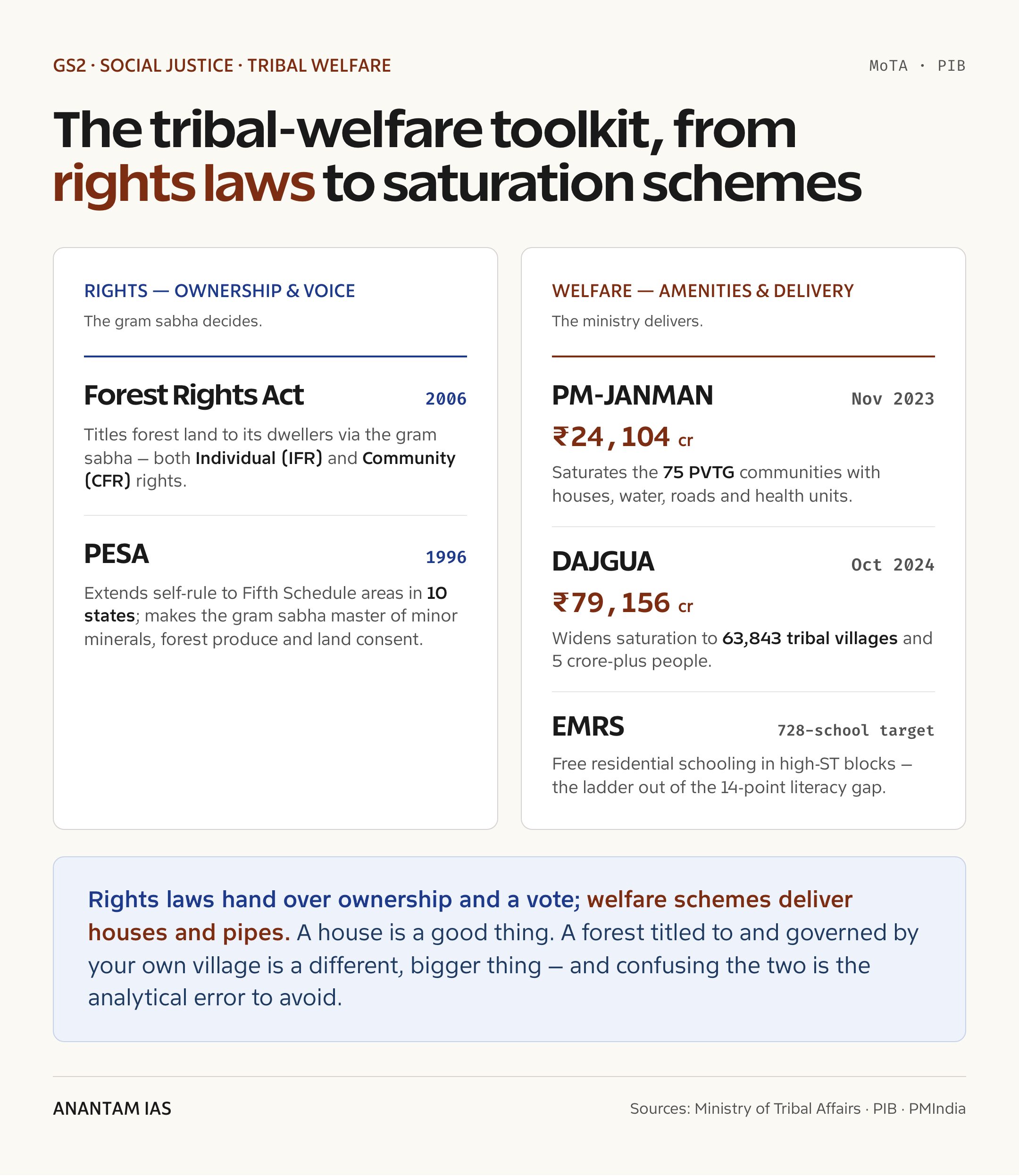
Two more instruments lock that in. PESA, the Panchayats (Extension to Scheduled Areas) Act, 1996, extends self-rule to the Fifth Schedule tribal areas of 10 states and makes the gram sabha master of community resources, minor minerals, minor forest produce, and consent for land acquisition. The welfare schemes, PM-JANMAN for the 75 PVTGs and DAJGUA for tribal villages at large, deliver houses, water, and roads. So the architecture is clear: rights laws give ownership and voice, welfare schemes give amenities. The question this editorial turns on is whether the two move together, or whether the money races ahead while the rights stall.
A house is a good thing. A title to your own forest, decided by your own village, is a different and bigger thing. Confusing the first for the second is the analytical error to avoid.
What the Data Says
The numbers split cleanly into two stories that don’t match, and that mismatch is the editorial. Start with the rights story, because it’s the one the June 2025 review put on the table.
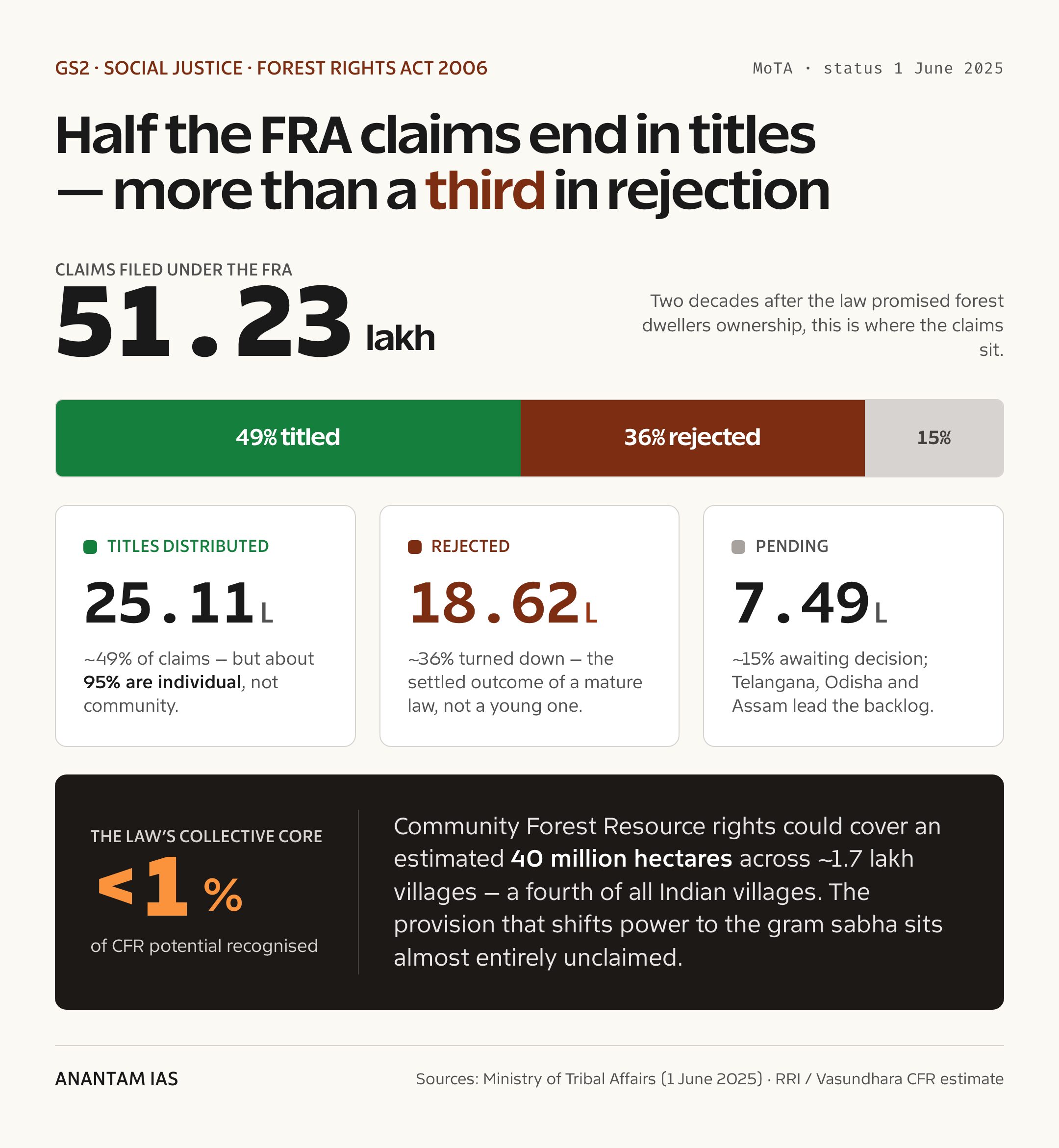
As of 1 June 2025, the Ministry of Tribal Affairs recorded 51.23 lakh claims filed under the Forest Rights Act. Of those, 25.11 lakh, about 49%, ended in a title. But 18.62 lakh, roughly 36%, were rejected, and another 7.49 lakh, about 15%, were still pending. So after nearly two decades of the law, almost exactly half of all claims have produced a title, and more than a third have been turned away. Read that rejection figure twice. It isn’t a rounding error in a young scheme. It’s the settled outcome of a mature one.
The texture matters more than the headline. Look at what kind of right is actually being recognised. Around 95% of the titles distributed are individual, not community. That’s the tell. The FRA’s most transformative provision, the community forest resource right that puts a whole forest under a village’s governance, is the one barely touched. Researchers at the Rights and Resources Initiative and Vasundhara estimate India’s CFR potential at roughly 40 million hectares across about 1.7 lakh villages, a fourth of all Indian villages. Less than 1% of that potential has been recognised. So the law’s collective heart, the part that would actually shift power to the gram sabha, is sitting almost entirely unclaimed.
Now the welfare story, which runs the other way. PM-JANMAN, launched on Birsa Munda’s birth anniversary in November 2023 with a ₹24,104 crore outlay, targets the 75 PVTG communities directly. By the May 2025 review of 18 states, it had sanctioned 2,26,064 PVTG houses, made all 694 mobile medical units functional, piped water into 7,406 villages, and electrified about 1.2 lakh households. DAJGUA, approved a year later with a far larger ₹79,156 crore outlay, aims to saturate 63,843 tribal villages covering 5 crore-plus people. So in money and reach, this is the largest tribal-development push the country has ever mounted, and an honest answer says so plainly.
But the human-development gaps the money is meant to close are stubborn, and they’re where the urgency lives. ST literacy stood at 59% against the national 73% in Census 2011, a 14-point gap. On the NITI Aayog National Multidimensional Poverty Index, over 50% of STs are multidimensionally poor, the worst of any social group, against about 33% for SCs and 27% for OBCs. Multidimensional poverty here means deprivation across health, education, and living standards together, not just low income. Under-five mortality among ST children runs around 50 per 1,000 against the national 42 (NFHS-5), and the relative tribal mortality gap with better-off groups has actually widened over the past quarter-century even as absolute numbers fell. So tribal India isn’t just behind. On some markers it’s falling further behind in relative terms, which is exactly what record spending is supposed to reverse.
The Case For
The case that tribal welfare is genuinely advancing is strong, and a lazy answer that waves it away will lose marks. So let’s state it at full strength.
Rights are being recognised at real scale, not just promised. 25.11 lakh FRA titles is among the largest formal transfers of land rights to forest dwellers anywhere in the world, and the MoTA dashboard shows community titles covering close to 1.83 crore acres, so where CFR does land, it lands big. So the glass isn’t empty. Half of all claimants now hold a legal title to land their families once held only by custom, and that’s a structural change welfare cheques can’t deliver.
The money is reaching the most vulnerable by design. Putting ₹24,104 crore behind communities that number a fraction of a percent of the population is a deliberate choice to spend disproportionately on those furthest behind, and DAJGUA’s ₹79,156 crore widens that to tribal villages at large. So the design admits the obvious truth, that a generic scheme reaches a remote PVTG hamlet years after everyone else, and tries to correct for it.
Early delivery is visible on the ground. Roughly 1.36 lakh houses completed for the PVTG cohort, water to 7,406 villages, 694 mobile medical units running, over a lakh households electrified, all inside about eighteen months. These aren’t sanctions on paper. They’re roofs and taps. For a family in a hamlet no scheme reached for decades, that’s not a small thing, and pretending it is would be dishonest.
The education ladder is widening too. Eklavya Model Residential Schools (EMRS) put fully residential, free schooling into high-ST blocks, and the network is being scaled toward a target of 728 schools by 2026, with somewhere between 405 and 440 functional in late 2025 by various reports. So the state is building the one institution most likely to close that 14-point literacy gap over a generation.
And the rights framework has teeth when communities actually use it. The Niyamgiri case proved it. In 2013 the Supreme Court ruled that the gram sabhas of the affected villages, not a ministry, must decide whether Vedanta’s bauxite mine could touch the Dongria Kondh’s sacred hills. All 12 gram sabhas voted no. The project was rejected. So when the law lets the village decide, the village can stop a multi-crore mine cold. That’s tribal agency working exactly as the FRA and PESA intend, and it’s the proof of concept for everything the way-forward section argues.
The Case Against
Here’s what the welfare story walks past. Spending and titles are inputs and counts. They don’t tell you whether tribal communities gained power over their own land, and on that test the record is thin.
Start with the rejections. 36% of FRA claims rejected isn’t simply a clean-up of false claims. Much of it traces to how the law gets administered, claims dismissed without the reasoned, gram-sabha-rooted process the FRA itself demands. A 2019 Supreme Court matter cited government figures of roughly 13 lakh claims allegedly wrongly rejected, which nearly triggered mass eviction before a stay. So the worry isn’t only how many were rejected. It’s that the rejections may not have followed the law’s own due process, leaving lakhs of families one administrative order away from losing the land they live on.
The collective right is being hollowed out. Recall the earlier figure: less than 1% of the 40-million-hectare CFR potential is recognised, and 95% of titles are individual. So the FRA is being run as a land-distribution scheme for households while its radical core, community governance of the forest commons, is quietly skipped. A title to your own plot is welcome. But it doesn’t give the village collective control of the bamboo, the grazing land, or the water, and it doesn’t give the gram sabha standing to say no to outsiders. So the law’s power-shifting promise stays mostly on paper.
The FRA’s safeguards face legislative erosion. Critics, including legal-rights groups, argue the Forest (Conservation) Amendment Act, 2023 exempts large categories of forest land and “strategic” projects near borders from clearance, makes no reference to the FRA, and can bypass the gram-sabha consent the FRA guarantees. So even as the FRA recognises rights with one hand, a separate law is read by its critics as carving a route around those rights with the other.
Displacement still falls hardest on tribes. There’s no recent official national displacement census, so the headline figure is an estimate. Researchers such as Walter Fernandes estimate that tribal communities make up roughly 40% of people displaced by development projects despite being about 8% of the population, with resettlement chronically poor. Even allowing for the dated and contested nature of that number, the direction is not in doubt: dams, mines, and sanctuaries have uprooted tribal communities far out of proportion to their share of the population, and the law meant to require their consent is the same one being diluted.
PVTG vulnerability is structural, and houses don’t fix structure. PVTGs are defined by stagnant or declining populations and fragile, pre-agricultural economies. A saturation push of houses, roads, and water genuinely helps. But it doesn’t by itself secure their habitat rights, the right to the larger territory a hunter-gatherer or shifting-cultivation community needs to survive as itself. So you can build a PVTG family a pucca house and still leave the community’s land base and way of life unsecured. The welfare and the right aren’t the same intervention.
And PESA is weak where it matters most. More than two decades on, a couple of the 10 Scheduled-Area states still lack notified PESA Rules, and even where the rules exist, gram-sabha powers over minor minerals and land are routinely overridden in practice. So the statute that’s supposed to make the village sovereign over its resources is, in too many places, a sovereignty on paper.
The Deeper Structural Read
Step back from the schemes and the fault line shows up. It isn’t welfare versus rights as rivals. It’s that the state finds welfare easy and rights hard, and the gap between them tells you where real power still sits.
Welfare is administratively comfortable. A ministry sanctions houses, lays pipes, and counts outputs, the tribal citizen stays a beneficiary, and the bureaucracy stays in charge. Rights are the opposite. A community forest resource title hands the gram sabha authority that a forest officer, a contractor, or a mining lease used to hold. So the resistance to recognising CFR, the 1% figure, isn’t mainly about paperwork. It’s about who loses control when a village gains it. That’s the uncomfortable truth under the data: the part of the FRA that’s stalled is precisely the part that redistributes power, and the parts that flow freely are the parts that don’t.
The Niyamgiri principle is the sharpest analytical tool you have, so put it in your answer. The Supreme Court didn’t just stop one mine. It established that in matters touching a tribal community’s land and culture, the gram sabha’s consent is decisive, not advisory. So the constitutional design already answers the welfare-versus-rights question. Article 244 and the Fifth Schedule, PESA, and the FRA together don’t picture tribes as recipients of central largesse, but as self-governing communities deciding their own resource use. The Xaxa Committee, the 2014 high-level panel chaired by Virginius Xaxa, said exactly this: it named land alienation, displacement, and the override of gram-sabha consent as the central tribal crisis, and asked the state to strengthen consent and restore alienated land, not to substitute schemes for self-rule.
There’s a federal and developmental layer below that. Tribal land sits on top of much of India’s mineral wealth, which sets up a permanent collision between the forest-dweller’s right and the state’s hunger for coal, bauxite, and iron ore. The Samata judgment of 1997 tried to referee it, holding that in Fifth Schedule areas mining leases to private non-tribal parties are void, mining should run through state bodies or tribal cooperatives, and a fifth of profits should fund a permanent development fund for the affected. So the law has long recognised that tribal land can’t be treated as just another resource frontier. But the displacement record, and the reading of the 2023 forest amendment as a workaround, show how much pressure that principle is under.
And here’s the part that should sit with you as a future administrator. A missed hamlet or leakage in welfare is a delivery problem, fixed with better systems and more money. The CFR gap is a willingness problem. So the moment an answer treats “we’ve spent ₹79,156 crore” as the rebuttal to “we’ve recognised under 1% of community forest rights,” it has confused two different failures, one of capacity and one of intent. The structural read keeps them separate.
What Should Be Done
So what does a tribal policy that takes rights as seriously as welfare actually look like? Not a plea for “balance,” but a set of moves you could hand a tribal-affairs secretary tomorrow. Seven of them, and none weakens welfare.
- Finish the Forest Rights Act, starting with community rights. Set time-bound targets to move CFR recognition from under 1% toward the 40-million-hectare potential, and re-examine the 36% rejections with reasons recorded, exactly as the FRA’s own due process requires. A title given to a household is good. A forest governed by its village is the law’s actual promise. See the framework on welfare schemes for vulnerable sections for how rights-based delivery differs from input-based delivery.
- Make gram-sabha consent primary and binding in Scheduled Areas. This is the Niyamgiri principle as standing policy, not a one-off court win. Where the Forest (Conservation) Amendment Act, 2023 appears to route around gram-sabha consent, reconcile it with FRA safeguards rather than letting the two laws contradict each other. Consent that a village can actually exercise is the difference between agency and tokenism.
- Recognise PVTG habitat rights, not just deliver PVTG houses. PM-JANMAN’s roofs and taps should sit on top of secure community land tenure, not substitute for it. Map and title each PVTG’s habitat first, then saturate it with amenities. A house on land the community doesn’t securely hold is a house that can still be displaced.
- Converge the money around outcomes, not inputs. PM-JANMAN, DAJGUA, EMRS, and the health and nutrition schemes should be tracked on one dashboard against tribal-specific human-development gaps, literacy, MPI, child mortality, not against houses sanctioned. The test isn’t how much was spent. It’s whether the 14-point literacy gap and the 50-versus-42 mortality gap are closing. Read this alongside India’s multidimensional poverty data to anchor the targets.
- Protect against displacement with real consent and real rehabilitation. Implement the Xaxa Committee and Samata-judgment principles, gram-sabha consent before acquisition, profit-sharing where mining proceeds, and restoration of alienated land. Displacement that uproots tribes at four to five times their population share, on the most reliable estimates, is not a side effect to be managed later. It’s the core injustice to design out.
- Strengthen PESA into real self-rule. Notify the rules in every Scheduled-Area state, devolve genuine authority over minor minerals, minor forest produce, and land, and stop the routine override of gram-sabha decisions. A statute that makes the village sovereign on paper but powerless in practice teaches tribal citizens that their consent is decorative.
- Centre tribal agency, in the spirit of the Tribal Panchsheel. Nehru and Verrier Elwin’s principles, develop along the tribes’ own genius, respect their rights in land and forests, and avoid over-administering them, aren’t nostalgia. They’re a warning against a welfare model that treats tribal citizens as objects of delivery rather than authors of their own development.
Every one of these strengthens, rather than slows, the welfare push. A house delivered on land a community securely holds, in a village that governs its own forest, is welfare that finally adds up to dignity. That’s the entire point of spending the money in the first place.
For Your Mains Answer
This topic is a GS1 and GS2 crossover that examiners love, because it forces you to hold welfare delivery and rights-based justice in the same frame instead of praising one and forgetting the other.
GS paper mapping: GS1, salient features of Indian society, diversity, and the effects of development on tribal communities. GS2, welfare schemes for vulnerable sections (STs and PVTGs), their performance and mechanisms, constitutional provisions (Articles 244, 342, 46, Fifth Schedule), and the role of gram sabhas and laws like the FRA and PESA. Optional GS3 link, environment versus development, land acquisition, and displacement.
Likely question frames:
- Record spending on tribal welfare has not been matched by progress on tribal rights. Critically examine, with reference to the Forest Rights Act and recent saturation schemes.
- The Forest Rights Act sought to make the gram sabha, not the forest department, the authority over tribal land. Assess how far that intent has been realised.
- Welfare addresses tribal deprivation, but only rights address tribal disempowerment. Discuss in the light of PESA, the FRA, and the Niyamgiri precedent.
Quotable data points:
- STs are 8.6% of India, 10.42 crore people, across 705 notified tribes; 75 are PVTGs in 18 states and A&N (Census 2011 / MoTA).
- FRA as of 1 June 2025: 51.23 lakh claims, 25.11 lakh titles (49%), 18.62 lakh rejected (36%), 7.49 lakh pending (15%) (MoTA).
- About 95% of FRA titles are individual; under 1% of the roughly 40-million-hectare community forest rights potential is recognised (MoTA / RRI).
- PM-JANMAN: ₹24,104 crore (Nov 2023) for the 75 PVTGs; DAJGUA: ₹79,156 crore (Oct 2024) for 63,843 villages and 5 crore-plus people.
- Over 50% of STs are multidimensionally poor, the poorest social group (NITI Aayog MPI).
- ST literacy 59% against national 73%; ST under-five mortality about 50 versus 42 nationally (Census 2011 / NFHS-5).
- Tribes are an estimated 40% of development-displaced people though about 8% of the population (researchers such as Walter Fernandes; academic estimate, attribute).
- Niyamgiri, 2013: all 12 gram sabhas said no to Vedanta’s bauxite mine, gram-sabha primacy in action.
Keywords to use: Forest Rights Act, individual and community forest rights, gram sabha, PESA, Fifth Schedule, PVTG, habitat rights, multidimensional poverty, tribal agency, Niyamgiri, Xaxa Committee.
Syllabus linkages: vulnerable sections and welfare schemes, constitutional provisions for STs, mechanisms and institutions for protection, development and management of social-sector schemes, role of gram sabhas and NGOs, environment-development conflict.
Balanced conclusion line: Record spending proves the state’s intent to help tribal India, but only the recognition of rights, the community forest title, the binding gram-sabha consent, the secured PVTG habitat, proves its intent to let tribal India decide for itself; welfare without rights builds beneficiaries, while welfare with rights builds citizens.
How to Build the Answer
Open with the tension, not a definition. The sharp version is that the state is spending more than ever on tribal welfare while still rejecting a third of forest-rights claims, so the question isn’t whether help is flowing but whether power is shifting. That first sentence shows the examiner you’ve grasped the welfare-versus-rights distinction, which is the whole point of the topic. Define ST, PVTG, and the FRA in the second sentence, not the first.
Bring data in early, but ration it. A strong opening body paragraph can carry three figures: 51.23 lakh claims, 49% titled, 36% rejected. Then say what they prove, that maturity hasn’t fixed the rejection problem. UPSC rewards the move from fact to inference far more than the fact itself.
Steelman the welfare case before you criticise it. Concede the record outlays and visible delivery, ₹24,104 crore, ₹79,156 crore, 1.36 lakh houses, before you point out that none of it touches the CFR gap. An answer that admits the spending is real reads balanced; one that dismisses it reads partisan.
Group the way forward, don’t scatter it. Cluster the reforms: finish CFR, make gram-sabha consent binding, secure PVTG habitat, converge on outcomes, protect against displacement, strengthen PESA. Use the topic’s own vocabulary, gram sabha, Fifth Schedule, habitat rights, so the answer reads like governance analysis rather than a news recap.
Close on the syllabus link and on judgment, not summary. The reliable pattern is “the goal is not X alone, but X with Y,” which lets you say welfare alone builds beneficiaries while welfare plus rights builds citizens. The last line should land a value, not repeat the intro.
Common Mistakes to Avoid
- Don’t treat spending as success. ₹79,156 crore sanctioned is an input, not an outcome. The marks are in whether the literacy and mortality gaps are closing.
- Don’t conflate individual and community rights. The 95%-individual, under-1%-CFR split is the single most revealing fact in the topic. An answer that misses it misses the point.
- Don’t present the displacement figure as official. The 40% estimate is academic and dated; attribute it to researchers such as Walter Fernandes and use it as directional, not as a census count.
- Don’t go one-sided. Both the welfare advance and the rights stall are real. Steelman the spending before you critique the gap.
- Don’t forget the tribal citizen as an agent. Niyamgiri’s 12 gram sabhas saying no is the image to carry; tribes here are decision-makers, not just beneficiaries to be helped.
A Compact Answer Spine
- Introduction: Open with the welfare-versus-rights tension; define ST, PVTG, and the FRA in the next sentence.
- Evidence: Use two or three attributed figures, the FRA status split and one HDI gap, and tie each to an implication.
- Arguments: The case that welfare is advancing (spending, delivery, EMRS), then the case that rights are stalling (rejections, CFR gap, displacement). Keep both fair.
- Structural diagnosis: Welfare is easy because it keeps the state in charge; rights are hard because CFR and PESA shift power to the gram sabha.
- Way forward: Four to five grouped reforms, each with a clear actor, MoTA, gram sabha, the courts.
- Conclusion: Adapt the balanced conclusion line to the exact question wording.
Diagram or Flowchart Idea
For a 15-marker, draw one logic chain, not a decorative web. The cleanest format: tribal deprivation → two responses, welfare schemes (PM-JANMAN, DAJGUA) and rights laws (FRA, PESA) → welfare delivers amenities, rights stall at CFR → gap between beneficiary and citizen → reforms (finish CFR, binding consent, habitat rights). The examiner reads that argument in five seconds.
For a 10-marker, skip the diagram and use a two-column table instead, “Welfare (amenities, state in charge)” against “Rights (ownership, gram sabha in charge).” It does more work under time pressure and is faster to evaluate.
Ethics and Governance Angle
Add one ethical line even in a GS2 answer. The deepest issue here is agency, not amenities. A house given to a tribal family is good; a forest governed by their gram sabha treats them as authors of their own lives rather than objects of policy. Name the concrete person, the Dongria Kondh whose sacred hill survived because the village got to decide, the PVTG family whose new house sits on land they still can’t securely call their own.
Then convert the ethics into design. Don’t just say “respect tribal rights.” Say how: recognise community forest title, make gram-sabha consent binding, secure habitat before delivering houses, route mining through consent and profit-sharing. That’s the move from moral language to administrative maturity.
A sentence pattern that travels across welfare topics: “The scheme is legitimate in aim, but its legitimacy depends on whether the beneficiary becomes a decision-maker.” It accepts the state’s good intent without handing it a blank cheque, which is exactly what a balance question rewards.
How to Use Data Without Sounding Mechanical
Use fewer numbers than you know. Three well-explained figures beat ten scattered ones. Lead with the FRA split (49% titled, 36% rejected), contrast with the spending (₹79,156 crore), and clinch with the gap (under 1% of CFR recognised). One rights figure, one welfare figure, one structural gap is usually enough.
Never leave a statistic standing alone. Follow it with “this means” or “the implication is.” That tiny move turns a data dump into analysis. In Mains, the figure is raw material; the inference is the finished answer.
Finish by asking whether a tired examiner can follow your argument in one pass. If it needs rereading, simplify. Short intro, data early, two sides marked cleanly, grouped way forward. For UPSC, clarity is how depth becomes visible.
One last sweep: cut any line that sounds grand but does no work, and replace it with a fact, a cause, a consequence, or a reform. That habit separates an answer that feels informed from one that feels memorised.
FAQ
What is the difference between individual and community forest rights under the FRA?
Individual Forest Rights (IFR) title the specific plot a family farms and lives on. Community Forest Resource rights (CFR) title an entire village’s collective forest, the grazing land, water bodies, and produce, and give the gram sabha authority to protect and govern it. As of June 2025, about 95% of FRA titles distributed are individual, and under 1% of the estimated 40-million-hectare CFR potential has been recognised, so the law’s collective, power-shifting core remains largely unrealised.
What do PM-JANMAN and DAJGUA actually do?
PM-JANMAN (₹24,104 crore, November 2023) is a saturation mission targeting the 75 Particularly Vulnerable Tribal Groups with houses, water, roads, health units, and electricity. DAJGUA (₹79,156 crore, October 2024) widens that approach to 63,843 tribal villages covering more than 5 crore people. Both deliver amenities at record scale, but neither, by itself, secures land rights or gram-sabha control over forests, which is why they’re welfare instruments rather than rights instruments.
Why does the Niyamgiri case matter so much for tribal rights?
In 2013 the Supreme Court held that the gram sabhas of the affected villages, not a ministry, had to decide whether Vedanta’s bauxite mining could proceed on the Dongria Kondh’s sacred hills. All 12 gram sabhas voted no, and the project was rejected. It’s the landmark precedent that gram-sabha consent in tribal-resource matters is decisive, not advisory, and it’s the clearest proof that the FRA and PESA can deliver genuine tribal agency when communities are allowed to decide.
Is the figure that tribes are 40% of the development-displaced reliable?
It’s an estimate, not an official count, and it should be cited that way. There’s no recent national displacement census, so the figure traces to academic work, notably by Walter Fernandes, with vintage around 2001 to 2008. The exact percentage is contested, but the direction is well established: dams, mines, and sanctuaries have displaced tribal communities far out of proportion to their roughly 8% share of the population, while rehabilitation has remained poor.
Tell Google you want more of this.
Add Anantam IAS as a preferred sourceOne tap, and this site shows up more often in your own Top Stories, AI Overviews and AI Mode. Remove it any time.