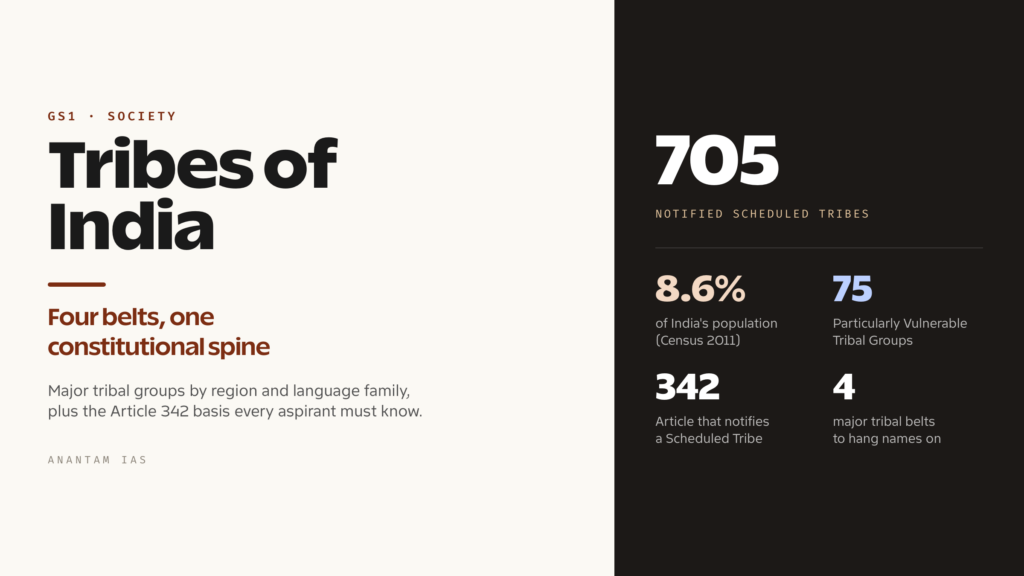
India has about 705 notified Scheduled Tribes, together roughly 8.6% of the population — around 104 million people (Census 2011). The largest is the Bhil, followed by the Gond and the Santhal, and within these sit 75 Particularly Vulnerable Tribal Groups (PVTGs). A community becomes a Scheduled Tribe only when the President notifies it under Article 342, and tribal areas are protected mainly through the Fifth and Sixth Schedules, PESA (1996) and the Forest Rights Act (2006). Several northeastern tribal states also carry special constitutional status under Article 371 and entry safeguards such as the Inner Line Permit.
When you sit down to learn “the tribes of India,” the list feels endless and the names blur together. Gond, Santhal, Bhil, Naga, Toda, Jarawa. Which state, which family, what makes each one distinct? The confusion is real, and it’s not your fault: there are about 705 notified Scheduled Tribes spread across nearly every state, speaking languages from four different families. Nobody memorises all of them, and you don’t have to.
What you do need is a map in your head: which tribes belong to which belt, the constitutional logic that makes a community a “Scheduled Tribe,” and the handful of safeguards that keep coming up in answers. Get that scaffolding right and the names hang on it naturally. This guide builds that scaffolding for UPSC GS1 (Indian Society) and GS2 (welfare of vulnerable sections), the two papers where tribal questions live.
Who Is a Scheduled Tribe and Why It Matters
A Scheduled Tribe is a community the President of India formally notifies as one under Article 342 of the Constitution. That’s the whole legal basis. The President issues a notification for a state or union territory after consulting its Governor, and only Parliament can later add or remove a community from that list by law. So “tribe” in everyday speech and “Scheduled Tribe” in the Constitution are not the same thing. A group becomes an ST only when it appears in that presidential schedule.
The Constitution itself never defines what a “tribe” is. Instead, administrators use five working signs drawn from the Lokur Committee (1965): primitive traits, a distinctive culture, geographical isolation, shyness of contact with the wider community, and overall backwardness. Think of the Sentinelese on North Sentinel Island, who reject all outside contact, or a Baiga community deep in the Maikal hills practising shifting cultivation. These criteria have been criticised for sounding patronising, and the Xaxa Committee (2014) asked the government to move beyond words like “primitive.” But the five signs are still the lens through which inclusion is decided, so they’re worth quoting exactly in an answer.
The numbers tell you why this matters. STs make up about 8.6% of India’s population as per Census 2011, roughly 104 million people. They are not a fringe. They are a constitutionally distinct group whose land, forests, and self-governance carry special protection, which is exactly why the topic spans both the society paper and the governance paper. If you want the wider frame of how India’s social groups are organised, our guide to diversity in Indian society sets tribes alongside caste, religion, and language.
The Major Tribal Belts of India
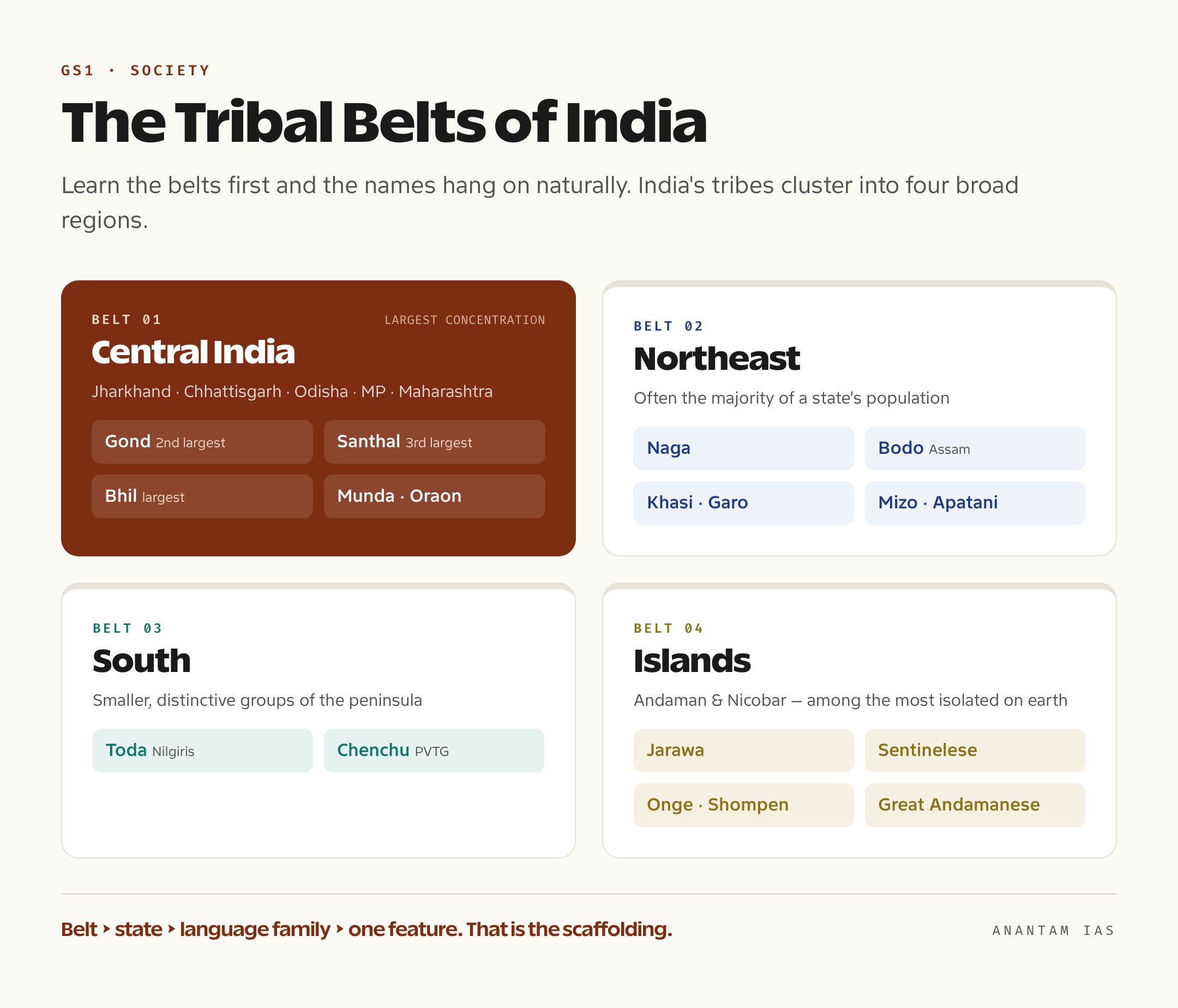
India’s tribes cluster into four broad belts, and learning the belts first is the trick that makes the names stick. The single largest concentration sits in the central or “Middle India” belt, running across Jharkhand, Chhattisgarh, Odisha, Madhya Pradesh, and parts of Maharashtra and West Bengal. This is the home of the giants: the Gond (second-largest tribe in India, spread across central India, speaking a Dravidian language), the Bhil (the largest tribe of all, concentrated in Rajasthan, Gujarat, and Madhya Pradesh), the Santhal (third-largest, of the Austroasiatic family, famous for the Santhal rebellion of 1855), and the Munda and Oraon of the Jharkhand plateau.
The second belt is the Northeast, where tribes are not a minority but often the majority of a state’s population. Here you find the Naga groups of Nagaland, the Bodo of Assam (whose movement shaped the state’s politics), the Khasi and Garo of Meghalaya (both matrilineal, where lineage and property pass through the mother), the Mizo of Mizoram, and the Apatani of Arunachal Pradesh, known for their wet-rice terraces and recognised by UNESCO interest in their sustainable farming. Most of these speak Tibeto-Burman or Austroasiatic languages. The third belt, western and Himalayan, holds the Bhotia and Gujjar of the hill states. The fourth is the South, with smaller, distinctive groups like the Toda pastoralists of the Nilgiris and the Chenchu forest gatherers of Andhra Pradesh and Telangana.
Then there are the island tribes of the Andaman and Nicobar Islands, among the most isolated peoples on earth: the Great Andamanese, the Onge, the Jarawa, the Sentinelese, and the Shompen and Nicobarese. Several of these are negrito or mongoloid groups whose populations have crashed to a few dozen or a few hundred, which is why they need the strongest protection the state can give. Here are the major tribes laid out by region so you can see the pattern at a glance.
| Tribe | State / Region | Notable Features |
|---|---|---|
| Bhil | Rajasthan, Gujarat, MP, Maharashtra | Largest tribe in India; bow-and-arrow tradition; Bhili language |
| Gond | MP, Chhattisgarh, Maharashtra, Telangana | Second-largest; Dravidian Gondi language; Gondwana legacy |
| Santhal | Jharkhand, West Bengal, Odisha | Third-largest; Austroasiatic; Santhal rebellion (1855) |
| Munda | Jharkhand, Chhattisgarh, Odisha | Austroasiatic; Birsa Munda’s Ulgulan revolt |
| Oraon (Kurukh) | Jharkhand, Chhattisgarh, Odisha | Dravidian Kurukh language; agriculturists |
| Naga (many groups) | Nagaland, Manipur, Arunachal | Tibeto-Burman; distinct clan structure; Sixth Schedule debates |
| Bodo | Assam | Largest plains tribe of NE; Bodoland autonomous council |
| Khasi | Meghalaya | Matrilineal; Austroasiatic; Sixth Schedule area |
| Garo | Meghalaya | Matrilineal; Tibeto-Burman; Sixth Schedule area |
| Mizo | Mizoram | Tibeto-Burman; Christian-majority; bamboo-flowering famine history |
| Apatani | Arunachal Pradesh | Wet-rice and fish farming in Ziro valley; sustainable agriculture |
| Toda | Nilgiris (Tamil Nadu) | Pastoralists; buffalo-centred culture; barrel-vaulted huts |
| Chenchu | Andhra Pradesh, Telangana | Forest food-gatherers; a notified PVTG |
| Jarawa | Andaman Islands | Negrito; near-isolated; protected from contact |
| Sentinelese | North Sentinel Island | Most isolated tribe; reject all outside contact |
| Great Andamanese | Andaman Islands | Population collapsed to a few dozen; a PVTG |
Particularly Vulnerable Tribal Groups in Brief
Within the 705 Scheduled Tribes sits a smaller, more fragile sub-set of 75 Particularly Vulnerable Tribal Groups (PVTGs). These are the communities the state singles out for the most urgent attention because they are slipping, not just lagging. A group qualifies as a PVTG on four signs: a pre-agricultural level of technology, a stagnant or declining population, extremely low literacy, and a subsistence economy. The Chenchu, the Great Andamanese, the Baiga, and the Bondo are examples.
The label has history. The Dhebar Commission (1960-61) flagged the problem, the government notified 52 “Primitive Tribal Groups” in 1975, the list grew to 75 in 1993, and the name changed to PVTGs in 2006 to drop the word “primitive.” Because PVTGs are a deep topic in their own right, with their own schemes like PM-JANMAN and a special habitat-rights provision, this overview deliberately stops here. For the full criteria, the state-wise list, and the welfare framework, read our dedicated explainer on Particularly Vulnerable Tribal Groups rather than trying to cram it into the broad picture.
Constitutional and Legal Safeguards for Tribes
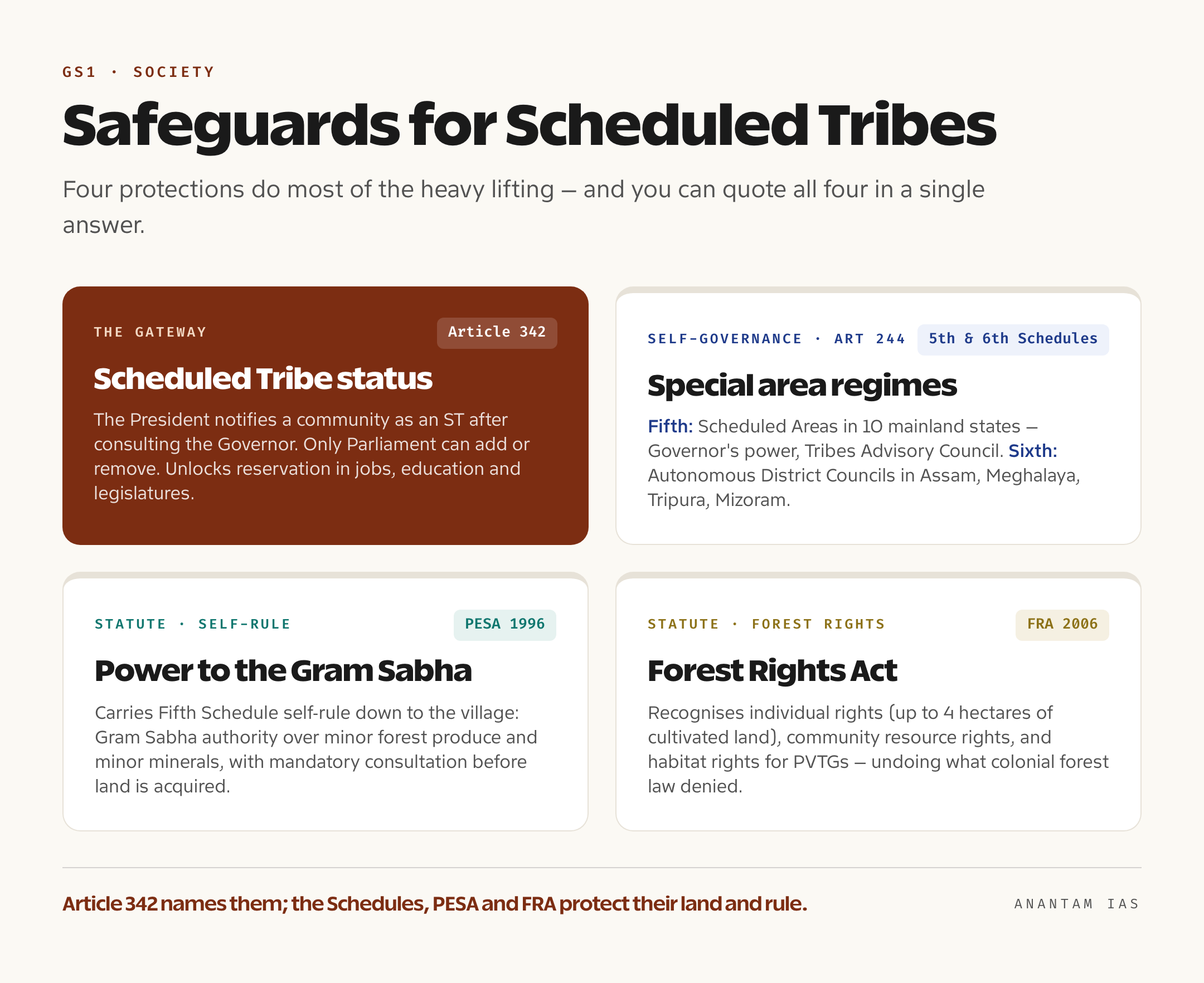
Four protections do most of the heavy lifting, and you can quote all four in a single answer. The first is Article 342 itself, which gives a community its ST status and unlocks reservation in legislatures, jobs, and education. The second and third are the special governance regimes under Article 244: the Fifth Schedule covers Scheduled Areas in ten states of mainland India and sets up Tribes Advisory Councils plus a Governor with power to bar or modify laws that harm tribal interests, while the Sixth Schedule governs the tribal areas of Assam, Meghalaya, Tripura, and Mizoram through Autonomous District Councils that can legislate on land, forests, and customary law.
The fourth layer is statutory. The Panchayats (Extension to Scheduled Areas) Act, 1996, known as PESA, carries Fifth Schedule self-rule down to the village by making the Gram Sabha the authority over minor forest produce, minor minerals, and mandatory consultation before land is acquired. And the Scheduled Tribes and Other Traditional Forest Dwellers (Recognition of Forest Rights) Act, 2006, the Forest Rights Act, finally recognised what colonial forest law had denied: that forest-dwellers have legal rights over the land they cultivate (individual rights up to 4 hectares), over community resources, and, for PVTGs, over their habitat itself. Alongside these sits the Tribal Sub-Plan (TSP) funding mechanism, which earmarks development money in proportion to ST population. To go deeper, study the Fifth Schedule and Scheduled Areas, the Sixth Schedule of the Constitution, the PESA Act 1996, and the Forest Rights Act 2006 one explainer at a time.
| Safeguard | Constitutional / Legal Basis | What It Protects |
|---|---|---|
| Scheduled Tribe status | Article 342 | Identity, reservation in jobs, education, legislatures |
| Fifth Schedule | Article 244(1) | Scheduled Areas in 10 mainland states; Governor’s power; Tribes Advisory Council |
| Sixth Schedule | Article 244(2) | Autonomous District Councils in Assam, Meghalaya, Tripura, Mizoram |
| PESA 1996 | Statute under Fifth Schedule | Gram Sabha control over resources and consultation |
| Forest Rights Act 2006 | Statute | Individual, community and habitat forest rights |
| Tribal Sub-Plan | Planning mechanism | Population-proportionate development funding |
How to Study This for UPSC
Start with the scaffolding, not the names. Learn the four belts and the constitutional spine (Article 342, the criteria, the Fifth and Sixth Schedules, PESA, FRA) before you touch the long tribe list, because the framework is what gets tested most often and what holds the names in place. Then layer the major tribes on top, anchoring each to its state, its language family, and one distinctive feature. That one feature is what turns a flat list into a recallable fact.
For Prelims, examiners love precise matching: tribe to state, tribe to PVTG status, Schedule to states covered. Memorise that the Sixth Schedule applies to exactly four states, that there are 75 PVTGs, and that ST share is 8.6%. For Mains, the questions are analytical: tribal displacement and the Forest Rights Act, PESA versus ground reality, the tension between conservation and tribal rights (the Hasdeo Aranya case is a strong example), and whether the Lokur criteria are still fair. Skip the temptation to learn all 705 names. The fifteen or so in the table above, plus the famous PVTGs and the freedom-struggle leaders like Birsa Munda, cover almost everything you’ll be asked.
Frequently Asked Questions
How many tribes are there in India? About 705 individual ethnic groups are notified as Scheduled Tribes across roughly 30 states and union territories, as recorded after Census 2011. The exact figure shifts slightly as Parliament adds or removes communities.
What is the difference between a Scheduled Tribe and a tribe? Every Scheduled Tribe is a tribe, but a tribe becomes “Scheduled” only when the President notifies it under Article 342. Until that notification, a tribal community has no ST legal status or benefits.
Which is the largest tribe in India? The Bhil are the largest tribal community, spread across Rajasthan, Gujarat, Madhya Pradesh, and Maharashtra. The Gond are second-largest, concentrated in central India.
What are the criteria to identify a Scheduled Tribe? Administrators use the five Lokur Committee signs: primitive traits, distinctive culture, geographical isolation, shyness of contact, and backwardness. The Constitution itself gives no fixed definition.
Which states come under the Sixth Schedule? Only four: Assam, Meghalaya, Tripura, and Mizoram, where tribal areas are governed by Autonomous District Councils. The rest of mainland tribal governance runs through the Fifth Schedule.
Practice Questions
Prelims MCQs
- Scheduled Tribes are notified by the President under which Article of the Constitution? (a) Article 341 (b) Article 342 (c) Article 244 (d) Article 366 Answer: (b) Article 342 deals with Scheduled Tribes; Article 341 deals with Scheduled Castes.
- Which committee’s criteria are used to identify Scheduled Tribes? (a) Xaxa Committee (b) Dhebar Commission (c) Lokur Committee (d) Bhuria Committee Answer: (c) The Lokur Committee (1965) gave the five working criteria still in use.
- As per Census 2011, Scheduled Tribes form approximately what share of India’s population? (a) 6.6% (b) 8.6% (c) 10.4% (d) 16.6% Answer: (b) STs are about 8.6%, roughly 104 million people.
- The Sixth Schedule of the Constitution applies to tribal areas in which group of states? (a) Jharkhand, Odisha, Chhattisgarh, MP (b) Assam, Meghalaya, Tripura, Mizoram (c) Nagaland, Manipur, Sikkim, Arunachal (d) Rajasthan, Gujarat, Maharashtra, Telangana Answer: (b) Only these four northeastern states are covered by the Sixth Schedule.
- How many communities are classified as Particularly Vulnerable Tribal Groups (PVTGs)? (a) 52 (b) 75 (c) 104 (d) 705 Answer: (b) There are 75 PVTGs within the larger set of 705 Scheduled Tribes.
Mains Practice Questions
- The criteria for identifying Scheduled Tribes have been criticised as outdated and patronising. Critically examine in the light of the Xaxa Committee’s observations. (15 marks, 250 words)
- “The Forest Rights Act, 2006, sought to undo a historical injustice but its implementation has fallen short.” Discuss with examples. (15 marks, 250 words)
- Compare the Fifth and Sixth Schedules of the Constitution as instruments of tribal self-governance. (10 marks, 150 words)
- Examine the tension between forest conservation and the rights of tribal communities in India, with reference to recent controversies. (15 marks, 250 words)
- How far has the PESA Act, 1996, succeeded in transferring real power to the Gram Sabha in Scheduled Areas? (10 marks, 150 words)
The tribes of India look like a memory test, but they’re really a structure test. Hold the four belts and the four safeguards firmly, attach a handful of well-chosen tribes to each, and you’ll answer almost any question the exam throws at you without ever pretending to know all 705 names. That selective confidence, knowing what to learn deeply and what to leave alone, is what separates a clean answer from a panicked one.
Tell Google you want more of this.
Add Anantam IAS as a preferred sourceOne tap, and this site shows up more often in your own Top Stories, AI Overviews and AI Mode. Remove it any time.