Introduction
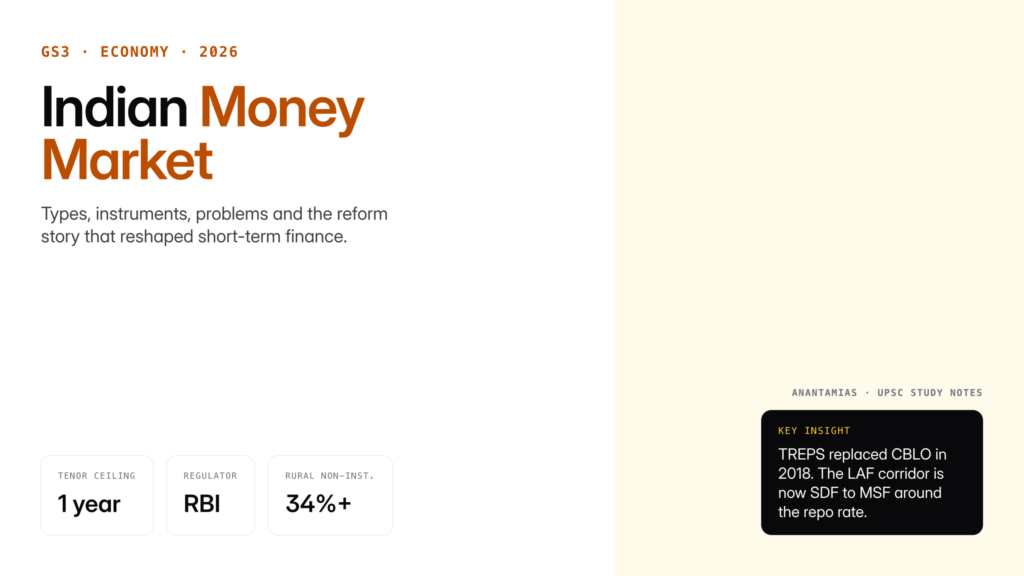
The Indian money market is the short-term end of the financial system where liquidity is bought, sold, and priced for tenors up to one year. For a UPSC aspirant, understanding the different types of market inside the money market — call money, treasury bills, commercial paper, certificates of deposit — is foundational because monetary policy transmission, banking stability, and government borrowing all pass through these channels.
India’s money market is a story of structured dualism. On one side sits the organised segment, regulated tightly by the Reserve Bank of India and dominated by scheduled commercial banks, primary dealers, and the government. On the other side persists a vast unorganised money market of indigenous bankers, moneylenders, chit funds, and nidhis that still serves millions of households and micro enterprises. This article unpacks every layer, explains reforms since 1991, and maps the whole terrain to the UPSC syllabus.
Quick Facts at a Glance
| Parameter | Detail |
|---|---|
| Regulator | Reserve Bank of India (RBI) |
| Tenor | Up to one year |
| Principal Act | RBI Act 1934, Banking Regulation Act 1949 |
| Key committees | Chakravarty (1985), Vaghul (1987), Narasimham I and II |
| Major instruments | Call money, T-bills, CPs, CDs, repos |
| Organised participants | RBI, banks, primary dealers, mutual funds, insurance |
| Unorganised players | Indigenous bankers, moneylenders, chit funds, nidhis |
| Benchmark rate | Weighted Average Call Rate (WACR) |
| Policy corridor | Repo, SDF (floor), MSF (ceiling) |
| Electronic platform | NDS-Call, CROMS, TREPS on CCIL |
Background and Historical Context
India inherited a shallow money market at independence. Until the 1980s the segment was narrow, with the call money market confined to a handful of banks and the treasury bill auction suppressed by ad-hoc 91-day T-bills that monetised the fiscal deficit. The Chakravarty Committee on the monetary system (1985) and the Vaghul Working Group on the money market (1987) recognised that monetary policy could not work without a deep, integrated short-term market, and their recommendations seeded the reforms that followed.
The 1991 balance-of-payments crisis accelerated change. The Narasimham Committee on the Financial System (1991) and its sequel (1998) pushed for deregulation of interest rates, entry of new instruments, and the dismantling of automatic monetisation. The landmark 1997 supplemental agreement between the RBI and the Government of India abolished ad-hoc treasury bills and replaced them with the Ways and Means Advances system, a turning point that allowed market-determined short-term yields to emerge.
Between 1988 and 2005 a scaffolding of new institutions was built. The Discount and Finance House of India (DFHI) provided secondary market liquidity, Primary Dealers were licensed from 1996 to develop the government securities market, the Clearing Corporation of India Ltd (CCIL) was set up in 2001 to guarantee settlement, and Negotiated Dealing System platforms moved trading from telephones to screens. By 2005 the call money market had become a pure inter-bank market, and collateralised segments like CBLO and later TREPS had overtaken the uncollateralised call segment in volume.
Key Features and Instruments
Call and Notice Money Market
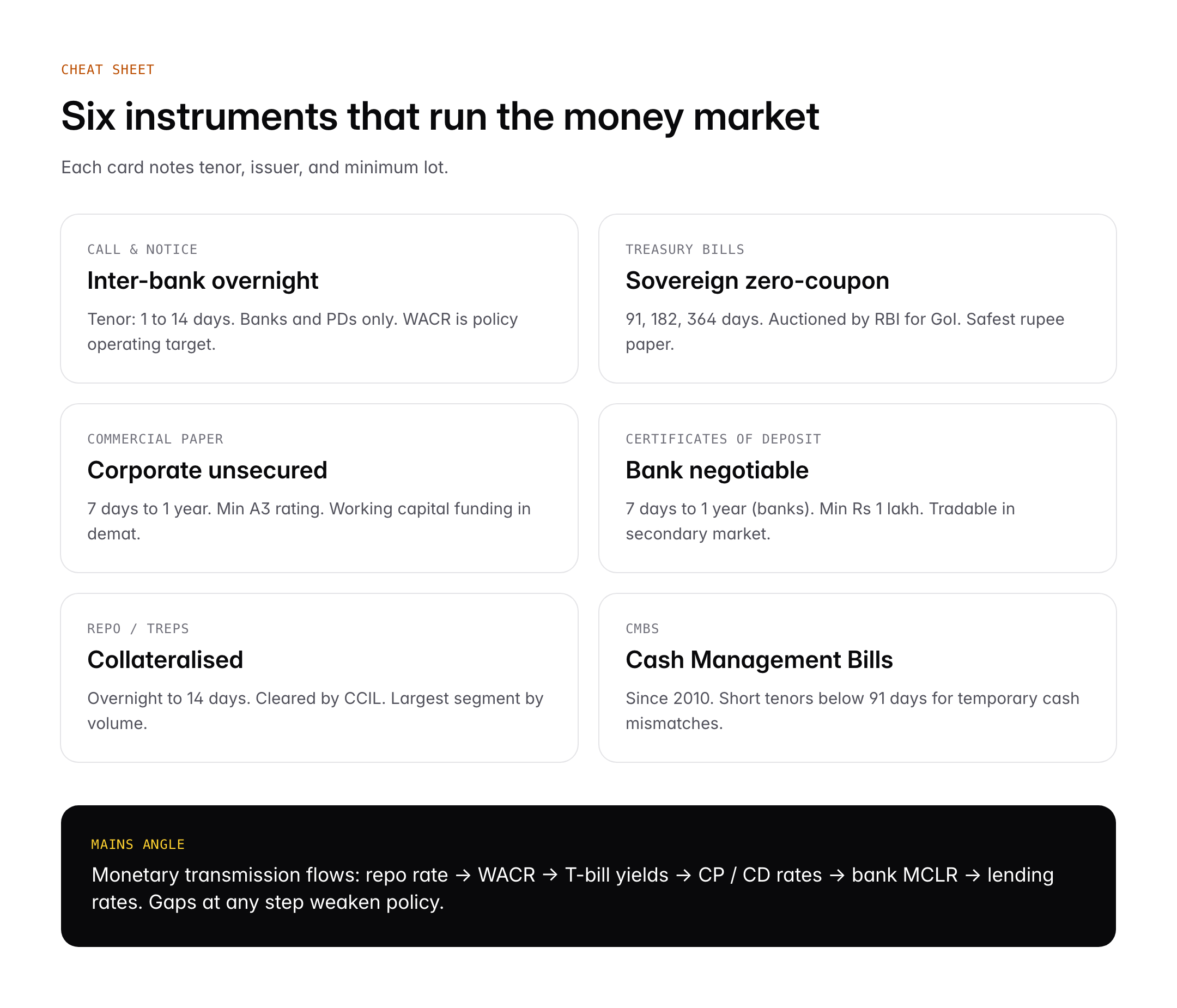
The call money market deals in funds repayable on demand; the notice money market handles tenors up to 14 days. Only scheduled commercial banks, cooperative banks, and primary dealers can participate. The weighted average call rate (WACR) is the operating target of RBI monetary policy and is steered within the policy corridor formed by the Standing Deposit Facility floor and the Marginal Standing Facility ceiling around the repo rate.
Treasury Bills
Treasury bills are zero-coupon sovereign securities issued at a discount. The RBI auctions 91-day, 182-day, and 364-day T-bills on behalf of the Government of India. They are the safest rupee instrument and serve as the benchmark for pricing other short-term paper. Cash Management Bills, introduced in 2010, cover temporary government cash mismatches.
Commercial Paper
Commercial paper (CP) is an unsecured promissory note issued by corporates, primary dealers, and all-India financial institutions to raise working capital for tenors of 7 days to 1 year. A minimum credit rating of A3 from an accredited agency is mandatory. CPs are issued in demat form at a discount to face value.
Certificates of Deposit
Certificates of deposit (CDs) are negotiable money market instruments issued by scheduled commercial banks and select financial institutions against funds deposited with them, with tenors of 7 days to 1 year for banks and up to 3 years for FIs. Minimum investment is Rs 1 lakh in multiples of Rs 1 lakh.
Repo, Reverse Repo and TREPS
Repurchase agreements (repos) are the backbone of liquidity management. The RBI conducts repo and reverse repo auctions under the Liquidity Adjustment Facility (LAF). The market segment Triparty Repo (TREPS), cleared through CCIL since 2018, has replaced the earlier Collateralised Borrowing and Lending Obligation (CBLO) and is now the largest short-term market by volume, open to mutual funds, insurance firms, corporates, and banks.
Open Market Operations
Open market operations (OMO) are the outright purchase or sale of government securities by the RBI to inject or absorb durable liquidity, as distinct from LAF repos which address frictional liquidity. OMOs are a core quantitative instrument of monetary policy alongside the Cash Reserve Ratio and Statutory Liquidity Ratio.
Significance for UPSC and General Knowledge
- Money market topics appear in GS Paper 3 under monetary policy, banking, and financial inclusion.
- Prelims frequently tests differences between instruments, regulators, and eligibility for each segment.
- The transmission of repo rate changes to bank lending rates is a perennial Mains question.
- The unorganised money market connects to financial inclusion, SHG-bank linkage, and microfinance.
- Reforms since 1991 illustrate the sequencing principle in liberalisation, relevant for essay and GS3.
- Cross-links exist with fiscal policy (T-bills, WMA) and with capital market topics like G-sec yields.
Detailed Analysis: Organised vs Unorganised Money Market
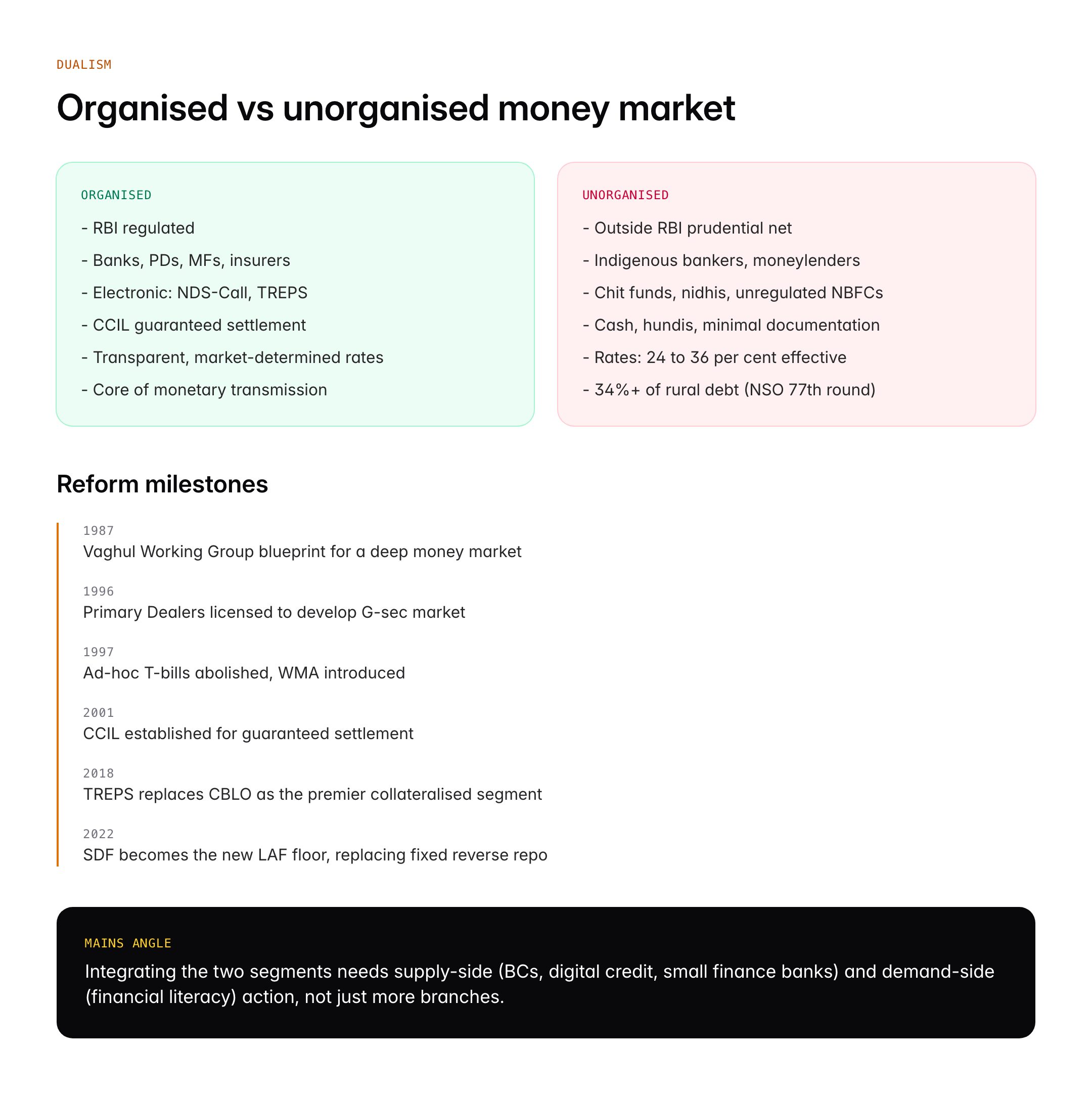
The organised money market covers regulated participants operating under the RBI’s supervision. It includes the call and notice money market, the T-bill market, the CP and CD markets, the repo market, and the Bill Rediscounting Market for trade bills. Transactions are electronic, settlement is guaranteed by CCIL, and prices are transparent on NDS-Call and the Reuters platform. Monetary policy decisions reach the real economy through this segment first.
The unorganised money market operates outside the RBI regulatory net. Its core actors are indigenous bankers like the Shroffs, Chettiars, Marwaris, and Gujaratis, who accept deposits and discount hundis; moneylenders who lend at very high rates against personal security; chit funds that pool contributions among members; nidhi companies that mobilise and lend exclusively among members; and unregulated nonbanking financial companies. The segment thrives because it offers speed, flexibility, door-step service, and few documentation demands in semi-urban and rural areas. It is also where most usury, over-indebtedness and borrower distress originates.
Dualism has narrowed since 1969 bank nationalisation and the 1975 regional rural bank push, and further under Jan Dhan Yojana from 2014 which opened more than 51 crore accounts by 2024 (Ministry of Finance data). Mudra loans, self-help group bank linkage through NABARD, and small finance banks have steadily pulled borrowers into the formal net. Yet an All India Debt and Investment Survey round (NSO 77th round, 2019) found that non-institutional agencies still supplied over 34 per cent of rural household debt, which shows how far the integration project remains from completion.
The segments are connected at the top. Indigenous bankers often keep working balances with commercial banks, rediscount hundis at scheduled banks, and pass RBI policy signals down the chain with a lag. Closing the gap requires both supply-side work — more bank branches, business correspondents, digital credit — and demand-side literacy so that borrowers can recognise formal options.
Comparative Perspective
| Feature | Indian Money Market | US Money Market | UK Money Market |
|---|---|---|---|
| Regulator | RBI | Federal Reserve, SEC | Bank of England, FCA |
| Core instrument | T-bills, repos | Fed funds, T-bills, CP | Sterling CDs, gilt repos |
| Policy benchmark | WACR within LAF corridor | Federal Funds Rate (SOFR) | SONIA |
| Dominant segment | TREPS (triparty repo) | Tri-party repo | Sterling repo |
| Unorganised share | Significant in rural areas | Negligible | Negligible |
| Depth | Growing, still shallow | Deepest in the world | Deep and globally linked |
Indian market depth remains below advanced peers because corporate bond and CP markets are concentrated among top-rated issuers, and secondary trading of CDs is thin. However, the shift from uncollateralised call to collateralised TREPS since 2018 mirrors a global trend after the 2008 crisis, bringing India closer to international best practice on counterparty risk.
Problems of Indian Money Market
Despite reforms, the market carries structural weaknesses. Segment-wise interest rates often diverge because of limited arbitrage capacity at smaller players. The absence of a true bill market for trade finance keeps working capital lending bank-dominated. The unorganised segment coexists parallel to the organised one, producing rate dualism where a small trader can face an effective rate of 24 to 36 per cent while a blue-chip firm borrows at close to the repo rate. Seasonal tightness during Kharif and Rabi, as well as around advance tax payments, still causes call rate spikes that the LAF does not fully smooth. CP and CD markets depend heavily on mutual funds as buyers, so mutual fund redemptions can shut primary issuance, as happened briefly during the IL&FS shock in 2018 and the COVID stress in March 2020.
Other persistent issues include low retail participation in T-bills even after the Retail Direct scheme launched in November 2021, limited foreign participation because of capital account controls, and a still-narrow set of derivatives for hedging short-term rate risk. These weaknesses raise the cost of capital and blunt monetary transmission.
Prelims Pointers
- RBI is the sole regulator of the Indian money market
- Call money market operates up to 14 days; notice money beyond 1 day up to 14 days
- WACR is the operating target of monetary policy under the flexible inflation targeting framework
- Treasury bills are issued in 91-day, 182-day, and 364-day tenors
- Cash Management Bills were introduced in 2010
- Commercial paper was introduced in 1990 and needs a minimum A3 rating
- Certificates of deposit were introduced in 1989
- LAF corridor: SDF (floor) and MSF (ceiling) around repo
- SDF replaced the fixed reverse repo as the floor in April 2022
- TREPS replaced CBLO in November 2018, cleared through CCIL
- CCIL was established in April 2001
- The Retail Direct scheme for retail participation in G-secs launched in November 2021
- The 1997 RBI-GoI agreement abolished ad-hoc treasury bills and introduced WMA
Mains Practice Questions
Q1. Examine the role of the Reserve Bank of India in deepening the Indian money market since 1991. How effective has monetary transmission become?
- Trace reforms from Vaghul (1987) through LAF (2000), CCIL (2001), TREPS (2018), SDF (2022).
- Assess transmission through WACR to bank MCLR and external benchmark-linked rates.
- Evaluate remaining bottlenecks such as shallow CP secondary market, low retail presence in G-secs.
Q2. Discuss the coexistence of organised and unorganised money markets in India. What policy measures can integrate the two?
- Define segments with examples and cite NSO 77th round share of non-institutional credit.
- Link to financial inclusion: Jan Dhan Yojana, Mudra, SHG-bank linkage, small finance banks.
- Suggest measures: digital credit, BC network expansion, consumer education, bringing nidhis and chit funds under tighter regulation.
Conclusion
The Indian money market has travelled a long distance from the dualistic and under-developed landscape of the 1980s to a largely collateralised, electronically traded platform where monetary policy signals move in minutes. Every instrument from treasury bills to TREPS plays a part in pricing liquidity, funding the government, and transmitting the RBI’s stance to the broader economy.
The unfinished agenda is to fold the unorganised segment into the formal net without losing the speed and flexibility that make it useful in the first place. For the UPSC aspirant, the money market is one of the clearest case studies of sequenced reform, institutional design, and the interplay between financial architecture and real economic outcomes, making it a rich resource across Prelims and Mains GS3.
Frequently Asked Questions
What is the Indian money market?
The Indian money market is the segment of the financial system that deals in short-term funds with tenors up to one year. It is regulated by the Reserve Bank of India and includes instruments like treasury bills, commercial paper, certificates of deposit, call money, and repurchase agreements that enable banks, corporates and the government to manage short-term liquidity.
What are the main types of market inside the money market?
The core types of market include the call and notice money market, the treasury bill market, the commercial paper market, the certificate of deposit market, the repo and triparty repo market, and the bill rediscounting market. Each caters to a specific tenor, participant mix, and purpose, together forming the organised segment of the Indian money market.
Why is the money market important for UPSC?
The money market is central to GS Paper 3 topics like monetary policy, banking reforms, and financial inclusion. Prelims tests factual details of instruments while Mains asks about transmission of repo rate, integration of organised and unorganised segments, and reforms since 1991, making it a high-yield area across the exam.
How are open market operations different from LAF repos?
Open market operations are outright purchases or sales of government securities that change durable liquidity in the system, while LAF repos are short-term reversible transactions that manage frictional liquidity. OMOs are used for structural imbalances whereas LAF fine-tunes day-to-day conditions within the policy rate corridor.
What constitutes the unorganised money market in India?
The unorganised money market comprises indigenous bankers, moneylenders, chit funds, nidhi companies, and unregulated NBFCs operating largely in rural and semi-urban areas outside RBI prudential regulation. It still supplies more than a third of rural household debt according to the NSO 77th round, making financial inclusion a continuing policy priority.
What are the major problems of the Indian money market?
Problems include rate dualism between organised and unorganised segments, seasonal call rate volatility, heavy reliance on mutual funds for CP and CD absorption, a thin secondary market for short-term paper, low retail participation in T-bills, and limited derivatives for hedging short-term interest rate risk.
What reforms have shaped the money market since 1991?
Key reforms include abolition of ad-hoc T-bills and introduction of WMA in 1997, launch of primary dealers in 1996, establishment of CCIL in 2001, shift from CBLO to TREPS in 2018, introduction of the Standing Deposit Facility in April 2022, and the Retail Direct scheme in November 2021, all driven by recommendations from the Vaghul, Narasimham, and internal RBI working groups.
How is the money market related to monetary policy transmission?
The RBI steers the weighted average call rate, the operating target, within the LAF corridor formed by SDF and MSF around the repo rate. Changes ripple through treasury yields, CP and CD rates, bank deposit rates, and finally bank lending rates, so a well-functioning money market is a prerequisite for effective monetary policy transmission.
Tell Google you want more of this.
Add Anantam IAS as a preferred sourceOne tap, and this site shows up more often in your own Top Stories, AI Overviews and AI Mode. Remove it any time.