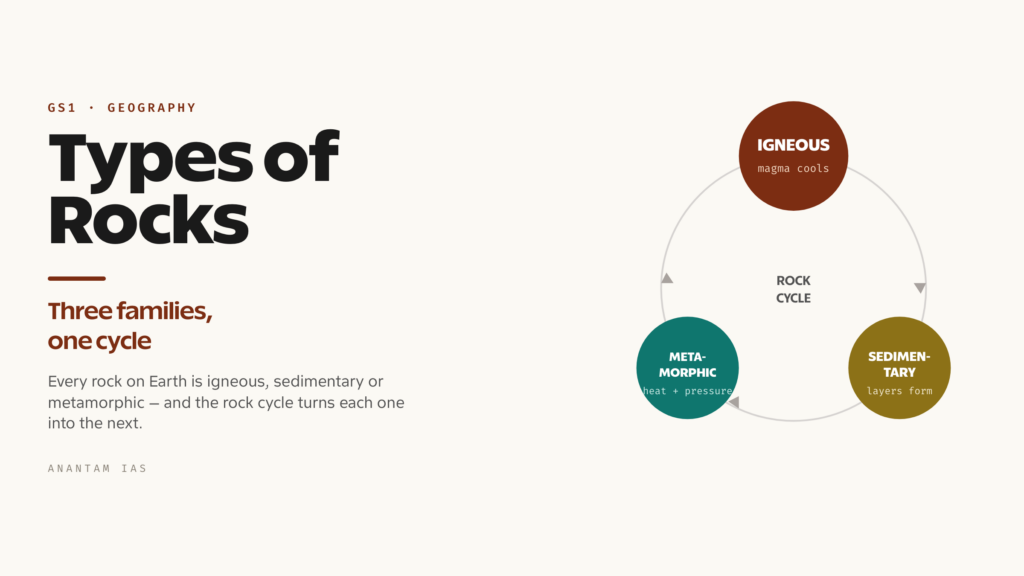
Pick up any pebble from a riverbank and you are holding one of three things. There is no fourth option. Every rock on Earth, from the granite of a temple plinth to the coal in a power station, belongs to one of three families: igneous, sedimentary, or metamorphic. Tell them apart and a confusing chapter suddenly becomes a single, repeating story.
That story is what trips up most aspirants. They memorise lists of rock names and then freeze when a question asks how marble forms or why the Deccan is black. The whole secret is that the three families are not separate boxes. They flow into one another through the rock cycle, and once you see that loop, the examples almost remember themselves.
What a Rock Actually Is
A rock is just a natural solid made of one or more minerals packed together. A mineral is the building block: a naturally occurring inorganic substance with a fixed chemical formula and an orderly crystal structure, like quartz (silicon dioxide) or calcite (calcium carbonate). Think of minerals as the bricks and a rock as the wall built from them.
Most rocks are mixtures. Granite, for instance, is quartz, feldspar, and mica grains locked together, which is why you can see the speckles with your bare eye. A few rocks are nearly single-mineral, like limestone, which is mostly calcite. The branch of geology that studies how rocks form and change is called petrology, and the rock under your feet, weathered over thousands of years, is the parent material that eventually becomes soil.
Why does any of this matter beyond a textbook? Because rock type decides almost everything that sits on top of it. The kind of soil a region grows, the minerals it can mine, whether it holds groundwater or oil, even how it shakes in an earthquake, all trace back to the rocks underneath. Get the three families right and large parts of physical and economic geography click into place.
The Three Families of Rocks
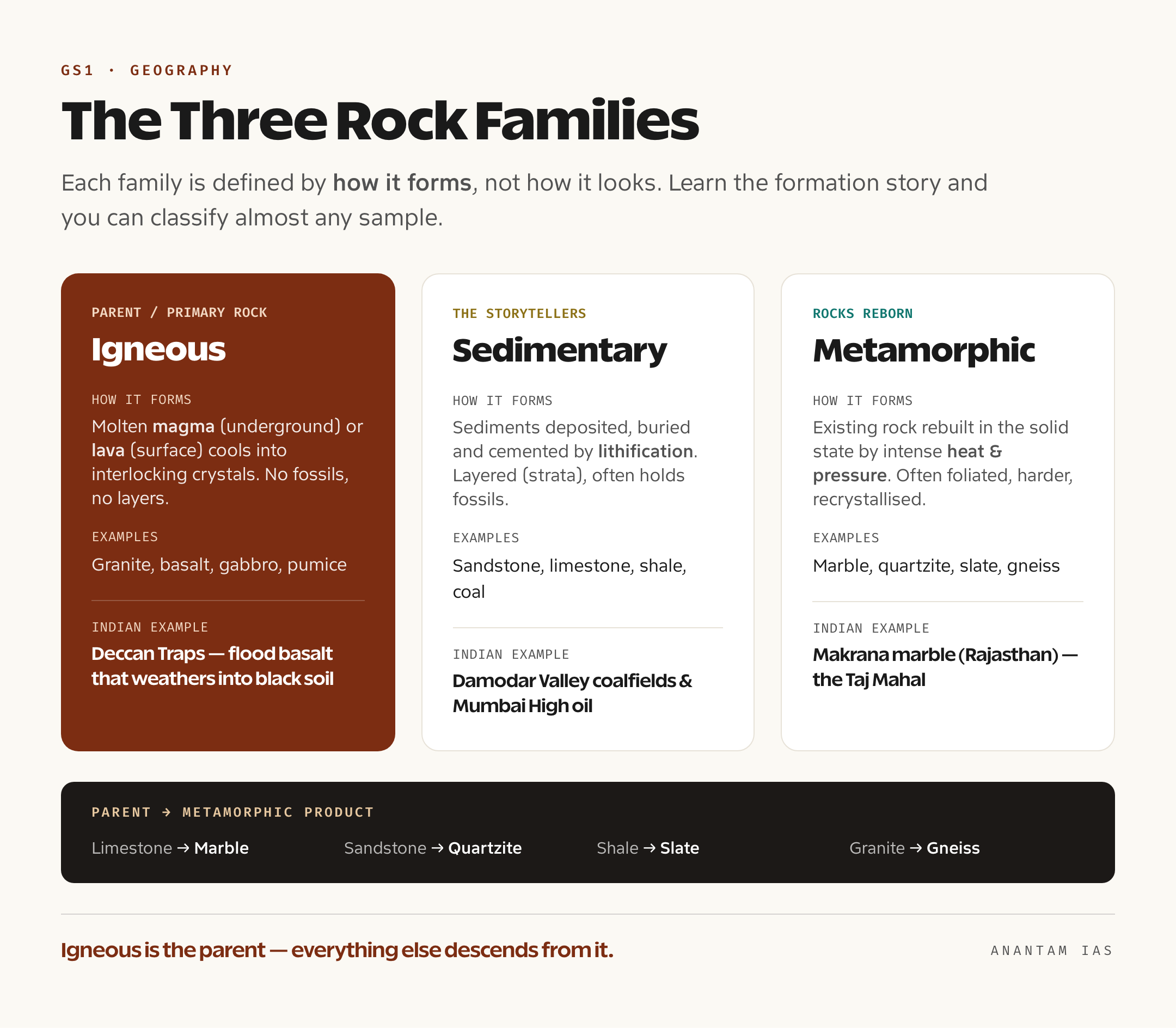
There are exactly three types of rocks, and each is defined by how it forms, not by how it looks. Igneous rocks crystallise from molten material. Sedimentary rocks build up from deposited fragments or chemicals. Metamorphic rocks are older rocks rebuilt by heat and pressure. Master those three formation stories and you can classify almost any sample.
Here is the comparison most aspirants wish they had on day one. Notice that the “key features” column is what an examiner actually tests, because it tells you which family a rock belongs to without watching it form.
| Type | How It Forms | Key Features | Examples |
|---|---|---|---|
| Igneous | Cooling and solidification of molten magma (underground) or lava (on the surface) | Crystalline, interlocking grains, no fossils, no layers | Granite, basalt, gabbro, pumice |
| Sedimentary | Deposition and lithification (compaction and cementing) of sediments | Layered (stratified), often contains fossils, can be soft | Sandstone, limestone, shale, coal |
| Metamorphic | Existing rock transformed by intense heat and pressure | Often foliated (banded), harder, recrystallised | Marble, quartzite, slate, gneiss |
Igneous Rocks: The Parent Rocks
Igneous rocks are the primary or parent rocks, the original solid material from which everything else is eventually derived. The word comes from the Latin ignis, meaning fire, and that is exactly the idea: they form when molten rock cools and hardens into interlocking crystals. Because they freeze straight from a liquid, they hold no fossils and show no layers.
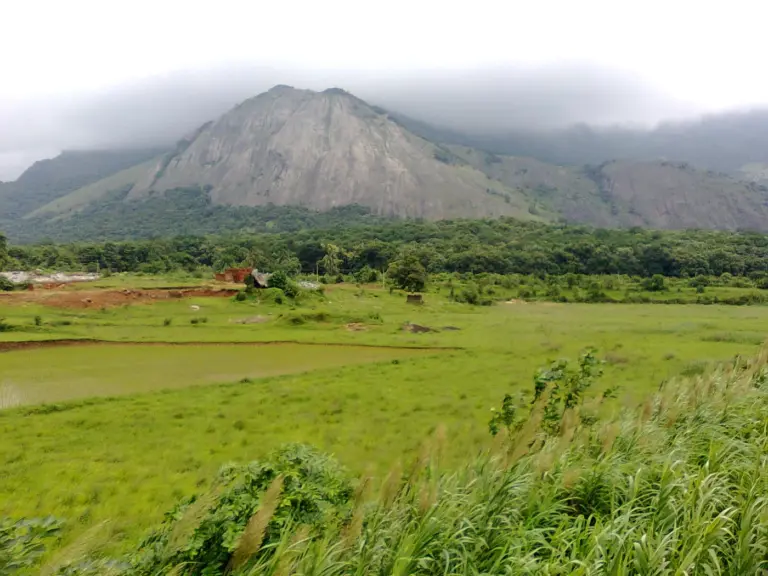
The single most useful split is by where the cooling happens. Intrusive (or plutonic) rocks cool slowly deep underground, so their crystals grow large and visible, like granite, the speckled stone of countless monuments. Extrusive (or volcanic) rocks cool fast on the surface after a volcanic eruption, so their crystals are tiny or glassy, like basalt. For India, basalt is the headline. The Deccan Traps, the vast step-like lava plateau covering much of Maharashtra, Madhya Pradesh, and Gujarat, are flood basalt erupted around 66 million years ago. When that basalt weathers, it produces the fertile black soil (regur) of India’s cotton belt, which is why a question about igneous rocks can quietly become a question about agriculture.
Sedimentary Rocks: The Storytellers
Sedimentary rocks form when loose sediments, sand, mud, shells, dissolved minerals, are deposited, buried, and then cemented into solid rock through lithification. They are the storytellers of geology because they form in distinct strata (layers), one on top of another over time, and they routinely trap fossils. If a rock has visible layers or a fossil shell in it, you are almost certainly looking at a sedimentary rock.
They are also the most common rocks you will ever stand on. Sedimentary rocks blanket roughly 75 percent of the Earth’s land surface, even though they make up only a thin skin of the crust. The everyday examples are worth knowing cold: sandstone (cemented sand, the red stone of the Red Fort and Fatehpur Sikri), limestone (calcium carbonate, the raw material for cement), shale (hardened mud), and coal (compressed plant remains). This family matters enormously for the economy because coal and petroleum are almost always hosted in sedimentary basins, never in fresh granite. India’s coalfields in the Damodar Valley and the offshore oil of the Mumbai High both sit in sedimentary rock.
Metamorphic Rocks: Rocks Reborn
Metamorphic rocks are existing rocks, igneous or sedimentary, that have been transformed in the solid state by intense heat, pressure, or chemically active fluids, usually deep inside the crust or near plate boundaries. The word means “change of form,” and that is precise: the rock never melts (if it did, it would become magma and start the igneous story over). Instead its minerals recrystallise into a new, denser, often harder rock.
The most useful split here is texture. Foliated metamorphic rocks develop visible bands or sheets because pressure squeezes their minerals into parallel layers, like slate and gneiss. Non-foliated rocks lack that banding because their minerals are equidimensional, like marble and quartzite. The single highest-yield thing to memorise is the parent-to-product pairing: which rock turns into which. This is the table examiners love.
| Parent Rock | Metamorphic Product | Note |
|---|---|---|
| Limestone | Marble | Non-foliated; the stone of the Taj Mahal (from Makrana, Rajasthan) |
| Sandstone | Quartzite | Non-foliated; extremely hard and resistant |
| Shale | Slate | Foliated; splits into flat sheets, used for roofing |
| Granite | Gneiss | Foliated; shows light and dark mineral bands |
| Coal | Graphite, then diamond | Higher heat and pressure turn carbon into graphite and, at extremes, diamond |
That last row is the crowd-pleaser. Coal, which is itself a sedimentary rock made of carbon, becomes graphite under metamorphism, and under the extreme pressure and temperature of the deep mantle that same carbon can crystallise into diamond. One element, three completely different rocks, decided entirely by heat and pressure.
The Rock Cycle: How the Three Connect
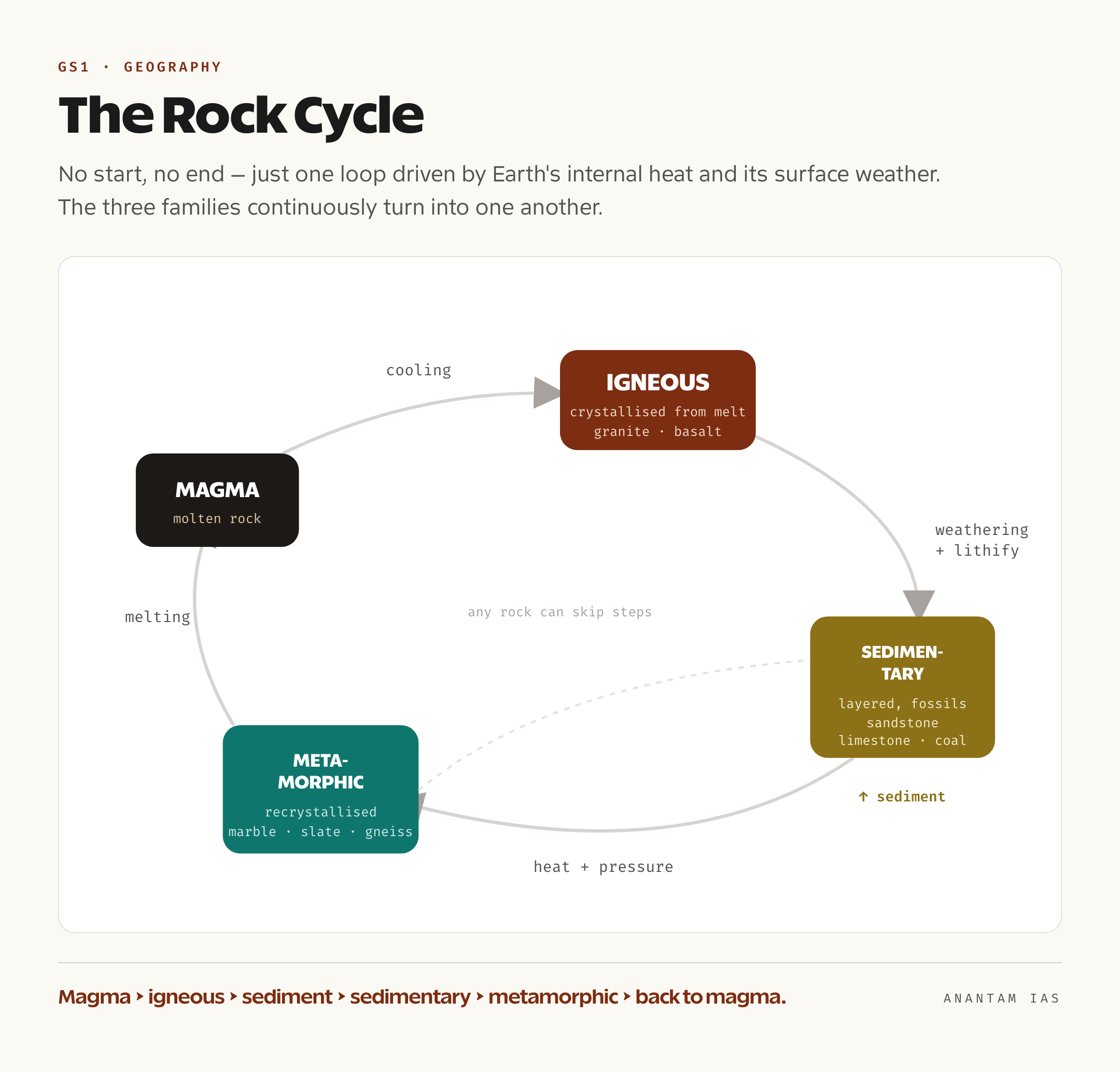
The rock cycle is the single most important idea in this whole topic, and it is simply this: the three rock families are not permanent, they continuously turn into one another. There is no starting point and no end, just a loop driven by Earth’s internal heat and its surface weather. If you can draw this loop, you understand rocks better than someone who has memorised a hundred rock names.
Trace one full circuit. Magma cools to form igneous rock. That igneous rock, exposed at the surface, is broken down by weathering and erosion into loose sediment. The sediment is carried away, deposited in layers, and cemented into sedimentary rock. Bury that sedimentary rock deep enough and the heat and pressure convert it into metamorphic rock. Push the metamorphic rock deeper still and it melts back into magma, ready to begin again. Crucially, the cycle has shortcuts: any rock can skip steps. A metamorphic rock can be uplifted and weathered straight into sediment, and a sedimentary rock can be re-buried and metamorphosed without ever melting. The arrows go everywhere, which is exactly why the same atoms have been recycled through countless rocks over billions of years.
This loop is also where the economic story lives. Each turn of the cycle concentrates different resources. Cooling magma deposits metallic ores and gives us building granite. Sedimentary basins trap coal, petroleum, and limestone for cement. Weathered parent rock becomes the soil that feeds a country. So the rock cycle is not an abstract diagram, it is the engine behind minerals, fossil fuels, construction stone, and the very ground we farm. You can connect it directly to the Deccan plateau, where one igneous event still shapes soils and crops today, and to weathering and erosion, the surface half of the cycle that converts hard rock into loose sediment.
How to Study This for UPSC
Study rocks as a cycle, not as three vocabulary lists, and you will never blank on a question. The examiner is rarely impressed by how many rock names you can recall; they test whether you understand formation and the parent-to-product links. So learn the logic first, then hang the examples on it.
Read in this order. Start with what a rock and a mineral are, then the three families and their formation, then the parent-to-product table, and finally the rock cycle that ties it together. Spend the most time on the two tables in this article, the family comparison and the parent-to-product pairs, because that is where Prelims questions cluster. You can safely skip the long lists of obscure rock names (rhyolite, andesite, schist) at the start; learn them later only if your optional is geography.
Know how it is tested. In Prelims, expect direct matching questions: match the rock to its type, or the parent rock to its metamorphic product (limestone to marble, shale to slate, coal to graphite). In Mains GS1, rocks rarely appear alone; they show up inside answers on Indian geomorphology, soils, and mineral distribution, so the payoff is being able to write that black soil comes from weathered Deccan basalt, or that coal sits in sedimentary basins. Pair this page with the explainers on types of soil in India and the peninsular plateau, since rocks are the parent material for both soils and the mineral wealth of the shield. If you want the volcanic half of the igneous story in detail, the note on volcanism and landforms covers how lava reaches the surface in the first place.
Frequently Asked Questions
What are the three main types of rocks? The three types of rocks are igneous (formed by cooling magma or lava), sedimentary (formed by deposition and cementing of sediments), and metamorphic (formed when existing rocks are changed by heat and pressure). Every rock on Earth belongs to one of these three families.
Which rock type is called the parent or primary rock and why? Igneous rock is called the parent or primary rock because it crystallises directly from molten magma, the original source material. Sedimentary and metamorphic rocks are ultimately derived from igneous rock through weathering and transformation, so the whole rock cycle can be traced back to igneous origins.
What is the rock cycle in simple terms? The rock cycle is the continuous process by which the three rock types turn into one another. Magma cools into igneous rock, which weathers into sediment that becomes sedimentary rock, which heat and pressure convert into metamorphic rock, which can melt back into magma. There is no fixed start or end, and any rock can skip steps.
Why is the Deccan Trap region important for the topic of rocks? The Deccan Traps are India’s most famous igneous formation, a vast plateau of flood basalt (an extrusive igneous rock) erupted around 66 million years ago. When this basalt weathers, it produces the fertile black soil of the cotton belt, linking igneous rocks directly to Indian agriculture.
Can one rock change into another? Give an example. Yes, that is exactly what the rock cycle describes. For example, the sedimentary rock limestone turns into the metamorphic rock marble under heat and pressure, shale becomes slate, and coal becomes graphite and, at extreme conditions, diamond.
Practice Questions
Prelims MCQs
- Which one of the following is an extrusive igneous rock? (a) Granite (b) Basalt (c) Marble (d) Sandstone. Answer: (b) Basalt cools rapidly on the surface from lava, making it extrusive (volcanic), while granite is intrusive.
- The Deccan Traps are primarily composed of which rock? (a) Limestone (b) Gneiss (c) Basalt (d) Slate. Answer: (c) The Deccan Traps are flood basalt, an extrusive igneous rock, and their weathering gives India’s black soil.
- Which type of rock is most likely to contain fossils? (a) Igneous (b) Sedimentary (c) Metamorphic (d) Volcanic. Answer: (b) Sedimentary rocks form by deposition in layers, which traps remains of organisms as fossils; igneous and metamorphic processes destroy fossils.
- Match the parent rock with its metamorphic product. Which pair is correct? (a) Limestone to Slate (b) Sandstone to Marble (c) Shale to Quartzite (d) Granite to Gneiss. Answer: (d) Granite metamorphoses into gneiss; limestone gives marble, sandstone gives quartzite, and shale gives slate.
- In the rock cycle, what process directly converts igneous rock into sediment? (a) Melting (b) Lithification (c) Weathering and erosion (d) Metamorphism. Answer: (c) Weathering and erosion break exposed igneous rock into loose sediment, which is later cemented into sedimentary rock.
Mains Practice Questions
- Explain the rock cycle and discuss how it links igneous, sedimentary and metamorphic rocks into a single continuous system. (15 marks, 250 words)
- Distinguish between intrusive and extrusive igneous rocks with suitable examples, and assess the economic significance of the Deccan Trap basalts for India. (15 marks, 250 words)
- Sedimentary rocks cover most of the Earth’s land surface yet form only a thin part of the crust. Discuss their mode of formation and their importance as hosts of fossil fuels. (10 marks, 150 words)
- What is metamorphism? Explain the difference between foliated and non-foliated metamorphic rocks with examples, and describe how common building stones are derived from their parent rocks. (15 marks, 250 words)
- Examine how the underlying rock type influences soil formation and mineral distribution in peninsular India. (15 marks, 250 words)
So when you next see a rock-based question, do not reach for a memorised list. Ask the one question that actually matters: how did this form? Did it cool from molten rock, settle in layers, or get rebuilt by heat and pressure? That single habit turns three intimidating families into one story you can tell in your sleep, and it quietly unlocks the chapters on soils, plateaus, and minerals that the examiner really cares about.
Tell Google you want more of this.
Add Anantam IAS as a preferred sourceOne tap, and this site shows up more often in your own Top Stories, AI Overviews and AI Mode. Remove it any time.